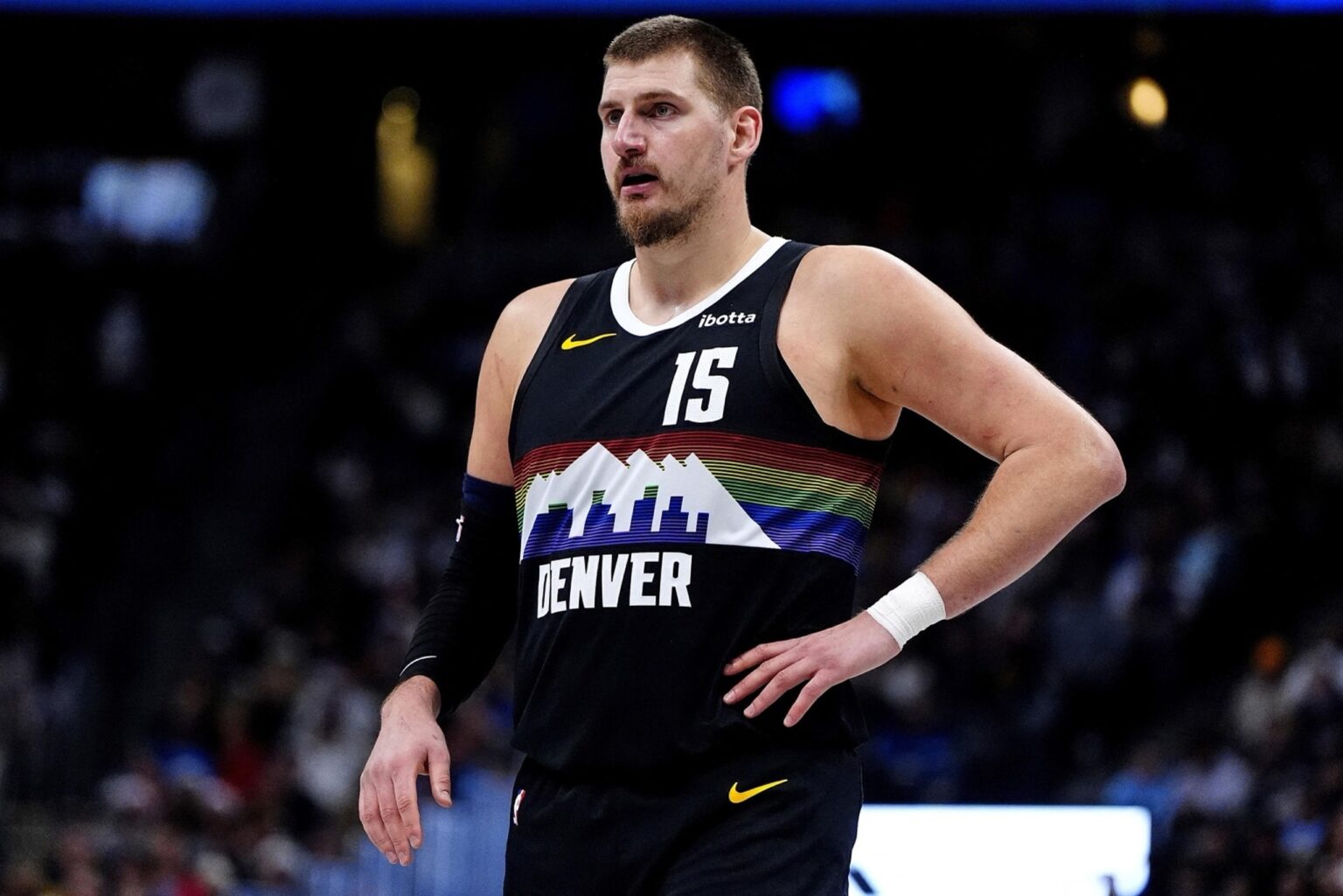
The Nuggets are not dealing with an easy offseason. They went 54-28, finished third in the West, closed the regular season on a 12-game winning streak, and still failed to get out of the first round. That is the kind of ending that forces a front office to look at every contract with less emotion and more honesty.
The loss itself made the problem hard to ignore. The Timberwolves eliminated the Nuggets 110-98 in Game 6, even while missing Anthony Edwards, Donte DiVincenzo, Ayo Dosunmu, and Kyle Anderson. Nikola Jokic finished with 28 points, 10 assists, and nine rebounds. Cameron Johnson added 27 points and shot 5-of-10 from three. But Jamal Murray was held to 12 points on 4-of-17 shooting, and the Nuggets did not have enough offense beyond their top pieces.
That is why the 2026-27 contract sheet is an issue. The Nuggets still have Jokic. They still have Murray. They still have Aaron Gordon, Johnson, Christian Braun, and some young players who could grow into bigger roles. But they are also expensive, thin in the wrong places, and facing a restricted free-agency battle for Peyton Watson.
Here are the Nuggets players under contract for the 2026-27 NBA season after a first-round exit that puts Nikola Jokic’s supporting cast under real pressure.
The Contract Sheet After The Elimination
The Nuggets currently have 10 players listed on their 2026-27 active roster. According to Spotrac, that group alone carries $213.8 million in active roster money before the team fully deals with cap holds, free agents, and roster charges. The projected cap is listed at $165.0 million, while Spotrac has the Nuggets already over the first apron and only $2.6 million below the second apron line when total allocations are counted.
1. Nikola Jokic: $59.0 million
2. Jamal Murray: $50.1 million
3. Aaron Gordon: $32.0 million
4. Cameron Johnson: $23.1 million
5. Christian Braun: $21.6 million
6. Jonas Valanciunas: $10.0 million, non-guaranteed
7. Zeke Nnaji: $7.5 million
8. Julian Strawther: $4.8 million
9. DaRon Holmes II: $3.4 million
10. Jalen Pickett: $2.4 million, club option
This is not a bad roster. That is the good part. The Nuggets are not looking at a blank sheet around Jokic. They have a real starting group, real playoff experience, and a core that still makes sense on paper. The issue is that the money already says contender, while the playoff result said something else.
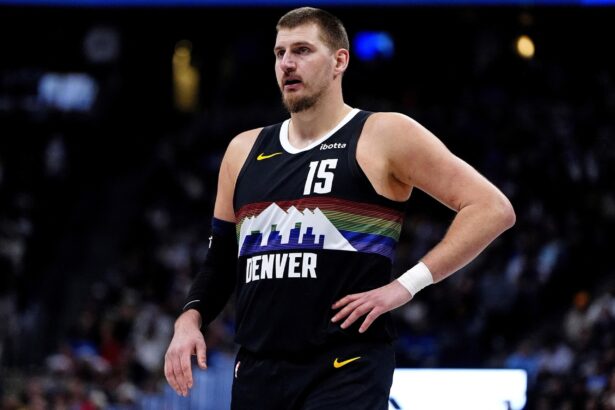
Jokic at $59.0 million is not the concern. He averaged 27.7 points, 12.9 rebounds, and 10.7 assists this season while shooting 56.9% from the field and 38.0% from three. That is a historic offensive season from a center who still controls every possession with scoring, passing, screening, and pace. If anything, Jokic’s salary is the easiest one to defend because he remains the entire reason the Nuggets can think about championships.
Murray at $50.1 million is more complicated. He had a very strong regular season, averaging 25.4 points, 4.4 rebounds, and 7.1 assists while shooting 48.3% from the field. He also played 75 games, which was important after years of durability concerns. But the postseason is where his contract gets judged. The Nuggets cannot pay him like a top-tier second option and then survive when he looks ordinary in an elimination game.
That does not mean the Nuggets should panic-trade Murray. That would be an emotional reaction. It does mean the team has to be honest about the standard. A $50.1 million guard next to Jokic has to be more than a shot-maker who can explode for a week. He has to be the second engine of a title offense. When McDaniels made his life miserable, and the Nuggets could not solve it, the entire roster construction got exposed.
Gordon at $32.0 million still fits. Aaron Gordon averaged 16.2 points, 5.8 rebounds, and 2.7 assists while shooting 49.7% from the field, and his value is bigger than the box score because of how well he plays off Jokic. He cuts, screens, defends multiple spots, and gives the Nuggets a physical forward who can finish through contact. The issue is not the concept of Gordon. The issue is health. He missed three games in the Timberwolves series with a calf injury, and the Nuggets missed his size badly.
Johnson at $23.1 million is one of the most important contracts on the roster because he is useful and movable at the same time. Cameron Johnson averaged 12.2 points, 3.8 rebounds, and 2.4 assists while shooting 48.0% from the field and 43.0% from three. He also showed in Game 6 that he can still punish a defense when the ball finds him. But he is not a self-creating wing, and that is why the Nuggets need to decide whether he is better as a long-term fit or as the salary piece that helps bring back another creator.
Braun’s deal is the one that might hurt them. Christian Braun averaged 12.0 points, 4.8 rebounds, and 2.7 assists while shooting 51.9% from the field, so his growth is good. But he is no longer just a cheap success story. At $21.6 million in 2026-27, Braun becomes a major salary slot. That is not a problem if he keeps growing as a two-way starter. It becomes a problem if the Nuggets are paying him like a major core piece while still needing more creation, more defense, and more bench reliability.
The back half of the roster has more questions than answers. Jonas Valanciunas at $10.0 million is non-guaranteed, which gives the Nuggets flexibility. Zeke Nnaji at $7.5 million is not expensive in a league-wide sense, but it is still money tied to a player who has not become a stable playoff piece. Julian Strawther at $4.8 million is affordable and shot 38.7% from three while averaging 7.2 points, 2.0 rebounds, and 1.1 assists, but the Nuggets need him to become more than a regular-season spacing option.
DaRon Holmes II at $3.4 million is still more of a developmental bet than a sure rotation player. Jalen Pickett’s $2.4 million club option is cheap enough to pick up if the team believes he can give them backup guard minutes. But these are not the contracts that decide the direction. The big money at the top and the Watson decision will shape everything.
Jokic And Murray Still Define Everything
This offseason starts with one fact: Jokic does not sound like a player trying to leave. After the elimination, he said the Nuggets are “far away” after losing in the first round, but he also said, “I still want to be a Nugget forever.” That is the best thing the franchise could hear after such a bad ending. It gives the Nuggets time. It does not give them an excuse to waste it.
The Nuggets should not overreact to Jokic’s series. Yes, Rudy Gobert and the Timberwolves made him work. Yes, Jokic was not at his peak for the full series. But he still ended Game 5 with 27 points, 16 assists, and 12 rebounds to keep the Nuggets alive, and then produced 28 points, 10 assists, and nine rebounds in Game 6. The concern is not whether Jokic is still great. The concern is whether the team has enough ways to help him when one matchup becomes uncomfortable.
That is where Murray comes in. The Nuggets’ championship formula was built on the Jokic-Murray two-man game. When it is rolling, it is almost impossible to guard because Jokic can punish any coverage and Murray can hit pull-ups, attack switches, and play off the ball. But that formula did not look the same against the Timberwolves. Murray admitted after Game 6 that the looks he needed did not go down, and said he felt he did not show up when the team needed him most.
That does not make Murray a bad contract by itself. In the regular season, he was better than he has been in years. He played more games, carried more offense, and looked like a real All-Star-level guard for long stretches. But at $50.1 million, the standard becomes brutal. The Nuggets do not need him to be good. They need him to be reliable in the exact kind of series they just lost.
Gordon and Johnson help the Jokic-Murray structure, but neither one fixes that core problem alone. Gordon is a connector, physical defender, and dunker spot weapon. Johnson is a high-level shooter who can punish rotations. Braun is an energy wing who can defend, run, and cut. Those players all have value. But none of them is a consistent on-ball problem solver against elite playoff defense.
That is why the front office has to think in a more aggressive way. The Nuggets do not need to choose between blowing it up and doing nothing. There is a middle ground. They can keep Jokic and Murray while still admitting the roster around them needs a different kind of support. More athleticism is needed. More perimeter defense is needed. More off-the-dribble creation is needed. More bench scoring is needed.
Watson’s Free Agency Could Create The Real Stress
Peyton Watson is not listed on the active contract sheet because he is heading into restricted free agency. That is the most important offseason detail outside the top of the roster. Spotrac lists Watson with a $13.1 million cap hold and a $6.5 million qualifying offer, which means the Nuggets can keep matching rights if they extend the qualifying offer.
Watson’s season changed his value. He averaged 14.6 points, 4.9 rebounds, and 2.1 assists while shooting 49.1% from the field and 41.1% from three. For a 23-year-old wing with size, athletic tools, and defensive upside, that is exactly the kind of player teams chase in restricted free agency.
The league interest is already there. Jake Fischer reported that the Lakers, Bulls, and Nets are potential suitors for Watson. The Lakers and Bulls were also reportedly interested in trading for him at the deadline, and executives believe Watson could receive a deal larger than Braun’s five-year, $125.0 million contract.
That is where the Nuggets’ situation becomes dangerous. Matching a fair Watson contract is easy to defend from a basketball angle. Matching a huge Watson offer sheet is harder when the Nuggets already have Jokic, Murray, Gordon, Johnson, Braun, and others on the books. Re-signing Watson at market value could push them deep into second-apron territory unless they cut salary elsewhere.
I would still match unless the number gets ridiculous. The reason is simple: the Nuggets cannot afford to lose young, athletic, two-way wings for nothing. Watson is exactly the kind of player they need more of, not less. If they let him walk because the bill gets uncomfortable, they would be making the roster older, slower, and thinner around Jokic.
The Watson problem is also tied to the Braun contract. Braun already got paid. If Watson receives an offer in the same range or higher, the Nuggets would have two young wings making major money before either one has proven he can be a clear third option on a championship team. That is not impossible to manage, but it would force decisions elsewhere.
Cam Johnson becomes the obvious trade salary in that situation. His $23.1 million cap hit is large enough to bring back a useful player, and his shooting makes him easy to sell to another team. Valanciunas’ $10.0 million non-guaranteed salary also gives the Nuggets a lever before his guarantee date. Nnaji’s $7.5 million could be attached to a deal if the Nuggets are willing to pay the asset cost. Pickett’s club option is small, but every roster spot matters when a team is that close to the apron structure.
Tim Hardaway Jr. and Bruce Brown Jr. are also part of the free-agent picture. Both are unrestricted free agents with Non-Bird rights, while Tyus Jones is also listed among the Nuggets’ free agents.
Hardaway gave the Nuggets real value during the regular season. He averaged 13.5 points, 2.6 rebounds, and 1.4 assists while shooting 44.7% from the field and 40.7% from three, and he finished third in Sixth Man of the Year voting. That kind of shooting is hard to replace, especially for a team that can generate clean looks through Jokic.
Brown is a different case. Bruce Brown Jr. averaged 7.9 points, 3.9 rebounds, and 2.1 assists while shooting 47.5% from the field. His return made sense because of his 2023 championship connection, but nostalgia should not drive the next decision. If he comes back on a cheap number, fine. If the Nuggets are choosing between Brown and a younger, more explosive option, they need to choose upside.
Jones did not have the role many might have expected when he arrived. Tyus Jones averaged 3.0 points, 1.1 rebounds, and 2.4 assists while shooting 34.9% from the field. He is usually a careful point guard, but the Nuggets need more force from the backup guard spot. The bench cannot just protect leads. It has to create offense when Jokic sits.
That is where Strawther and Holmes become important. Strawther’s shooting gives him a path to a bigger role, and the Nuggets need his confidence. Holmes gives them a young frontcourt piece who can still grow into a real rotation player. But the Nuggets cannot enter next season asking every young player to become ready at the same time. That is not a plan. That is hope.
The Nuggets Need A Real Pivot, Not A Panic Move
The Nuggets should not tear down the core. That would be a mistake. Jokic is still in his prime, still wants to stay, and still gives the franchise one of the best title paths in the league if the roster is strong enough. Trading Murray right after a painful series would also be dangerous unless the return is clearly better. Star guards who already have championship chemistry with Jokic are not easy to replace.
But the Nuggets also cannot act like this is fine. They lost in the first round to a short-handed Timberwolves team, failed to reach 100 points three times in the series, and watched their offense shrink when Murray could not get loose. That is not just bad luck. That is roster feedback.
The cleanest path is not one massive move. It is a series of tough, practical decisions. Match Watson if the number is survivable. Explore Johnson trades if the return gives the Nuggets more creation or defensive versatility. Use Valanciunas’ non-guaranteed salary carefully. Stop treating the bench as an afterthought. Decide whether Nnaji is part of the future or just salary. Push Strawther and Holmes, but do not rely on them as the only answers.
The 2026-27 contract sheet shows a team that still has enough talent. It also shows a team that is expensive before it is complete. That is the tension of the offseason. The Nuggets do not need to panic, but they do need to move. The 2023 title team is gone. The next version has to be deeper, faster, and more flexible.