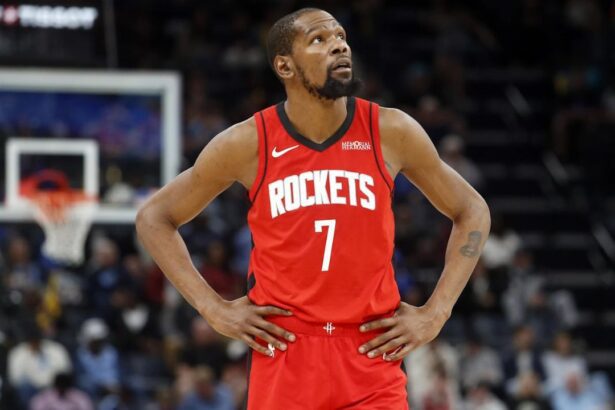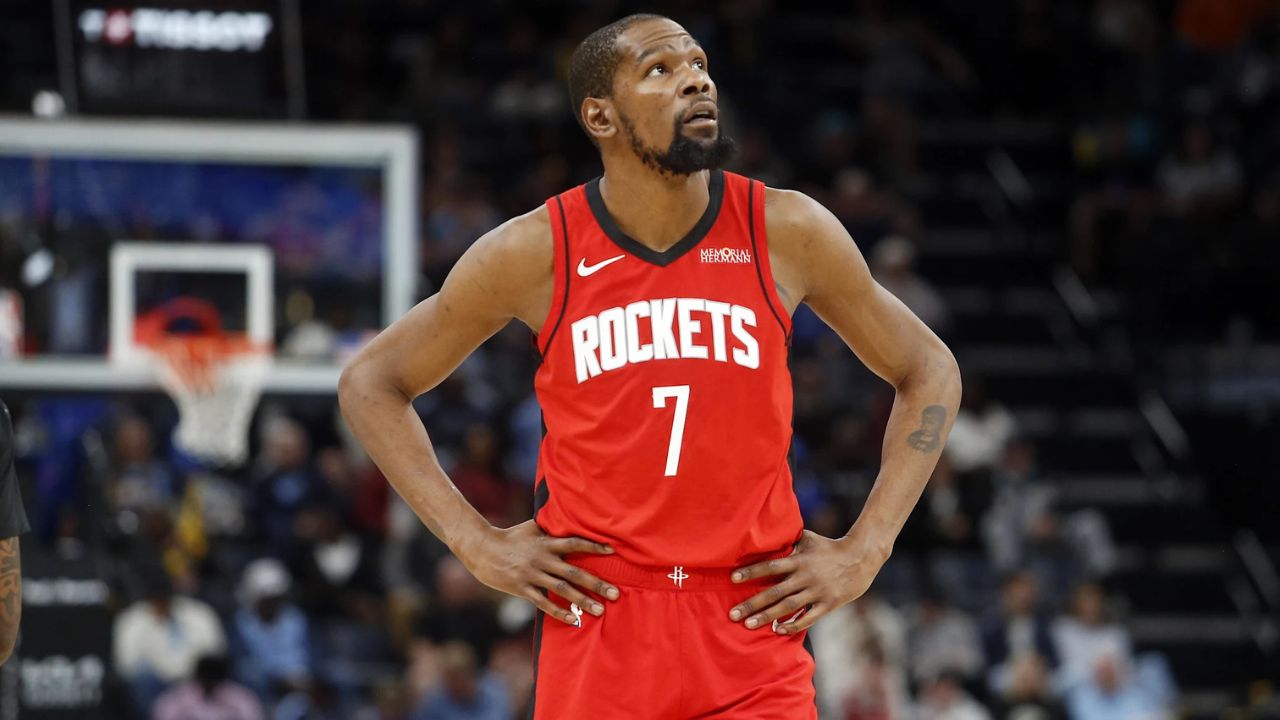
The Rockets are not in a rebuild anymore. They went 52-30, finished fifth in the West, and still lost in the first round against the Lakers. That is the real problem. This team is good enough to win regular-season games, but the playoff offense still needs more shooting, more guard play, and better half-court spacing around Kevin Durant, Alperen Sengun, and Amen Thompson.
The roster already has expensive money on the books. Durant, Sengun, Fred VanVleet, Steven Adams, Dorian Finney-Smith, and Jabari Smith Jr. are all on the 2026-27 cap sheet, and Amen Thompson plus Tari Eason are extension questions.
The main issue is simple. The Rockets need more players who can shoot and space the offense. They also need another guard who can make decisions when defenses load up on Durant and Sengun. Reed Sheppard helped as a shooter, hitting 39.0% from three on high volume, but the Rockets still can’t rely on one young shooter to fix the whole lead guard issue.
These four names make the most sense.
1. Coby White
Contract Status: Unrestricted Free Agent
Coby White is the expensive target, but he is also the best basketball answer if the Rockets can find a real path to him. He is 26, can play on or off the ball, and gives the Rockets something they still need: another guard who can create without being a weak shooter.
White finished the season with 17.4 points, 3.4 rebounds, and 4.0 assists in 25.0 minutes, shooting 44.6% from the field and 36.2% from three. The efficiency was strong, with 59.5% true shooting. That is not empty scoring. That is real guard production on a key role since his trade to the Hornets.
For the Rockets, the argument starts with Fred VanVleet. VanVleet is on an option at $25.0 million, but he missed the season, and that changes the way the Rockets have to think. They still need a steady guard, but they also need more speed and more rim pressure than VanVleet gives at this stage. White is not a pure point guard, but he can bring the ball up, run second-side actions, shoot off the catch, and attack closeouts.
That is important next to Amen Thompson. Thompson had a bigger offensive role without VanVleet, putting up 18.3 points, 7.8 rebounds, and 5.3 assists, but his season also showed he may be better next to another real handler instead of being the only guard engine. White would let Thompson defend, cut, rebound, and attack bent defenses. That is where Thompson is most dangerous.
White also works with Alperen Sengun. Sengun can run offense from the high post, but he needs guards who can punish teams for going under screens or loading the paint. White made 2.3 threes per game and can shoot off movement. He is not only standing in the corner. He can come off a handoff, rise into a three, or hit the roller if the defense sends two.
The money is the hard part. White’s old deal was three years and $36.0 million, and he should beat that easily now. His market could land around $16.0 million to $20.0 million per season. A four-year, $78.0 million deal sounds realistic. If the price goes closer to $30.0 million per year, the Rockets should walk away. They need White, but they don’t need to lose all flexibility for him.
This would probably require a sign-and-trade or another cap move. As a pure fit, he is the best target here. As a cap move, he is the hardest.
2. Ayo Dosunmu
Contract Status: Unrestricted Free Agent
I think the more realistic guard target is Ayo Dosunmu. He is not as strong a scorer as White, but the Rockets may like him more because of the two-way profile. He can defend, run, pass enough, and shoot well enough to stay on the floor with Durant, Sengun, and Thompson.
His season after landing with the Timberwolves was strong. Dosunmu had 14.8 points, 3.4 rebounds, and 3.6 assists in 27.3 minutes. The shooting was the big jump: 51.7% from the field, 43.9% from three, and 63.0% true shooting. That is why his market should be filled with suitors. A guard who can defend and hit 43.9% from three is not a small piece.
This is the type of player the Rockets need around their main group. Dosunmu doesn’t need to dominate the ball. He can play as the third guard, defend either backcourt spot, push after misses, and attack when the first action fails. He also keeps the ball moving. That matters for a Rockets offense that can get heavy when Durant and Sengun are both working in the half-court.
The 43-point game against the Nuggets is the key part. Ayo Dosunmu didn’t just fill minutes. He came off the bench, took over a playoff game, and gave the Timberwolves offense when they needed it. For the Rockets, that is the sell: defense, pace, open threes, and enough scoring to handle bigger minutes when the rotation gets tight.
The defensive side is also important. The Rockets built their identity under Ime Udoka with pressure, size, and switching. Dosunmu matches that style. He is 6-foot-4, strong enough to guard up a little, and disciplined enough to stay inside a team scheme. He won’t replace Dillon Brooks as a pure wing defender, but he gives the Rockets a stronger guard defender than most free agents in their price range.
This is where the contract makes more sense than White. The non-taxpayer mid-level exception is projected around $15.0 million, and Dosunmu’s next salary could sit near that number. A three-year deal around $45.0 million would be fair. If his market gets to $17.0 million or $18.0 million per season, it becomes harder, but still not crazy if the Rockets believe the shooting jump is real.
Dosunmu is not the star move. He is the smart move. He gives the Rockets another playoff guard without breaking the roster.
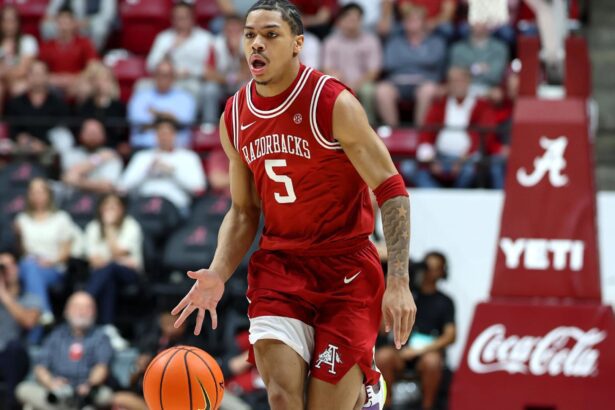
3. Quentin Grimes
Contract Status: Unrestricted Free Agent
Quentin Grimes is not a perfect target, but he is the kind of player the Rockets should study hard. He has size for a guard, can defend, can pass more than people think, and has enough shooting history to trust the jumper more than his 2025-26 percentage shows.
Grimes played 75 games for the 76ers and finished with 13.4 points, 3.6 rebounds, and 3.3 assists in 29.4 minutes. The field-goal percentage was solid at 45.0%, and his true shooting was 58.5%. The issue was the three-point shot. He hit only 33.4% from deep after being better earlier in his career. That is the swing point in his free agency.
The Rockets should not chase him as a pure shooter. That would be a mistake. They should chase him as a two-way guard who can hit enough threes, defend at the point of attack, and give them another ball-mover. Grimes had 3.3 assists per game, and that part is useful. He is not just a catch-and-shoot wing. He can attack a tilted defense and make the next pass.
Grimes already played college basketball at Houston, and he knows the pressure of that market. That doesn’t mean the Rockets should overpay him, but it does make the fit easier to sell if the front office wants a player who can settle into the culture fast.
The playoff run was the downside. He dropped to 6.7 points, 2.7 rebounds, and 2.3 assists in 22.1 minutes during the postseason, though he did score 18 points with four made threes in Game 5 against the Celtics. That is the full Grimes case right now: useful player, uneven season, still enough skill to bet on at the right price.
The Rockets need more players who can defend without killing spacing. Grimes can be that if the shot returns to league-average or better. He can play next to Sheppard, Thompson, VanVleet, or even in bigger lineups with Durant at the four. That gives Udoka more options without forcing a small backcourt every night.
The contract should be controlled. ESPN’s Bobby Marks suggested a two-year, $30.0 million type of deal for Grimes, and that is about the right range. For the Rockets, two years is better than four. Something around $14.0 million to $15.0 million per season is fair. Go above that, and the shooting risk becomes too expensive.
Grimes is not the top target, but he is a strong middle-class option if White and Dosunmu cost too much.
4. Luke Kennard
Contract Status: Unrestricted Free Agent
Luke Kennard proved difficult to defend in the playoffs. His constant movement, quick release, and ability to find space away from the ball forced defenses to stay alert and often resulted in late closeouts or missed rotations. He doesn’t need heavy touches to be effective; he simply reads the floor well and punishes any hesitation.
During the regular season, Kennard averaged 8.4 points, 2.3 rebounds, and 2.2 assists in 21.6 minutes per game, shooting 53.3% from the field, 47.8% from three-point range, and 91.3% from the free-throw line. His playoff performance raised the level further. In a tougher environment, he increased his scoring to 11.5 points in 32.6 minutes while maintaining 47.4% shooting from beyond the arc. That consistency under pressure stands out.
The Rockets already got the warning in Game 1. Luke Kennard didn’t just stretch the floor, he beat them. With the Lakers missing Luka Doncic and Austin Reaves, Kennard scored a game-high 27 points on 9-of-13 shooting and went 5-of-5 from three.
Kennard would provide valuable floor spacing. He creates breathing room for driving threats like Amen Thompson, offers better passing angles around Alperen Sengun’s post-ups and elbow touches, and prevents defenses from overloading on Kevin Durant. Because he is a genuine shooting threat, opponents cannot easily leave him to help elsewhere, and that’s an immediate advantage in half-court sets.
Defensively, he remains a liability. He can be targeted in isolation and may not be on the floor in every critical playoff moment. However, with the available size and versatility from players like Thompson, Tari Eason, Dorian Finney-Smith, and Jabari Smith Jr., those weaknesses can be managed. Kennard’s role would center on stretching the floor rather than guarding elite perimeter scorers.
Other contending teams, including the Lakers, Nuggets, Magic, and Bucks, are likely to show interest. For the right fit, a two-year deal in the range of $24 million total (approximately $11–13 million per year) would represent fair value. Any significant increase beyond that would make the defensive concerns more difficult to justify.
Final Thoughts
This team does not need a full roster rebuild; it just needs to address its clear weaknesses. The top priority is adding a guard capable of managing tough playoff possessions. Coby White represents the ideal solution in that role, though he would be expensive and difficult to acquire.
A more realistic option is Ayo Dosunmu, who brings guard defense, reliable shooting, and the ability to attack downhill at a reasonable mid-level price. If greater size and perimeter defense are preferred in the backcourt, Quentin Grimes could serve as a strong alternative. Luke Kennard, meanwhile, stands out as the best option for pure spacing and floor stretching.
While White would solve the most pressing issue if a creative path emerges, a more practical approach may involve targeting Dosunmu and Kennard together. One delivers two-way reliability at the guard spot; the other provides elite shooting gravity that opens the floor for everyone else.
The group has shown enough promise to be taken seriously as contenders, yet a 52-win season followed by a first-round exit is not the standard they should accept. The 2026 offseason must focus on adding shooting, better ball control, and experienced playoff guards to complement Durant, Sengun, and Thompson. Small, targeted upgrades can make a meaningful difference.