The Lakers aren’t wasting any time this offseason, as they just moved Deandre Ayton to the Wizards for Jaden Hardy and two second-round picks. With Walker Kessler now anchoring the starting center spot after his massive trade, the Lakers still have work to do behind him.
Ayton had exercised his $8.1 million player option after averaging 12.5 points, 8.0 rebounds, and 1.0 block across 72 games last season, so trading him freed up a bit of money, brought back two extra second-rounders, and moved a serviceable backup who was expected to be on the block regardless.
Kessler solves the rim protection problem the Lakers have had since pairing up with Luka Doncic. He arrived via a sign-and-trade with the Jazz on a four-year, $130.0 million contract, with Los Angeles sending out two unprotected first-round picks and two pick swaps to get it done.
Before shoulder surgery cut his season short, he was averaging 14.4 points, 10.8 rebounds, 3.0 assists, and 1.8 blocks on 70.3% shooting through five games, building on a 2024-25 season where he put up 11.1 points, 12.2 rebounds, and 2.4 blocks for Utah.
What the Lakers need now is the guy behind him, someone who can log 14 to 18 minutes a night, rebound, protect the rim, set solid screens, hold up in playoff minutes, and not wreck the spacing every time Doncic heads to the bench.
5. Drew Eubanks
The Lakers don’t have much financial wiggle room left after the Walker Kessler sign-and-trade, the Quentin Grimes deal, the Collin Sexton signing, and Austin Reaves’ new four-year, $184.8 million max extension. The team has already burned through its exceptions using the mid-level, which means anything from here on out is likely a minimum-salary move unless another trade materializes.
That’s the world Drew Eubanks fits into. He averaged 5.2 points, 3.0 rebounds, and 0.5 assists last season with the Kings, shooting 59.6% from the field across 42 games. The numbers aren’t going to jump off the page, but his game doesn’t require the ball to be useful. He finishes at the rim, rolls hard, cuts, cleans up putbacks, and takes what’s given to him. For a backup center behind Kessler, that’s enough at the right price.
The concern is rebounding. Eubanks pulled down just 3.0 boards a night in 13.1 minutes last season, which is fine for a deep bench role but represents a real drop-off after Ayton gave the Lakers 12.5 points and 8.0 rebounds. Los Angeles just traded away size, and Eubanks doesn’t fully replace it.
He’s also not offering anything from the perimeter either. Eubanks is strictly an inside player, so his value lives or dies on screening, running the floor, and finishing plays at the rim. That’s manageable in short stretches with Kessler holding down the bulk of center minutes, but the Lakers shouldn’t be counting on Eubanks as anything more than depth.
Bottom line, he’s the emergency option. Cheap, available, experienced enough to handle ten minutes a night without doing much damage. Not a name that moves the needle, but a sensible way to keep the roster flexible for a bigger swing elsewhere.
4. Larry Nance Jr.
Now, this is a very different option from what the reporting is pointing towards. Larry Nance Jr. is not a big body, he’s not a full-time rim protector, and he’s not walking in to replace the rebounding numbers Ayton put up. But if the Lakers want a backup who can pass, switch onto smaller players, and make quick reads out of the short roll, Nance is probably the best small-ball option available.
His numbers with Cleveland last season were modest across the board: 3.7 points, 2.7 rebounds, and 1.0 assists. There’s no point dressing that up. He played a reduced role, and at 33, he’s not the same player who used to fly around the floor on both ends.
What makes him realistic is the price tag. Nance was on a one-year, $3.6 million deal with the Cavaliers last season, putting him squarely in the range of a veteran the Lakers can actually pursue without needing to get creative financially.
The real question is whether that skill set fits what the Lakers need. Kessler is 7-foot-1 and built to protect the rim and control the glass. Nance offers close to the opposite profile: he can play alongside shooters, keep the ball moving, and give Doncic another outlet in lineups that lean smaller. There’s real value in that, but only if the Lakers are willing to live with some undersized minutes at center.
There’s a ceiling on what Nance solves here. He’s not going to fix defensive rebounding on his own, and he’s not the kind of glass presence a guy like Drummond can be. But as a fourth or fifth piece with a defined role, he adds a different look to the rotation instead of just another slow-footed center.
3. Kevon Looney
Signing a veteran like Kevon Looney would bring more playoff pedigree than anyone else on this list, and that’s really the whole pitch. Chris Haynes reported that the Pelicans were expected to decline his $8.0 million team option, which would make him an unrestricted free agent, and he is one of the backup center options the Lakers are weighing after moving Ayton.
Last season wasn’t pretty statistically. Looney averaged 2.8 points, 5.6 rebounds, and 1.6 assists in just 21 games in New Orleans, shooting 41.7% from the field. That’s a steep drop-off, and the low game count is its own red flag. The Lakers can’t sign him expecting the 2022 Warriors version who logged heavy playoff minutes, won second chances, and lived on the offensive glass. That player isn’t walking through the door anymore.
Even so, Looney’s case is specific. He’s good at setting a screen, he doesn’t dribble into trouble, he can pass out of the elbow, and his positioning on defense is still sound. None of that shows up in a box score, but for a backup center, it matters. The Lakers don’t need 10 points a night from this role. They need someone who can survive stretches, hold the glass, and not force Doncic or Reaves into awkward spacing.
The tradeoff is athleticism. Looney was never a vertical threat even in his prime. Signing him means prioritizing basketball IQ and low-mistake play over size and burst, which can work fine in limited minutes but could get exposed against faster, more athletic second units.
Looney probably deserves to rank ahead of Eubanks and Nance given his playoff track record and rebounding numbers, historically. But he shouldn’t be the top choice, because the Lakers already have their defensive anchor in Kessler. What they need behind him is someone durable enough to hold up over 82 games, and Looney played only 21 last season. Good option, but maybe not the best fit.
2. Nick Richards
Nick Richards might be the most intriguing name here if the Lakers are looking for size without simply signing another aging veteran. Per Silver Screen and Roll, he’s another player connected to the Lakers, and he fits the need that opened up: a true center who rebounds, finishes above the rim, and gives Kessler some rest without changing the outlook of the position.
Richards averaged 5.8 points, 5.1 rebounds, and 0.7 blocks last season on 51.2% shooting. He’s not a stretch guy by any means; he’s not much of a passer, and he’s not going to surprise anyone offensively. What he is is a legitimate big man who runs the floor, plays above the rim, and rebounds.
His recent contract history also makes him a realistic target. Richards just wrapped up a three-year, $15.0 million deal, with a $5.0 million salary for 2025-26. That puts him firmly in the low-cost tier of available centers rather than anyone commanding real money, which matters for a Lakers team that doesn’t have much room to spend unless they free up cap space elsewhere.
The tradeoff is polish. Richards doesn’t offer much in terms of playmaking, and his free-throw shooting has been shaky enough that opposing coaches have targeted him late in games. His career averages sit at 7.1 points, 5.8 rebounds, and 0.6 assists, so there’s no hidden offensive upside here.
Still, at 28, he’s younger than Drummond, Looney, and Nance, and he brings more physical tools than most centers left on the minimum-salary market. The Lakers aren’t asking him to be a star. They just need size behind Kessler, and Richards checks that box with more athletic upside than most of the alternatives.
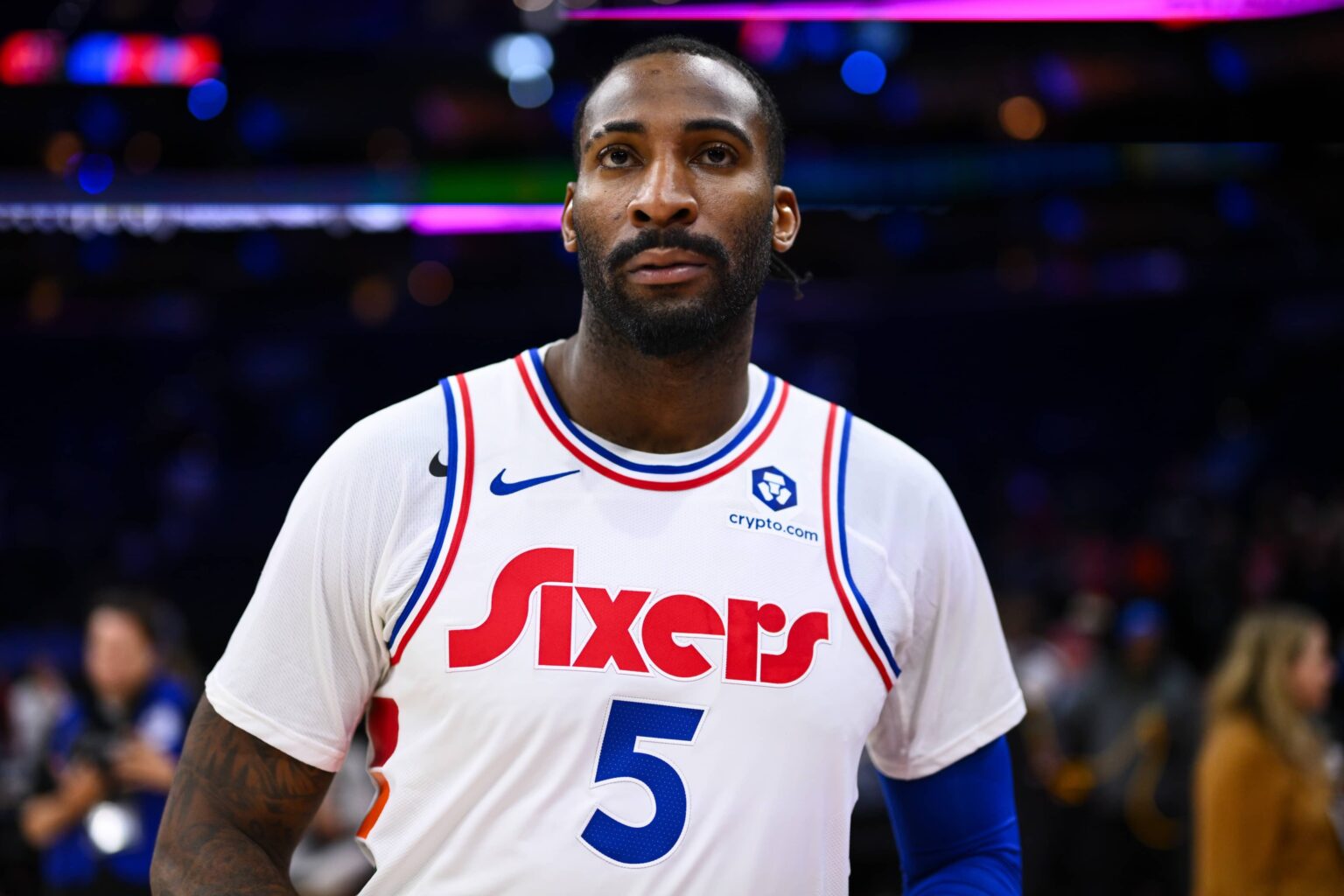
1. Andre Drummond
Probably the top choice for the Lakers in the market, Andre Drummond’s fit is almost too good to ignore. Shams Charania reported that the Lakers plan to focus on finding a backup for Kessler now that Ayton is gone, with Drummond, Looney and Jonas Valanciunas (likely heading to Europe) among the names under consideration.
Drummond already spent time with the Lakers back in 2020-21, so this wouldn’t be an unfamiliar fit from the front office’s perspective.
His production is the main reason he lands at No. 1. Drummond averaged 6.4 points, 8.4 rebounds, and 1.3 assists last season with the 76ers on 47.2% shooting. He’s an unrestricted free agent who logged 63 games played, meaning both his availability and his rebounding numbers stack up better than anyone else on this list.
Rebounding is really the entire argument. Ayton gave the Lakers 8.0 boards a night last season, and if that production is leaving with him, Drummond is the one free agent realistically capable of replacing it without needing a heavy offensive role. He’s averaged 11.9 rebounds for his career, and even in a diminished role last season, he still ranked 15th league-wide in rebounds per game.
There are real limitations. Drummond isn’t spacing the floor, certain playoff matchups can get him hunted defensively, and his finishing around the rim has slipped from his peak years. But none of that is really what the Lakers need from him.
Kessler is the starter, Doncic runs the offense, Reaves handles secondary playmaking, and the job description for this role is simple: protect the paint, rebound, screen, and give the second unit some physicality.
Financially, he also lines up well with where the Lakers are at. Drummond had a two-year, $10.0 million deal with Philadelphia, and there’s no reason to expect his market to explode after a reserve season. For a Lakers team mostly limited to minimum-level deals, he’s exactly the kind of veteran who could realistically be in range.
Richards has more long-term upside, and Looney brings more playoff experience. But right now, the Lakers need the safest possible answer behind Kessler. That’s Drummond.