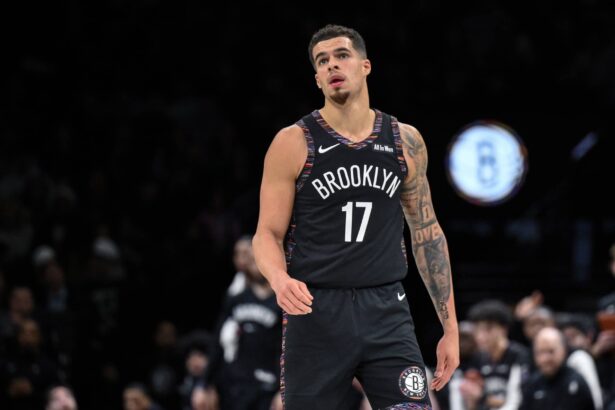
Michael Porter Jr. thinks that sports betting is creating a potentially dangerous relationship between fans and professional athletes.
On the Curious Mike podcast, Porter discussed how frequently he has received angry messages from fans and bettors after games. According to the NBA star, even playing well does not protect athletes from abuse because someone might have bet on him to perform poorly.
“These are people’s livelihoods at this point, and they’re putting their lives in these athletes’ hands to perform well. And the crazy bad part about it is, it doesn’t matter if you play good or bad, because there’s people betting on your over or under. So I’ll go get 30, somebody in my DM talking crazy, ‘Oh, tonight, tonight you wanted to go play well.’ I’m talking about 75% of my DMs.”
Porter’s example perfectly illustrates the unusual situation prop bets have created. A 30-point performance will be celebrated by fans who bet the over, while simultaneously infuriating someone who bet the under.
For Porter, the hostile messages are just part of the concern. He thinks there is a possibility that online threats could eventually turn into serious confrontations in person.
The 28-year-old questioned what could happen when someone loses a significant amount of money or even their home because of a wager involving a particular athlete.
Porter did acknowledge that he has never encountered a bettor who confronted him aggressively, but he mentioned examples like Dejounte Murray and Jimmy Butler, where fans have approached them aggressively due to failed bets.
His larger concern is that it may take a serious incident involving this potential danger before it receives enough attention.
Porter also recalled seeing death threats directed at NFL and NBA players after costly mistakes, explaining that those reactions made him think about how quickly online anger can become something very dangerous.
“I’m like, okay, even when it comes to the sports betting thing, I’m like, if these people in my DMs are threatening, you know, in our DMs are threatening us, you know, when they lose their money betting on us or da da da, and then one day someone is going to catch one of us in person.”
“It’s already happened a few times, and it’s going to be a real altercation. So stuff like that, and eventually I believe that, like, someone could get hurt, either the athlete or the athletes, and then, like, when a real thing, like, okay, what’s the conversation then? So I like to think about those things now.”
“Like, how do you protect the players from that happening? Should they be able to bet on, like, player props where they bet on our individual over-under, and then they lose all their money or they lose their crib cuz they bet on us? Now they’re actually mad, looking for this person. I’ve never ran into a person in person that really pressed me. I’ve just seen the clips. Somebody ran into Dejounte Murray. I think somebody, uh, said something to Jimmy Butler, and it’s like, you know, they had altercations.”
“And I’m saying one day, like, something could actually go down. Like, I remember the Ravens. I think the Ravens lost, um, because I think the tight end didn’t, didn’t, uh, catch the ball. I think Lamar Jackson threw it to him. He fumbled the ball or whatever, and they lost the Super Bowl or something because of that. And I go to dude’s Instagram cuz I’m like, ‘Yo, like, I know how people about to be on social media.’ So I go to his Instagram and I’m looking at the comments, and it’s real death threats.”
“Like, I be wondering, I be peeping how people are. So, like, I went to his comments. I’m like, ‘Yo, it’s real death threats.’ So, like, if there’s real death threats cuz a dude, you know, didn’t catch the football, eventually something’s really going to happen where they catch one of these athletes out in public, and people are actually—and it’s scary.”
“And then I’m just curious for when, like, that, that happens. But I guess maybe, maybe I should lean more to what you’re on and be like, until something actually happens.”
The comments highlight the complicated consequences of the rapid growth of sports betting. Athletes have always dealt with criticism after poor performances, but player props add another layer to the discussion.
A fan no longer necessarily needs to care whether the player’s team wins or loses. The anger can be directly tied to whether the player scores a certain number of points, gets enough rebounds, or dishes out enough assists.
And as Porter pointed out, there is effectively no performance that could satisfy everyone.
It was one of several subjects that Porter addressed on his podcast. He also discussed finances, saying that despite making $40 million annually, he could comfortably live off $2,000 per month. He also apologized for previous comments about the WNBA and professional ping-pong, apologizing to Lexie Brown and WNBA players.
But Porter’s comments on gambling carry a far more serious message. Sports betting may provide entertainment for millions of fans, but Porter thinks that the increasing connection between wagers and individual athletes has created a problem that the sports world will need to address before someone gets seriously hurt.