We often do not think of passing when discussing the greatest NBA centers of all time, but there have been some elite exceptions over history. That is why we have collected the 10 best passing centers ever.
These giants were known to spot the open man faster than the defense can react, often piling up ridiculous assist numbers for his position.
Even if the centers in the modern era are able to put up statistics faster than ever, we are relying on a mix of the eye test when it comes to skills and resume.
10. Bam Adebayo
Career APG: 3.6
Highest APG Average: 5.4 (2020-21)
Single Game Career-High: 11 (5 Times)
Bam Adebayo doesn’t have Nikola Jokic’s passing arsenal or Bill Walton’s flair, but what makes Bam special is that he can catch the ball at the elbow and make decisions without needing the offense to stop. That makes Bam invaluable in Miami’s offense since he was drafted No. 14 overall in 2017.
His best passing season came in 2020-21, when Adebayo averaged 18.7 points, 9.0 rebounds and 5.4 assists over 64 games. He has generated 2,276 assists over his career, as well. That’s impressive considering he was still being asked to anchor one of the league’s best defenses on the other end.
The fun part with Bam is that his passing doesn’t create highlights. He keeps the offense moving. His career-high 11 assists, which he has reached five times, shows that there is legitimate playmaking ability underneath the defensive reputation.
9. Alvan Adams
Career APG: 4.1
Highest APG Average: 5.6 (1975-76)
Single Game Career-High: 13 (1985)
Alvan Adams was ahead of his time. The 6’9″ Phoenix Suns big man entered the NBA in 1975 as the No. 4 overall pick and immediately looked nothing like the traditional center. As a rookie, Adams averaged 19.0 points, 9.1 rebounds, and a remarkable 5.6 assists per game. He won Rookie of the Year and made the All-Star team in the same season.
Averaging 5.4 APG as a rookie center is ridiculous when you put it into historical context. Adams was comfortable operating from different areas of the floor, and he could anticipate where teammates were going before they got there. He eventually averaged 4.1 assists for his career across 988 games.
His 13-assist career high is another piece of evidence that the passing wasn’t a fluke. Adams also recorded 12 career triple-doubles, which is particularly impressive for a player from his era. The Suns basically had a point-center before it became fashionable.
8. Vlade Divac
Career APG: 3.1
Highest APG Average: 5.3 (2003-04)
Single Game Career-High: 13 (1996)
Vlade Divac might be one of the most recognizable passing centers in NBA history because his entire game looked different. At 7’1″ and 243 lbs, Divac had the size of a traditional center but the instincts of a European guard.
He loved operating from the high post and delivering passes that most big men wouldn’t even attempt. Divac finished his 16-year NBA career averaging 11.8 points, 8.2 rebounds, and 3.1 assists.
His career-high of 13 assists came against Vancouver in 1996, but his passing was much more than the occasional big statistical night. What really separates Divac is creativity.
He was comfortable throwing behind-the-back passes, looking away from his intended target, and using his body to disguise where the ball was going. He wasn’t the most statistically dominant player here, but when you watch Divac, you immediately understand why he is in the top 10.
7. Marc Gasol
Career APG: 3.4
Highest APG Average: 4.6 (2017)
Single Game Career-High: 14
Marc Gasol was basically a quarterback. He could sit at the top of the floor and patiently wait for the right pass to develop. His passing became even more dangerous once Memphis allowed him to stretch the floor in the modern game.
Gasol averaged a career-high 4.6 assists in 2016-17 while also averaging 19.5 points and 6.3 rebounds. He shot 38.8% from three that season, which created an entirely different problem for defenses. He could shoot and could pass from inside the post.
Gasol eventually finished his career with 3.4 assists per game, and his 14-assist explosion against Denver in 2017 remains the perfect example of just how unusual his skill set was.
6. Wes Unseld
Career APG: 3.9
Highest APG Average: 5.2 (1976)
Single Game Career-High: 13 (1970)
Wes Unseld wasn’t a center who happened to be a good passer. Passing was arguably the best part of his game. Remember: stats weren’t as easy to come by in his era, especially for assists.
At only 6’7″, he was undersized by center standards, but his strength (245 lbs) and incredible outlet passing made him one of the most influential big men of his generation.
Unseld’s signature was the outlet pass. He could grab a rebound, barely take a dribble, and fire a full-court pass directly into the hands of a teammate sprinting toward the other basket. That became the standard at which Unseld operated.
His career numbers tell the story: 10.8 points, 14.0 rebounds, and 3.9 assists per game, with a career-high 13 assists in a game. Unseld also won Rookie of the Year and MVP in the same 1968-69 season and eventually led Washington to an NBA championship. He wasn’t flashy, but he was incredibly effective.
5. Arvydas Sabonis
Career APG: 2.1
Highest APG Average: 3.0 (1998)
Single Game Career-High: 9 (1999)
Yes, Sabonis’ NBA assist numbers don’t look impressive compared with the names before or after him. That’s largely because we never saw the best version of Arvydas Sabonis in the NBA. By the time he finally arrived in Portland at age 31, his body had already taken an enormous beating.
Even so, the passing ability was obvious. At 7’3″ and 279 lbs, Sabonis could see over defenses and deliver one-handed passes with either hand. Much like Jokic today, Sabonis was able to make any pass a player could make in any offense.
His NBA career high was nine assists, and he averaged a career-best 3.0 in 1997-98. But the NBA numbers don’t tell the whole Sabonis story.
His international career showed a much more expansive passing game, and the pre-NBA version of Sabonis was a breathtaking offensive center. This ranking is an acknowledgment of the player we saw, but unfortunately, we never got to see him at his physical peak.
4. Bill Russell
Career APG: 4.3
Highest APG Average: 5.8 (1967)
Single Game Career-High: 13 (3 Times)
Bill Russell‘s passing gets overlooked because everything else about his resume is so enormous. He won 11 championships, five MVP awards, and made 12 All-Star selections. Russell is also one of the best defenders ever but was also a terrific passer.
In 1966-67, Russell averaged 13.3 points, 21.0 rebounds, and 5.8 assists across 81 games. That’s a remarkable passing number for a center in an era when spacing and ball movement looked nothing like they do today.
Russell’s passing was tied directly to his rebounding and defense. He could grab the ball, immediately see his teammates, and launch the transition before the defense had time to organize. His career-high 13 assists came three different times, and he finished his career averaging 4.3 assists.
Russell wasn’t a Jokic-style playmaker in the half-court, but he was an elite transition playmaker who understood how a fastbreak pass could lead to easy scoring opportunities and a ton of team wins.
3. Bill Walton
Career APG: 3.4
Highest APG Average: 5.0 (1978)
Single Game Career-High: 14 (1975)
Bill Walton was basically a point center before the NBA had any idea what a point center was supposed to look like. His passing was incredibly advanced for a 6’11” big man, and he could facilitate from anywhere on the court with either hand.
His 1977-78 MVP season is the clearest example. Walton averaged 18.9 points, 13.2 rebounds, 5.0 assists, and 2.5 blocks in only 58 games. He was literally the offensive hub of one of the league’s best teams.
The postseason before that was even more revealing. During Portland’s 1977 championship run, Walton averaged 5.2 assists in the Finals while dominating Philadelphia on both ends.
His career-high 14 assists came against Seattle in 1975. Walton’s career was unfortunately shortened by injuries, but when he was healthy, he was one of the most complete passing big men ever.
2. Wilt Chamberlain
Career APG: 4.4
Highest APG Average: 8.6 (1968)
Single Game Career-High: 21 (1968)
Wilt Chamberlain at No. 2 might surprise younger fans because his reputation is dominated by scoring and rebounding. But Wilt became one of the most prolific passing centers the game had ever seen.
The 1967-68 season is the ridiculous part. Wilt averaged 24.3 points, a league-high 23.8 rebounds, and 8.6 assists per game, leading the league in assists while playing center. He deliberately shifted his approach under coach Alex Hannum, becoming better at making his teammates succeed on the court alongside him.
And then there is the single-game record: 21 assists against Detroit on February 2, 1968. That number remains extraordinary. Wilt was 7’1″, routinely drawing double teams and possessing a field of vision that allowed him to see passing lanes over smaller defenders.
He could score 50, grab 25 rebounds, or decide that night was going to be about getting everyone else involved. That is why Wilt occupies a spot on many of the all-time top 10 rankings across most statistics.
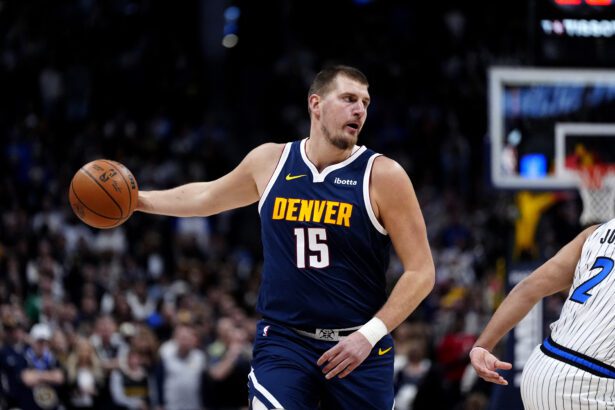
1. Nikola Jokic
Career APG: 7.5
Highest APG Average: 10.7 (2026)
Single Game Career-High: 22 (2025)
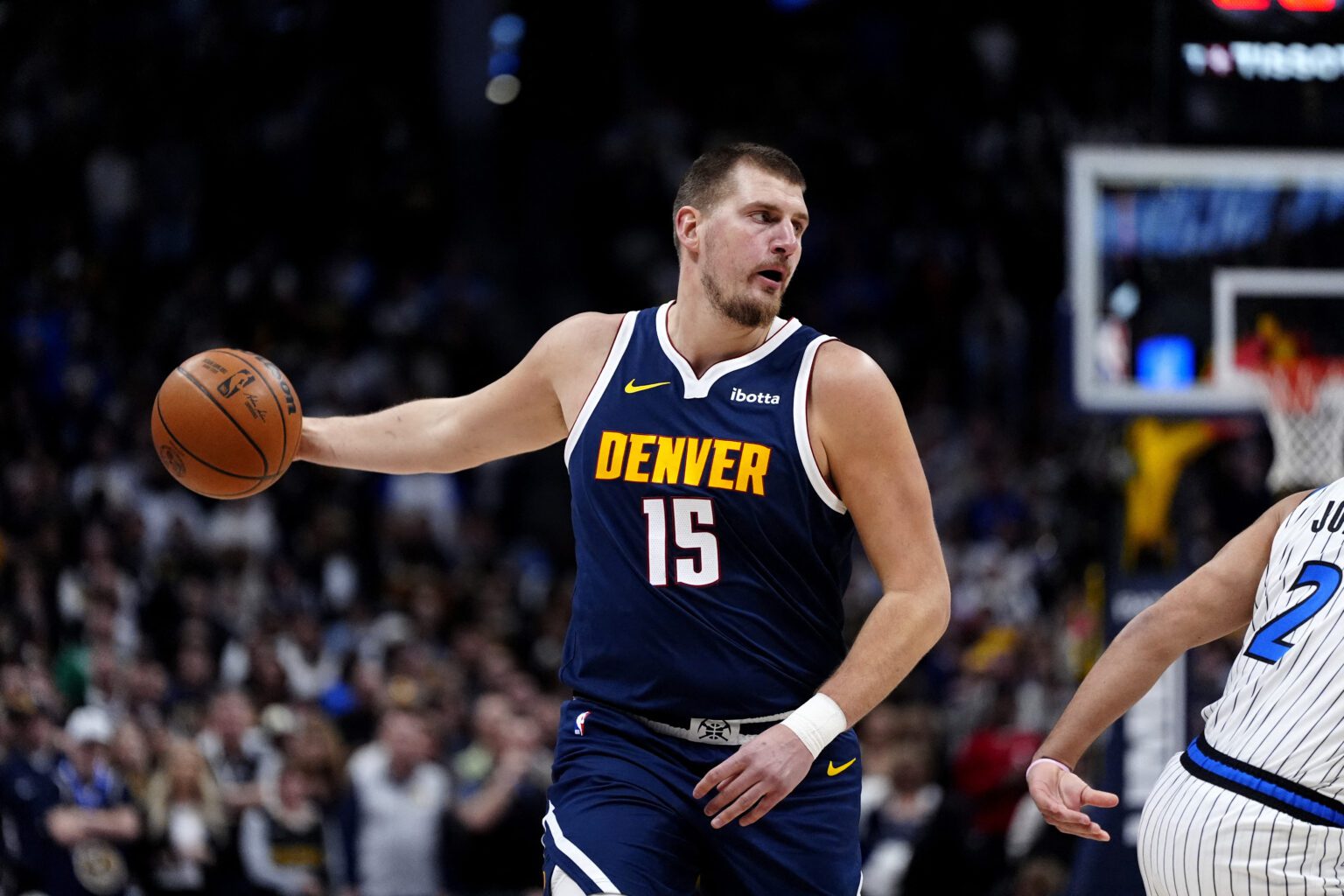
There really isn’t much of an argument against Nikola Jokic at No. 1 anymore. He’s the most complete passing center we’ve ever seen because he can make any pass at anytime and is literally an offensive hub for the Denver Nuggets.
The offense flows through him at all times, and somehow, the most ridiculous pass often looks like the easiest one.
The numbers have now become just as ridiculous as the eye test. In the 2025-26 season, Jokic averaged 27.7 points, a league-high 12.9 rebounds, and a league-high 10.7 assists. Winning a rebounding and assist title in the same year is extraordinary.
In 2024-25, he became only the third player in NBA history to average a triple-double for an entire season, putting up 29.6 points, 12.7 rebounds, and 10.2 assists. But the numbers almost undersell the real reason Jokic sits here, particularly since everybody’s stats in the modern era are inflated.
His passing is simply unpredictable. He can throw one-handed bullets from impossible angles and use his massive frame to shield the ball while analyzing the entire floor. His career-high 22 assists came against Phoenix in March 2025, and he has already recorded multiple games with 18, 19, or more assists.
At this point, Jokic is redefining what we should expect from a big man, and he deserved to be recognized as the greatest passing center ever.