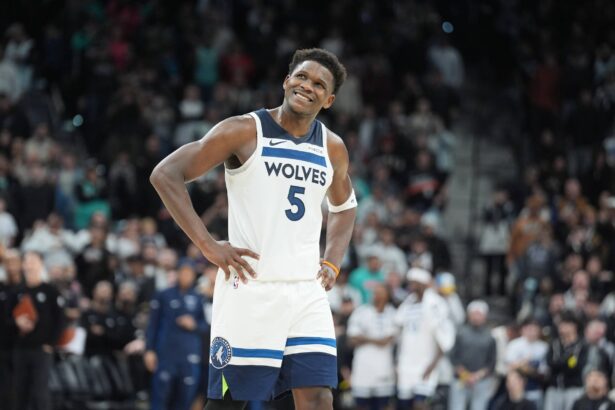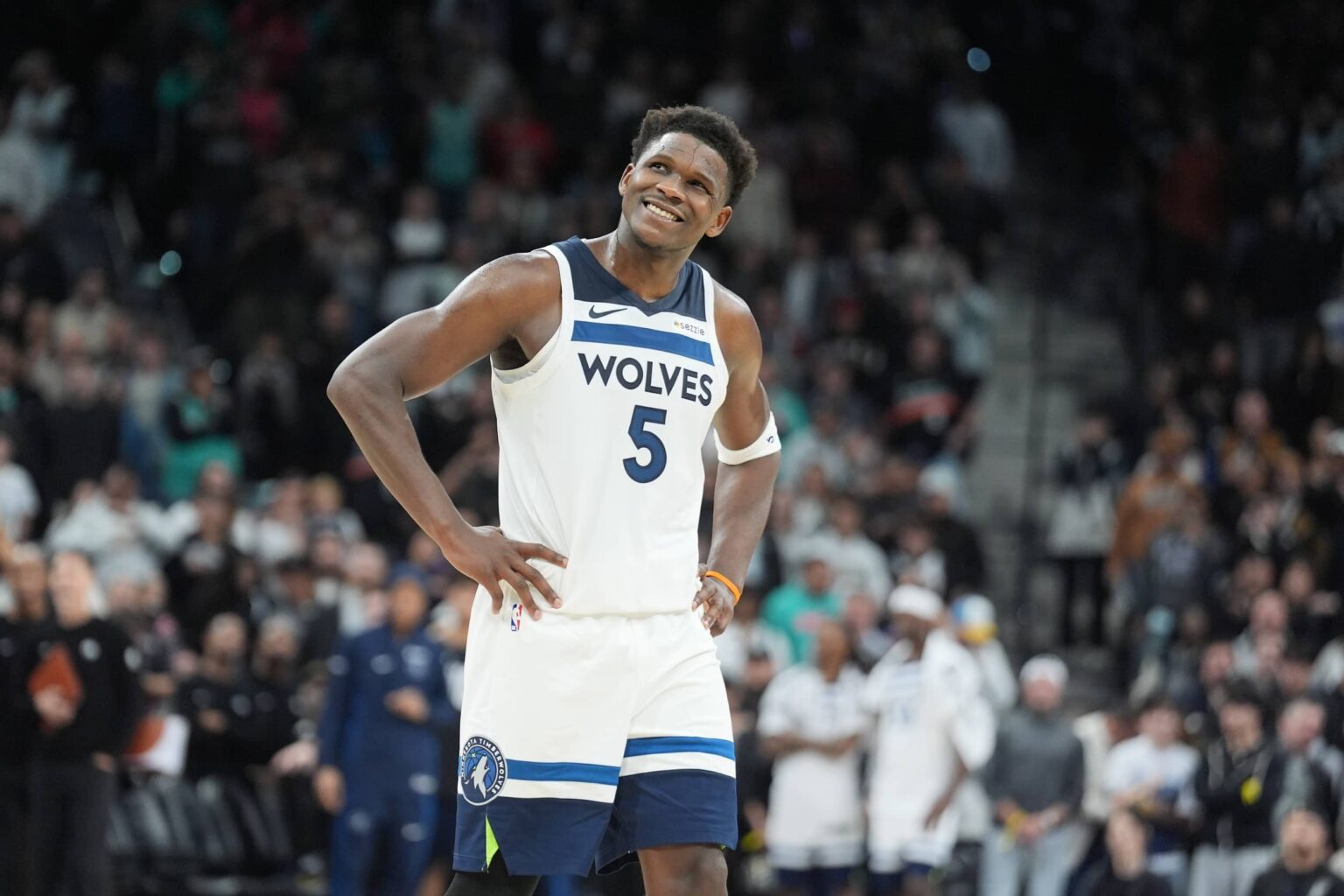
The Timberwolves are still in a good place, but this postseason made the next step pretty obvious: they need more usable depth and more lineup flexibility around Anthony Edwards.
They went 49–33, landed the No. 6 seed, pulled off a real statement by beating the Nuggets, and then ran into a second-round ceiling against the Spurs. That’s not a failure. It’s just not the finish line for a team paying contender prices and built around Edwards, Rudy Gobert, Julius Randle, Naz Reid, and Jaden McDaniels.
The urgency ramps up because Donte DiVincenzo’s right Achilles tear changes the shape of the rotation. He wasn’t a luxury. He was a real two-way connector: a guard who could shoot, move the ball, and survive defensively. His 12.2 points, 4.1 rebounds, and 3.8 assists stabilized the minutes when Edwards sat and kept the offense from getting too sticky.
When a player like that goes down for a long stretch, your offseason can’t just be about “adding a piece.” It has to be about replacing an entire role.
That also ties into the trade chatter around the bigger salaries. Gobert, Randle, and Reid all show up in different rumor frameworks for the same reason: fit, money, and timeline. It doesn’t mean the Timberwolves want to move everyone; it means they can’t afford to be rigid. The West doesn’t pause while you tinker.
And the cap makes it even more constraining. They’re operating over it, flirting with the luxury tax, and once Dosunmu is re-signed, they’re likely living in apron territory. So this isn’t a “go shopping with cap space” summer.
The best path is: retain your own, then upgrade using exceptions, minimums, and, if you want a bigger swing, sign-and-trade structures that usually require moving money first.
4. De’Anthony Melton
De’Anthony Melton is the lowest-cost name here, and that is why he is a good fit on the list. The Timberwolves need more guard defense after DiVincenzo’s injury, but they also need to be careful with money. Melton has a $3.5 million player option for 2026-27, and reports have him likely to opt out. He isn’t going to be a top-market free agent, but he should get more than that option if teams believe his health is stable.
Melton played 49 games for the Warriors in 2025-26 and posted 12.3 points, 1.6 steals, and strong defensive value after coming back from the ACL injury that hurt his 2024-25 season. The shooting was the problem. He hit only 29.4% from three, and that number is the main reason his market should stay affordable. His career 3-point mark is 35.8%, so the Timberwolves would basically be betting that he bounces back to his usual level.
The fit is simple. Melton can guard point guards and shooting guards, create deflections, rebound well for his size, and play without needing many touches. That fits next to Edwards because the Timberwolves don’t need another guard who holds the ball for 18 seconds. They need someone who can move the ball quickly, hit enough open threes, guard the ball up top, and hold up in playoff minutes.
The money is the key part. If the Timberwolves stay above the apron, they may only have minimum-type tools. If they cut salary and stay under the first apron, they can access the mid-level exception. Melton should be a target if his market lands in the $5.0 million to $8.0 million range, or if he has to take a short “prove it” deal. If he gets closer to full mid-level money, the fit becomes harder.
This would not fix the offense by itself. Melton is not the lead guard answer, and his 2025-26 shooting makes him risky. But as a fourth target, he works. He gives the Timberwolves a real defensive guard, some secondary handling, and a path to replace part of the DiVincenzo minutes without making a huge salary commitment.
3. Quentin Grimes
Quentin Grimes is the best 3-and-D target on the board for what the Timberwolves need. He is 26, entering unrestricted free agency, and coming off a contract year where his value went up. He accepted a one-year $8.7 million qualifying offer with the 76ers, which puts him on the open market without restricted free agency holding him down.
Grimes’ 2025-26 season was more about proving that his 2024-25 breakout with the 76ers wasn’t fake. In the first month of the season, he was averaging 17.2 points, 4.4 assists, 4.1 rebounds, and 2.5 made threes, with 47.0% from the field, 39.7% from three, and 81.3% from the line.
Grimes ended the year at 13.4 points, 3.6 rebounds, and 3.3 assists while shooting 45.0% from the field and 33.4% from three. In the playoffs, his role got smaller, and he finished at 6.7 points in 22.1 minutes per game, but he still shot 40.0% from three. The final season line was not huge, and the playoff scoring dropped, but the Timberwolves would be chasing the early-season version that looked more valuable.
His fit next to Edwards is very good. Grimes can space the floor, run off movement, and punish late rotations. He would also help lineups where Edwards rests because he can do more now than just spot up. The Timberwolves struggled too often when the offense got slow, and Grimes gives them another player who can shoot off the catch and still make a second-side play.
The problem is the contract. Grimes could earn around four years and $74.0 million, given his age, role, and production. That is around $18.5 million per year. The Timberwolves can’t just offer that with cap space. They would need a major salary move, a sign-and-trade, or a path below the first apron to use larger exceptions.
That is why Grimes is No. 3 and not higher. He fits the roster better than almost any external wing, but the money is tough. If the Timberwolves move a big salary like Randle or Gobert, then he becomes more realistic. If they don’t, he is probably too expensive for their tools. Basketball-wise, though, he is exactly the kind of guard-wing the Timberwolves should want next to Edwards.
2. Coby White
Coby White is the strongest external point guard target. He is not a pure pass-first guard, but the Timberwolves need more than an organizer. They need another player who can score off the dribble, shoot, play next to Edwards, and run second units when Edwards sits. White gives them more offensive value than a low-usage backup point guard like Mike Conley at age 39.
White finished the 2025-26 season at 17.4 points, 3.4 rebounds, and 4.0 assists while shooting 44.6% from the field. After being traded to the Hornets, he gave them 15.6 points, 3.0 rebounds, and 3.0 assists in 21 games while shooting 39.1% from three. That second number is important because the Timberwolves need guards who can play off Edwards, not just take the ball from him.
His contract situation is interesting. White just finished a three-year, $36.0 million deal. ESPN’s Bobby Marks projected a three-year, $54.0 million deal for him, with a first-year salary around $16.5 million and a player option in the third year. A $20.0 million annual salary is a possible number if his market suddenly widens.
For the Timberwolves, White would solve a real roster issue. The old Conley-type role can’t be the only point guard structure anymore. The Timberwolves need someone younger, faster, and more able to bend the defense. White can push pace, attack closeouts, shoot off the catch, and take late-clock pull-ups when Edwards is trapped.
The fit is not perfect defensively. White is not Melton as a defender, and he is not Grimes as a wing stopper. If the Timberwolves added him, they would need McDaniels, Edwards, Gobert, and maybe another defensive guard to cover some ground. But the offensive upgrade would be clear. The Timberwolves were too often dependent on Edwards creating something from nothing. White reduces that pressure.
The money is again the hard part. The Timberwolves don’t have cap space. If White’s market is $18.0 million to $20.0 million per year, they would need to clear salary or build a sign-and-trade. The Hornets have his Bird rights and can go over the cap to keep him, so the Timberwolves can’t just assume he is available at the mid-level.
Still, if the Timberwolves move one of the large frontcourt contracts, White should be one of the first calls. He is 26, has real scoring growth, and fits the Edwards timeline better than a short-term veteran guard. He doesn’t make them perfect, but he gives them the kind of guard creation they were missing when the Spurs loaded up in the second round.
1. Ayo Dosunmu
Ayo Dosunmu is the easy No. 1 because this is not only a target. This is the Timberwolves’ own free agent, and they already paid to get him. They traded Rob Dillingham, Leonard Miller, and four second-round picks to the Bulls for Dosunmu and Julian Phillips at the deadline. That kind of price only makes sense if the plan is to keep him.
The regular-season fit was excellent. In 24 games with the Timberwolves, Dosunmu posted 14.4 points, 4.2 rebounds, and 3.5 assists in 28.9 minutes. He shot 52.1% from the field, 41.4% from three, and 92.5% from the line. That is the exact profile the Timberwolves needed: efficient guard scoring, good size, downhill pressure, and shooting without high usage.
The postseason made the case stronger. Dosunmu had 15.6 points, 3.6 rebounds, and 4.1 assists while shooting 50.0% from the field, 42.5% from three, and 92.6% from the line, carried by a 43-point masterpiece against the Nuggets without Edwards and DiVincenzo. With both stars out, Dosunmu became a superstar who could attack the Nuggets and win them a crucial Game 4.
His advanced profile also supports the eye test. Dosunmu had a 61.9% true shooting mark, 59.0% effective field goal percentage, 17.8% assist rate, and only 8.8% turnover rate. That is efficient, low-mistake basketball. He is not a superstar creator, but he gives the Timberwolves a guard who can touch the paint, pass on time, make open threes, and defend well enough to stay in playoff crunch time.
The contract is the main offseason question. The most the Timberwolves can offer before free agency is around three years, $52.4 million, somewhat around $17.0 million per season, and growing. That is the range. If Dosunmu wants more on the open market, the Timberwolves have to decide how far they are willing to go.
The good part is that the Timberwolves have his Bird rights. They can go over the cap to re-sign him. The bad part is the tax and apron pressure. The Timberwolves sit at $193.4 million in salary for 10 players before a new Dosunmu deal, only $7.1 million below the tax line. Re-signing him almost certainly pushes them into expensive territory again.
They still have to do it. Letting Dosunmu walk after trading assets for him would be poor management, especially with DiVincenzo hurt. He is younger than the older guards at 26, big enough for playoff matchups, and efficient enough to play next to Edwards without stealing his offense.
Dosunmu is not only the safest option. He is the most realistic one. Grimes and White may need cap gymnastics. Melton depends on the market price and health. Dosunmu is already in the building, already worked in the system, and already gave the Timberwolves playoff salvation. If the goal is to strengthen the contender push, keeping him is the first move.