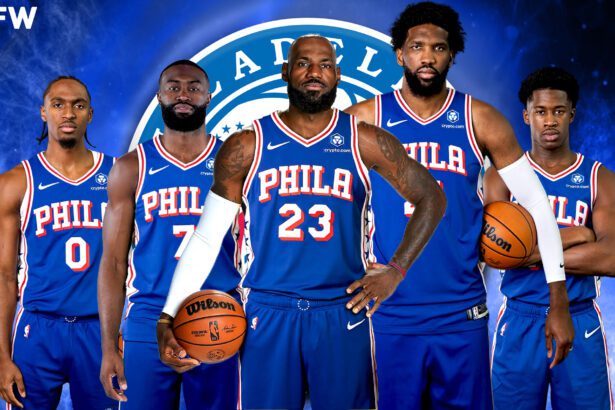
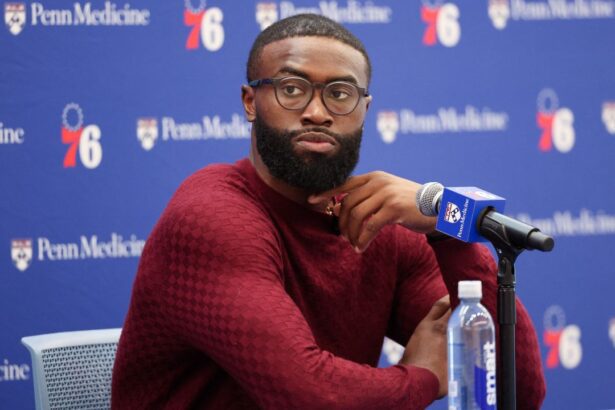
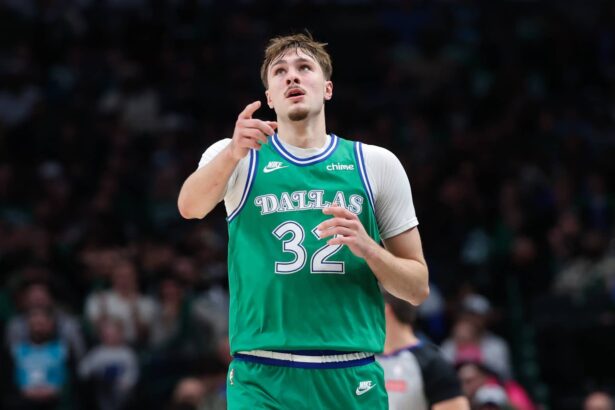
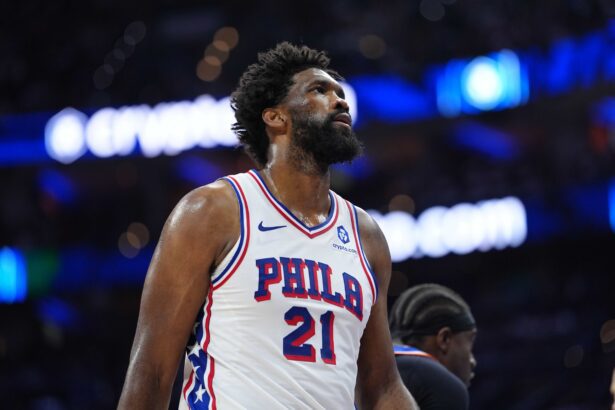
There might not be a harder team to project statistically in the whole league this season than the Philadelphia 76ers. There’s still just one ball, and it now has to go around a starting five of Tyrese Maxey, VJ Edgecombe, Jaylen Brown, LeBron James, and Joel Embiid.
Maxey averaged 28.3 points a night last year. Brown was at 28.7. Embiid was still putting up 26.9 whenever he was on the floor. Even LeBron, at 41 years old, finished at 20.9 points and 7.2 assists. Somebody has to give shots up. Realistically, more than one guy does.
And honestly, that’s not a bad problem to have. The 76ers went 45-37 last season with the 14th-ranked offense in points per game (115.9), but finished 29th in assists at just 24.6 a night. Now LeBron walks into an offense that was desperate for another real passer, and a return to his dominant point guard role is there for the taking.
Maxey should start getting cleaner looks, Brown doesn’t need to live at a 36.2% usage rate anymore, Edgecombe can spend more possessions cutting and shooting instead of trying to create out of nothing, and Embiid can stop burning himself out on every tough half-court set.
So here’s where I land: fewer monster individual scoring lines, but better efficiency pretty much across the board. Nobody’s hitting these numbers exactly, unless I’m a psychic, but based on last year’s scoring, the new roles, and how this group actually fits together, here’s how I see it shaking out.
Point Guard: Tyrese Maxey
Projected 2026-27 Stats: 24.8 PPG, 3.8 RPG, 6.1 APG, 1.3 SPG, 0.3 BPG, 48.0% FG, 39.2% 3PT
If there’s one guy who looks primed to lose points this year, it’s Maxey, and I want to be clear: that’s not a knock on him at all. He just put together the biggest scoring season of his career: 28.3 points, 4.1 rebounds, 6.6 assists across 70 games, on 46.2% shooting from the field, 36.7% from three and 89.2% from the line. He made the All-NBA Third Team off that. Philadelphia isn’t suddenly demoting him to fourth option.
What’s changing is volume. Maxey was forced into 21.4 shots a game last season because Embiid only played 38 games, Paul George basically never played, and somebody had to create everything for this team. That job doesn’t exist anymore with Brown and LeBron next to him. There simply aren’t enough possessions to go around.
I’d expect his usage to drop from around 29.4% into the 24-25% range, and his attempts to settle closer to 18 a game. That’s a real dip on paper. But the quality of those looks should climb.
This is where LeBron changes everything. Maxey shot 41.7% on 3.4 catch-and-shoot threes a game last year, and historically he’s been even better in that role: 45.5% back in 2022-23, 44.4% in 2023-24. Instead of having to beat his man off the dribble, get downhill and manufacture the whole two points himself, he can just come off a screen and let LeBron find him before the defense resets.
There’s another number worth flagging here too: Maxey posted a 60.6% true shooting mark whenever he shared the floor with Embiid last season. Now add Brown and LeBron into those same lineups, and defenses simply run out of bodies to load up against him.
So yes, I’ve got him falling from 28.3 down to 24.8 points. I also have him hitting career-best field-goal numbers and getting back near 40% from three. A smaller role might genuinely mean a better version of Maxey.
Shooting Guard: VJ Edgecombe
Projected 2026-27 Stats: 14.6 PPG, 5.1 RPG, 3.2 APG, 1.4 SPG, 0.6 BPG, 45.5% FG, 38.0% 3PT
Edgecombe’s the strange case here. Normally, a No. 3 pick coming off a 16-point rookie year walks into Year 2 with more shots, more pick-and-rolls, a bigger role, and obviously more expectations. Instead, Philadelphia went out and added Jaylen Brown and LeBron James.
His rookie season was genuinely impressive at 16.0 points, 5.6 rebounds, 4.2 assists, and 1.4 steals across 75 starts, making the First Team All-Rookie, with 43.8% from the field and 35.4% from three. There’s clearly room for the efficiency to keep climbing.
What I’d actually change isn’t his minutes, it’s what he’s doing with them. Last season he had the ball constantly because Philadelphia needed him to create. This year he might be the fifth option in the starting lineup, and weirdly, that could be exactly what his shooting needs.
Edgecombe hit 38.7% of his catch-and-shoot threes last season but only 31.1% off the dribble. That’s a massive gap, and this new lineup should push him towards more off-the-catch shots. He doesn’t need to take six dribbles and try to score late in the clock when he’s got Maxey, Brown, LeBron, and Embiid all standing around him.
I think assists take the biggest hit, going down from 4.2 to somewhere around 3.2 simply because there will be far fewer possessions where he’s the guy initiating offense. I also wouldn’t be shocked if his scoring dips slightly even as he becomes a more efficient player.
Sounds contradictory, I know, but 14.6 points on 45.5%/38.0% is honestly a better scoring season than 16.0 points on 43.8%/35.4%, especially for a team that’s actually trying to win a title and end the season on top of the East.
Defensively, this might turn into his real job. Maxey’s undersized, LeBron can’t be chasing players around screens all night at 41, and Brown’s already carrying a heavy offensive workload, so Edgecombe could end up guarding the other team’s best perimeter scorer most nights.
He might not get the typical sophomore leap in the box score. I think his actual impact on winning goes up anyway.
Small Forward: Jaylen Brown
Projected 2026-27 Stats: 23.6 PPG, 6.2 RPG, 3.8 APG, 1.1 SPG, 0.4 BPG, 49.5% FG, 36.0% 3PT
Before projecting anything for Brown, his 28.7 points last season needs some context. Jayson Tatum missed most of the year, Brown’s usage spiked all the way to 36.2%, and he was essentially forced to become Boston’s entire one-man offense. He took enough shots to lead the league in made field goals and set career highs in both rebounds (6.9) and assists (5.1).
That job simply doesn’t exist in Philadelphia. I actually think Brown could drop from 28.7 down toward 23 or 24 points and still end up having a better offensive season. His 57.3% true shooting last year was fine given the workload, but it wasn’t elite. He had to take a lot of tough, contested shots because Boston needed the volume. Nick Nurse can take a lot of those chances off his plate.
Think about the dilemma defenses are dealing with now. Blitz Maxey and you’re tilting the floor for Brown to attack. Double Embiid and Brown gets a lane to attack. Hide a weaker defender on him, and LeBron can just hunt that matchup all game. That should push Brown’s field-goal percentage back up toward 49-50%.
The assist number is the more interesting one. He got to 5.1 last season purely because the ball was in his hands constantly, but he’s never really been a point-forward, and Philadelphia doesn’t need him to be one. LeBron and Maxey handle most of the creation, Embiid gets his own touches at the nail, and Brown gets to go back to doing what he’s actually elite at: scoring.
I’d guess his usage settles somewhere around 28%, a huge drop from 36.2%, but still plenty for 23-24 points a night. And honestly, I think that role fits him. Brown is far more dangerous attacking a defense in motion than trying to run an offense against five defenders who are already set and waiting for him.
The counting stats come down. The efficiency goes up. And Philadelphia probably ends up with a version of Brown that looks a lot closer to the guy who won Finals MVP than the guy who had to carry an entire team last season.
Power Forward: LeBron James
Projected 2026-27 Stats: 17.8 PPG, 5.8 RPG, 7.4 APG, 1.0 SPG, 0.5 BPG, 53.0% FG, 36.5% 3PT
After many years wondering when the time would come, this might finally be the season LeBron doesn’t need to score 20 a night. He’s entering Year 24. He’s 41 and still going strong.
He already dropped to a career-low 20.9 points last season, but everything else was still there: 6.1 rebounds, 7.2 assists, 51.5% shooting, and a career-low 26.2% usage rate on top of it. I think that usage number drops again this year as age and firepower climb with the 76ers.
There’s just no reason for Philadelphia to ask him to take 18 shots a night when Maxey, Brown, and Embiid can all get to 25 on their own. His role now is passing, controlling tempo, and making everyone else’s job easier.
The shot selection should get even more surgical too. Over 40% of LeBron’s attempts came at the rim last season, where he shot an absurd 75%, 92nd percentile among forwards. At 41, he’s still wrecking smaller defenders whenever he gets a lane or a mismatch down in the block.
That’s exactly how I’d deploy him. Let Maxey push the pace in transition, then let LeBron settle into the half-court organizer role at the elbow in the Horns setting he ran so well with AD in 2020. Seven-plus assists a night should come pretty easily in that setup if everyone stays on the floor.
The 17.8-point projection is also partly about minutes. There’s no reason Philadelphia needs LeBron logging 35 minutes in a random January game. Something in the 30-31 range makes far more sense, especially with the whole point of this season being playoff preparation.
This could end up as one of the strangest statistical seasons of LeBron’s career, with fewer points than we’ve ever seen from him, paired with maybe some of the easiest assists he’s had in years.
Center: Joel Embiid
Projected 2026-27 Stats: 24.6 PPG, 8.3 RPG, 4.2 APG, 1.0 SPG, 1.3 BPG, 50.0% FG, 35.0% 3PT
I’m projecting Embiid’s scoring down again, but for a completely different reason than a couple of years ago. This isn’t about him losing the ability to score. Even in a season that was a physical disaster, he still gave Philadelphia 26.9 points, 7.7 rebounds, 3.9 assists, and 1.2 blocks in just 31.6 minutes, shooting 48.9% from the field, 33.3% from three, and 85.4% from the line.
The actual problem was that he only played 38 games. That number matters to the 76ers way more than whether Embiid finishes at 25 points or 29. This team already has plenty of scoring now, so the smarter move is to lower his offensive workload, cut down the post-up minutes, and try to keep him around 30 a night.
His usage was still enormous whenever he did play, at around a 32.5% usage rate even in the postseason. There’s no reason left to live in that territory. Hand some of those touches to Brown and Maxey, let LeBron run the offense, and turn Embiid into the matchup-killer instead of asking him to be the whole system again.
I also think the rebounding bounces back a bit. His 7.7 last season was well below his 10.8 career average, and a lot of that was just never getting a real stretch of health to settle into a rhythm. I wouldn’t project him all the way back to 11, but something in the eight-to-nine range feels realistic.
So my number is 24.6 points, which would be Embiid’s lowest scoring average since 2019-20, but that’s not really the stat I’m focused on. If Philadelphia gets 50-plus games of 24.6 points, 8.3 rebounds, 4.2 assists, and MVP rim protection out of him, that’s worth infinitely more than another 30-point season where he’s watching half the year in street clothes.
Final Projected Stat Lines
Tyrese Maxey: 24.8 PPG, 3.8 RPG, 6.1 APG, 1.3 SPG, 0.3 BPG, 48.0% FG, 39.2% 3PT
Joel Embiid: 24.6 PPG, 8.3 RPG, 4.2 APG, 1.0 SPG, 1.3 BPG, 50.0% FG, 35.0% 3PT
Jaylen Brown: 23.6 PPG, 6.2 RPG, 3.8 APG, 1.1 SPG, 0.4 BPG, 49.5% FG, 36.0% 3PT
LeBron James: 17.8 PPG, 5.8 RPG, 7.4 APG, 1.0 SPG, 0.5 BPG, 53.0% FG, 36.5% 3PT
VJ Edgecombe: 14.6 PPG, 5.1 RPG, 3.2 APG, 1.4 SPG, 0.6 BPG, 45.5% FG, 38.0% 3PT
The part I like about this team is pretty simple: a lot of these guys can score less, and the offense can still be better. Maxey and Brown won’t need to force 20-plus shots every night, LeBron won’t need to carry the scoring load at 41, Edgecombe can just play his role, and Embiid won’t have to do everything by himself.
That’s really the idea here. The stats might go down a little for almost everybody, but if the shots are easier, the ball moves better, and the stars are healthier by April, the 76ers will take that every single time.