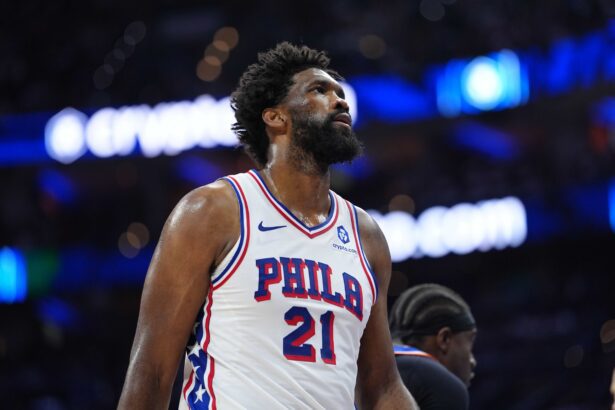
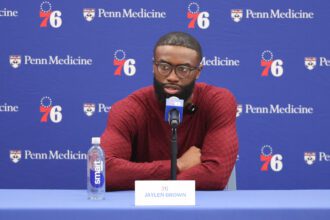
Jaylen Brown’s trade to the 76ers stunned the entire NBA for multiple reasons. One of them was the cost at which the 76ers were able to acquire the former Finals MVP from the Celtics: a 36-year-old Paul George, two first-round picks, and two second-round picks.
There were reports before the trade that suggested it may have been the excessive asking price from the Celtics’ front office that killed his demand across the league. But now, senior NBA analyst Zach Lowe claims that it was Jaylen Brown who was sabotaging his own value.
“I think there were at least one or two other teams who might have been interested in Jaylen Brown and who got intel that Jaylen Brown wasn’t interested in them and to maybe stay out of the bidding. I think Boston felt the circle closing,” Lowe said.
Brett Siegel, the NBA insider with ClutchPoints, also confirmed that the Trail Blazers were one of the teams that Brown refused to join. It makes sense since they already have multiple starting-caliber guards and young talent with potential. Therefore, it would have been much harder for Brown to succeed there.
This also goes to show that the front office did not surprise Jaylen Brown with the news of his trade, but rather that he was pulling some strings of his own from behind the curtains to leverage where he wants to go.
One of the reasons why the Celtics made this trade is their lack of willingness to extend Jaylen Brown, despite the five-time All-Star having an MVP-caliber season in 2025-26.
He finished the regular season averaging 28.7 points, 6.9 rebounds, and 5.1 assists while going 47.7% from the field and 34.7% from behind the three-point line. He led the Celtics to the No. 2 seed in the East, without his major co-star Jayson Tatum available throughout the year.
So it seems almost impossible that the Celtics did not have better offers than the one they ended up accepting.
Brad Stevens claimed that Brown was one-half of two players who occupied 70% of their salary cap in the future, which would have limited their options and flexibility. Thus, the front office had to make the hard decision of trading him.
But since he is up for a two-year, $142 million contract extension, he may have indeed leaked to teams and given indications of his unhappiness about potentially joining that franchise.
It is noteworthy that Brad Stevens also said he did not involve any players in the trade process, and Brown seemed to be shocked that he ended up with the rivals. But all of that, I suppose, could be maneuvers to avoid the media’s criticism.
If this is true, then it means that Brown knew he was getting traded, and that he pulled strings to land in their own division with the 76ers; then one could equate this trade to Kevin Durant joining the Warriors in 2016-17. Since the Celtics lost to the 76ers in the last playoffs, he has now found his way there.
However, we can’t say much until we know it is factually correct, since mentioning which teams he does not want to play for doesn’t necessarily mean he has decided for the front office which team’s offer to accept.
Do you think Brown pulled some strings behind the scenes in this trade? Let us know what you think in the comments section.