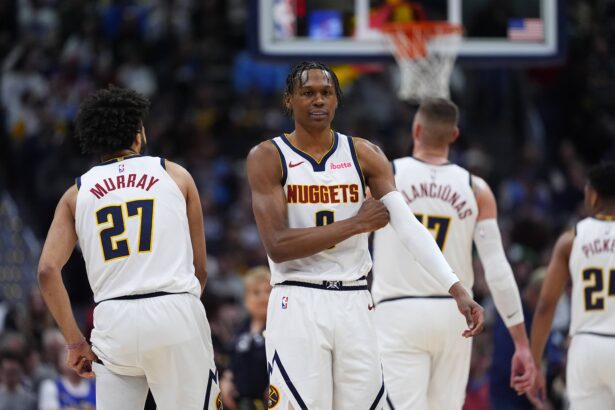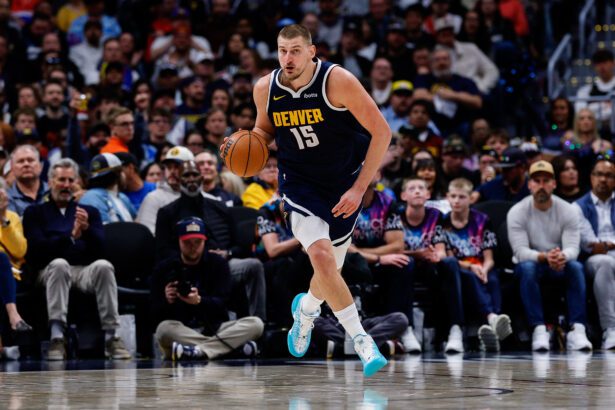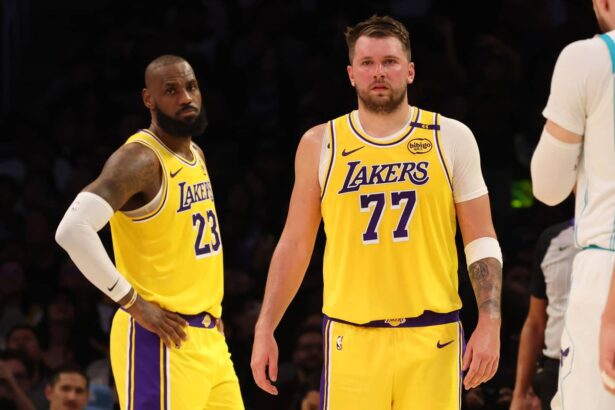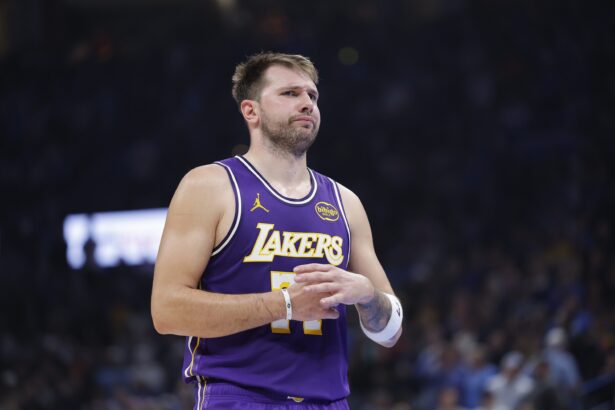
The Los Angeles Lakers already made plenty of moves this offseason, but one hole in the roster remains quite loud. LeBron James is gone, Rui Hachimura left for the Clippers on a two-year, $28.0 million contract, Deandre Ayton was sent to Washington, and the whole roster was rebuilt around Luka Doncic, Austin Reaves, and Walker Kessler.
That is an enormous reset for a team that just finished 53-29, ended fourth in the West, beat Houston in the First Round, and then fell to the Thunder in the Western Conference Semifinals.
The activity this summer was aggressive by any measure. Reaves signed a four-year, $185.0 million extension, while Kessler arrived through a major trade, with Los Angeles surrendering significant future draft capital and committing to him on a four-year, $130.0 million deal.
The front office also brought in Quentin Grimes, Collin Sexton, Sandro Mamukelashvili, and Kevon Looney, so their offseason has been a signing frenzy in order to revamp the team towards Doncic’s preferences.
Even with all of that movement, the wing position still needs an answer. The Lakers now have their guards, a legitimate defensive center, additional scoring off the bench, and reasonable frontcourt depth, but they lack a starting-caliber wing capable of guarding at a high level, rebounding, running in transition, and contributing on offense when given a chance.
This is exactly why Jonathan Kuminga’s name keeps circling back to Los Angeles. The Hawks declined his team option, which turned him into an unrestricted free agent, but the Hawks could still help arrange a sign-and-trade structure sending Kuminga to the Lakers, with Jarred Vanderbilt and a 2032 first-round pick swap moving in the other direction.
Peyton Watson has surfaced in that same conversation, as the Nuggets are open to hearing sign-and-trade offers for Watson, who remains a restricted free agent. Here at Fadeaway World, we have already put Kuminga and Watson side by side as options for the Lakers, since the need is obvious on paper: size, versatility on defense, athleticism, and a younger forward whose timeline lines up better with Doncic than another undersized guard would.
But should Kuminga end up costing too much, or should Watson never really become available, there exists a more grounded Plan B. Less exciting, of course, but sound, from a pure basketball standpoint.
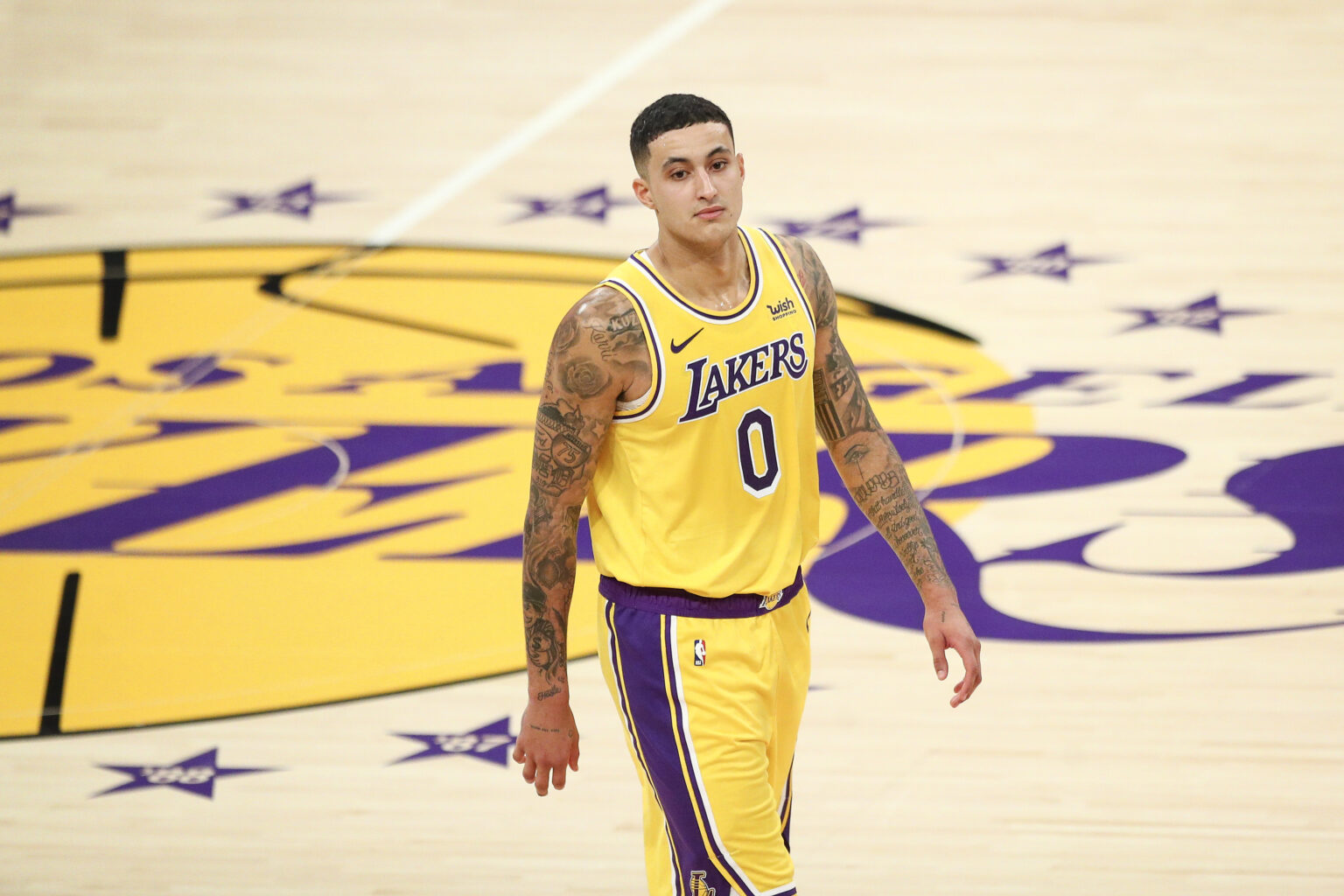
Kyle Kuzma could come back to Los Angeles as its new starting wing.
The Trade Idea
Los Angeles Lakers Receive: Kyle Kuzma
Milwaukee Bucks Receive: Jarred Vanderbilt, Jake LaRavia, Dalton Knecht, 2033 second-round pick
This is a bold proposal, but not some long shot for a superstar swing. Kyle Kuzma is no longer a star, and Los Angeles has no reason to pay for him as though he were still one. The idea behind this trade is much simpler than that. The Lakers would send three rotation-caliber players and a single second-round pick to the Bucks in exchange for a starting forward who brings size, scoring, rebounding, and real championship pedigree.
The financial structure of this deal makes sense as a concept. Kuzma carries a $20.5 million cap number for 2026-27. Vanderbilt sits at $12.4 million, LaRavia at $6.0 million, and Knecht near $4.2 million, which places the outgoing Lakers salary close to $22.6 million, right in the range required to build a deal centered on Kuzma’s number.
The Lakers shouldn’t need to attach a first-round pick to this proposal. That would be overpaying by a wide margin. Kuzma is useful, but he is not on the level of Kuminga, Watson, or a locked-in two-way wing with genuine star upside. Knecht already represents the real asset in this package. The second-round pick simply gives the Bucks an easier reason to say yes, without making the Lakers appear overly eager.
Why The Lakers Would Do It
Everything comes down to one need: a wing who is ready to start immediately. A season ago in Milwaukee, Kuzma averaged 13.0 points, 4.5 rebounds, and 2.7 assists across 69 games, shooting 49.2% from the field, 34.7% from three, with a true shooting mark of 58.1%. Nothing about those numbers looks like empty volume. His usage dropped noticeably from the years he spent in Washington, his efficiency climbed in return, and the overall picture is closer to a well-scaled role player.
That version of Kuzma suits the Lakers far better than the high-usage one ever could. Playing next to Doncic, he would not need to manufacture 18 shots on his own. He would need to run the floor, cut, rebound, attack a scrambling closeout, knock down the open three, and use his frame against smaller wings. Very few players in the league create easier scoring chances than Doncic, and Kuzma has consistently played better basketball when his role is narrowed rather than stretched too thin.
Kuzma also offers the Lakers some flexibility across lineups. He can play the 3 in larger groups or slide to the 4 whenever JJ Redick wants extra spacing on the floor. He is not a lockdown defender, and nobody should sell this move as some kind of complete defensive fix. Still, he stands 6-foot-8, carries real playoff mileage, and has already proven he can handle the pressure that comes with wearing a Lakers jersey. That counts for something on a roster that just lost both LeBron and Hachimura at forward in the same summer.
The internal options currently on the roster don’t solve this the same way. Vanderbilt averaged 4.4 points, 4.5 rebounds, and 1.3 assists last season, shooting 47.1% from the field and only 29.3% from three. His defense holds value, but the lack of shooting still changes lineups in a harmful way. LaRavia put up 8.2 points, 4.0 rebounds, and 1.8 assists, though his three-point shooting sat at just 32.1%. Knecht managed only 4.2 points in 10.2 minutes a night while shooting 34.2% from deep, which makes him more of a developing piece than someone ready to be trusted in a starting role.
That combination is exactly why Kuzma feels like a short-term solution. He is far from flawless, but right now, he is more complete than those three individual pieces put together.
Why The Bucks Would Listen
The Bucks’ motivation is straightforward: direction. This is no longer a win-now roster. Giannis Antetokounmpo was traded to Miami in a massive deal, and the franchise has clearly entered a new stage of its timeline. The Bucks finished 32-50, landing 11th in the East, so keeping Kuzma around simply to chase a Play-In spot doesn’t carry much logic if a good package is sitting on the table.
Kuzma’s contract is not damaging by any means, but it is not small either. He is set to earn $20.5 million in 2026-27, with one additional year remaining after that. For a franchise that just reshaped its entire timeline, converting that salary into Vanderbilt, LaRavia, Knecht, and a second-round pick is a reasonable reset.
Vanderbilt would give Milwaukee a defensive forward capable of rebounding and guarding multiple positions. He doesn’t shoot it well, but his activity and defense still carry weight on a roster searching for more of both. LaRavia, only 24, adds size, some secondary passing, and an expiring contract. Knecht represents the clearest upside swing of the group. He’s due to break out, but he remains a recent first-round pick with real shooting touch on a cheap rookie-scale deal.
The Bucks will likely ask for more in the opening conversation. That is simply how these things start. But the Lakers shouldn’t allow themselves to get pulled into a larger asset battle over this. Kuzma is 31, not 25. He raises the floor far more than he raises the ceiling. For the Bucks, the real value lies in getting younger, cheaper, and more flexible as they move past the Giannis era.
Kuzma Works Better As Plan B
Everything depends on how the Lakers frame this decision. Chasing Kuzma as a fallback option, once Kuminga or Watson becomes too costly or too complicated to finalize, makes considerably more sense.
Kuminga offers the highest ceiling of the group, but his market has grown messy. He reportedly turned down, or was left unimpressed by, a two-year, $20.0 million offer from the Lakers, and Atlanta’s possible sign-and-trade framework would cost Vanderbilt plus the only first-round pick swap the Lakers have available this summer. That is a steep price for a player who averaged 12.2 points and 5.6 rebounds while shooting just 33.3% from three last season.
Watson represents the stronger defensive bet, but Denver still controls much of the process given his restricted status. That is precisely where Kuzma becomes relevant. He is older, yes, but the trade mechanics are far easier, since this would purely be a matter of salary and asset value exchanged with Milwaukee.
Kuzma’s shot profile also aligns well with what this Lakers team needs besides Doncic. He attempted 10.0 shots per game last season, converted 49.2% of them, and never required elite usage to reach his 13.0 points per game average. For this particular roster, that profile works just fine.
Defense remains the one area keeping this from being a complete solution. Kuzma cannot replicate what Vanderbilt offers at his best defensively. He does not carry Watson’s shot-blocking instincts from the wing, nor Kuminga’s athletic ceiling. Still, Los Angeles cannot continue building lineups in which one forward spot becomes an afterthought in the half-court. That kind of gap always surfaces once the postseason arrives.