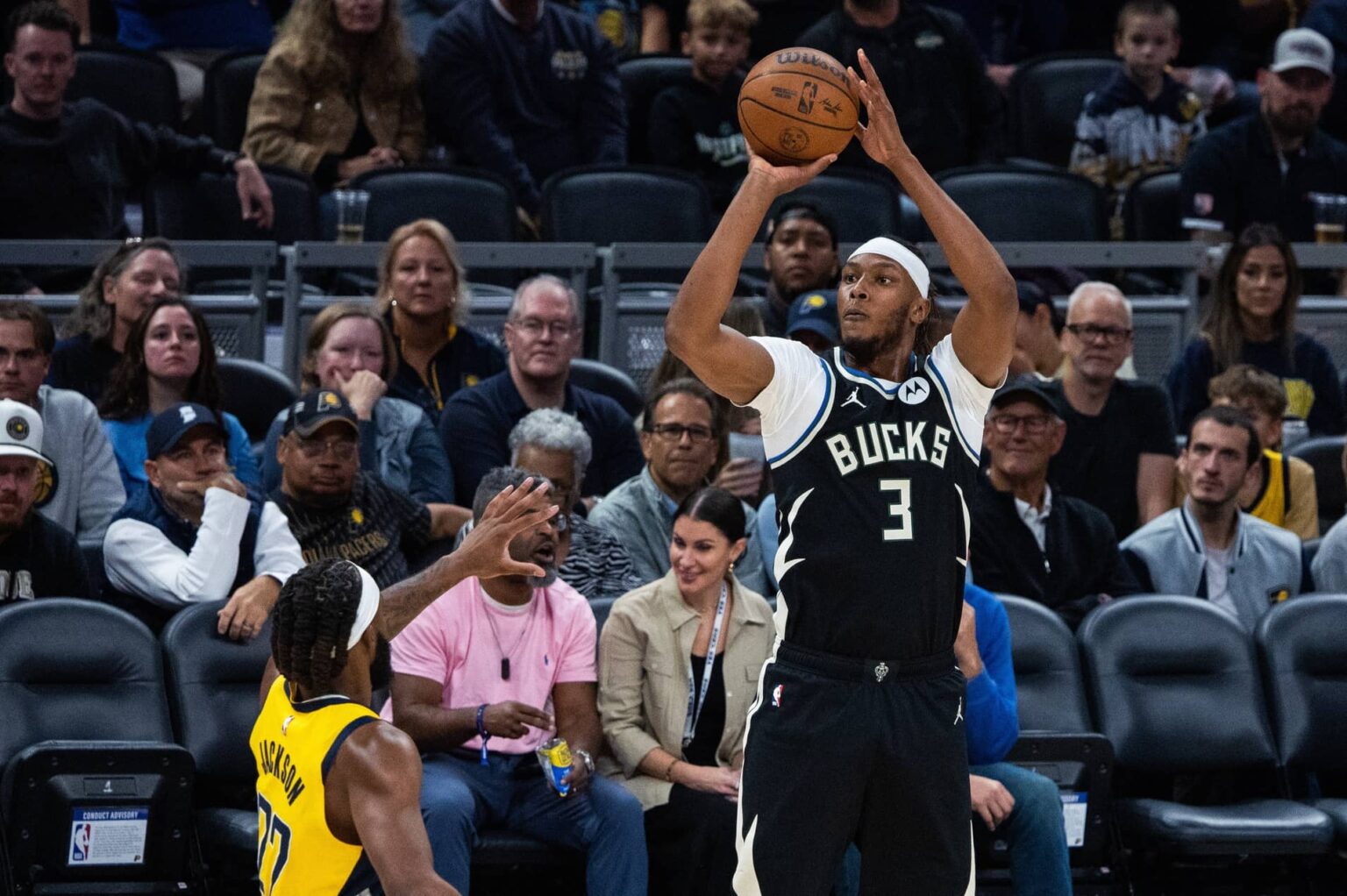
One of the first veterans moved if the Bucks fully commit to a rebuild now is Myles Turner, without hesitation. The Giannis-Heat trade changed the roster direction.
The Bucks now have Tyler Herro, Kel’el Ware, Jaime Jaquez Jr., Kasparas Jakucionis, Brayden Burries, Nate Ament, Ryan Rollins, and future picks. That group needs reps, touches, and a younger frontcourt timeline.
Turner is 30, owed $26.6 million in 2026-27, then $27.9 million in 2027-28, with a $29.1 million player option in 2028-29. That contract makes more sense for a playoff team.
Turner’s first year with the Bucks wasn’t great. He had 11.9 points, 5.3 rebounds, 1.5 assists, and 1.6 blocks while shooting 44.0% from the field. Still, the role-player value is obvious. He hit 38.3% from three on 5.4 attempts per game. He also stayed in his normal defensive lane as a rim protector, with 1.6 blocks in 26.9 minutes.
That combination is why teams should call. A center who protects the rim and shoots above 38.0% from three is rare. Turner isn’t a franchise star, but he can fix lineup math for teams with spacing or paint-defense problems.
For the Bucks, the ask should be simple: shorter money, a young player, or at least one first-round pick. Here are four offers that could make sense.
Lakers Add A Stretch Five Next To Luka Doncic
Los Angeles Lakers Receive: Myles Turner
Milwaukee Bucks Receive: Deandre Ayton, Jarred Vanderbilt, Marcus Smart, 2031 first-round pick
The Lakers need a better center fit around Luka Doncic. Deandre Ayton is cheaper at $8.1 million with his player option, but he doesn’t stretch the floor and hasn’t solved the playoff center issue. Turner gives the Lakers a different shape. Doncic gets a five-out pick-and-pop option, and LeBron James gets more room to attack from the elbows and short corners.
Turner’s 38.3% from three on 5.4 attempts is the whole sell. Ayton gives more rebounding and interior finishing, but defenses don’t have to guard him outside the paint. Turner pulls the opposing center away from the rim. That helps Doncic more than another roll-only big.
The salary works with Ayton, Jarred Vanderbilt, and Marcus Smart. Ayton is at $8.1 million, Vanderbilt is at $12.4 million, and Smart is at $5.4 million, also with a player option. That gets the outgoing money to $25.9 million, close enough for Turner’s $26.6 million. The Bucks also get the 2031 first-round pick, which is the main asset.
For the Bucks, Ayton is a short-term center option or future flip salary. Vanderbilt gives them a defensive forward at $12.4 million. Smart can be moved again, bought out, or kept as a veteran guard if they want structure around the young players.
The Lakers would be paying the first-round pick because Turner fits the Doncic timeline better than Ayton. That is the point. Doncic needs shooting at every frontcourt spot. Turner gives them that and still protects the rim.
Celtics Use Their Trade Exception For Frontcourt Size
Boston Celtics Receive: Myles Turner
Milwaukee Bucks Receive: Chris Cenac Jr., 2030 first-round pick, 2031 second-round pick
The Celtics have the simplest path because of the $27.7 million trade exception. Turner’s $26.6 million salary fits inside it, so Boston can add him without matching salary if apron rules and timing line up.
That is huge for a roster that still needs frontcourt help. Neemias Queta gave the Celtics 10.2 points, 8.4 rebounds, and 1.7 assists while shooting 65.3% from the field. He was productive, but Turner gives them a different offensive layer. Queta is a rim finisher. Turner is a spacing center.
Boston has Jayson Tatum, Jaylen Brown, Derrick White, Payton Pritchard, and Sam Hauser. That group already shoots. Turner adds another above-the-break big man who can take 5.0 threes per game and still block shots. His scoring dipped in Milwaukee, but his shooting volume didn’t go away.
The cost would be about assets, not salary. Chris Cenac Jr. was just drafted No. 27 after posting 9.5 points and 7.9 rebounds at Houston. He is a long frontcourt prospect, but Turner helps faster. Add a 2030 first-round pick and a 2031 second-round pick, and the Bucks get a young big man plus future draft value.
This deal is more attractive for the Bucks if they want salary removal. They would move Turner’s multi-year money and open minutes for Ware. The Celtics would accept the hard-cap pressure because Turner fills an immediate need.
The risk for Boston is paying a first for a 30-year-old center who just had a down year. But Turner’s archetype fits playoff basketball better than most available bigs.
Pelicans Turn Poole’s Contract Into A Frontcourt Upgrade
New Orleans Pelicans Receive: Myles Turner, AJ Green
Milwaukee Bucks Receive: Jordan Poole, 2029 first-round pick
The Pelicans are the messiest fit because the roster already has expensive salaries. Zion Williamson is at $42.2 million, Jordan Poole is at $34.0 million, Dejounte Murray is at $32.8 million, and Trey Murphy III is at $27.0 million. That is too much money for a 26-56 team.
This offer uses Poole’s expiring 2026-27 salary as the main matching piece. Poole had 13.4 points, 2.0 rebounds, and 3.1 assists while shooting 37.2% from the field and 33.3% from three. That contract isn’t positive value, so the Pelicans would need to attach the 2029 first-round pick.
Turner gives the Pelicans a better frontcourt fit next to Zion and Murphy. Derik Queen had 11.7 points, 7.1 rebounds, and 3.7 assists as a rookie, but his defense is still developing. Yves Missi is athletic and protects the rim, but he doesn’t space. Turner gives them a center who can stand outside, clear driving lanes for Zion, and still contest shots.
AJ Green is a small add-in to help the salary math and give the Pelicans another shooter. The Bucks can move him because they should be focused on Burries, Ament, Rollins, Herro, and Jaquez.
For the Bucks, this is mostly a pick-buying deal. Poole’s contract expires in 2027, while Turner has money through 2028-29 if he picks up the option. That shorter money has value in a rebuild. The 2029 first is the prize.
For the Pelicans, the question is whether Turner raises the floor enough. If they want to keep Zion, Murphy, and Murray together, they need a center who helps spacing. Turner does that better than their current options.
Hornets Finally Get The Center Type Their Core Needs
Charlotte Hornets Receive: Myles Turner
Milwaukee Bucks Receive: Grant Williams, Tidjane Salaun, 2029 first-round pick (via Suns)
The Hornets have been linked to Turner-style ideas for a reason. Their core has shooting and wing scoring, but they still need a center who changes the offensive geometry.
LaMelo Ball, Brandon Miller, and Kon Knueppel need room. Knueppel broke the rookie three-point record and finished with 273 made threes. Miller is a wing scorer. Ball is a high-volume passer and shooter. Turner fits that group because he doesn’t clog the lane. He spaces to three, screens, and protects the rim.
The Hornets drafted Hannes Steinbach at No. 14 after he had 18.5 points and 11.8 rebounds at Washington. That was a strong pick, but Steinbach isn’t the same type of player. He is more of a rebounder and interior hub. Turner gives them the stretch-five version right now. Steinbach can develop behind him or play certain two-big minutes.
The Bucks get Grant Williams at $14.3 million, Tidjane Salaun at $8.2 million, and a 2029 first-round pick via Suns. Williams is a veteran forward on an expiring contract. Salaun is the young piece. He hasn’t hit yet, but he still has size, athletic tools, and a rookie-scale deal.
This is the most balanced Hornets offer. They don’t touch Ball, Miller, Knueppel, or Steinbach. They use a future pick and Salaun to turn the center spot into a playoff-level position.
For the Bucks, this beats keeping Turner in a rebuild. Williams can be moved again. Salaun gets developmental minutes. The 2029 first gives them another chip.
Turner isn’t cheap, but the Hornets need this exact skill set. Rim protection plus 38.0% three-point shooting is hard to find.
Who Has The Best Offer?
In this particular instance, I believe the Hornets have the strongest offer, but not by a huge gap.
Their package gives the Bucks three useful things at once: a future first-round pick, a young forward in Tidjane Salaun, and a movable veteran contract in Grant Williams. That is the right type of return for a 30-year-old center on a rebuilding team. Salaun hasn’t proved much yet, but he is still 20, has size, and can get minutes without blocking Kel’el Ware or Nate Ament. The 2029 first-round pick via Suns is the main part because that pick has more upside than a likely late Celtics pick.
The Celtics are close because their offer is the simplest. Boston can absorb Turner into the $27.7 million trade exception, so the Bucks don’t have to take back salary. That has value in a rebuild. Chris Cenac Jr. also gives them another long forward to develop, and the 2030 first-round pick keeps the deal serious. The downside is that Boston’s pick could be late, and Cenac is probably not as interesting as Salaun right now.
The Lakers offer depends almost fully on how Milwaukee views the 2031 first-round pick. That pick could be strong because LeBron James will be gone, and Luka Doncic and Austin Reaves will be 32. Still, the player return is weaker. Deandre Ayton, Jarred Vanderbilt, and Marcus Smart don’t give the Bucks a young building block. It is more salary plus one high-variance pick.
The Pelicans offer is fourth. A 2029 first-round pick is nice, but Jordan Poole’s $34.0 million salary creates a weird guard picture next to Tyler Herro, Ryan Rollins, and Brayden Burries. It would be a pick-buying move, not a roster move.