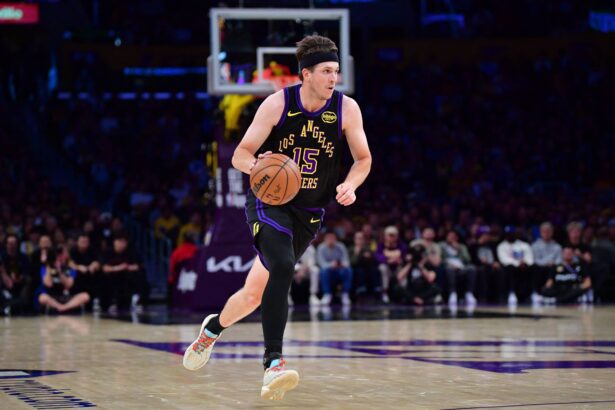
The Lakers are still hunting a young, athletic wing who can defend, run the floor, cut hard, and be a defensive menace next to Luka Doncic in playoff minutes. They’ve already added Walker Kessler, Quentin Grimes, Sandro Mamukelashvili and Collin Sexton, while Austin Reaves stays put as the second guard.
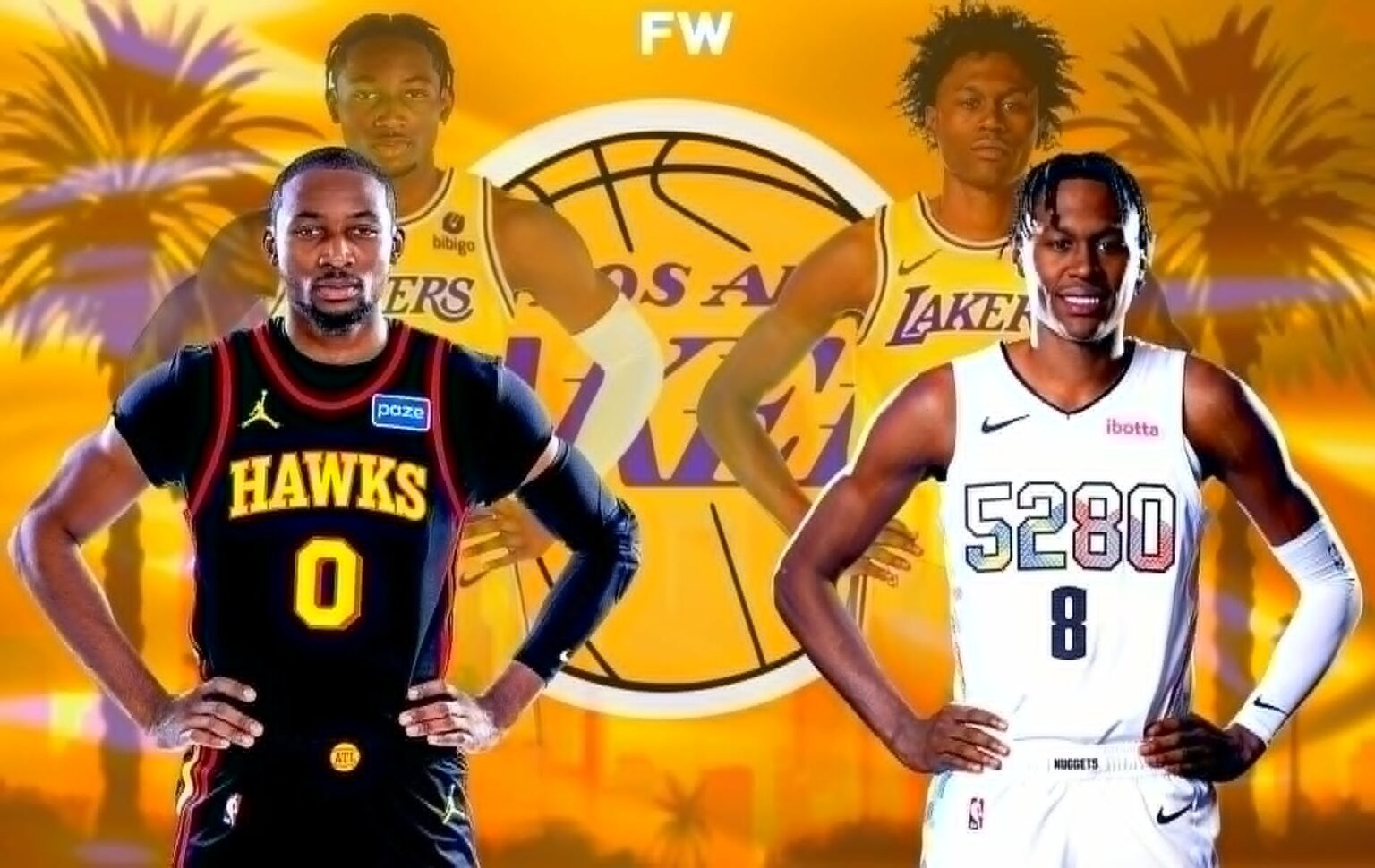
The roster has far more structure now, but small forward remains the one spot that still looks unfinished. That’s exactly why Jonathan Kuminga and Peyton Watson both keep surfacing as logical targets, just for different reasons entirely.
The reporting has connected both names to the Lakers throughout the summer. Jake Fischer reported earlier in the offseason that the Lakers had interest in Watson, while later reports suggested attention shifted toward Kuminga once Rui Hachimura was no longer expected to return.
The Athletic’s Dan Woike also reported that Kuminga was receiving significant consideration from the Lakers, largely because of his size, athleticism, and defensive upside. Watson remains a restricted free agent, and Sam Amick said the Nuggets plan to match any offer sheet but are also open to a sign-and-trade given that talks with Watson’s camp remain far apart. Kuminga is the simpler path, since the Hawks already declined his $24.3 million team option, making him an outright unrestricted free agent.
The statistical profiles are close enough to make this genuinely fun to break down. Watson finished at 14.6 points, 4.9 rebounds, and 2.1 assists, standing 6-foot-8 at 23 years old. Kuminga finished at 12.2 points, 5.6 rebounds, and 2.3 assists, built at 6-foot-7 and 225 pounds, also 23 years old.
Watson took the bigger scoring leap. Kuminga carries the stronger frame and the cheaper price tag. That’s essentially the entire debate for a Lakers team trying to decide who to land.
Shooting
Watson wins this category, and it isn’t particularly close at the moment. He shot 49.1% from the field, 41.1% from three, and 73.0% from the line last season, a massive jump for a wing who wasn’t supposed to be this far along as a scorer.
His true shooting sat at 59.4%, and ranked in the 68th percentile in that category. That’s exactly the kind of shooting leap that forces defenses to guard someone differently. He’s no longer just an athlete lurking in the dunker spot. He can stand in the corner, knock down threes above the break, and make defenses pay for helping off him.
Kuminga’s shooting profile is messier. His raw line came in at 46.3% from the field and 33.3% from three across 36 games. His true shooting landed at 58.0%, which is fine on its own, but the underlying shot profile still raises real spacing concerns, with a three-point attempt rate of just 27.6% and graded in the 28th percentile.
That’s the core issue for a team built around Doncic. The Lakers don’t just need a wing capable of scoring. They need a wing who stays useful even when he doesn’t touch the ball for four straight possessions.
Kuminga’s counterargument is that he applies real pressure at the rim and draws fouls, ranking in the 89th percentile in free-throw rate, which is genuinely impressive. But for the Lakers specifically, the first question is spacing around Doncic, Reaves, and mainly Kessler. Watson answers that question far more directly right now.
Defense
This category also leans toward Watson, though for a different reason entirely. His defensive value isn’t just solid point-of-attack work. It’s real defensive chaos. He averaged 1.1 blocks in 29.6 minutes and graded out in the 92nd percentile in both block percentage and defensive versatility.
That’s an unusually rare combination for a wing standing 6-foot-8. He can guard on the ball in stretches, slide down to protect the rim, and block shots rotating from the weak side. That matters enormously next to Doncic, since the Lakers need players who can cover for mistakes without requiring the entire defensive scheme to be built around them.
Kuminga is the more physically imposing defender of the two. His frame at 6-foot-7 and 225 pounds holds up better against bigger forwards, and advanced metrics label his defensive role as a versatile stopper, with an 84th percentile versatility score and a 59th percentile rim-defense number, per Cleaning The Glass. That’s precisely why the Lakers have shown interest. He looks like the type of athlete capable of taking on the toughest forward matchup whenever the roster needs it.
The problem is consistency. Watson carried a bigger role last season, started 40 games, and put together a full breakout year before dealing with some late-season injury concerns. Kuminga played only 36 games total, with a knee issue surfacing during a midseason stretch, and his season ended with a disastrous plus-minus performance in a critical Game 6. That doesn’t define his season, but it does highlight how unstable his role can still become once the games matter most.
Watson has the better overall defensive production. Kuminga has the more imposing frame. For a Lakers roster that needs immediate defensive impact, Watson gets the nod here.
Off-Ball Play
This is where Watson fits the Lakers’ current roster construction better than Kuminga does. Doncic is going to dominate the ball on most possessions. Reaves will handle plenty of touches as well, and Sexton needs the ball with the second unit. There simply aren’t many possessions left over for another forward who needs the ball in his hands to be effective. Watson is already built for that reduced-usage role.
His usage with the Nuggets translates almost seamlessly to what the Lakers need. He cut hard, ran the floor in transition, filled the corners, attacked closeouts, and defended multiple positions without needing a high-usage role to reach 14.6 points a night. His creation numbers only graded in the 46th percentile, with passing in the 29th percentile, which sounds discouraging at first glance, but for the Lakers specifically, that’s almost exactly the point. Watson shouldn’t be asked to generate his own offense. He should be asked to finish the advantages Doncic creates for him.
Kuminga is the better self-creator when it comes to pressuring the rim, but that comes bundled with more decision-making risk. His creation numbers graded in the 76th percentile, but his turnover rate under pressure sat in just the 15th percentile, as he’s usually too eager to score and drive down the lane than make the right play. That’s essentially the entire Kuminga dilemma summarized.
He generates more offense on his own than Watson does, but his game doesn’t slot as easily into a lineup where someone else already controls the game like a Doncic, a Curry, or a Jokic-type. He wants to drive, gather, bump through contact, and finish, which has real value but can get clunky in a lineup without ideal spacing.
The Lakers don’t need Kuminga to become a top-three scoring option on this roster. They need him to be a bigger, more athletic version of a Derrick Jones Jr. type. That’s a significant mental adjustment for him to make. Watson already plays much closer to that exact role today.
Fit With Doncic
Watson is the more natural fit alongside Doncic specifically because he checks more of the boxes the Lakers are looking for in this new era. Doncic averaged 33.5 points, 7.7 rebounds, and 8.3 assists last season, and at 6-foot-8, the offense is always going to run through his size, his passing angles, his pick-and-roll control, and his ability to hunt post mismatches. The ideal role players around him are simple by design: shoot when left open, cut hard when help rotates away, defend at a high level, and avoid needing extra dribbles to be effective. Watson fits that description almost perfectly.
He also pairs more logically alongside Kessler. If Kessler is already functioning as the roster’s non-shooting big man, the Lakers need their forward to be respected from three-point range. Watson’s 41.1% clip from deep makes that considerably easier to pull off. Playoff defenses may still test him given his shooting volume wasn’t elite, but they can’t fully ignore him either. If Doncic gets trapped and kicks the ball out to Watson, the Lakers can live comfortably with that shot in a way they simply couldn’t with a hesitant catch-and-shoot look from Kuminga.
Kuminga’s best fit alongside Doncic shows up in transition and defensive pressure. He can run the floor with Doncic, cut from the weak side, attack a bent defense, and guard bigger forwards across the league. That’s genuinely valuable, and it’s exactly why this debate doesn’t end after the first two categories. The Lakers need real athletic pop on this roster, and Kuminga provides that in a way Watson simply can’t match physically.
The issue is that teams built around a player like Doncic don’t need every wing on the floor to be a driver. They need wings who don’t compromise spacing in the process. Kuminga’s 33.3% clip from three overall suggests defenses will continue helping off him more freely than they would against Watson. In a playoff series, that distinction becomes a real problem. Doncic can manufacture a shot for almost anyone, but spacing ultimately determines just how difficult that shot has to be.
All-Around Value
This is where the entire equation flips. Watson remains the better pure basketball fit, but Kuminga might actually be the smarter Lakers move once the contract enters the conversation. Watson reportedly wants north of $25.0 million annually, and some reports suggest Denver’s range to retain him could climb into the $28.0 million to $30.0 million territory if it comes down to that. That’s a substantial commitment for a player with only one true breakout season who still isn’t a top-three offensive weapon on his own team.
Kuminga’s market looks far more manageable by comparison. One estimate floated a number closer to $15.0 million, and that changes the entire conversation for the Lakers. At $15.0 million, Kuminga is allowed to be imperfect and still represent some value. He becomes the athletic developmental wing, the defensive upside swing, and the forward bet the Lakers can make without requiring him to instantly become the fourth-best player on a contending roster. At $25.0 million to $28.0 million, Watson has to be a guaranteed, above-average starter from day one.
The Lakers’ current cap situation also makes chasing Watson considerably harder to execute. After the Kessler, Grimes, Mamukelashvili, Sexton, and Ayton-for-Hardy moves, the Lakers are running low on flexibility and may need to move some others for cap relief just to finish out the roster. That makes a Watson sign-and-trade especially complicated, since Denver ultimately controls the process and retains the ability to match any offer.
Kuminga, as a fully unrestricted free agent after Atlanta declined his option, represents a much cleaner path if the Lakers can find the necessary cap room or trade structure.
So the final answer here is a little inconvenient, but reasonably clear. Strip away the money entirely, and Watson is simply the better fit for the Lakers. He shoots at a higher level, defends with far more production, and plays a more natural complementary role next to Doncic. But the money can’t be ignored in this scenario. If Kuminga realistically costs around $15.0 million while Watson costs $25.0 million to $28.0 million, Kuminga becomes the better overall target for where the Lakers currently stand.