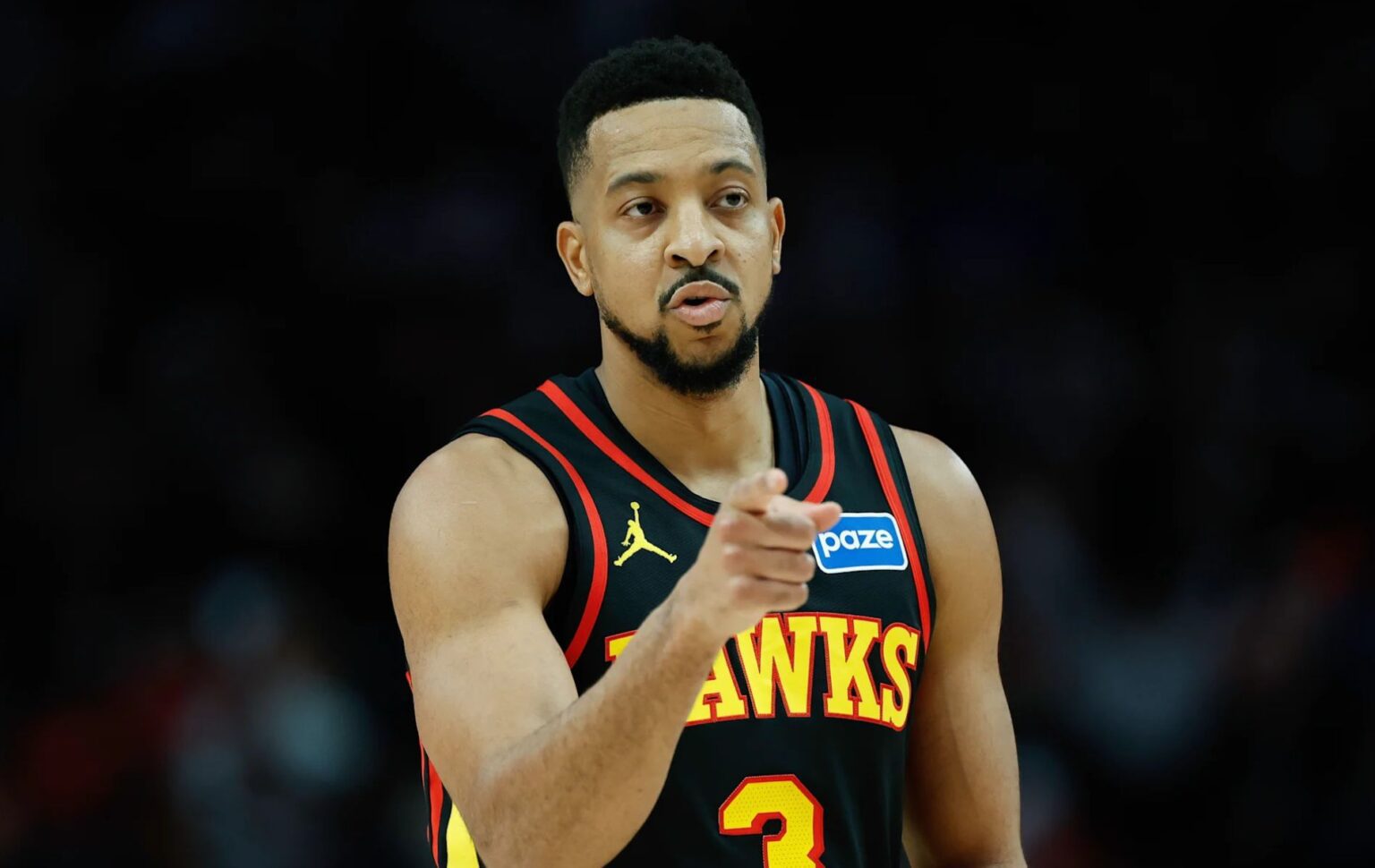
CJ McCollum isn’t a star anymore, but that’s honestly not the point with him in 2026 free agency. He’s 34 years old, turns 35 in September, and just finished a two-year, $64.0 million contract.
He made $30.7 million this past season, so his next deal shouldn’t be anywhere near that number. For a real contender, the better range is probably around the full mid-level exception, unless the Hawks use Bird rights and bring him back on a bigger short-term deal.
The production is still genuinely useful, though. McCollum averaged 18.7 points, 3.3 rebounds, and 3.9 assists while shooting 45.5% from the field and 37.5% from three. He also attempted 15.2 shots per game, so this wasn’t some low-volume efficiency illusion. He took real shots, made real threes, and gave the Hawks a veteran guard to lean on after the Trae Young trade.
That’s why contenders should care. He isn’t someone to build around, but he can absolutely help a playoff team that needs late-clock offense, bench scoring, and a guard who doesn’t freeze when the moment gets big.
These four teams all made the playoffs; they all have different needs, and McCollum fits all of them if the price is right.
4. Orlando Magic
The Magic are the lowest team on this list because they aren’t a finished contender yet, but the basketball fit is very real. They went 45-37 and finished 8th in the East, so the playoff base is already there. They also had a top defense, ranked 4th in defensive rating at 107.5, and that’s actually the main reason McCollum makes sense here. The Magic can cover his defensive limitations better than most teams in the league.
Their offense is the real problem. Paolo Banchero averaged 22.2 points, 8.4 rebounds, and 5.2 assists but shot only 30.5% from three. Franz Wagner averaged 20.6 points, 5.2 rebounds, and 3.3 assists. That’s a lot of big forward creation, but it gets really slow in the playoffs. Both guys can force shots, draw help, and make plays, but the Magic still desperately need guards who can shoot and create without destroying the spacing.
McCollum would give them exactly that. His 37.5% from three matters a lot on a roster that needs cleaner shooting around Banchero. He isn’t just a spot-up guy either. He can run pick and roll, reject screens, hit pull-up twos, and score late in the shot clock. For a team that can defend but consistently gets stuck in the half-court, that’s a big deal.
The role would have to be controlled, though. McCollum shouldn’t be taking shots away from Banchero, Wagner, or Desmond Bane. He should be a 24-to-28-minute guard who runs bench units and plays next to one of the forwards most of the time. His job would be pretty simple: make threes, keep the offense moving, and give the Magic a real veteran option when playoff games get ugly and possessions get hard.
The defensive fit is actually better than it looks because Jalen Suggs can guard the top perimeter matchup, Bane has strength, Wagner has size, and Banchero has size. McCollum wouldn’t be asked to defend the best guard every single night, which is exactly how he has to be used at this stage of his career.
The money is the main question. If he costs $20.0 million or more, it gets risky, but around the mid-level exception, this is a really good move. The Magic need more offense without destroying their defensive identity, and McCollum gives them that in a straightforward way.
3. Denver Nuggets
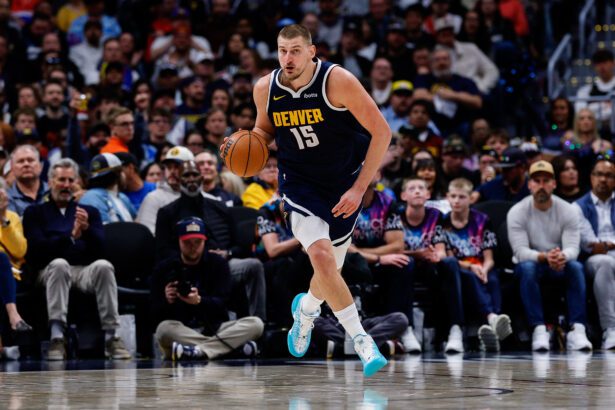
The Nuggets make sense because Nikola Jokic makes every good offensive guard look better, and that’s just the reality. They went 54-28 and finished 3rd in the West, and Jokic was absolutely ridiculous again with 27.7 points, 12.9 rebounds, and 10.7 assists while shooting 56.9% from the field. That kind of player gives McCollum an incredibly easy offensive runway.
The Nuggets had elite offense all year, scoring 122.1 points per game with the best offensive rating in franchise history at 122.6. Jamal Murray also had the best regular season of his career with 25.4 points, 4.4 rebounds, and 7.1 assists while shooting 48.3% from the field. So the Nuggets don’t need McCollum to fix their offense at all.
They need him because the second unit still needs more structure. Their offense can go completely flat when Jokic sits, and that’s been a recurring problem for years. McCollum can actually fix some of that. He can be the guard who runs those non-Jokic minutes, gives Murray some rest, and turns dead possessions into decent shots. That isn’t small in the playoffs when every possession matters.
The Jokic fit is also really easy to picture. McCollum coming off Jokic handoffs would be a strong action immediately. If the defender trails, McCollum shoots. If the big drops, he gets to the mid-range. If the defense switches, Jokic punishes the smaller defender. It’s simple basketball, and simple basketball wins when the spacing is right.
The defensive side is the real problem, though. The Nuggets had a 117.4 defensive rating that ranked 21st in the league, and adding a 35-year-old small guard obviously doesn’t fix that. A Murray-McCollum backcourt can absolutely be attacked. That means McCollum can’t be used as a regular starter. He has to be a sixth man and a matchup scorer, not a guy who closes every game regardless of the situation.
This fit only works if McCollum wants a ring more than the biggest possible check, because the Nuggets aren’t the team to give him one last huge contract. But if he wants to play meaningful playoff minutes next to Jokic and Murray, this is a really strong spot for him.
2. Boston Celtics
The Celtics should be in this conversation because they need another veteran scorer who can create his own shot, and that need didn’t really get addressed this past season. They went 56-26 and finished 2nd in the East, and they still had a strong title-level profile even after a weird year. They scored 114.9 points per game, allowed 107.2, and finished with a plus-7.7 point differential.
Jaylen Brown carried them with the best season of his career, averaging 28.7 points, 6.9 rebounds, and 5.1 assists while shooting 47.7% from the field and 34.7% from three in 71 games. That was a massive workload for one guy. The Celtics still had Derrick White and Payton Pritchard, but they were clearly missing one more guard who could score off the bench with Pritchard starting.
McCollum gives them something different. White is better defensively and more complete as a player. Pritchard can shoot and pressure defenses, but his size becomes a real problem in the playoffs. McCollum is a pure shot-maker. He can get a pull-up jumper, run a second-side pick and roll, and create points when the first action dies completely. That’s exactly the type of player the Celtics needed in some of their worst playoff stretches over the past few seasons.
The three-point volume fits, too. McCollum shot 37.5% from three on real attempts, and the Celtics always want shooting around Brown and Tatum. He doesn’t need the ball every possession. He can space, relocate, and attack closeouts, but unlike a normal spot-up shooter, he can also take over a bench unit for a few minutes when the team needs it.
The defense is the only real concern. McCollum can be hunted, especially against bigger guards and wings. But the Celtics are honestly one of the better teams to hide him because Brown can defend, White can defend, and Tatum can defend when healthy. They have enough size and structure to protect one smaller guard if the offensive value is worth it.
This should only be a mid-level type of move, though. The Celtics can’t pay him like the old CJ McCollum, and they shouldn’t even try. But if the number is reasonable, the fit is genuinely obvious. They don’t need him to be a star. They need him to be a playoff guard who gives them 14 points, a few threes, and some calm possessions when the game slows all the way down.
1. Atlanta Hawks
The Hawks have to be number one because this one already worked, and that’s the big difference between them and everyone else on this list. The Magic, Nuggets, and Celtics are projection fits. The Hawks already saw McCollum in their system, with their players, in real playoff games. That matters way more than any theory.
The Hawks went 46-36 and finished 6th in the East after the Trae Young trade, averaging 118.5 points per game and finishing with a plus-2.5 point differential. That isn’t elite, but it was enough to get past the play-in and into a real playoff seed, and McCollum was a genuine part of that.
The playoffs made the case even stronger. McCollum averaged 19.2 points in 32.0 minutes against the Knicks while shooting 46.5% from the field. Game 2 was the big one, 32 points, 3 rebounds, 6 assists, and a late run that helped the Hawks win 107-106. In Game 3, he had 23 points, 5 rebounds, 2 steals, 2 blocks, and the go-ahead shot in a 109-108 win. That’s real playoff value from a 34-year-old guard on a team that was still figuring itself out.
The ending was ugly, and that has to be acknowledged. McCollum shot only 30.3% from three in the series, had 3.5 turnovers per game, and finished minus-61 overall. The Knicks adjusted, Josh Hart made his life really difficult, and the Hawks lost in six. But even with all of that, McCollum gave them two playoff wins and real half-court shot-making on a team that desperately needed both.
The fit with Jalen Johnson and Dyson Daniels makes sense going forward. Johnson can handle, rebound, pass, and attack downhill, but still needs shooting and late-clock help around him. Daniels can defend the best guard which protects McCollum on that end. Corey Kispert gives spacing. Jonathan Kuminga gives rim pressure. Onyeka Okongwu gives size. McCollum can just be the veteran scorer without being asked to carry the whole offense, which is the right role for him at this point.
Michael Scotto reported the Hawks want to re-sign him, and they honestly should. They have his Bird rights, which gives them more flexibility than most contenders chasing him. That doesn’t mean they should overpay, though.
A short deal makes the most sense, maybe two years in the $30.0 to $40.0 million range with some protection on the second year. The Hawks need guard depth, shooting, and playoff experience. McCollum already gave them all three this past season, and that’s exactly why they should be first in line to bring him back.