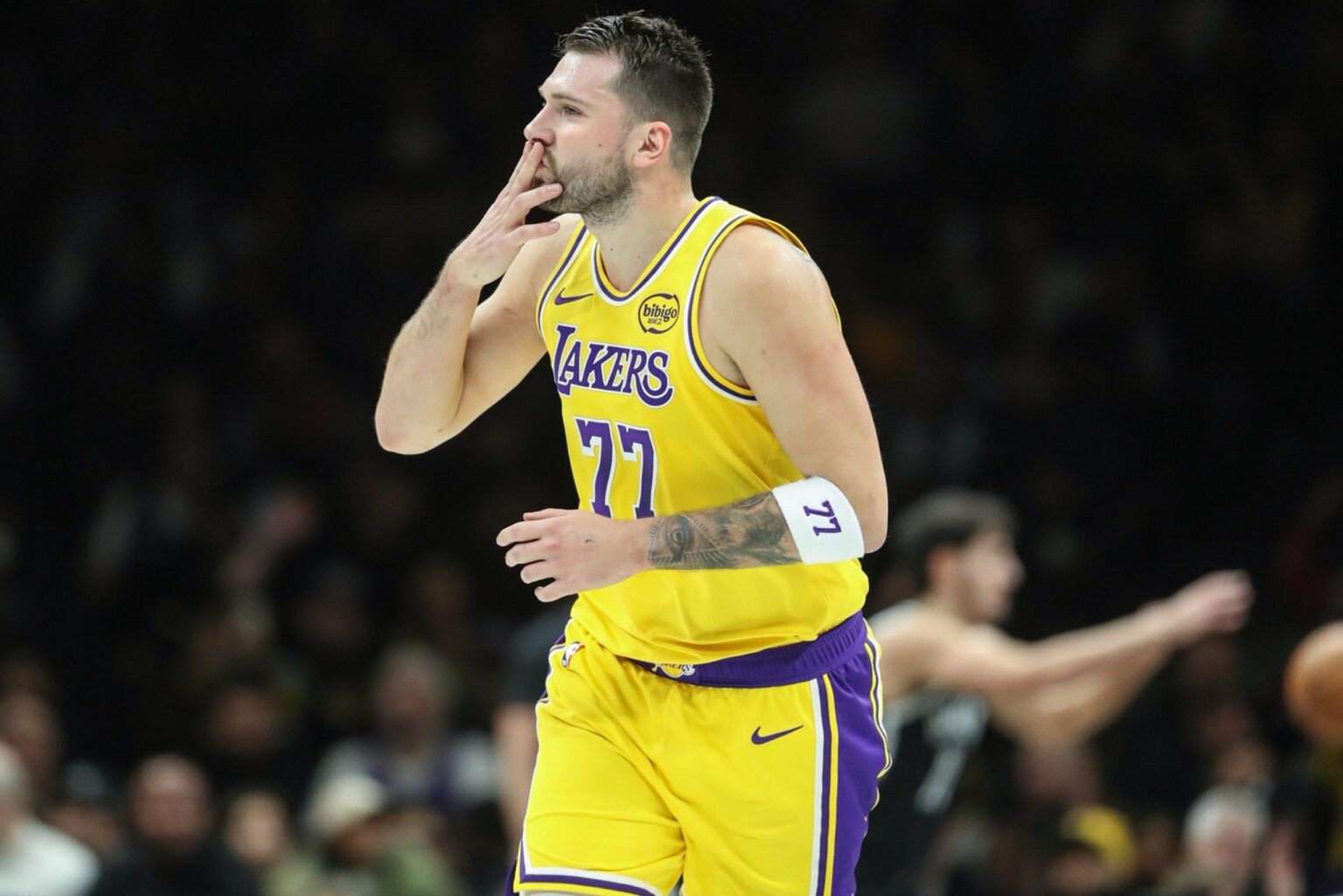
The Lakers have been very clear with their offseason direction. After landing Walker Kessler in a sign-and-trade with the Jazz, giving him a four-year, $130.0 million deal, and adding Quentin Grimes, Sandro Mamukelashvili, and Collin Sexton, the roster is now built around Luka Doncic’s style more than just star names.
The Kessler deal cost the Lakers two unprotected first-round picks in 2031 and 2033, plus first-round pick swaps in 2028 and 2030, so the Lakers already spent their biggest draft ammo to get a rim-protecting big man next to Doncic. Yet, the Lakers are still missing one last piece in the puzzle.
This three-team idea gives them exactly that in Peyton Watson, via sign-and-trade from the Nuggets, and Daniel Gafford from the Mavericks as their backup center after moving Deandre Ayton. That gives Doncic a 6-foot-8 defensive wing and one of his former Mavericks teammates from the 2024 Finals run.
The Nuggets would avoid a monster Watson contract by getting P.J. Washington, Jake LaRavia, Jarred Vanderbilt, and a second-round pick via the Mavericks, and the Mavericks would move two veterans to add Cameron Johnson, Dalton Knecht, Jaden Hardy, and two second-round picks to start revamping the roster around Cooper Flagg.
The Potential Framework
Los Angeles Lakers Receive: Peyton Watson via sign-and-trade, Daniel Gafford
Denver Nuggets Receive: P.J. Washington, Jake LaRavia, Jarred Vanderbilt, 2030 second-round pick (via 76ers)
Dallas Mavericks Receive: Dalton Knecht, Cameron Johnson, Jaden Hardy, 2031 second-round pick (via Wizards), 2032 second-round pick (via Wizards)
Why The Lakers Do It
The Lakers do this because it gives Doncic two things he needs right away: a vertical backup center and a wing who can defend without the opponent’s best perimeter player. Gafford is the easy part. He already played with Doncic, already understands the timing on lobs, short rolls, early seals, and weak-side dump-offs, and already proved he can be useful in a Doncic playoff offense.
He averaged 9.5 points, 6.9 rebounds, 1.1 assists, and 1.3 blocks last season while shooting 65.5% from the field. The Lakers already have Kessler, who barely played 5 games last season, so the Lakers definitely need the insurance. Doncic gets a rim runner on the floor at all times with this rotation, and the Lakers aren’t forced to play small or use Mamukelashvili as a full-time backup 5 when matchups get physical.
Watson is the bigger swing amid reports that the Nuggets and the wing are “far apart” in contract negotiations, and Denver could explore sign-and-trade options if his salary range is too big to take in.
Watson broke out last season with 14.6 points, 4.9 rebounds, 2.1 assists, 0.9 steals, and 1.1 blocks in 29.6 minutes for the Nuggets, while shooting 49.1% from the field, 41.1% from three, and 73.0% at the line. That is not just an athlete anymore. Watson has turned into a starting-caliber wing with size, shooting, and defensive playmaking.
The Lakers would lose Knecht, Hardy, Vanderbilt, and two second-round picks, which hurts their depth, although none of these players were highly featured in the rotation last season. Watson is younger, better offensively, and easier to keep in a main rotation. If the Lakers are trying to win now, the upgrade from Vanderbilt to Watson is a big step into their instant-contending frame.
The pairing makes too much sense for a very needed Lakers team in the defensive department. Doncic, Reaves, Watson, Mamukelashvili, and Kessler is a much bigger and more balanced starting group. Then Grimes, Sexton, Gafford, and other pieces give the bench real shape. It isn’t perfect, but the roster would look much more like the Doncic formula: defenders, vertical big men, secondary creation, and fewer random pieces.
Why The Nuggets Do It
The Nuggets do this only if Watson’s contract gets too expensive. Their first choice is still keeping him. As Sam Amick of The Athletic reported, the Nuggets plan to match any Watson offer sheet, but are also open to sign-and-trade talks because negotiations with Rich Paul and Klutch Sports have stalled.
It also said Watson is looking for a deal around $25.0 million per season, while only the Nets and Clippers have the cap space to sign him to an offer sheet.
Watson is 23 and just had a breakout season, so the Nuggets can’t treat him like a young bench player. But paying him $25.0 million-plus per year next to Nikola Jokic, Jamal Murray, Aaron Gordon, Christian Braun, and Cameron Johnson creates a very heavy cap sheet. The Nuggets are already a high-payroll team, so turning one restricted free agent into three rotation pieces is at least worth discussing.
P.J. Washington is the main reason the Nuggets consider it. He is not Watson as an athlete, but he is a strong playoff-style forward with size, rebounding, and defense. He sits on a four-year, $88.8 million extension, and his 2026-27 salary is $19.8 million. That is cheaper than a maxed-out Watson offer, and it gives the Nuggets a bigger forward body next to Jokic and Gordon.
Washington posted 14.2 points and 7.0 rebounds last season, but his three-point shooting dropped to 32.5%, and that is the concern. He can defend, rebound, and play physical basketball, but the Nuggets would need the jumper to recover closer to his better years. Next to Jokic, that is possible because the shots get easier. He would screen, cut, defend wings, rebound, and hit open threes.
Jake LaRavia and Jarred Vanderbilt are the depth part. LaRavia averaged 8.2 points, 4.0 rebounds, and 1.8 assists in 82 games for the Lakers. He also makes $6.0 million, which is a fair number for a 24-year-old forward who can eat regular-season minutes. Vanderbilt gives the Nuggets a defense-first forward at $12.4 million, with rebounding and toughness but limited shooting. Neither one replaces Watson’s upside, but both help the rotation.
The hard part is Cam Johnson. He averaged 12.2 points, 3.8 rebounds, and 2.4 assists for the Nuggets while shooting 48.0% from the field, 43.0% from three, and 83.9% from the line. Trading that shooting hurts a Jokic offense. But if Watson’s next contract makes the cap sheet too heavy, this is the type of pivot that gives Denver playable depth instead of only tax pain.
Why The Mavericks Do It
The Mavericks side is about reshaping around Cooper Flagg and getting cheaper, better shooting. Marc Stein reported that the Mavericks are viewed as open to moving Klay Thompson, Gafford, and Washington, and that matches their roster problem. The Mavericks went 26-56, finished 12th in the West, and are no longer in the same place they were when Doncic was there. They need to reset the roster around Flagg, Dereck Lively II, and Kyrie Irving, if he is healthy, along with younger pieces.
Gafford is good, but the Mavericks have a center crowd. The Mavericks drafted Morez Johnson with the No. 9 pick in the 2026 NBA Draft, and once you add Lively into that frontcourt, it makes sense to move one older, experienced center in order to develop the younger pieces.
Washington is also movable because of role overlap. He had an up-and-down season, played only 56 games because of ankle issues, and his fit with Flagg, when both need forward minutes, might be in a bit of trouble. Washington is a good NBA player, but he is not untouchable in this new build. If the Mavericks can turn Washington and Gafford into Johnson, Knecht, Hardy, and two second-round picks, that gives them more shooting and more young depth to develop.
Cam Johnson is the big prize for the Mavericks. He is making $23.1 million in 2026-27, so he is not a cheap, young piece at all, but he is one of the easiest plug-in shooters in the league. He shot 43.0% from three last season and gives Flagg the exact spacing he needs. Flagg needs room to attack, post smaller players, and make plays from the elbows. Johnson helps more than Washington does if Washington is shooting 32.5% from three.
Dalton Knecht is the second bet. He put up only 4.2 points, 1.4 rebounds, and 0.4 assists for the Lakers, and his stock took a hit, but he is still 25, 6-foot-6, and a former No. 17 pick. The Mavericks would be buying low on shooting upside. Hardy gives them a familiar type of bench scorer on a $6.0 million salary as they moved him in the Anthony Davis deal.
This isn’t a superstar return for the Mavericks, but it gives them more spacing and more movable contracts. Cam Johnson can start or be flipped later if another contender comes with an offer. Knecht can be developed with a team that will give him reps now consistently. For a team trying to clean up a roster after a 26-win season, that is a logical move.
Final Verdict
The Lakers walk away as the clear winners in terms of pure basketball upgrade. Watson gives them the defensive wing this roster is missing, and Gafford hands Doncic a familiar Mavericks big man who already knows exactly how to play off his passing from their time together in Dallas. If the Lakers can navigate the salary-matching logistics, this is precisely the kind of aggressive swing that pushes the roster closer to that “Dallas 2.0” model the front office has clearly been chasing.
Denver ends up with the most complicated return of the three teams. Washington, LaRavia, and Vanderbilt are all useful pieces, but parting with both Watson and Johnson in the same deal is a real cost. This framework only makes sense if Watson’s next contract climbs high enough that the Nuggets decide adding depth outweighs holding onto one expensive, still-ascending wing.
Dallas comes away with the most sensible rebuild package on paper. The Mavericks move two players they’ve reportedly been willing to part with, add Johnson’s shooting to the roster, take a low-cost swing on reviving Knecht’s value, bring in Hardy, and collect two second-round picks in the process. It’s not a haul that reshapes the franchise, but it fits far better around Flagg than continuing to squeeze more pieces into an already crowded frontcourt.
Judging this purely as a basketball trade, it’s an exciting move for the Lakers and a solid one for the Mavericks. Denver’s side of the ledger comes down entirely to where Watson’s number lands. At $23.0 million, the Nuggets are probably walking away. But if that figure climbs into the $28.0 million to $30.0 million range and extension talks remain stuck, this stops being theoretical and becomes a real framework worth taking seriously.