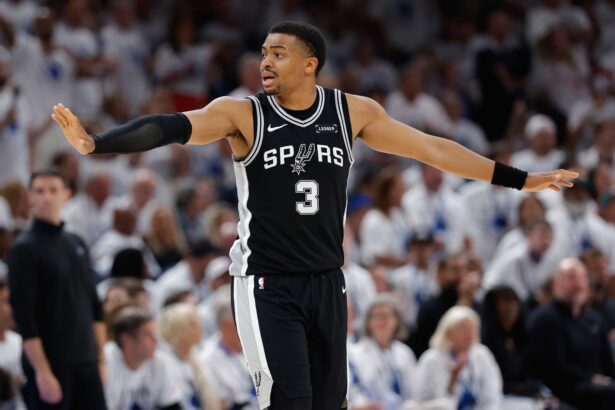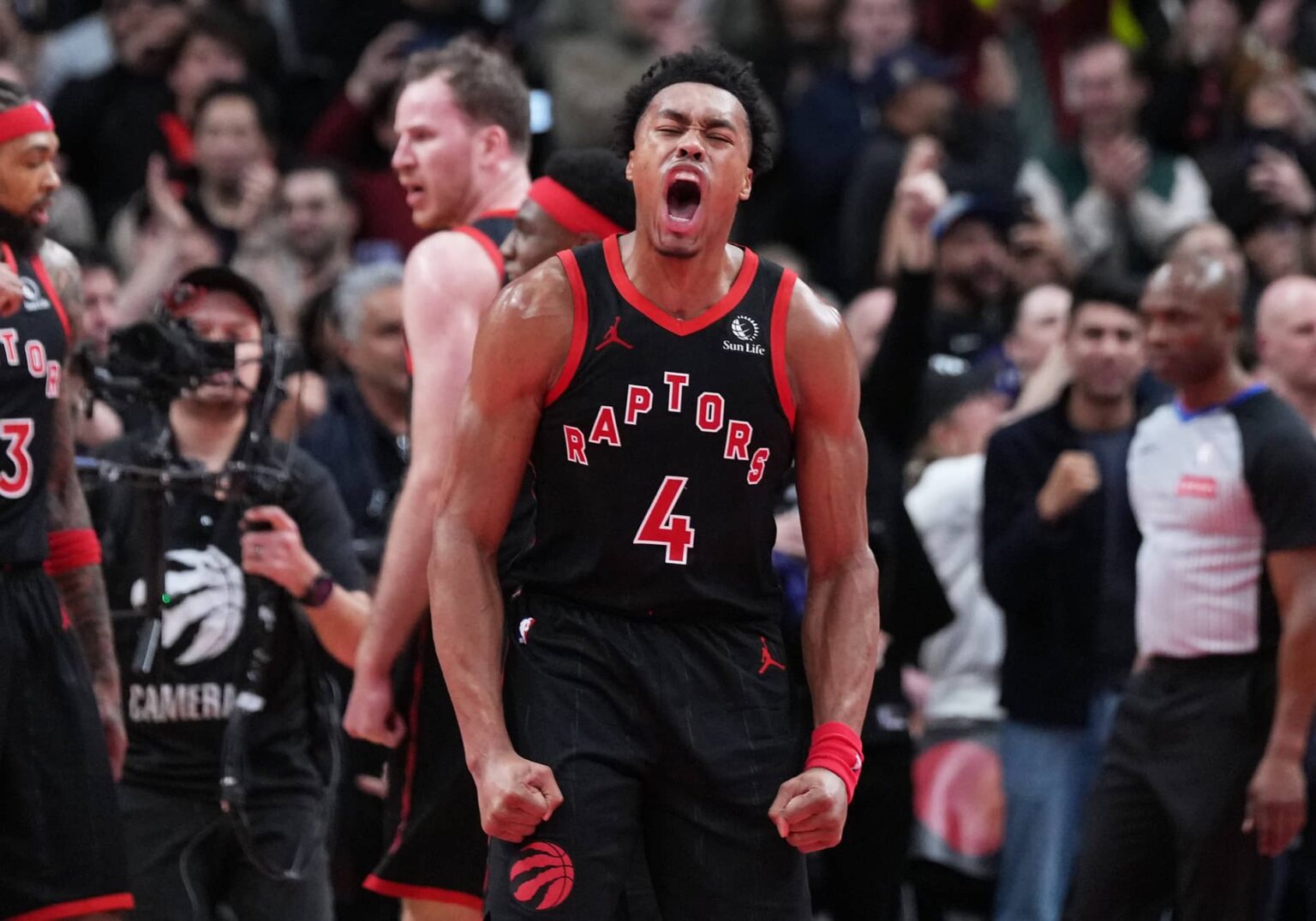
The Toronto Raptors already pulled the trigger on the biggest move of the offseason, bringing Kawhi Leonard back from the Clippers in a blockbuster that sent Brandon Ingram, Gradey Dick, two first-round picks, a pick swap and two second-round picks out west, marking the franchise’s most aggressive win-now swing since the 2019 championship run.
Leonard is 35 now, but this isn’t a fading star coming off a hollow season, since he averaged 27.9 points, 6.4 rebounds and 3.6 assists last year, made his seventh All-Star team, and is already expected to open extension talks with Toronto in the aftermath of the trade.
That move brings the next issue into focus almost immediately. Toronto’s projected starting five now runs Immanuel Quickley, RJ Barrett, Leonard, Scottie Barnes, and Jakob Poeltl, a group that looks loaded with size, scoring and playoff shot creation on paper, particularly with Barnes and Leonard manning the forward spots. But if this roster is actually going to scare anyone in the East come spring, the center position is where the front office still has work left to do.
Poeltl himself isn’t the problem, since he averaged 10.7 points, 7.0 rebounds, and 2.0 assists while shooting an efficient 70.0% from the field last season, giving Toronto reliable screening, finishing around the basket, and a steady regular-season presence at the five.
The concern is durability and how far his ceiling actually stretches once the postseason arrives, as he had already missed 33 of Toronto’s first 68 games last season due to back issues, the most he’s sat out in any single season across his ten-year career. That’s a significant red flag for a franchise that just parted with much draft capital to bring in a 35-year-old Leonard.
What Toronto needs isn’t another scorer to pad the box score and make the starting lineup sound more impressive on paper. It’s a center who can protect the rim consistently, run the floor alongside Barnes, finish the plays Leonard and Quickley create for him, and stay available when opposing playoff teams start hunting every soft spot on the roster.
Poeltl can still help in that role, but the Raptors should keep searching for the center who actually completes this starting five when it matters most.
3. Robert Williams III Gives The Raptors A Defense-First Swing
Toronto Raptors Receive: Robert Williams III
Portland Trail Blazers Receive: Trayce Jackson-Davis, Jonathan Mogbo, Jamal Shead, Allen Graves, 2032 second-round pick
There’s no denying that Robert Williams III is the riskiest name on this list, but he’s also the cheapest way for Toronto to add a genuine playoff-caliber center without touching Jakob Poeltl right away. Poeltl’s injury history is exactly why this center conversation exists in the first place, but trading him before anyone even sees this roster with Kawhi Leonard fully integrated still feels premature.
Williams offers the Raptors a different path entirely, one where they keep Poeltl in the fold for now, add a more explosive defensive athlete alongside him, and let the center rotation sort itself out through actual competition.
The money is tight, though it can be made to work. Williams just signed a three-year, $44.0 million contract with the Blazers, carrying a $14.0 million salary in year one. Toronto would send out roughly $11.1 million combined between Trayce Jackson-Davis at $2.4 million, Jonathan Mogbo at $2.3 million, Jamal Shead at $2.3 million, and Allen Graves at $4.1 million.
It’s a clunky four-for-one structure on paper, but that’s simply the reality of a front office that already sent Brandon Ingram, Gradey Dick, two first-round picks, a pick swap, and two second-round picks out the door to land Leonard. The asset cupboard isn’t what it used to be.
Williams averaged 6.7 points, 7.0 rebounds, 1.0 assists, and 1.5 blocks in just 17.1 minutes per game last season, shooting an efficient 70.8% from the field, and that limited role is really the entire appeal here. He doesn’t need post touches, he doesn’t slow down an offense, and he gives the starting lineup a vertical lob threat capable of erasing defensive mistakes behind them. He also managed to play 59 games last season, a genuinely encouraging sign after years of injury concerns following him around the league.
For Portland, this move is about creating depth and staying flexible. Williams remains stuck behind Donovan Clingan on the depth chart, and the Blazers already have plenty of frontcourt bodies on the roster following his extension. Taking on a handful of cheap rotation players plus a second-round pick lets them shed $44.0 million in long-term money tied to a backup center they don’t necessarily need.
For Toronto, this is purely a health gamble. Williams could start on certain nights, close games on others, and give the Raptors the most athletic rim protector currently on their roster.
This is far from the safest route available. But if the goal is adding a center who makes the starting lineup scarier without surrendering another first-round pick, Williams represents the best version of that particular bet.
2. Daniel Gafford Gives The Raptors A Better Rim-Running Fit
Toronto Raptors Receive: Daniel Gafford
Dallas Mavericks Receive: Jakob Poeltl, 2028 second-round pick, 2032 second-round pick
Daniel Gafford functions as the more direct replacement for Poeltl in this starting five. He’s not a floor-spacer, and he’s not running the offense from the elbow, but his game fits this particular Raptors lineup in a far more explosive way.
Alongside Quickley, Barrett, Leonard, and Barnes, Toronto needs a center capable of running the floor, screening hard, finishing lobs above the rim, and protecting the paint without requiring any plays drawn up specifically for him, and Gafford checks every one of those boxes.
The financials here are refreshingly simple. Gafford carries a $17.3 million cap hit for 2026-27 following his three-year, $54.4 million extension with the Mavericks. Poeltl sits at $19.5 million for Toronto, making the salary match nearly effortless. The Raptors would actually be sending out slightly more money than they receive, which helps, given they’re already carrying Leonard’s $50.3 million salary and entering a considerably more expensive era.
This isn’t some annoying multiplayer structure either, it’s simply one center swapped for another, with two second-round picks heading to Dallas to account for the fact that Gafford is younger, faster, and a better vertical fit for what Toronto is building.
Gafford averaged 9.5 points, 6.9 rebounds, 1.1 assists, and 1.3 blocks in 21.7 minutes last season, shooting an excellent 65.5% from the field, and he’s shot 70.2% for his career overall, which tells you his offensive role has never needed much complexity.
He screens, dives to the rim, catches, dunks, rebounds, and blocks shots. That description sounds almost too basic, but it’s precisely what Toronto needs if Leonard and Barnes are going to control the majority of half-court possessions moving forward.
Dallas has its own logical reasons to move on from Gafford. The Mavericks drafted Morez Johnson at No. 9 overall, and Gafford is now facing more competition for minutes heading into next season. Dallas is also already full at the frontcourt with PJ Washington and Dereck Lively II, so flipping Gafford for Poeltl plus two second-round picks represents a sensible value play on their end. Poeltl is older and less explosive vertically, but he’s a steadier screener, passer, and connector out of the short roll.
For Toronto, Gafford isn’t a headline-grabbing acquisition. But it might be the best fit for this specific lineup on the entire list. Gafford would thrive off all of the activity the Raptors’ main group provides. He wouldn’t necessarily improve the team’s five-out spacing, but he would make this starting group faster, louder above the rim, and considerably more athletic than the current Poeltl-led version.
1. Myles Turner Is The Best Starting-Lineup Upgrade
Toronto Raptors Receive: Myles Turner
Milwaukee Bucks Receive: Jakob Poeltl, Collin Murray-Boyles, 2028 first-round pick
Myles Turner stands out as the best possible target because he solves two problems simultaneously that Poeltl simply doesn’t address: rim protection and floor spacing. Toronto doesn’t just need anyone at center following the Leonard trade. It needs someone who can stretch to the corner, drag the opposing big man completely away from the paint, still protect the rim on the other end, and hold up in a playoff series.
There’s real reporting behind this idea too. Sportsnet’s Michael Grange reported that league sources believe Toronto could have genuine interest in Turner if Milwaukee moves into fire-sale mode following the fallout from the Giannis Antetokounmpo trade. Turner is a clear upgrade over Poeltl, and he still has three years and $83.8 million remaining on his current deal. That number is expensive, no question, but that’s simply the cost of doing business after trading for a 35-year-old Leonard.
The money works out cleanly on this one. Turner is set to make $26.6 million in 2026-27. Poeltl comes in at $19.5 million, and Collin Murray-Boyles adds another $6.6 million, putting the outgoing total at $26.1 million, which lines up almost perfectly with Turner’s salary.
I don’t absolutely love sending Murray-Boyles out after his impressive rookie performance in the postseason, but with the Raptors needing instant contention in Kawhi’s short window, this might be the sacrifice needed to make a bigger upgrade.
Turner averaged 11.9 points, 5.3 rebounds, 1.5 assists, and 1.6 blocks in 26.9 minutes last season, shooting 38.3% from three on 5.4 attempts per game, and while the scoring numbers themselves aren’t overwhelming, the shot profile is exactly the point.
Poeltl finishes well around the rim, but he doesn’t pull opposing defenders away from it. Turner does exactly that: he opens up driving lanes for Barrett, creates more room for Barnes to operate from the post and elbow, and gives Leonard more space for his mid-range game. It also hands Quickley a legitimate pick-and-pop threat at center instead of purely a roll man.
For Milwaukee, this becomes a genuine reset package if the organization truly commits to a fire sale. Poeltl gives them a capable starting center at a lower salary, Murray-Boyles adds a young frontcourt piece to develop, and the 2028 first-round pick provides real long-term value at a moment when Toronto’s later picks are already limited through the Leonard trade.
This is the move that turns Toronto’s starting lineup into the scariest version of itself. Quickley, Barrett, Leonard, Barnes, and Turner bring shooting, size, defense, and enough shot creation without ever clogging the floor. It costs the most of any option here, but it also fixes the most.