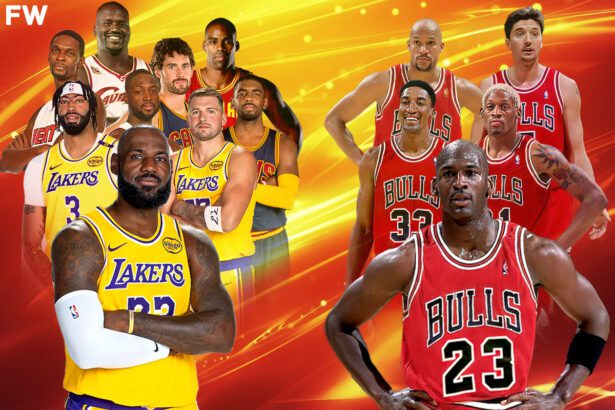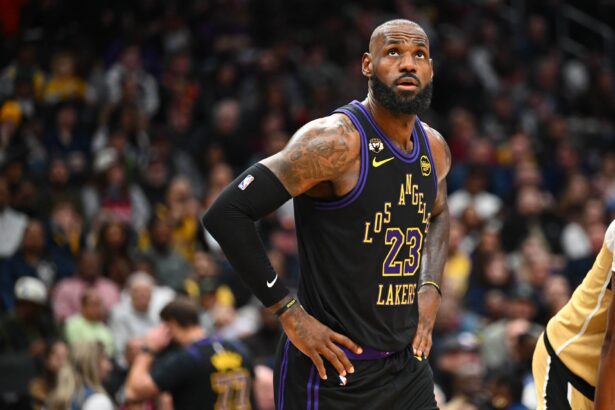
Los Angeles Lakers superstar LeBron James has been routinely criticized for jumping ship. Whether this involved his move to Miami to join Dwyane Wade and Chris Bosh or his move back to Cleveland to join Kyrie Irving and Kevin Love, James is blamed for perpetuating superteam culture wherever he goes.
While there may be some truth to this, Klutch Sports CEO Rich Paul didn’t perceive things the same way. Hence, to defend James on the “Game Over” podcast, Paul drew comparisons with Michael Jordan‘s Chicago Bulls teams, suggesting that the Bulls always surrounded Jordan with talent.
“You can say that Michael was successful because [of] the pieces that were placed around him, he never had to leave,” Paul began. “They replenished, and they were able to, I believe, grow together, and all the pieces made sense, and they fit… Michael, his growth came from being open and willing to play within a system… This is not a knock against LeBron.”
Paul continued by pointing out the players on that Cleveland Cavaliers‘ 2006-07 roster that a 22-year-old LeBron James took to the Finals. To this point, even co-host Max Kellerman agreed that the roster didn’t even seem like a playoff team, much less a title contender.
“The point I’m making is, when you have these guys go on these shows and say things, they haven’t done the work. So now, you talk about how he had to go places,” Paul continued.
“So you’re telling me in life, if I’m in a position where things aren’t getting better, and there’s an expectation on me to be better, and I have to depend on someone else making decisions that my career is up against, you’re telling me to sit there? Or is it the right thing to do to go elsewhere? … What are you talking about? That makes no sense.”
Paul reiterated that, given the circumstances, joining the Miami Heat was the best move for James. In light of the teams he had to play with at the end of his first stint with Cleveland, moving was the only option left.
On that note, Paul also added that James gained more experience about the importance of roster-building after playing in Miami, something he implemented during his second stint with the Cavaliers. Still, in its own way, his comment only pointed to James perpetuating the construction of superteams for his benefit.
While Rich Paul isn’t incorrect in suggesting that James’ decision to leave Cleveland was wise, claiming that Jordan was surrounded by talent for large portions doesn’t seem appropriate.
Although Michael Jordan had the benefit of being a part of some of the greatest teams in NBA history, the early years of his career were marked by grating uncertainty.
Until Scottie Pippen and Horace Grant were drafted in 1987, the Bulls’ most productive player was Charles Oakley. At 24, Jordan finally had a team capable of competing in the playoffs, and the subsequent success in the 1987-88 season convinced the Bulls to invest in building around the core of Jordan and Pippen.
In due time, the Bulls attracted more talent, with players such as Dennis Rodman, Toni Kukoc, and Ron Harper joining, forming the foundation of the Bulls dynasty. On the other hand, LeBron James joined teams with established talent, such as the Heat and the Cavaliers.
The one outlier in this was LeBron James’ move to the Los Angeles Lakers in the 2018-19 season, which featured a team of relatively inexperienced young players. However, this also changed in the span of a season, as the Purple and Gold traded their young core for Anthony Davis, providing James with yet another superstar partner to mount a title push.
Overall, Paul’s rationale for defending James’s decision to jump teams isn’t completely incorrect. Choosing to draw parallels with Jordan may have simply been the incorrect approach.