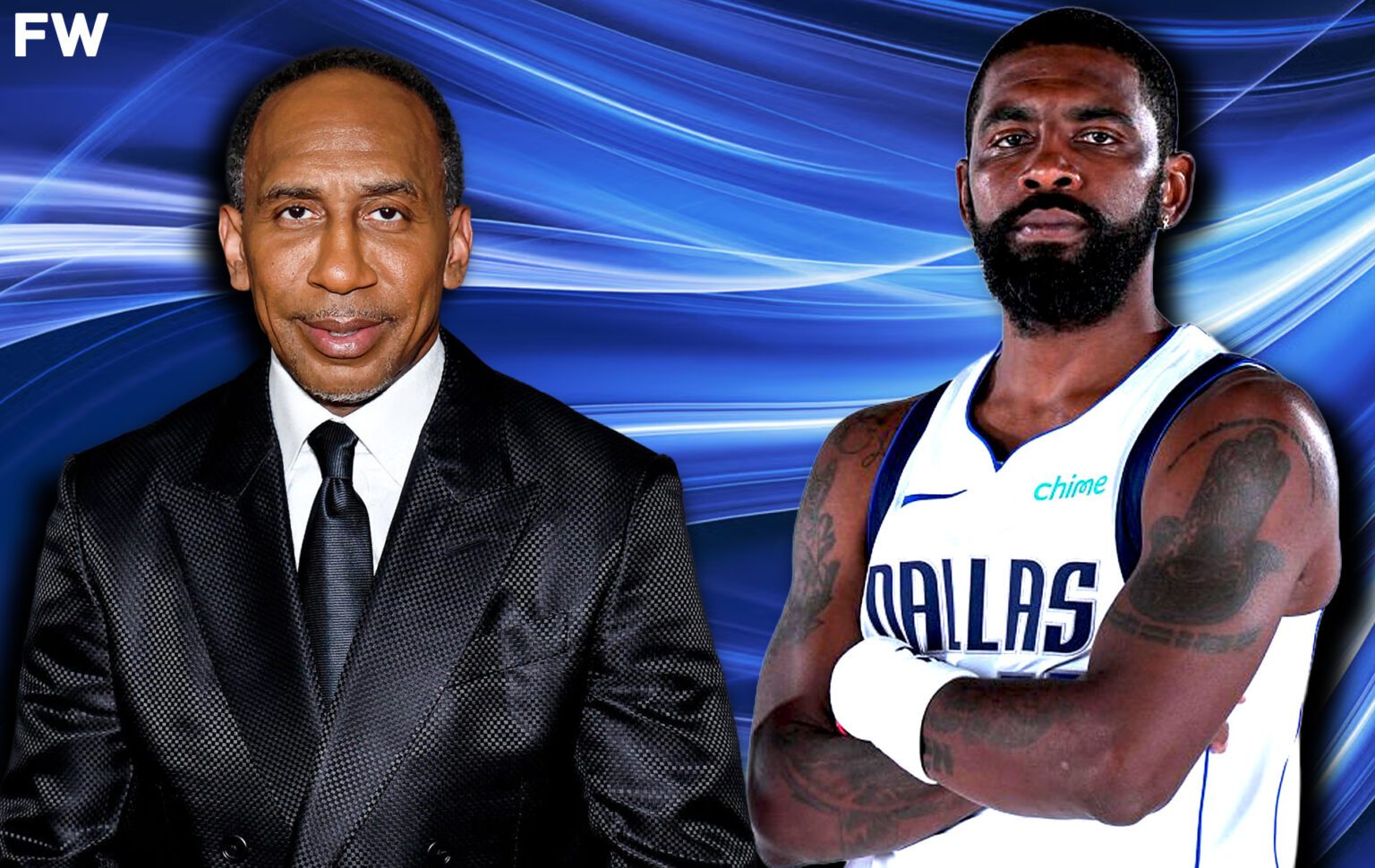
Stephen A. Smith has publicly apologized to Kyrie Irving years after being one of the NBA star’s biggest critics during the COVID-19 vaccine controversy.
Speaking on his own podcast, the ESPN star admitted he was wrong in the way he had judged Kyrie Irving for his stance during the 2021-22 season, and he said he owed the Dallas Mavericks guard a heartfelt, honest apology.
“If I’m wrong, I’ll say I’m wrong. But when it comes to Kyrie Irving, I can’t apologize strongly enough. You know, you may be wondering what I’m talking about because you may not be paying so much attention to politics. I do. I always have and I always will. Not from an aficionado’s perspective, but just as a conscientious observer, watching the news, watching these shows, listening to perspectives, reading the newspapers, et cetera. I pay attention to some degree. Not an expert, but I watch.”
“A gentleman by the name of Dr. Anthony Fauci showed up on Capitol Hill this past Wednesday. Dr. Fauci was up there testifying. He was appearing before the Senate Homeland Security and Governmental Affairs Committee because they wanted to know specifically about his knowledge regarding the coronavirus pandemic and what role he may have played, inadvertently or otherwise, in what ravaged this country and this world for over a year, if not longer.”
“About 1.2 million American lives were lost. Worldwide, more than seven million deaths were officially reported. The World Health Organization estimates approximately 14.9 million excess deaths in 2020 and 2021 alone. And while that stuff was going on, we saw Dr. Anthony Fauci essentially protected. We saw him essentially labeled untouchable in terms of questions or scrutiny or anything like that. We saw vaccine mandates and booster mandates and, you know, distancing stipulations and mask mandates and all of this other stuff.”
“And along the way, there were a select few individuals in the world of sports, especially, that stood up and said, ‘No. I’m not down for this.’ And it was people like me who were critical of them. In my case, it wasn’t about the vaccine itself. It was about the fact that, from a societal perspective, if we all got to deal with it, we all got to deal with it.”
“And I looked at a willingness for one to sacrifice themselves for the betterment of the team, even though you thought something would be unhealthy for you potentially. And I felt like it was worth the risk. I didn’t want to take the vaccine, but I took it. Millions of other people didn’t want to take the vaccine, but we took it. Why? Because there was a mandate that was handed down. And if we weren’t willing to meet that mandate, our jobs, our livelihoods, if not compromised in a very significant way, would be completely stripped from us.”
“But there were others who had the courage to say, ‘Bump that.’ One of those people at the forefront was Kyrie Irving. I bring his name up because I had my issues with him from a leadership standpoint, never as a player because he’s sensational, but with him in terms of leadership. And I didn’t look at it as being courageous. I looked at it as being selfish. And I watched Dr. Fauci on Capitol Hill yesterday, and the person I thought about most was Kyrie Irving.”
“There were others. Aaron Rodgers, then of the Green Bay Packers, before moving on to the Jets and ultimately the Pittsburgh Steelers. There was Novak Djokovic, the greatest tennis player in the world. There was Bryson DeChambeau, golf extraordinaire. Conor McGregor in the UFC. There was Cole Beasley of the NFL’s Buffalo Bills. There was Bradley Beal of the NBA. Jonathan Isaac playing for the Orlando Magic. Bradley Beal playing for the Washington Wizards. There was Kirk Cousins in the NFL as well. There was Tyler Bertuzzi of the Detroit Red Wings in the NHL. There was Andrew Wiggins of the Golden State Warriors in the NBA. The list went on and on.”
“But Kyrie Irving stood out in my mind because of the heat that he was taking. And folks were piling on because that was just the latest transgression, in their eyes, that he was committing and subjecting the public to. He refused the vaccine. New York City’s mandate made him ineligible for home games, and he linked his stance to people losing jobs over vaccine mandates.”
“It was Aaron Rodgers, who said he was immunized, not necessarily vaccinated. Tried to be slick with that. We got on him about that. But then he disclosed that he had not received an authorized COVID vaccine and had pursued an alternative immunization protocol. He defended bodily autonomy and criticized the NFL rules for unvaccinated players.”
“There was Djokovic, who remained unvaccinated and said he was willing to miss major tournaments rather than take the vaccine. He was deported before the 2022 Australian Open and missed the 2022 U.S. Open because of government entry rules. Conor McGregor’s vaccination status was not publicly established. In a subsequently deleted post, he opposed compulsory vaccination while saying he was not against vaccines themselves.”
“Cole Beasley, the NFL wide receiver, fiercely criticized the joint NFL-NFLPA rules that treated vaccinated and unvaccinated players differently, saying he would accept retirement rather than get vaccinated. Again, Jonathan Isaac cited his previous infection and natural immunity, invoked bodily autonomy and faith, and called vaccination a personal, God-given choice. Bradley Beal said he was unvaccinated for personal reasons and questioned why vaccinated people could still contract COVID. He later clarified that he was not urging others to reject vaccination.”
“Kirk Cousins remained unvaccinated and called the decision private after missing practices as a close contact. He suggested using plexiglass to avoid another close-contact designation. Tyler Bertuzzi, in the NHL, was one of four unvaccinated players when the 2021–22 season began. His decision kept him out of games in Canada and cost him the corresponding paychecks. A lot of people spoke out against these folks.”
“I spoke out against Kyrie Irving years ago. As we learned and gathered more information, still not condemning Dr. Anthony Fauci, not saying that everything he said was wrong, there’s still so much unknown about the pandemic, the coronavirus, its origin, its true total specific impact. We can’t engage in complete condemnation anyway, toward Fauci, a lot of Democrats, a lot of businesses in corporate America and beyond who supported their position. But the real point is, we can’t condemn those who were a bit suspicious and raised the proverbial eyebrow about what was going on. That includes not raising that proverbial eyebrow at somebody like Kyrie Irving.”
“Kyrie Irving is a phenomenal, phenomenal basketball player. He’s also a good brother who’s conscientious and never intended to hurt anybody. He just exercised his God-given right as a man and as an American citizen to do something differently than the public was pressuring him to do. I wasn’t alone. There were many, many people who took that position. But they were wrong. And I was wrong. He deserved better. Especially from me.”
“Back then, just to enlighten everybody, COVID almost killed me. Got it in 2021. Sick as a dog. Couldn’t shake it. I was in the emergency room 90 minutes before the ball dropped in Times Square to bring in 2022. Doctors told me, ‘This antibiotic and this steroid are what you need to use. If this doesn’t work, we’re going to have to call your family.’ I had double pneumonia stemming from COVID, which plagued me for more than three weeks. Couldn’t breathe. Woke up in cold sweats every night as if I had jumped into a pool with my clothes on. Some people, like my sister, had it and were better in three days. It nearly killed me. One size never fit all with this virus during this pandemic. But yet there were many people encouraging folks to do it anyway.
“Kyrie Irving wasn’t one of them. In my opinion, particularly with hindsight, it didn’t make him stubborn or selfish. It made him brave. His willingness to stand up and say, ‘No, I’m not doing that.’ It’s just a time for reflection, to look at things differently. With Kyrie Irving, that should certainly be the case, especially now after what we witnessed on Capitol Hill yesterday. When I see anything about the Rona, as they say, the coronavirus pandemic, and I see anybody testifying, and every time I see further suspicions come to light about what it entails, I think about him. I’m just sorry. It wasn’t intentional. It was what I believed.”
“And I didn’t even believe there was stuff that was suspicious about the vaccine. I always vibed with Kyrie Irving about that. I just felt that, in the end, I was a leader at ESPN. He was a leader for his NBA team. And to get things flowing toward normalcy and recapturing our quality of life in this world and in this country, that it was worth taking a chance. And every time I see additional information oozing out of Capitol Hill or anywhere else, adding credence to the suspicions that took place, I think about him.”
“I think about Aaron Rodgers, too, who’s a good dude. His personality might not be everybody’s taste, but he’s a good man, a future Hall of Famer, and one of the greatest NFL quarterbacks in history, who has always deserved better than how he’s been treated. So I think about him, too. But again, no one more than I think about Kyrie Irving. Sometimes it’s not about intent. It’s about the impact of one’s actions.”
“And when I think back to how selfish I thought his inaction was when it came to the pandemic and the vaccines and the boosters and all of that stuff, and then you learn more about the harm that it has done to the human body, and you’re reading about Fauci and the ordeal where he had chest pains and they thought it was some form of cancer, and then it was some pulmonary infection, ultimately you recognize the fact that these vaccines have harmed some people.”
“It ain’t for everybody. And you think about how we were told it’s for everybody. And one of the few people that stood up publicly and was like, ‘Nah,’ was Kyrie Irving. That’s our fault. It turns out that, no matter what the truth is behind all of this, Kyrie Irving did nobody wrong. We did him wrong. I did him wrong. And for that, I’m sincerely sorry. I just thought it was important to say that. And all of those people in the sports world—you deal with the preponderance of evidence that’s presented to you, and you come up with a perspective. It certainly doesn’t mean you’re always right. And I’ll be damned if I’m always right. This is the latest evidence pointing to that.”
“It doesn’t mean that Dr. Fauci was totally wrong just because he pleaded the Fifth 111 times. It means there’s grounds for suspicion. And that suspicion alone justifies the skepticism, the cynicism, and the doubt that came along with the Kyrie Irvings, the Aaron Rodgerses, the Novak Djokovics of the world. They weren’t as wrong as we thought they were. At the very least, we can say that. And that alone warrants a sincere apology to all of them. In my case, especially Kyrie Irving. It’s all I wanted to say. Other than that, it just means I need to do better. I’m not alone, but I’m responsible for me. I need to do better, and I will.”
This apology is a massive reversal from Smith’s previous position, which attacked Kyrie Irving over his controversial time with the Brooklyn Nets. At the peak of the pandemic, Irving chose not to get the COVID-19 vaccine, a decision that made him ineligible to play home games under New York City’s vaccine mandate.
His absence became the biggest story in the NBA, with many analysts, including Smith, saying that Irving’s decision seriously hurt the Nets’ championship hopes.
Smith’s change of heart came after watching recent Senate hearings involving former health official Dr. Anthony Fauci, and Smith said those proceedings caused him to rethink how he viewed people who questioned the vaccine mandates during the pandemic.
He also mentioned that not everything Fauci said was incorrect, but after seeing the hearings, he believes there should be greater understanding and respect for those who expressed doubt about the vaccine at that time.
Smith also stated that his mockery and criticism of Irving were never about basketball, but about his point guard’s leadership during that unprecedented health crisis. Smith also extended similar understanding to other athletes who questioned the vaccine mandate during that time, including Aaron Rodgers, Novak Djokovic, Jonathan Isaac, Bradley Beal and others.
But he still made it clear that Irving remained the one person he had wronged the most.
The apology closes one of the longest-running debates around Irving’s vaccine stance and represents a rare public admission from one of sports media’s most recognizable voices that he believes he got the story wrong, showing what true journalism looks like.