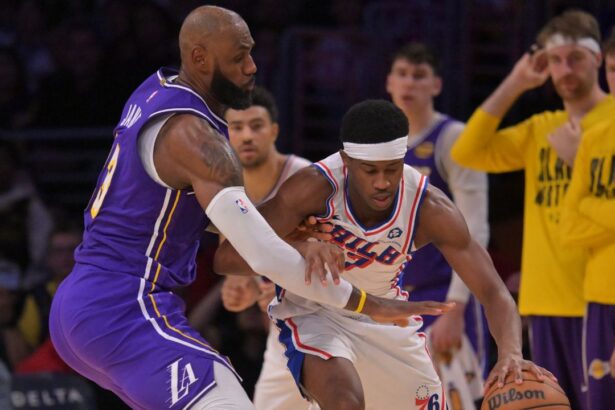
LeBron James‘ reported plan to live in New York City while playing for the Philadelphia 76ers has already generated a significant amount of attention. However, a new report suggests that commuting by helicopter might not be as straightforward as everyone had initially thought.
According to The Athletic’s Brett Katz, the biggest obstacle is not the cost of the commute. Instead, it is the weather, regulations, and overall travel logistics.
Multiple reports have suggested that LeBron is considering living in New York and traveling approximately 100 miles to Philadelphia for games and practices. By helicopter, that journey would take roughly 45 minutes, making it significantly quicker than driving between the two cities.
However, as Katz explained, there are several factors that could make this plan very difficult.
“New York has been conservative with allowing helipads on tops of buildings since 1977, when a helicopter tipped over while attempting to land on the MetLife building in Midtown Manhattan. Some remain, but they are not for commercial use; instead, they are allowed for hospitals or police. Though he has yet to change the city’s policies, New York mayor Zohran Mamdani campaigned on further restrictions for air travel, saying last April that ‘we must end non-essential helicopter flights immediately.'”
Due to these reasons, the helicopter would not be able to depart from a private rooftop near his residence. Instead, the flight would have to leave from one of Manhattan’s three public heliports, adding another layer to his commute.
Weather is also a massive challenge. Unlike Southern California, where Kobe Bryant and Kawhi Leonard reportedly used helicopters to avoid traffic, the Northeast has much more difficult flying conditions.
Fog is very common throughout the New York-Philadelphia corridor, especially during the mornings when NBA teams hold shootarounds and practice sessions.
Visibility is one of the main reasons helicopter flights are delayed or canceled. FAA regulations require at least three miles of visibility, and cloud ceilings must remain high enough for safe operation. Strong crosswinds, thunderstorms, snowstorms, and icy conditions can easily ground helicopters for safety.
The numbers also highlight how frequently these issues arise. Between October 2025 and April 2026, New York experienced 11 days of winds exceeding 40 miles per hour. Philadelphia recorded 33 such days during the same time period.
Such weather disruptions are a major possibility during the NBA season. When helicopters are unable to fly, LeBron would have to make the trip by car.
This creates another challenge. The drive between Manhattan and Philadelphia can take under two hours under ideal conditions. However, Interstate 95 happens to be one of the busiest highways in the United States. Traffic delays are very common, and they could extend the journey, particularly on weekdays.
NBA players also arrive at arenas hours before tip-off and often attend morning shootarounds. LeBron James has famously been known to arrive six to eight hours before tip-off, so those plans also have to be taken into consideration.
The financial cost is unlikely to concern LeBron. Previous estimates suggested that commuting by helicopter for home games and practices could cost LeBron James approximately $800,000 per season. Additional tax costs could push the total annual expense above $1 million.
For most athletes, that would be a major expense.
However, for LeBron, whose career on-court earnings exceed $584 million and who has a reported net worth exceeding $1.4 billion through endorsements and his business empire, it is just a small fraction.
LeBron also wouldn’t be the first 76ers player to live in New York. J.J. Redick reportedly commuted from Brooklyn during his Philadelphia days from 2017 to 2019, while Wilt Chamberlain also lived in New York while playing for the Sixers decades earlier.
The difference is that neither wanted to use helicopters as their means of transportation. At this stage, LeBron has still not publicly confirmed where he plans to live, and reports suggest that no final decision has been made.
If he wants to stay in New York, that commute is certainly possible.
However, this latest report makes it clear that weather patterns, aviation regulations, and the realities of Northeast travel could make a simple 45-minute helicopter ride far more complicated over the course of an 82-game regular season.