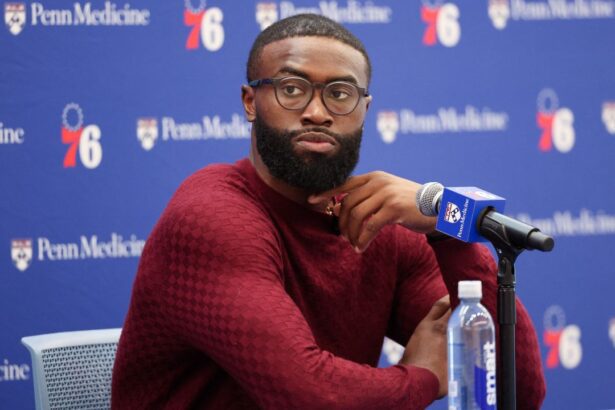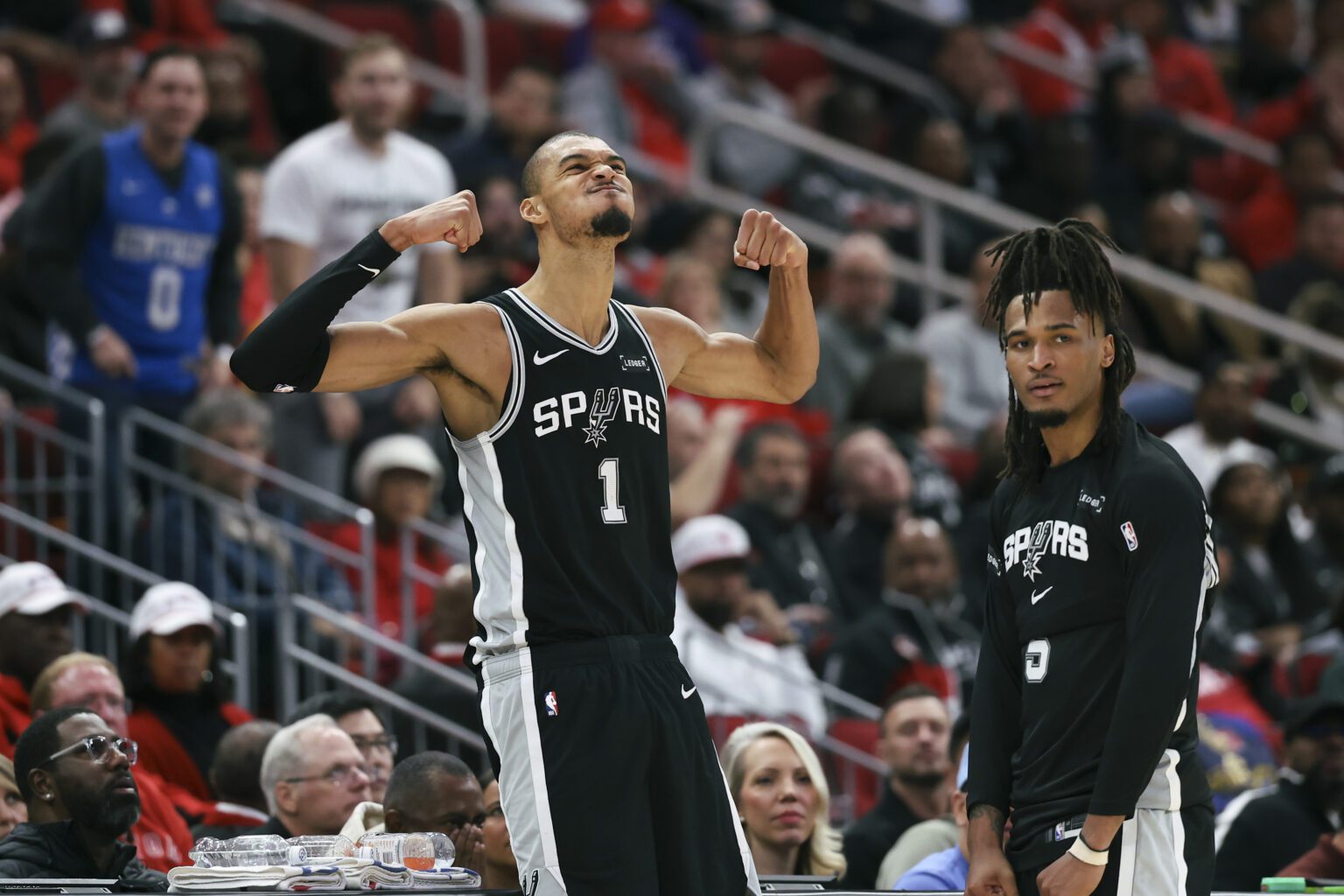
The San Antonio Spurs waived Jeremy Sochan on February 11, turning a former No. 9 pick into a free agent less than four seasons after draft night. That is a sharp outcome for a player who made an All-Rookie team early in his career and, for a stretch, looked like a clean long-term fit as a versatile defender.
This season explains why it got here. Sochan played 28 games and averaged 4.1 points, 2.6 rebounds, and 1.0 assists in 12.8 minutes. He rarely saw real rotation minutes after early January, and even in recent games where the Spurs had extended garbage time, he still could not find a role.
That is the point of this piece. The Spurs are one of the league’s best draft-development organizations, but the last 10 years show the same truth every team lives with: first-round picks land on a wide spectrum. Some become franchise-level hits. Some become useful rotation players. And some, like Sochan’s ending in a Spurs uniform, become cautionary examples of how quickly a pick can lose value when fit, shooting, and role all drift at the wrong time.
2016 NBA Draft
Dejounte Murray – 29th Pick
For a late first-round pick, Dejounte Murray became close to the ideal outcome for the Spurs.
The Spurs took him at No. 29 in 2016, betting on length, defense, and upside at a spot in the draft where you are usually just hoping to find a real NBA rotation player. Murray didn’t pop immediately, but he grew into exactly the type of guard development story this franchise is known for.
By 2018, he was already getting elite recognition on that end. Murray made the All-Defensive Second Team, which mattered because it showed he was not just “active.” He was impactful in a way that translated to winning possessions.
The next stage was offense and responsibility. Injuries were part of his Spurs arc. He lost the entire 2018-19 season to a torn ACL, then worked his way back into a bigger role. The payoff came in 2021-22, when he made his first All-Star team and put up near point guard triple-double production: 21.1 points, 8.3 rebounds, 9.2 assists, and 2.0 steals in 68 games. That season was the clearest proof he could drive an offense, not just defend.
The Spurs also “won” the exit. In 2022, they traded Murray to the Hawks and turned a No. 29 pick into a package built around multiple first-round picks and a pick swap. That is exactly how small-market, development-based teams stay flexible while rebuilding.
Even after leaving, Murray’s profile stayed strong when healthy, including 17.5 points, 6.5 rebounds, and 7.4 assists in 31 games in 2024-25 before an Achilles injury ended his season.
Rating: Great
2017 NBA Draft
Derrick White – 29th Pick
This one is a clean win, and it matters because it shows how the Spurs can consistently extract real value from the end of the first round.
The Spurs took Derrick White at No. 29 in 2017, and they didn’t need him to become a star for it to work. They needed a reliable two-way guard who could grow into real minutes, handle more responsibility over time, and stay playable in different lineups. That is exactly what happened.
Across his Spurs tenure, White averaged 11.6 points, 3.3 rebounds, and 3.9 assists in 237 games. Those are strong numbers for a late first-round pick, especially because his impact was not only box-score driven. He defended, he moved the ball quickly, and he could function on or off the ball depending on who he shared the floor with. His best stretches in a Spurs uniform came when his decision-making matched his aggression. When he attacked the paint and got to his pull-up spots, he looked like a real starting guard.
The other key part is how the Spurs handled the exit. In February 2022, they traded White to the Celtics and turned him into Josh Richardson, Romeo Langford, a first-round pick that became Blake Wesley, plus a future first-round pick swap. That is the kind of asset conversion good front offices aim for: you develop the player, then you sell at a moment where the return fits your timeline.
For a No. 29 pick, this is exactly what “hitting” looks like.
Rating: Great
2018 NBA Draft
Lonnie Walker IV – 18th Pick
Lonnie Walker IV is the type of pick that looks reasonable on draft night, gives you real moments, but never quite becomes what the slot suggests it should become.
The Spurs took Walker at No. 18 in 2018, aiming for an athletic scoring guard with real upside. The problem is his Spurs run started with a setback and never fully stabilized. He dealt with a right medial meniscus tear early in his rookie season, which slowed his early development and kept him in and out of rhythm as the rotation shifted around him.
When Walker did play, the flashes were obvious. He could get downhill, rise into tough jumpers, and swing a quarter when he was hot. But the Spurs never got consistent two-way production, and the “what is his best role” question followed him for most of the four years. He had stretches where the scoring looked real, then long stretches where the shot selection, defense, or decision-making made it hard to keep him in a closing group.
The overall Spurs résumé tells the story. In his Spurs career, Walker averaged 9.4 points, 2.4 rebounds, and 1.6 assists in 208 games. His best single-season scoring year with the Spurs was 2021-22 at 12.1 points per game while playing a larger role, but the efficiency and defensive reliability were never strong enough to lock in a long-term commitment.
The ending matters for the grade, too. The Spurs did not turn him into a meaningful trade return. He left and continued bouncing around the league, which is not an automatic negative, but it does show the Spurs never reached the “starter you can build around” outcome you hope for at No. 18.
Walker was not a bust in the strict sense. He played, he contributed, and he had real NBA-level scoring nights. But for a mid-first pick, the bar is higher than “useful at times.”
Rating: Good
2019 NBA Draft
Luka Samanic – 19th Pick
This selection was an upside bet that did not materialize.
The Spurs drafted Luka Samanic 19th overall with the expectation that his size and skill flashes could translate into a modern forward role with time and development. Instead, he never earned consistent rotation minutes, and the organization moved on quickly.
The defining moment came in October 2021, when the Spurs waived Samanic just two seasons after drafting him. That timing is significant for a mid-first pick, where the standard is at least a credible rotational trajectory or enough retained value to justify patience.
His production with the Spurs reflected that gap. In 36 games, Samanic averaged 3.8 points, 2.2 rebounds, and 0.6 assists. Those totals are not inherently disqualifying for a young player, but combined with the short tenure and lack of a stable role, they point to a clear outcome for this exercise.
Rating: Bust
Keldon Johnson – 29th Pick
Keldon Johnson represents the opposite outcome, and it is especially notable given his draft position.
With yet another 29th selection in 2019, the Spurs developed Johnson into a reliable, high-minutes contributor across multiple Spurs roster iterations. His value has been tied to a straightforward, scalable profile: physical play, rim pressure, transition effort, and the ability to score without needing an offense built around him. That matters in a rebuild, because players like this keep a team functional while younger pieces grow into bigger roles.
The clearest evidence is the size of his sample and the stability of his production. Across his Spurs career, Johnson has averaged 15.3 points, 5.4 rebounds, and 2.1 assists in 423 games. That is not a short peak or a “one good season.” It is years of real minutes, and it includes seasons where he carried a larger scoring load.
In 2022-23, he had the most demanding role of his career and still maintained starter-level production at 22.0 points, 5.0 rebounds, and 2.9 assists in 63 games, which is part of why the Spurs were comfortable paying him like a long-term piece.
Johnson signed a four-year, $74.0 million extension in 2022, with reported incentive bonuses that can increase the total value. For the 29th pick, that is a strong value signal: the organization believed he was worth keeping at a mid-tier number rather than treating him as a replaceable role player.
His role has shifted as the roster has improved, and that is where Johnson’s adaptability shows up. In 2025-26, he is at 13.4 points and 5.9 rebounds per game, with a strong 54.7% from the field, and he has remained productive even when his minutes fluctuate. He also continues to swing games in bench minutes, including a 21-point performance heading into the All-Star break as the Spurs extended a winning streak.
He has not reached franchise centerpiece status, but that is not the appropriate benchmark for the No. 29 pick. The Spurs drafted a late first-rounder and got a multi-year, starter-caliber contributor who can also thrive in a reduced role. That is a high-end outcome.
Rating: Great
2020 NBA Draft
Devin Vassell – 11th Pick
Devin Vassell is a solid outcome for a mid-lottery pick, even if the trajectory has not been linear.
The Spurs drafted Vassell at No. 11 in 2020 with a clear archetype in mind: a two-way wing who could defend multiple spots, space the floor, and scale up as a scorer as his handle and decision-making improved. That baseline has mostly held. Vassell has been a real NBA player from the start, and the Spurs have treated him like a long-term piece, including a five-year, $146.0 million extension that reflected organizational belief in his ceiling and fit.
The cleanest way to judge the pick is the durability of production. Across six seasons with the Spurs, Vassell has averaged 14.1 points, 3.8 rebounds, and 2.6 assists in 344 regular-season games. That profile is not star-level, but it is a meaningful starter or high-end rotation value, which is a reasonable return at No. 11.
This season adds some important context. Vassell has dealt with an adductor strain that cost him multiple weeks in January, and his rhythm has been inconsistent since returning. Even so, his 2025-26 line sits at 14.1 points, 3.9 rebounds, and 2.3 assists, which reinforces the broader read: he is a dependable two-way wing, not yet the kind of offensive engine that bends defenses every night.
For the Spurs, that still matters. Wings who can defend, shoot enough to stay respected, and live in a structure without breaking it are difficult to find. Vassell has provided that, even if the ceiling question remains open.
Rating: Good
2021 NBA Draft
Joshua Primo – 12th Pick
The Spurs used a lottery pick on Joshua Primo, and the outcome was defined more by the abrupt ending than by anything he did on the floor.
Primo was one of the surprises of the 2021 draft. The Spurs selected him at No. 12 as a long-term swing on youth, size, and shot-making potential. He entered the league as one of the youngest players in the NBA and, in basketball terms, the plan was clear: bring him along slowly, build his body, and let the skills catch up to the physical profile.
On the court, the production was modest and largely developmental. Across two seasons with the Spurs, Primo played 54 games and averaged 5.8 points, 2.3 rebounds, and 1.6 assists as a rookie, then 5.6 points, 2.0 rebounds, and 1.0 assists in a couple of games the following season. His overall Spurs sample was 56 games with 5.7 points per game, which is a small enough workload that it is hard to make a pure basketball evaluation beyond “unfinished.”
The problem with this grading is that the pick did not just stall. It ended. The Spurs waived Primo in October 2022, two weeks after exercising the third-year option on his contract. Subsequent reporting tied the decision to allegations of indecent exposure, turning the situation into a major organizational rupture rather than a normal basketball miss.
For a lottery pick, the standard is straightforward: you need either a clear starter-level pathway or a player who holds enough value to be converted into meaningful assets. Primo became neither for the Spurs, and the early separation removed any chance of recovering value from the selection.
Rating: Bust
2022 NBA Draft
Jeremy Sochan – 9th Pick
The Spurs drafted Jeremy Sochan at No. 9 in 2022 with a clear idea: a versatile defensive forward who could grow alongside the franchise’s next centerpiece. Early on, that looked like a reasonable bet. Sochan made the 2022-23 All-Rookie Team, and his rookie-year production backed up the selection: 11.0 points, 5.3 rebounds, and 2.5 assists in 56 games.
The decline was not one clean issue. It was a combination of availability, role instability, and fit once the Spurs shifted from development to urgency. Injuries disrupted his rhythm, and by the time the roster and expectations changed, he never found a stable offensive identity that complemented Victor Wembanyama. When the Spurs committed to competing at a higher level and built a roster with more defined offensive hierarchy, Sochan’s margin for error shrank.
The point forward experiment is part of that story. The Spurs even used him at point guard briefly in 2023-24, and the concept never translated into consistent half-court functionality. The larger issue was that without dependable shooting, his offensive value had to come through cutting, screening, and quick reads, and the Spurs did not settle on a role that made those strengths feel additive next to Wembanyama.
The 2025-26 season turned the situation from “imperfect fit” into “no role.” Sochan appeared in 28 games and averaged 4.1 points, 2.6 rebounds, and 1.0 assists in 12.8 minutes. His minutes essentially vanished, and on Wednesday, the Spurs waived him after he logged only eight total minutes across the previous 12 games.
Sochan had real early indicators, including the All-Rookie nod and a starter runway. But for a No. 9 pick, the standard is sustained starter-level value next to your cornerstone or enough retained value to convert the player into meaningful assets. The Spurs did not get that outcome.
Rating: Bust
Malaki Branham – 20th Pick
Malaki Branham was drafted as a shot-maker bet. The Spurs took him at No. 20 because they believed his mid-range skill, touch, and self-creation could translate into a scalable scoring guard, even if the defense and strength would take time.
The rookie year gave them real reasons to think it could work. In 2022-23, Branham averaged 10.2 points, 2.7 rebounds, and 1.9 assists in 66 games, including 32 starts, while playing 23.5 minutes per night. The late-year stretch looked far more comfortable as a starter, which helped fuel the idea that he could grow into a reliable secondary scorer.
The issue is that the next steps never came in a way that stuck. His scoring dipped to 9.2 points per game in 2023-24, then his role collapsed in 2024-25 to 5.0 points in 9.1 minutes, even though he shot well from three in that reduced sample. When a young guard’s minutes fall that hard, it usually means the team does not see a clean pathway to a winning role, either because the defense is not holding up, the shot profile does not fit, or there is no clear positional identity.
The Spurs ultimately treated him as a movable piece rather than a long-term building block. In July 2025, they sent Branham (along with Blake Wesley and a 2026 second-round pick) to the Wizards for Kelly Olynyk, which was a clear “upgrade the rotation now” decision. By 2025-26, Branham’s production was down to 4.6 points and 0.8 assists in 9.8 minutes, and he was moved again at the deadline.
For the No. 20 pick, the bar is not stardom, but it is becoming a stable rotation player or holding enough value to return something meaningful later. The Spurs got an encouraging rookie season, but they did not get a durable on-court role, and they exited early.
Rating: Bust.
Blake Wesley – 25th Pick
Blake Wesley’s Spurs tenure was defined by volume of opportunity without a clear progression into a dependable rotation role. Over three seasons, he played 156 games and averaged 4.3 points, 1.6 rebounds, and 2.5 assists per game.
The year-to-year line shows why the evaluation never shifted. As a rookie in 2022-23, Wesley averaged 5.0 points and 2.6 assists in 37 games. In 2023-24, he averaged 4.4 points in 61 games. In 2024-25, he averaged 3.7 points and 2.0 assists in 58 games, while shooting 29.3% from three.
For a late first-round guard, the target outcome is not stardom, but stability: a bench piece who can be trusted on both ends without the offense stalling. Wesley’s offensive profile never reached that level with the Spurs, and his production remained light even as his experience increased.
Wesley is now with the Trail Blazers. In 2025-26, he is averaging 6.1 points, 2.1 rebounds, and 3.3 assists in 16.4 minutes per game, shooting 43.9% from the field. He also missed time earlier this season due to a fractured right foot that required surgery.
Rating: Bust
2023 NBA Draft
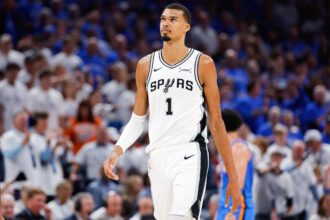
Victor Wembanyama – 1st Pick
This is the easiest entry on the list because the Spurs did not just find a good player. They drafted the league’s most unique roster-building talent.
The Spurs selected Victor Wembanyama No. 1 in 2023, and the projection has already translated into a Hall of Fame career. The simplest way to explain it is this: when you have a 7’5” player who can anchor a defense by himself and still score efficiently like a guard, your entire team plan changes. The Spurs went from “develop and wait” to “build and compete” because Wembanyama makes that timeline shift at an all-time rate.
The current season snapshot shows where he is already. In 2025-26, Wembanyama is averaging 24.4 points, 11.1 rebounds, and 2.8 assists, while shooting 51.1% from the field. That is front-line star production, and it comes with the defensive ceiling that most scorers do not provide. Even in a recent win over the Lakers, he put up 40 points and 12 rebounds in 26 minutes, which is the kind of output that ends games early.
If you want the larger sample, the career line is already strong for a player this young: 23.0 points, 10.9 rebounds, and 3.5 assists per game across his Spurs career to date. Those numbers matter less than what they represent. The Spurs can build a top-end defense around him, and they can run an offense that does not need perfect guard play to generate efficient looks because his presence creates them.
This is what “great” looks like at No. 1. The Spurs got a franchise cornerstone, and everything else on the roster now gets evaluated through that lens.
Rating: Great
2024 NBA Draft
Stephon Castle – 4th Pick
The Spurs used the No. 4 pick on Stephon Castle as a bet on size, playmaking, and defense, even with the shooting questions that followed him out of college. Two seasons later, it already looks like the kind of selection that changes your roster timeline, because Castle is producing like a primary guard, not a developmental project.
In the 2025-26 season, Castle is putting up 16.5 points, 5.0 rebounds, and 7.0 assists while shooting 46.4% from the field. That assist number is the loudest signal. It suggests the Spurs did not just draft a wing who can handle a few pick-and-rolls. They drafted a real organizer who can run offense for long stretches without the structure collapsing.
The context is important. The Spurs are no longer operating like a team that can accept empty minutes for development. They are winning now, sitting second in the West, and the rotation has real stakes. For a second-year guard to hold that kind of usage and responsibility on a top team says the evaluation has already cleared the most difficult hurdle.
Castle has also shown a ceiling flash that most young guards do not reach this early. He recently posted a 40-point, 12-rebound, 12-assist triple-double in a win over the Mavericks. That is not a normal spike game. That is a “this player can bend a defense” game.
Also worth noting: the Spurs technically had another lottery pick at No. 8, but they traded Rob Dillingham on draft night, making Castle the true first-round cornerstone of this class for them.
Rating: Great
2025 NBA Draft
Dylan Harper – 2nd Pick
Dylan Harper’s rookie season has been far more active than the typical “development year” you get from a top-two pick on a team with real expectations. Through 43 games, he is posting 10.9 points, 3.4 rebounds, and 3.7 assists, with 46.7% from the field.
The usage is also not small. ESPN’s advanced profile has him at a 23.6 usage rate, which tells you the Spurs are not treating him like a spot-up guard. They are letting him initiate, touch the paint, and make reads. Per 36 minutes, he is at 20.1 points and 6.8 assists. That is meaningful creation volume for a rookie who is not starting every night and is often sharing the floor with established ball-handlers.
Against the Lakers in their blowout, he put up 15 points on 6-of-8 shooting with six assists in 27 minutes off the bench. That was not empty scoring. It was quick decision-making, efficient paint pressure, and clean passing that kept the offense moving in second-unit minutes.
There is also real context in the availability notes. He has already dealt with minor injury management, including an ankle issue in early February, and still returned quickly enough to stay in rhythm.
The reason this cannot be graded as “great” yet is straightforward: the jumper has to stabilize for a No. 2 pick to reach top-end outcomes, and the three-point number is currently well below the standard. But as a rookie season in terms of role, creation volume, and functional production on a competitive team, Harper has been more than a placeholder. He has already been a rotation driver.
Rating: Good
Carter Bryant – 14th Pick
Carter Bryant was drafted to become a two-way wing the Spurs can play next to their stars, but his rookie year has been more about gradual integration than immediate rotation importance.
His season averages reflect the limited role. In 2025-26, Bryant is at 3.4 points, 2.0 rebounds, and 0.3 assists per game, with 37.1% shooting from the field. He has been used mostly in short stints, often in lower-leverage minutes, which is typical for a rookie wing who is still building trust on both ends.
His best documented moment so far is also his clearest “why the Spurs picked him” flash. Against the Lakers, Bryant scored a career-high 16 points on 6-of-12 shooting, went 3-of-8 from three, and added four rebounds and three assists in 27 minutes off the bench. That is the template: make open threes, compete defensively, and impact the game without needing plays called for him.
At pick No. 14, this is still incomplete. The rookie production is light, but there is at least one clear spike game that matches the intended role.
Rating: Good
Final Thoughts
From 2016 through 2025, the Spurs made 15 first-round picks. One of those picks (Rob Dillingham in 2024) was moved on draft night, so it does not fit the same idea. Taking that one out leaves 14 first-round picks to judge as Spurs outcomes.
In those 14 picks, the results are split like this. Five are Great: Dejounte Murray, Derrick White, Keldon Johnson, Victor Wembanyama, and Stephon Castle. Four are Good: Lonnie Walker IV, Devin Vassell, Dylan Harper, and Carter Bryant. Five are Busts: Luka Samanic, Joshua Primo, Jeremy Sochan, Malaki Branham, and Blake Wesley.
The pattern is clear. The Spurs were very strong in the late first round. Murray, White, and Johnson were picks in the 20s that turned into awesome players. That is how teams stay afloat when they are not picking near the top every year.
The misses mostly came in the middle of the first round and the lottery, where the expectations are higher, and the margin for error is smaller. Still, the decade is shaped by the top end.
Wembanyama is the franchise player. If Castle becomes an All-Star guard, the Spurs have the two hardest pieces to find in the NBA: a true star big man and a guard who can run the offense like the best of them. Adding Dylan Harper’s all-around skills, the combination is what usually moves a team from rebuilding to winning instantly.