The Timberwolves did not win Game 1 with a perfect performance. They won it because their defense stayed organized, their late-game offense became more stable, and Anthony Edwards returned sooner than expected.
The result changed the series. The Timberwolves beat the Spurs 104-102 at Frost Bank Center and took a 1-0 lead in the Western Conference semifinals. It also removed home-court advantage from the Spurs in the first game of the series. Edwards came off the bench after a left knee bone bruise and scored 18 points in 25 minutes. Julius Randle led the Timberwolves with 21 points. Jaden McDaniels and Terrence Shannon Jr. added 16 each.
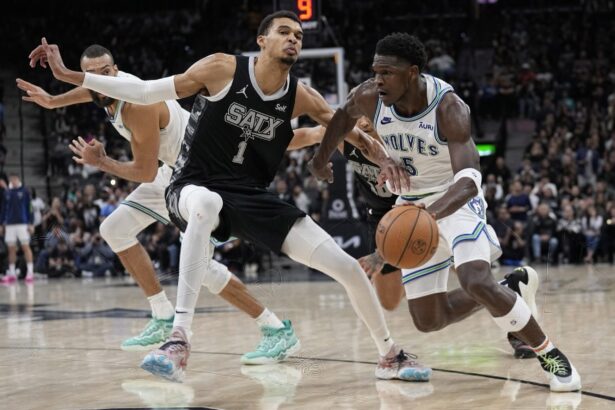
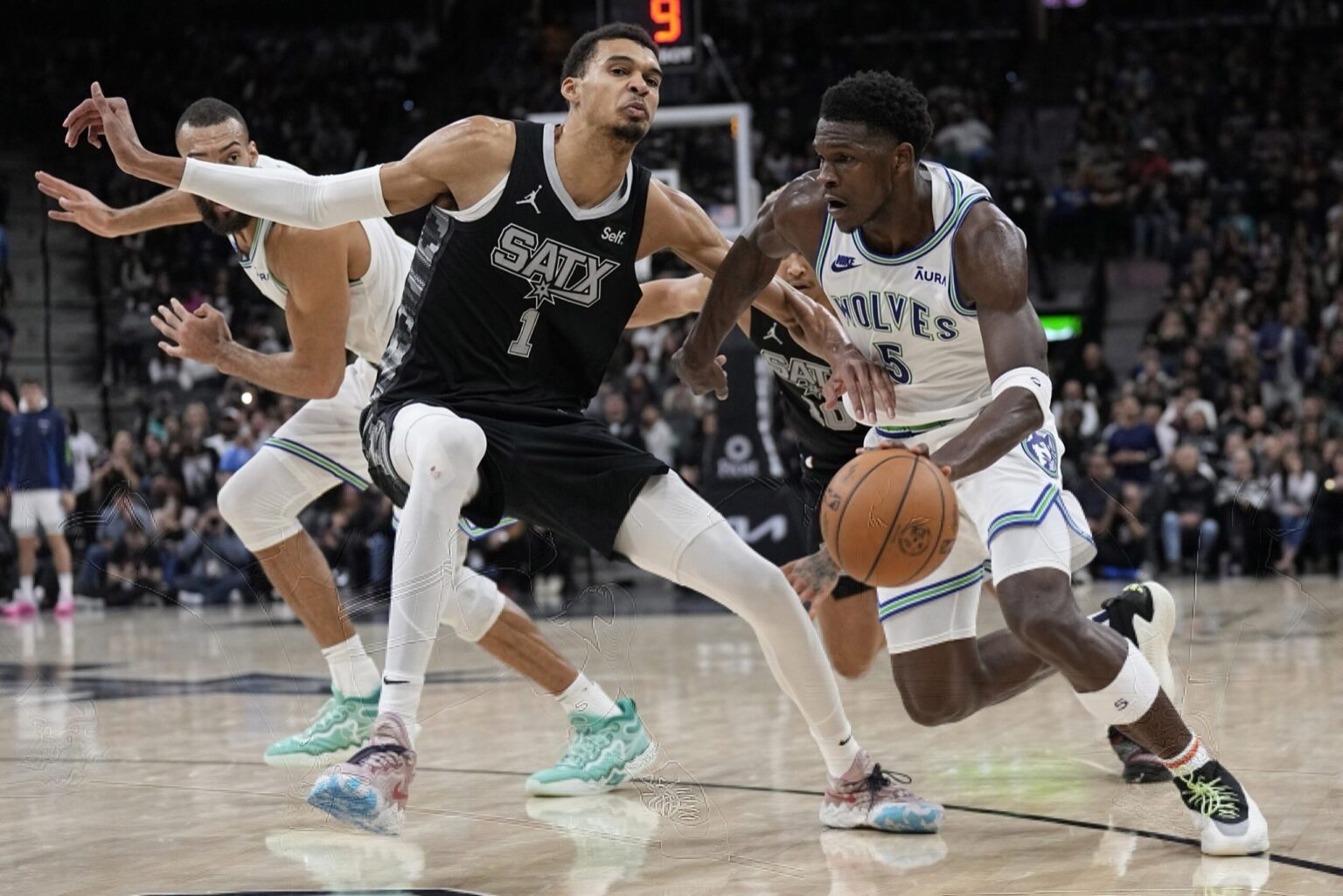
The Spurs had chances to win. They led by three after the third quarter. Victor Wembanyama finished with 11 points, 15 rebounds, and 12 blocks, setting a single-game NBA playoff record for blocks since the stat became official in 1973-74. Dylan Harper scored 18 points, while Stephon Castle and Julian Champagnie each scored 17. But the Spurs shot 10-for-36 from three, and Champagnie missed a potential winning 3-pointer at the buzzer.
The Timberwolves did not solve every problem. Wembanyama controlled the rim. The Spurs scored 58 points in the paint. The Timberwolves shot only 12-for-21 at the line. Their final minute also included an inbounds turnover that almost gave the game away. But the important point is this: they won a road playoff game while still leaving several areas open for correction.
That is why this series should not be treated as a simple case of the higher seed correcting itself. The Timberwolves have a defensive foundation, more playoff experience, and one perimeter scorer who can change the game in the fourth quarter. Game 1 showed a route to four wins.
They Can Go As Far As Anthony Edwards Takes Them
Anthony Edwards’ return was the main variable in Game 1. He was not at full physical capacity. He did not play his normal minutes. He did not attack with the same constant vertical force. That was expected.
Still, the Timberwolves needed him. Not only for scoring, but for structure. The Spurs are built to make half-court possessions difficult. They have length on the ball, Wembanyama behind the play and several wings who can shrink space. Without Edwards, too many Timberwolves possessions would have depended on Randle creating against a loaded defense or Mike Conley trying to organize late-clock offense. Edwards gave them a direct pressure point.
The number that defines his night is not 18. It is 11. Edwards scored 11 of the Timberwolves’ first 19 points in the fourth quarter. That stretch changed the game because it stopped the Spurs from defending only the first action. The Spurs had led by three after three quarters, but Edwards’ fourth-quarter shot creation forced them into more urgent help decisions. The Timberwolves later used a 7-0 run, capped by a Conley 3-pointer with 4:42 left, to take a 95-86 lead.
The value was clear. Edwards did not need to dominate the ball every trip. He needed to make the Spurs account for a real downhill threat. When he was involved in the action, the Spurs could not sit Wembanyama in one place and allow the guard defender to chase from behind. Edwards’ first step, even below full speed, forced the nail defender to help earlier. That opened pockets for kickouts, short rolls, and second-side decisions.
The Timberwolves used Edwards more as a controlled offensive tool than as a full-time engine. That was the right approach after the injury. He started possessions from the wing, exploded after movement, attacked a closeout, or operated against a tilted floor. The Timberwolves did not need him to run every possession at high usage. They needed his scoring threat to remove predictability from the offense.
That detail is important for the rest of the series. The Spurs can prepare for Randle isolations. They can close passing windows to force Rudy Gobert into turnovers. They can pressure Conley higher and trust Wembanyama to erase mistakes. Edwards is harder to reduce because he can attack before the defense is fully set. He is the Timberwolves’ answer when the Spurs push the game into a slow, physical half-court environment.
There was also visible restraint in Edwards’ game. That was not a weakness. It was necessary. He did not force the issue early. He came off the bench, stayed within the offense, and waited for the game to give him openings. That is a useful sign for the Timberwolves because a reckless Edwards would have made the offense easier for Wembanyama to read.
There were mistakes. The late inbounds turnover was the main one. With the Timberwolves up 104-100, Edwards’ pass was stolen by Devin Vassell, leading to a Harper layup with 30.9 seconds left.
But the broader point remains positive for the Timberwolves. Edwards can play better. He can handle more minutes if the knee responds. He can get downhill earlier in the clock. He can get to the free-throw line more often. He can make better late-game decisions. Game 1 was not his ceiling. It was a limited version of his offensive value.
That matters because the Timberwolves do not need to win this series with offensive volume alone. They need a player who can stabilize difficult possessions. Edwards is that player. Randle can score. Conley can manage. Reid can space. McDaniels can attack cuts and mismatches. But Edwards is the only Timberwolves player who forces the Spurs to change their defensive scheme.
This is where the series can move. If Edwards becomes more explosive by Game 2 or Game 3, the Spurs will have to decide whether to pressure him higher, switch more often, or send help earlier. Each option creates a different weakness. Pressure opens slips and short rolls. Switching gives Randle and Edwards matchups they can attack. Early help leaves shooters and cutters available. The Timberwolves do not need to solve Wembanyama completely if Edwards keeps forcing the Spurs into rotations before Wembanyama can set his feet.
That is the offensive case for the upset. The Spurs have the best defensive player in the series. The Timberwolves have the best late-game perimeter creator. In Game 1, the perimeter creator was limited and still changed the fourth quarter. If that version improves, the matchup becomes much closer than the seed line suggests.
Found The Antidote For The Alien?
The Timberwolves did not stop Victor Wembanyama in Game 1. They made his offense inefficient, static, and more perimeter-based than the Spurs wanted.
That is the real defensive win. Wembanyama finished with 11 points, 15 rebounds, five assists, three turnovers, and 12 blocks in 39:52. The offensive line was far below his regular-season level: 5-for-17 from the field, 0-for-8 from three, and 1-for-2 from the line. That gave him a 29.4% effective field goal rate and a 30.8% true shooting rate. During the regular season, he averaged 25.0 points on 51.2% from the field and 62.6% true shooting. That gap is the whole story.
The Timberwolves forced Wembanyama into the wrong shot mix. Almost half of his attempts came from three: eight of his 17 shots, or 47.1%. In the regular season, his three-point attempt rate was around 32.4%. That means the Timberwolves pushed him into a diet that was much more perimeter-heavy than usual. He went 5-for-9 inside the arc, but only 0-for-8 outside it. For the Wolves, that was an acceptable trade-off. They did not need to remove every paint touch. They needed to keep enough possessions away from seals, rolls, offensive rebounds, and short finishes.
The low free-throw number was just as important. Wembanyama had only two free-throw attempts in almost 40 minutes. His free-throw rate was 11.8%, while the regular-season rate was 41.7%. That is a major defensive statistic. The Timberwolves were physical without giving him repeated trips to the line. They hit him early, pushed him off spots, and contested without turning the game into free points.
The Timberwolves contested 14 of Wembanyama’s 17 field-goal attempts, or 82.4%. He shot 5-for-14 on those contested attempts, which is 35.7%. He did not punish the three uncontested attempts either. They were body contests before the catch, lower-body contact on the gather, and length behind the first defender.
The defense began before the pass. Rudy Gobert took most of the early physical work. His job was not to meet Wembanyama at the top of the release. That is too late. His job was to keep him from catching with two feet inside the paint. Gobert used his base to push Wembanyama higher, delay his seals, and make him receive the ball from less dangerous spots. When Wembanyama caught the ball away from the paint, the Timberwolves could stay at home longer and avoid emergency rotations.
That part is visible in the Spurs’ broader offensive struggles. The Spurs still shot 44.8% from the field, but they went 10-for-36 from three, only 27.8%. Wembanyama and De’Aaron Fox were the biggest drag there, combining to go 0-for-12 from deep. The Timberwolves made the Spurs’ two primary offensive players inefficient at the same time. Wembanyama had 11 points on 17 shots. Fox had 10 points on 14 shots with six turnovers. That is 21 points on 31 shots and six Fox turnovers from the two players who should organize the offense.
That is why the point-of-attack defense was part of the Wembanyama coverage. The Timberwolves did not only guard Wembanyama after the catch. They cut off the passes that usually give him better catches. If Fox turns the corner, Wembanyama becomes a lob target, short-roll passer, trailer, or deep-seal option. Fox had six assists, but he also had six turnovers and finished minus-13. The Timberwolves were physical and guarded the ball well, especially in direct actions with Jaden McDaniels chasing and affecting shots at the rim, as Gobert was tasked with sealing Wembanyama away and staying attached to him after a screen.
Julius Randle’s second-half work was one of the strongest defensive details. On the 24 possessions that ended with Randle as the final defender, the Spurs produced only 0.73 points per chance. That is far below their total Game 1 efficiency, which was about 1.07 points per estimated possession. The Spurs shot 5-for-16 in those Randle-defended sequences, only 31.3%, with three turnovers. Wembanyama himself went 0-for-2 with one turnover when Randle was the main defender.
That matchup worked because Randle defended Wembanyama’s base, not his release. Randle has the strength to get into Wembanyama’s lower body and move him before the shot. Against Wembanyama, the late contest is often cosmetic. The real defense is forcing the catch one step wider, pushing the dribble one step higher, and making the gather happen from a worse angle. Randle did that well enough to make Wembanyama pause. Once Wembanyama paused, the Timberwolves could load the floor.
Jaden McDaniels also mattered as a helper. He was not the main Wembanyama defender, but his length allowed the Timberwolves to stunt without fully committing. Smaller help defenders often do not change Wembanyama’s view. McDaniels can at least bother the passing lane and still recover. That is why the Wolves could cloud Wembanyama without making the defense collapse. The Spurs had 24 assists, but those assists did not translate into efficient shooting because many possessions ended with rushed threes or late-clock decisions.
The final defensive lesson is simple. The Timberwolves did not neutralize Wembanyama as a player. His 12 blocks say that clearly. They neutralized his offensive efficiency. They pushed him into a 47.1% three-point attempt rate, held him to a 30.8% true shooting rate, limited him to two free throws, contested 82.4% of his shots, and forced enough static catches that his scoring never matched his defensive impact.
The Spurs will adjust. They will try to get Wembanyama moving before the catch, use more Fox-Wembanyama actions and create earlier seals. But Game 1 gave the Timberwolves a real defensive base. They do not need to erase him. They need to keep turning his offensive possessions into low-efficiency shots, low free-throw volume, and delayed decisions.
Putting The Pressure On The Young Spurs Core
The Timberwolves did not shut down the Spurs’ young perimeter group completely. Dylan Harper, Stephon Castle, Devin Vassell, and Julian Champagnie combined for 66 of the Spurs’ 102 points. They shot 23-for-44 from the field and 10-for-22 from three. The problem was not that they missed everything. The problem was that the Timberwolves forced them to carry too much of the offense in a game that became physical, rushed, and unstable.
That is the key to the Spurs’ 10-for-36 night from three. Harper, Castle, Vassell and Champagnie made all 10 of the Spurs’ threes. The rest of the roster went 0-for-14. The Timberwolves did not simply force bad shooting. They made the Spurs depend almost entirely on young perimeter players to create spacing and offense. That is a dangerous burden in a second-round game.
Castle was the clearest example. He had 17 points, five rebounds, and five assists, but he fouled out in 28 minutes. The Timberwolves made him defend through contact, fight over screens, and still handle offensive responsibility. That is a heavy role for a young guard. His production was real, but so was the pressure. Once he fouled out with 3:20 left, the Spurs lost one of their better two-way options for the closing possessions.
Harper handled the moment well for a rookie. He scored 18 points on 7-for-13 shooting and had four assists with no turnovers. Still, the Timberwolves made his late possessions difficult. He scored only two points in the fourth quarter and missed two driving layups in the final minutes. His steal-and-layup sequence late was excellent, but it came from a Timberwolves mistake, not from the Spurs consistently creating in the half-court.
Vassell and Champagnie also gave the Spurs important shot-making, but neither fully controlled the game. Vassell scored 14 points and hit three 3-pointers, yet he took only 11 shots in more than 36 minutes. Champagnie had 17 points and seven rebounds, including late putbacks, but much of his impact came from broken plays and second chances. That kept the Spurs alive, but it was not stable offense.
This is where the Timberwolves’ defensive pressure showed up. They made the young Spurs players score through contact, play late in the clock and take on larger roles because Wembanyama and De’Aaron Fox were inefficient. Harper, Castle, Vassell, and Champagnie were good enough to make the game close. They were not good enough to control it.
That is a formula the Timberwolves can repeat. They do not need every young Spurs player to fail. They need to make them play fast, defend with fouls on their minds, and carry offensive weight under pressure. In Game 1, that was enough to turn a talented young core into a group still learning how to close this kind of series.
Final Thoughts
The Timberwolves’ Game 1 win was important because it gave the series a different tactical starting point. The Spurs still have the higher seed, home-court, and the most difficult matchup in Victor Wembanyama. But the Timberwolves proved they can make the game uncomfortable enough to reduce those advantages.
The main point is not that the Timberwolves found a perfect answer. They did not. Wembanyama had 12 blocks. The Spurs scored 58 points in the paint. The Timberwolves missed 50 field goals. There were several possessions where the offense looked blocked by size and length. Still, the Timberwolves won because they controlled the game’s pressure points better than the Spurs did.
The Timberwolves also showed they do not need Edwards at peak level to compete. That is the biggest warning sign for the Spurs. Edwards scored 18 points in 25 minutes, and he was still the player who changed the fourth quarter. If his knee responds well and his minutes increase, the Spurs will have to send more attention toward him. That could open better looks for Randle, McDaniels, Reid, and Conley.
The Spurs will adjust. They should use Wembanyama closer to the rim with elbow screens, dives, and run more direct actions with Fox, before Gobert and Randle can set their position attached to Wembanyama. They should also shoot better than 27.8% from three. Game 1 does not mean the Timberwolves control the series.
But it does show the series can be played on their terms: physical, slow, contested, and decided late. That is where their experience has real value. If the Timberwolves keep the Spurs out of easy rhythm and Edwards gets healthier, this is no longer just a stolen road game. It is a real path to the Conference Finals.