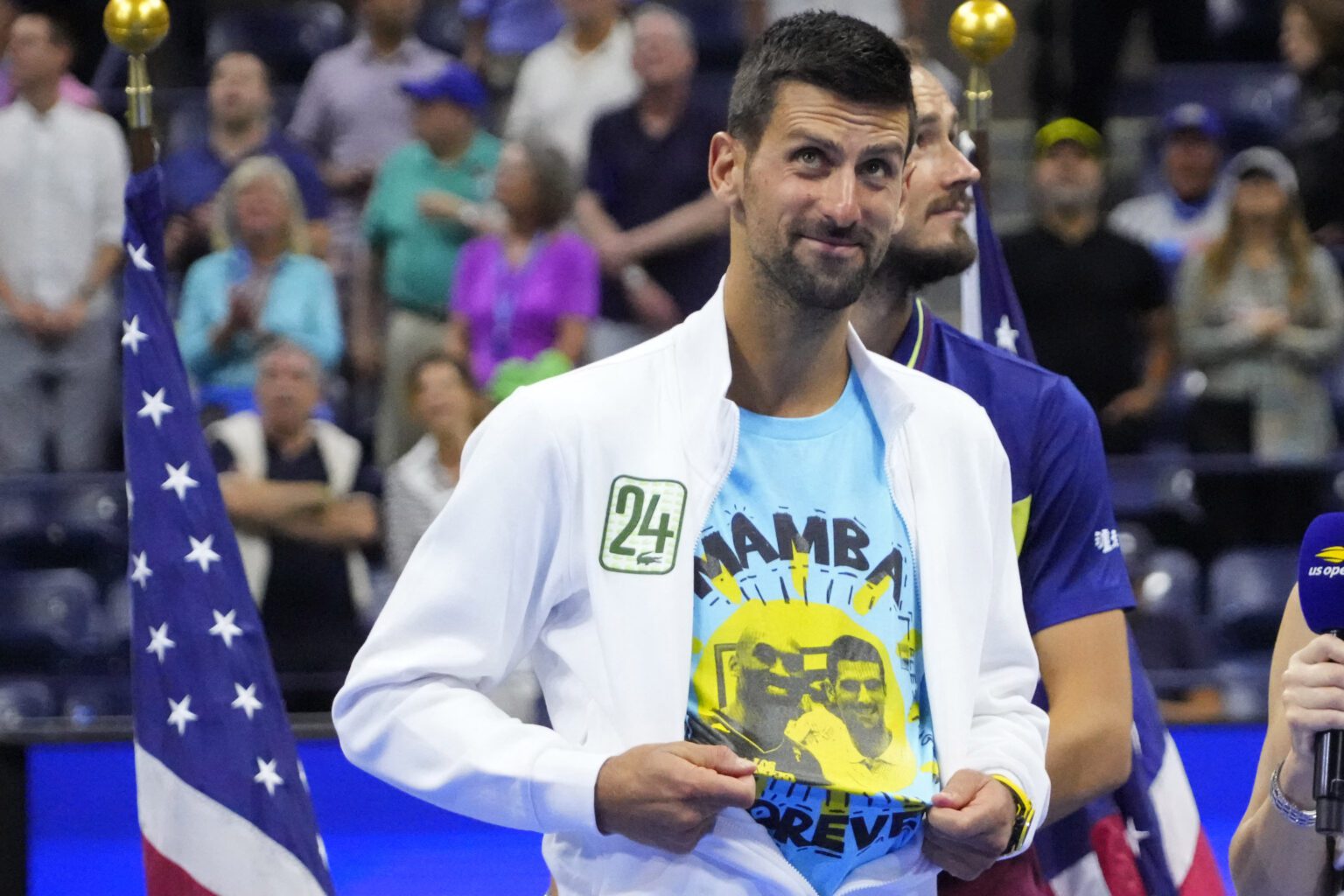
Novak Djokovic revealed how advice from Kobe Bryant helped reshape the way he dealt with failure during one of the toughest periods of his tennis career.
Speaking on the On Purpose podcast, Djokovic reflected on the period after winning his first Grand Slam at the 2008 Australian Open. Despite being one of the best players in the world, he went through a rough stretch at Grand Slam tournaments without winning another major.
“I had a three-year period. I didn’t win a Slam. I was winning some big tournaments, but I couldn’t win a Slam. These two guys were beating me in every big match, Federer and Nadal. I changed rackets, you know, team members. I did everything I can to kind of find the right formula. And I was struggling physically as well.”
“I wasn’t, you know, that’s where I actually, I had my transformative journey, nutrition-wise, where I took out the gluten and dairy products and refined sugar. Up to that point, I was eating all of these things thinking, well, I’m eating relatively healthy. I mean, relatively healthy. I thought, you know, that’s what I know.”
“But then, you know, when I started working with this doctor and he pointed out, you know, if you have strong gluten intolerance, it messes up with your gut. You got to take that out. You got to take out the dairy product because that creates a lot of inflammation in your body. You might be able to eat it later on, but not now. And refined sugar, absolutely no. So that was a huge change, but I committed to it. And then I felt that affected me.”
“In fact, my mental clarity, my recovery was much better. My decision-making on the court was better, et cetera. So that helped a lot. And of course, mentally as well, I was working on certain programs that I had from, you know, that were kind of not really very positive and not really serving the purpose on the court of winning a match. So that year, 2010, 2011, is when I experienced a huge boost of energy and transformation.”
“And that changed an unbeaten run of 40-plus matches and had three Slams and became number one and had one of the best seasons of my life. And that’s where everything started going in the upwards direction for me. And learning also from these guys and the matches that we’ve played against each other was something that was extremely important for me at the time. I was, of course, trying to consume as much as I can, this energy of the center court and everything.”
“And it was overwhelming at times, but I was also very thorough in my analysis of the matches afterwards, even though I don’t necessarily like to watch matches that I lost. But, you know, Kobe Bryant used to talk about this a lot. And when I was talking to him personally about that, he would, because I told him, ‘Kobe, I really don’t like, you know, watching myself perform bad or when I lost. And it just gives me these cramps in my stomach, and I don’t like it.'”
“And he said, ‘Even if it’s just specific intervals of the match that you lost that you want to watch, that you definitely look at that and you need to analyze that. And you need to go through that cramping feeling because that’s where you learn from those mistakes. And that’s where you have an opportunity to rectify that for the next tournament or next match and so forth.'”
Roger Federer and Rafael Nadal repeatedly stood in his way, and Djokovic admitted he was searching everywhere for answers.
Djokovic experimented with equipment, changed members of his team, and completely changed his nutrition. He removed gluten, dairy products, and refined sugar from his diet after working with a doctor who believed that these foods were leading to inflammation and physical issues.
That changed his health, but Djokovic was also trying to improve mentally. And that is where Kobe’s advice became so important.
Djokovic admitted that he hated watching matches he lost because seeing poor performances made him physically sick. But Bryant urged Djokovic to push through. Rather than avoiding these moments that hurt, his approach was to study them until they became useful.
For Djokovic, this meant deliberately revisiting matches, understanding what happened, and using them to prepare for the next tournament.
And that transformation soon became very obvious.
After failing to win another major between the 2008 Australian Open and the end of 2010, Djokovic exploded in 2011. He began the year with an unbeaten run of 40 matches, won three Grand Slam titles, and became world number one.
And that season changed the direction of his career.
Djokovic accumulated 24 Grand Slam titles, the most in men’s tennis history, turning what looked like an era dominated by Nadal and Federer into a three-way battle for historical dominance.
Interestingly, Djokovic now finds himself in another Grand Slam drought. He has not won a major since the 2023 US Open, although he has remained competitive deep into tournaments, reaching two finals and six semifinals since then.
And that makes Kobe’s lessons relevant again.
Djokovic’s career has repeatedly been built around adapting, whether it’s changing his diet, studying Federer and Nadal, or forcing himself to watch tough losses. His biggest improvements have often come from facing the problems rather than ignoring them.
And Kobe gave him a simple framework for doing exactly that: don’t look away from failure, study it.