The Pistons finished 60-22, claimed the No. 1 seed, and looked ahead of schedule all season, but Cleveland eliminated them in seven games in the second round. That series exposed the real problem: Cade Cunningham needs another superstar scorer next to him if Detroit wants to turn a great regular season into a Finals run.
Jalen Duren’s postseason complicated things further. He made the All-Star team, earned All-NBA Third Team honors, and averaged 19.5 points and 10.5 rebounds across 70 regular-season games, production that qualified him for a five-year, $287.1 million extension. Then he dropped to 10.2 points and 8.5 rebounds across 14 playoff games, and while camp reportedly sought around $40.0 million annually, Detroit’s offer landed well below that, putting his eventual deal closer to $200.0 million to $210.0 million rather than the full max.
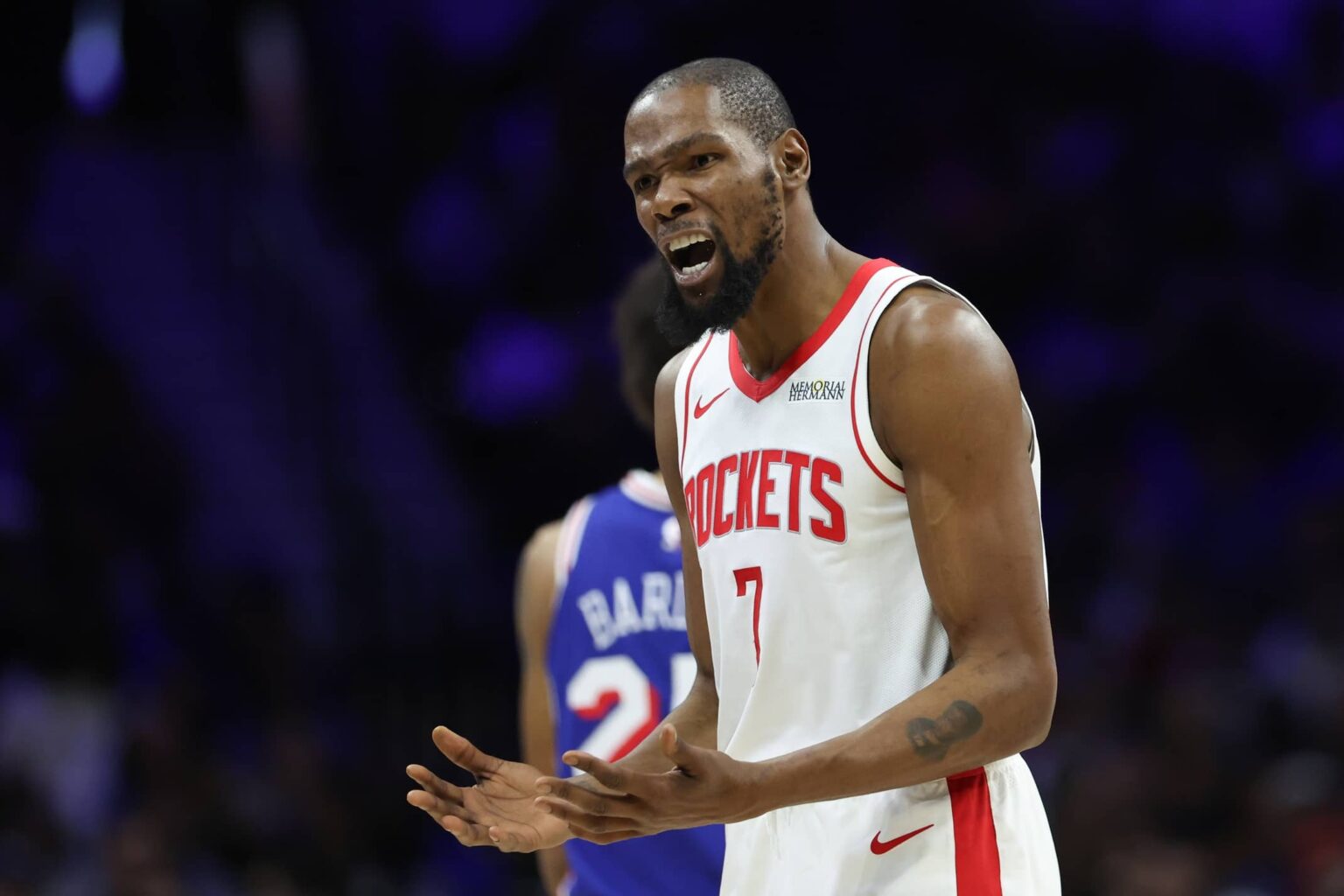
Duren still matters, especially with Isaiah Stewart already traded and center depth thinning out, but the playoffs showed he can’t be the second primary scorer. That’s where Kevin Durant enters the picture. Durant put up 26.0 points, 5.5 rebounds, and 4.1 assists in his debut season with the Rockets, and at 37, he remains one of the most efficient half-court scorers in the league.
Year one of the Durant experiment fell short for the Rockets, who went 52-30, took the No. 5 seed in the West, and lost to the Lakers in six games in the first round. Durant played just one game in that series before an ankle sprain ended his postseason. Houston still has Alperen Sengun, Amen Thompson, Jabari Smith Jr., Tari Eason and Reed Sheppard, so their timeline was never built around a 38-year-old Durant staying healthy through four rounds.
Brett Siegel reported Houston doesn’t view Durant as untouchable, and league chatter suggests Durant has a real interest in playing alongside Cunningham. Given the likely tension following the alleged burner account controversy, the front office could prefer a younger return that might fit the Sengun-Thompson-Smith timeline better.
A bigger version of this idea already existed. Siegel reported Detroit, Houston, and Boston had discussed a multi-team deal sending Durant to the Pistons, Sengun to the Celtics, and Jaylen Brown to the Rockets. That version is dead now that Brown already landed in Philadelphia, but it confirms Detroit’s real interest in Durant and Houston’s willingness to entertain sweeping trades involving him.
That’s where a four-team framework comes in. It’s messy and expensive, but Detroit is too good to wait, Houston is too young to stay boxed into a short Durant window, and this would shake an already chaotic offseason even harder.
The Trade Framework
Detroit Pistons Receive: Kevin Durant
Houston Rockets Receive: Trey Murphy III, Ron Holland II, 2033 first-round pick via Pistons
New Orleans Pelicans Receive: Caris LeVert, Marcus Sasser, 2029 first-round pick via Pistons, 2031 first-round pick via Pistons, 2030 first-round pick via Rockets
Brooklyn Nets Receive: Duncan Robinson, 2032 second-round pick via Pistons
The money is what makes this framework possible in the first place. Durant is set to make $43.9 million in 2026-27 after signing his two-year, $90.0 million extension with Houston. Detroit would send out Robinson at $16.0 million, LeVert at $14.8 million, Holland at $9.1 million, and Sasser around $5.2 million, putting the Pistons at roughly $45.1 million outgoing, enough to match Durant’s salary under standard over-the-cap rules. That number is massive, but Detroit doesn’t need to touch Cunningham or Duren to get there. That’s the entire point.
Houston moves out Durant’s $43.9 million and takes back Murphy at $27.0 million plus Holland at $9.1 million, bringing in about $36.1 million total. That lowers their payroll while adding a 26-year-old wing scorer and a 21-year-old former top-five pick. New Orleans sends out Murphy’s $27.0 million and takes back LeVert and Sasser, roughly $20.0 million combined, while landing three first-round picks. Brooklyn is the salary-relief team, absorbing Robinson’s $16.0 million for a single second-round pick. Robinson’s 2026-27 salary carries only $2.0 million guaranteed before his guarantee date, so the Nets aren’t taking on any real long-term risk.
This framework is aggressive, but nothing about it is random. Detroit pays the superstar price without losing Duren. Houston gets younger. New Orleans gets the three-first-round-pick value Michael Scotto reported as the going rate for Murphy. Brooklyn gets paid to absorb short-term salary. That’s what makes a four-team structure like this actually work.
The Pistons Finally Land The Superstar Scorer Cade Needed
The Pistons make this move because the front office finally understands the real problem. A 60-22 season and the No. 1 seed in the East proved this roster is legitimate, but the second-round loss to Cleveland exposed the ceiling. Cunningham can be the primary engine, but Detroit needed another elite half-court scorer for when playoff defenses started loading up on him. Durant solves that immediately.
Durant averaged 26.0 points, 5.5 rebounds, and 4.1 assists in his first season in Houston. His playoffs ended badly because of a left ankle injury, not because the scoring ability disappeared. Detroit would essentially be betting on skill over athletic prime. Durant, at 38, remains one of the most efficient scorers the league has ever seen. He doesn’t need 20 dribbles, doesn’t clog Cunningham’s space, and doesn’t need to be the only creator on the floor.
The most important part is that Detroit keeps Jalen Duren in this deal. Duren’s playoff collapse was rough following a regular season of 19.5 points and 10.5 rebounds, and his leverage shifted hard from max-extension territory to a far more complicated restricted free agency. But Detroit already traded Isaiah Stewart, so moving Duren too would leave the center spot completely empty, which makes no sense right after adding Durant.
The new core becomes Cunningham, Durant, Ausar Thompson, John Collins, and Duren. That’s bigger, better spaced, and considerably more playoff-ready. Detroit gives up Holland, Sasser, Robinson, LeVert, three first-round picks, and a second-round pick to get there. That’s a steep price, but it’s what adding a player like Durant costs without touching Cunningham or Duren. This is the rare superstar trade that doesn’t break up a young core. It only accelerates it.
Houston Turns A Short KD Window Into A Younger Wing Core
Houston isn’t making this trade because Durant is washed. That would be a bad read on his season. They’re making it because the timeline shifted quickly. The Rockets finished 52-30 and lost to the Lakers in six games. Durant barely played in that series because of the ankle injury, and that instantly made the whole experiment feel fragile.
The reporting already opened this door. All the trade chatter doesn’t mean Houston is desperate to trade him, but the front office is at least willing to ask whether a younger return fits better than running back another season of this exact build given what they went through.
Trey Murphy III is what makes this return work for Houston. He’s not Durant, but he’s 26, locked into a four-year, $112.0 million contract with a $27.0 million salary in 2026-27, and his size-shooting combination fits perfectly alongside Sengun and Amen Thompson. Murphy averaged 21.1 points, 6.5 rebounds, and 3.5 assists this past season, and even coming off a shooting dip by his own standards at 37.9% from deep (38.2% for his career), he still plays as a high-level modern wing.
Ron Holland is the secondary bet in this deal. He’s raw, but he gives Houston another young, athletic body with real defensive upside. Add the 2033 Pistons’ first-round pick, and the Rockets walk away with Murphy, Holland, a lighter payroll, and another future asset. It’s not a perfect return for a player of Durant’s caliber, but Durant is 38 and already dealt with an injury-shortened playoff run in Houston.
The Pelicans Finally Get The Murphy Price They Wanted
No doubt about it, the Pelicans make this whole trade expensive, and rightfully so. Murphy shouldn’t be moved for a discount package. He’s 26, under contract through 2028-29, and plays exactly the position every contender covets. If the Pelicans move Murphy, they need to walk away with the reported three-first-round-pick price tag. Anything less makes the return look weak.
Michael Scotto reported that New Orleans lowered its asking price from the equivalent of four first-round picks down to three in Murphy discussions. This framework delivers exactly that: a 2029 first-rounder via Detroit, a 2031 first-rounder via Detroit, and a 2030 first-rounder via Houston. The players involved aren’t really the point here. The picks are the entire return.
LeVert gives New Orleans a veteran guard-wing who can score, handle secondary ball-handling duties, and either contribute now or get moved again later. He’s making $14.8 million in 2026-27 following his two-year deal with Detroit. Sasser is the cheaper guard added to the deal, having averaged 5.2 points in limited minutes last season, and his shooting and manageable $5.2 million salary make him a trade candidate. New Orleans could use him as bench scoring or simply flip him elsewhere down the line.
This trade would essentially be the Pelicans admitting the Murphy price finally got too good to pass up. With Zion Williamson, Jordan Poole, Dejounte Murray, Herb Jones, Derik Queen, Jeremiah Fears and Yves Missi already in this roster, turning one expensive wing into three first-round picks and two rotation-caliber contracts adds flexibility for a rebuild. It clearly hurts the present. But if Murphy’s actual market really is three first-rounders, this is the kind of return that justifies moving him.
The Nets Get A Second-Round Pick With Short-Term Money
Brooklyn isn’t the headline team in this deal, but they are needed because Detroit’s outgoing salary has to land somewhere. Duncan Robinson is the easiest of Detroit’s contracts to move off because he’s owed $16.0 million in 2026-27, but only $2.0 million of that is guaranteed. That makes him far more valuable as a cap-management tool than as any kind of long-term financial burden. The Nets absorb him, pick up a 2032 second-round pick from Detroit, and preserve future flexibility.
This is exactly the type of low-cost move a rebuilding team should be making constantly. The Nets finished 20-62 last season and started to make moves to at least be competitive a bit. Robinson can still shoot at a high level, so this isn’t dead money on the roster. He averaged 11.0 points, 2.6 rebounds, and 2.4 assists last season, and his entire value is tied to his ability to space the floor.
There’s also a practical upside worth mentioning. If Robinson plays well in Brooklyn, they can simply keep him around as a floor-spacer next to Michael Porter Jr., Julius Randle, Keon Ellis and their younger guards. If he doesn’t work out, they can absorb his final year and avoid any lasting financial damage. That’s why this works as a low-risk role for a fourth team in a deal this large.
Brooklyn doesn’t need to be greedy in this scenario. They aren’t giving up a rotation player or a first-round pick of their own. They’re simply taking on salary that Detroit needs off its books to make the Durant trade function. One second-round pick is fair compensation, since Robinson isn’t a toxic contract, even if he’s not someone Brooklyn necessarily needed either.