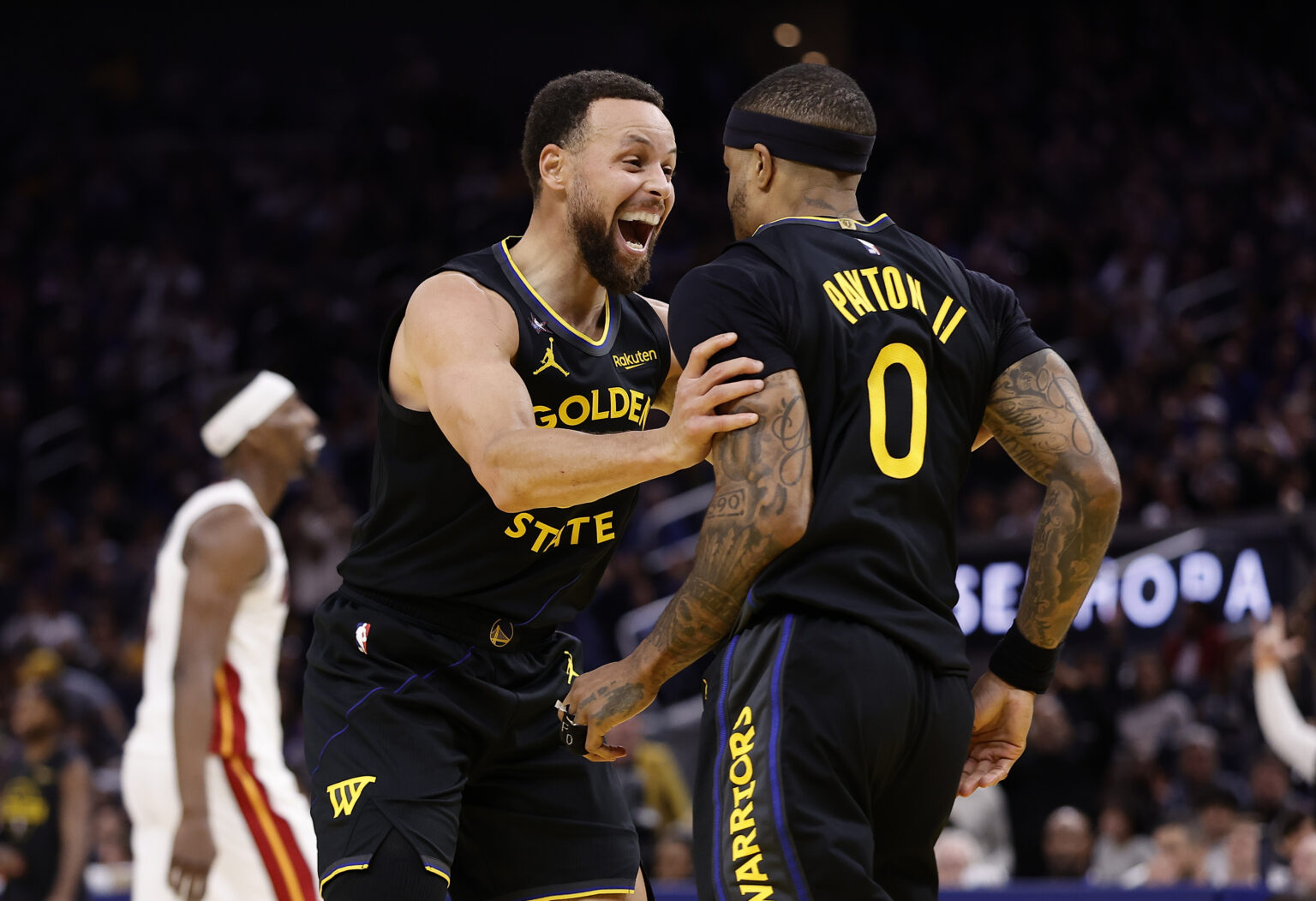
Golden State continues to look more comfortable by the night, and Monday’s win over Miami may have been its most convincing yet. The Warriors poured in 135 points, shot the lights out from deep, and pulled away steadily to secure a 135-112 victory over the Heat for their fourth straight win. What began as a highly anticipated matchup quickly tilted in Golden State’s favor as ball movement, pace, and shooting overwhelmed Miami.
The storyline shifted abruptly when Jimmy Butler, facing his former team, was forced to leave early due to injury. Butler’s exit changed the tone of the game, but the Warriors had already established control. Golden State finished at 51.6% from the field and an elite 47.1% from three, while Miami struggled to keep pace offensively despite winning the rebounding battle.
1. Golden State’s Shooting Turned The Game One-Sided
The Warriors put on a perimeter clinic, knocking down 24 three-pointers on 51 attempts. Stephen Curry led the way with five triples and finished with 19 points and 11 assists, consistently bending Miami’s defense and creating clean looks for teammates. Golden State’s spacing forced the Heat into rotation after rotation, and the ball rarely stuck.
That shooting advantage told the entire story. Miami went just 13-of-45 from beyond the arc, while Golden State outscored them by 33 points from three alone. Even when Miami briefly cut into the lead, the Warriors answered immediately with timely jumpers that halted any momentum before it could build.
2. Butler’s Injury Shifted The Momentum
Jimmy Butler showed flashes of aggression before leaving the game, posting 17 points, four assists, and two steals in just 21 minutes. He attacked the rim, drew contact, and gave Miami a sense of structure early. Once Butler exited, the Heat struggled to generate consistent offense or defensive resistance on the perimeter.
Miami never fully recovered from the loss. Without Butler to anchor their half-court sets, the Heat leaned heavily on jump shooting and transition looks. The result was a disjointed attack that produced 19 turnovers and allowed Golden State to dictate tempo for most of the night.
3. Depth And Ball Movement Powered The Warriors
Golden State’s bench was relentless, combining for 72 points and consistently extending the lead. Brandin Podziemski delivered a spark with 24 points on 9-of-19 shooting, while Buddy Hield added 16 points and knocked down four threes in rhythm. Al Horford chipped in with 10 points and eight rebounds, anchoring lineups that dominated the plus-minus column.
The Warriors finished with 38 assists on 49 made field goals, a clear reflection of their unselfish approach. Multiple players finished with at least seven assists, and the offense flowed effortlessly from one side of the floor to the other. Miami simply couldn’t keep up with the constant motion.
4. Miami’s Interior Effort Wasn’t Enough
The Heat did some things well, particularly on the glass. They grabbed 20 offensive rebounds and finished with a 54-46 edge overall, with Bam Adebayo pulling down 12 boards. However, those extra possessions didn’t translate into enough points, largely due to poor shooting nights from key contributors.
Adebayo struggled mightily offensively, finishing with just four points on 1-of-13 shooting. While Norman Powell scored 21 and Andrew Wiggins added 18, Miami couldn’t find consistent scoring elsewhere. The Heat shot just 39.4% from the field, and once Golden State built a double-digit lead, the gap only widened as the game wore on.