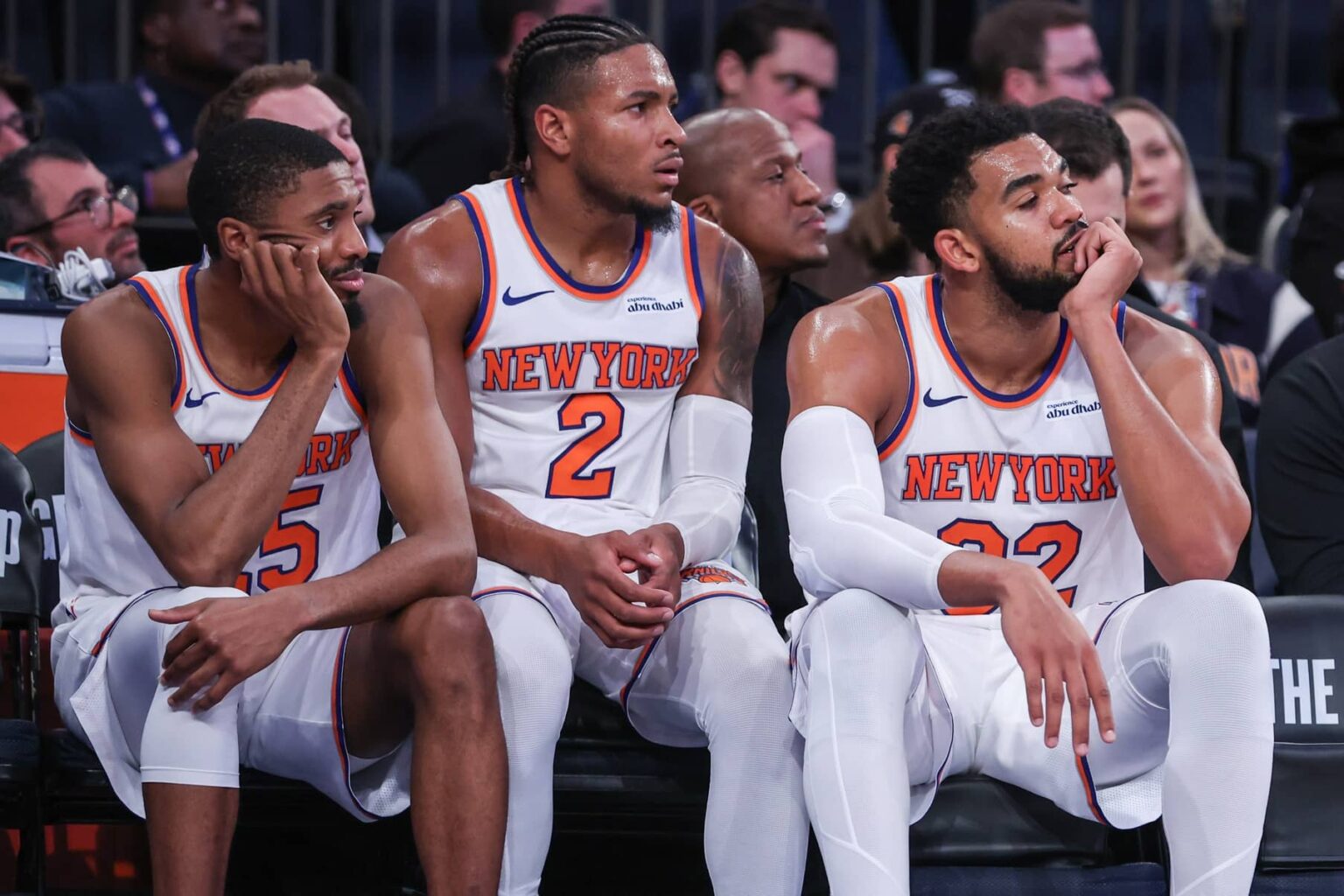
The New York Knicks sit second in the Eastern Conference with a 30–18 record and are riding a five-game winning streak, yet behind the surface success, uncertainty is quietly growing. According to James L. Edwards III of The Athletic, two of the Knicks’ biggest trade chips, Mikal Bridges and Karl-Anthony Towns, are no longer viewed around the league with the same value they once carried. That shift matters, especially with New York continuing to circle around Giannis Antetokounmpo.
Per Edwards, the Knicks remain one of several teams aggressively monitoring Giannis’ situation. The problem is structural. Milwaukee wants premier young players and multiple high-quality draft picks. New York does not have either in abundance.
To even approach the Bucks’ asking price, the Knicks would likely need to include two or three starters, most realistically OG Anunoby, Bridges, and or Towns. League sources believe Bridges and Towns simply do not command the same return today as they did when the Knicks acquired them, making an already difficult trade even harder to construct.
Towns’ situation is the most complicated. He arrived in New York during the 2024 offseason in a three-team trade that sent Julius Randle, Donte DiVincenzo, Keita Bates-Diop, a first-round pick, and two second-round picks out of the door. In his first season with the Knicks, Towns justified the gamble, averaging 24.4 points, 12.8 rebounds, and 3.1 assists while shooting 52.6% from the field and 42.0% from three.
This season has been a step back. His numbers have dipped to 20.0 points, 11.8 rebounds, and 2.9 assists, with efficiency sliding to 46.1% from the field and 36.1% from deep.
That decline would be easier to stomach if Towns’ contract were lighter. Instead, he is in year two of a four-year, $220 million deal and is making $53.1 million this season alone. Around the league, that combination of a massive salary and declining production has cooled enthusiasm. There are also rumblings that Towns has grown frustrated with persistent Giannis trade rumors, adding another layer of tension.
Bridges’ case is different but no less concerning. The Knicks paid a staggering price to acquire him in the 2024 offseason, sending out Bojan Bogdanovic, Shake Milton, Mamadi Diakite, four unprotected first-round picks, an additional protected first, an unprotected pick swap, and a second-rounder.
That deal effectively emptied New York’s draft cupboard. At the moment, the Knicks only have one tradable first-round pick, three pick swaps, and six second-rounders available.
On the court, Bridges has been solid. In his first season with New York, he averaged 17.6 points, 3.2 rebounds, and 3.7 assists on 50.0% shooting from the field and 35.4% from three-point range. This year, his scoring has dipped to 15.9 points, though his efficiency has improved to 50.2% from the field and 39.8% from three.
He is also entering a sensitive contract phase. Bridges is finishing the final year of his four-year, $90.9 million deal before a four-year, $150 million extension kicks in. That incoming money makes it harder to move without scaring off cautious front offices.
All of this has real consequences. The Knicks recently had a trade offer for Jeremy Sochan rejected, with the Spurs uninterested in taking on long-term money. That response mirrors broader league sentiment. New York’s assets look good on paper, but they are expensive, and their draft flexibility is limited.
There are still alternative paths. The Knicks remain linked to Jrue Holiday, with multiple paths available to pursue him. There is also growing league chatter around a potential three-team deal that could send Bridges out while funneling Giannis to New York. But every scenario becomes harder if Bridges and Towns are no longer viewed as premium assets.
None of this means the Knicks are failing. They currently boast the third-best offensive rating and the 12th-best defensive rating, improvements over last season on both ends. They are winning now. But the question is timing. Pushing all the chips in for Giannis before the deadline could cost the Knicks their depth. Waiting until the summer frees up more picks but risks losing a bidding war.
For now, the Knicks are stuck in between. They are good enough to contend, but their biggest trade pieces are losing shine at exactly the wrong moment.