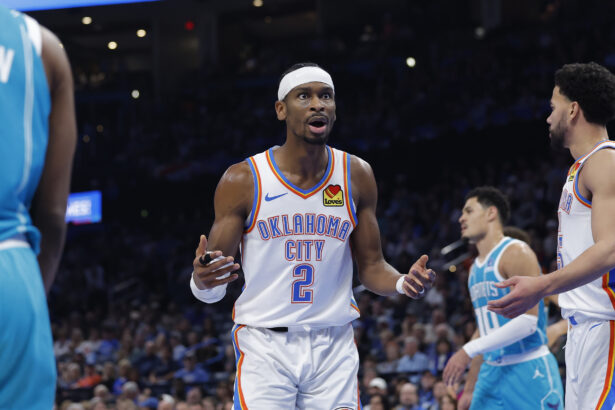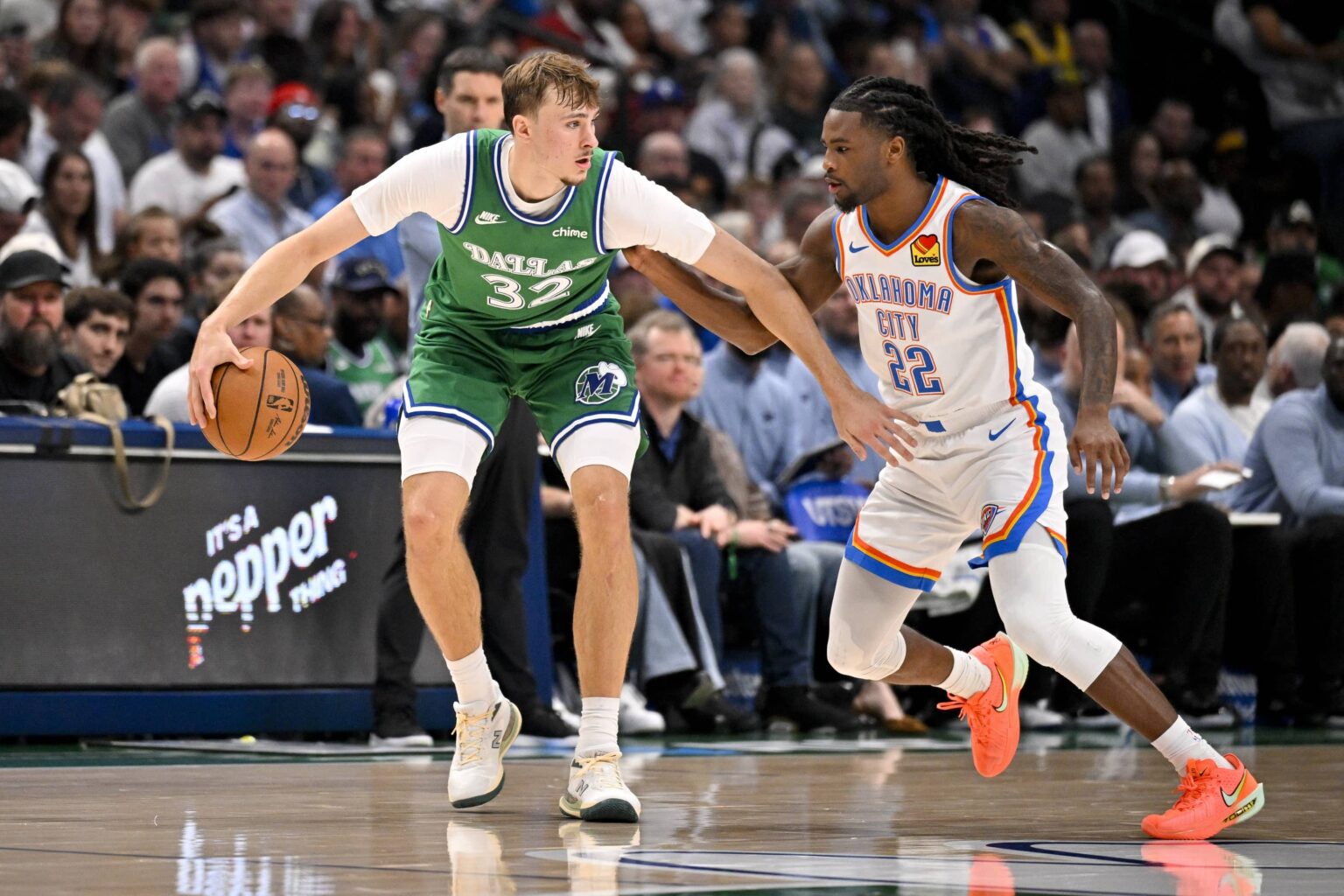
After the Thunder were eliminated by the Spurs in the Western Conference Finals, Cason Wallace went to his end-of-season press conference and gave the kind of answer that changed the offseason conversation fast.
Asked about being extension eligible, Wallace said he loves the Thunder, but his focus is getting better, competing, and staying in the league. That wasn’t a trade request. It also wasn’t the answer many expected from a 22-year-old guard who already won an NBA championship in 2025.
That is why the trade chatter started. Wallace is still on a cheap rookie deal, with a $5.8 million cap hit in 2025-26 and a $7.4 million team option salary in 2026-27. He can sign a rookie-scale extension this summer, and if no deal comes, he can reach restricted free agency in 2027. For a team already paying stars, this is a real roster question.
Wallace gave the Thunder 8.6 points, 3.1 rebounds, 2.6 assists, and 1.9 steals in 26.6 minutes, while shooting 35.1% from three. He also started Game 7 against the Spurs and had 17 points, seven rebounds, four assists, one steal, and five threes.
The issue is role. Shai Gilgeous-Alexander owns the ball. Jalen Williams needs touches. Ajay Mitchell, Jared McCain, and Alex Caruso all take guard minutes. Wallace is often boxed in as a defender, but he may want more than that. If the Thunder can’t offer a bigger offensive role, these are six potential landing spots that could.
6. Brooklyn Nets
Potential Trade Package: Ziaire Williams, 2028 first-round pick
The Nets are the lowest team on this list because the basketball role is easy, but the winning context is weak. They finished 20-62, 13th in the Eastern Conference, with a -10.3 net rating, a 108.7 offensive rating, and a 119.0 defensive rating. That is not a small gap. It means Cason Wallace would get minutes, touches, and a chance to start, but he would also walk into a team that needs help almost everywhere.
The fit still has logic. Wallace would give the Nets a guard who can pressure the ball, organize possessions, and play without needing 18 shots. The steals number is the biggest point here. He finished with 150 total steals, and the Nets badly need a guard who changes the first action of the possession.
Ziaire Williams is the salary and upside piece. He put up 10.2 points, 2.4 rebounds, 1.1 assists, and 1.4 steals, while shooting 42.5% from the field and 34.3% from three. He is a long wing, but he is still more of a bet than a sure rotation piece. For the Thunder, the real asset is the first-round pick. The Nets were bad enough that even a protected pick has value.
For Wallace, this is the biggest offensive runway. He could start, defend the best guard, and get more pick-and-roll reps. The negative is simple. The Nets are far from the Thunder in structure, spacing, and playoff pressure. That makes this a role bet more than a winning bet.
5. Chicago Bulls
Potential Trade Package: Rob Dillingham, 2028 first-round pick
The Bulls make sense because they need a guard who brings defense without killing ball movement. They finished 31-51, 12th in the Eastern Conference, with a -5.1 net rating. Their 113.0 offensive rating ranked 23rd, and their 118.1 defensive rating ranked 22nd. That is the profile of a team stuck between rebuilding and trying to compete. Wallace would give them a player who fits both timelines.
The Bulls already have Josh Giddey as a big playmaker. He gives size, passing, and rebounding, but he doesn’t solve the point-of-attack problem. Wallace does. He can guard smaller guards, fight over screens, and take pressure away from Giddey in late-clock defense. His 1.9 steals per game would instantly change a defense that allowed too many easy first-side actions.
The offensive fit is not perfect, but it is workable. Wallace shot 35.1% from three and 43.2% from the field. He is not a volume shooter yet, but he is playable off the ball. Next to Giddey and Matas Buzelis, that matters because the Bulls need guards who don’t stop the offense with low-efficiency pull-ups. Wallace would bring simple decisions: catch, swing, attack a closeout, or run a second-side pick-and-roll.
Rob Dillingham is the upside piece for the Thunder. He posted 6.3 points, 2.0 rebounds, and 2.2 assists, but shot only 39.6% from the field. That is why the Bulls would need to attach a first-round pick. Dillingham has speed and creation flashes, but he doesn’t give the same defensive floor.
For Wallace, the Bulls offer a real starting path. The concern is team direction. If the Bulls stay in the middle, Wallace could get more usage but less meaningful basketball than he had with the Thunder.
4. Dallas Mavericks
Potential Trade Package: Max Christie, 2028 first-round pick
The Mavericks are a strange landing spot, but the role is strong. They finished 26-56, 12th in the Western Conference, with a -5.4 net rating. Their offense sat at 111.2 per 100 possessions, and their defense allowed 116.5 per 100. They were not good enough on either side, and the guard defense was one of the biggest issues.
Wallace would have a direct path to a bigger role because the Mavericks need low-mistake guards around Cooper Flagg and their new timeline. That is the sell. Wallace doesn’t need to be a 20-point scorer. He needs to defend, push pace after stops, hit open threes, and keep the ball moving. His 2.6 assists against low usage show he can make simple reads. His 150 total steals show he can create transition chances without needing designed offense.
The Mavericks shot only 34.4% from three as a team. Wallace’s 35.1% from three isn’t elite, but it is playable when paired with his defense. The larger point is lineup balance. If Flagg grows as a primary forward, Wallace can be the guard who starts possessions on defense and finishes them with quick decisions on offense.
Max Christie is a reasonable Thunder return. He put up 12.2 points, 3.3 rebounds, and 2.0 assists, while shooting 44.3% from the field. His $7.7 million salary also fits better in a Wallace deal than many young players. Christie gives the Thunder a bigger wing guard with shooting value, and the first-round pick gives the front office the asset part.
The risk for Wallace is the Mavericks’ roster stability. The opportunity is real, but the team is still early in its post-Doncic build. This is a good role bet with medium winning value.
3. Toronto Raptors
Potential Trade Package: Ja’Kobe Walter, 2028 first-round pick
The Raptors are one of the better basketball fits because they already have a competitive base. They finished 46-36, 5th in the Eastern Conference, with a +2.9 net rating. Their offense scored 115.9 per 100 possessions, and their defense allowed 113.0. They also produced 29.5 assists per game, one of the stronger passing marks in the league. Wallace fits that type of team because he doesn’t need to dominate the ball.
The Raptors have Scottie Barnes, Brandon Ingram, RJ Barrett, and Immanuel Quickley. That is a lot of size, scoring, and secondary creation, but they still need more point-of-attack defense. Wallace would give them that without forcing Barnes or Ingram to spend too much energy chasing guards. He can start next to Quickley or close as the main defensive guard, depending on matchup.
The offensive concern is spacing. The Raptors shot 35.4% from three and attempted only 32.1 threes per game. Wallace is not a major movement shooter, but he is not a non-shooter either. At 35.1% from three, he can stay on the floor if the ball keeps moving. His best value would come from quick-touch offense, defensive pressure, and small advantage creation after Barnes or Ingram bends the defense.
Ja’Kobe Walter is the young piece. He gave the Raptors 7.5 points, 2.6 rebounds, and 1.2 assists in 2025-26. He also has real shooting upside, which is why the Thunder could like him as a cheaper wing guard. Because Walter made $3.6 million in 2025-26 and Wallace’s 2026-27 salary is $7.4 million, salary filler would likely be needed.
This is a strong spot for Wallace because the Raptors can offer winning, minutes, and a larger defensive identity. The only reason they are not higher is that Quickley still limits his full point guard path.
2. Miami Heat
Potential Trade Package: Jaime Jaquez Jr., 2030 first-round pick
The Heat are a very strong Wallace destination because their roster needs his exact skill set. They finished 43-39, 10th in the Eastern Conference, with a +2.2 net rating. They were good enough to stay alive, but not good enough to feel stable. Their roster has scoring and frontcourt size with Tyler Herro, Norman Powell, Andrew Wiggins, Bam Adebayo, and Kel’el Ware, but it still needs another guard who can defend the ball every night.
Wallace would fit that need right away. He is not just a steals player. He has the body control to defend without fouling too much, the strength to handle bigger guards, and the speed to recover after screens. The Heat have used many guards who can compete, but Wallace gives more long-term upside than a normal veteran stopgap. He is 22, cheap now, and extension eligible this summer. That gives the Heat one full season to decide if he can be a long-term starter before restricted free agency in 2027.
The offensive role would also be better than with the Thunder. Herro and Powell can handle scoring pressure. Adebayo can run dribble handoffs and short-roll passing. Ware gives vertical spacing. Wallace would not need to create everything, but he would get more reps as a real guard instead of being boxed in as only a defender.
Jaime Jaquez Jr. is a real price. He had 15.4 points, 5.0 rebounds, and 4.7 assists, while shooting 50.7% from the field. The Thunder would get a bigger forward who can pass, cut, and handle bench offense. The first-round pick balances Wallace’s age, defense, and contract control.
For Wallace, this is close to ideal. He would get high-level coaching, a real defensive role, and more offensive freedom. The only downside is that the Heat may still be one scorer short of a real title ceiling.
1. Orlando Magic
Potential Trade Package: Anthony Black, 2032 first-round pick
The Magic are the best landing spot because they combine role, defense, age timeline, and playoff pressure better than the other teams. They finished 45-37, 8th in the Eastern Conference, then pushed the Pistons to seven games in the first round. They are not the contender some expected, but they already have the main pieces: Paolo Banchero, Franz Wagner, Desmond Bane, Jalen Suggs, and Wendell Carter Jr. Wallace would give them another guard who can survive playoff possessions and keep the offense simple.
The fit is about balance. Banchero and Wagner need space, but they also need guards who defend enough to keep them out of constant rotation defense. Wallace brings that. He can guard the ball, force turnovers, and play next to bigger creators. The Magic already have defensive guards, but Wallace is more controlled than most young guards. He had 2.6 assists, only needs low usage, and can punish open threes at a decent rate.
The Magic also need more guard stability. Anthony Black had a strong season with 15.0 points, 3.8 rebounds, 3.7 assists, and 1.4 steals, but his 33.3% from three still leaves some spacing questions. Trading Black would hurt because he is bigger and younger, but Wallace is a cleaner playoff archetype next to Banchero, Wagner, and Bane. He is lower usage, more compact, and easier to place in closing lineups.
For the Thunder, Black is the type of return that keeps the asset strong. He gives them size, defense, rim pressure, and a different guard profile. The 2032 first-round pick makes the offer serious without forcing the Magic to touch the top of the roster.
This is the best Wallace destination because he could start, defend elite guards, play playoff basketball, and still grow beyond the “defense-only” label. The Magic need exactly that type of guard if they want to move from tough first-round team to real East threat.