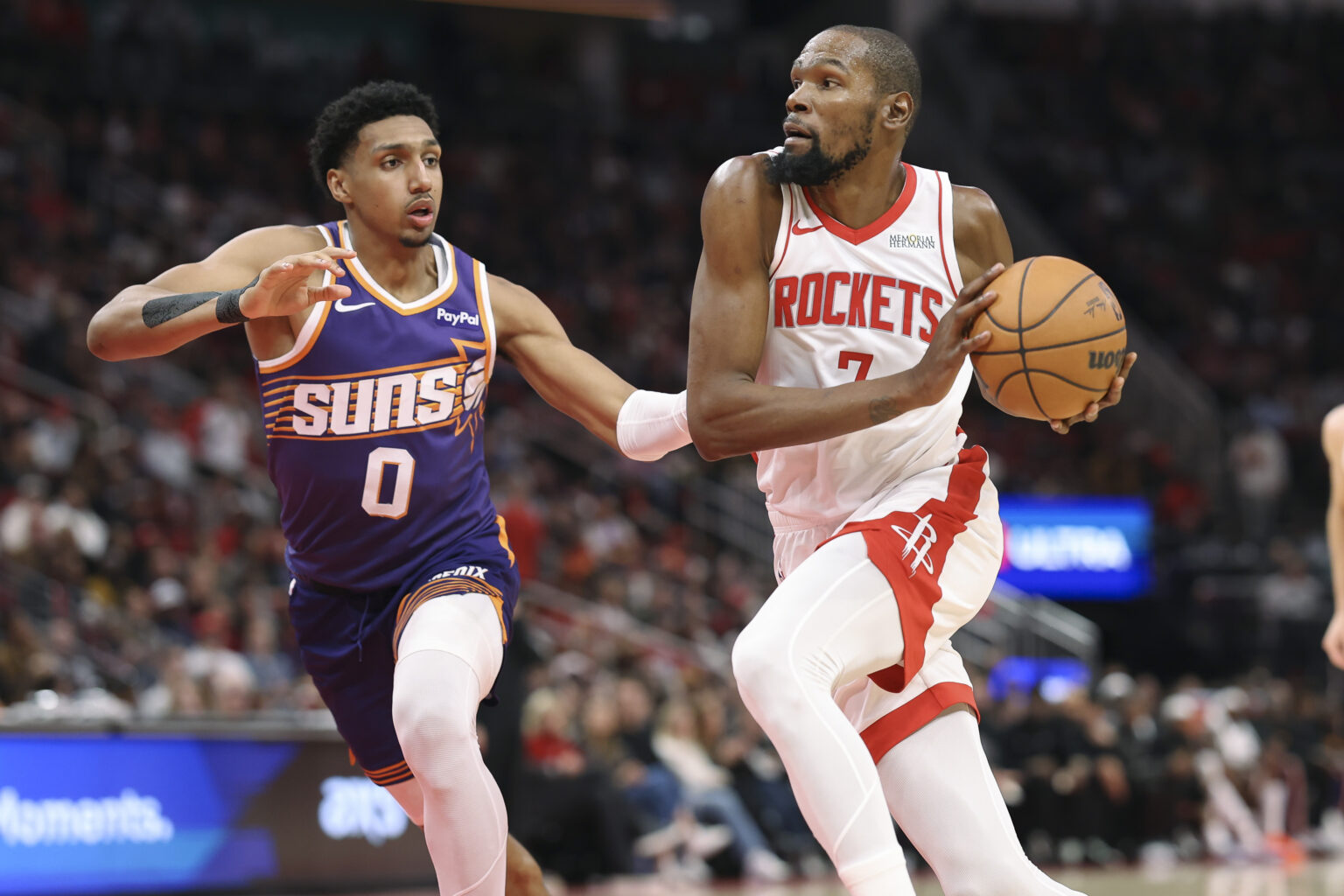
The Rockets didn’t just notch another win on Friday night, they showed once again that their identity doesn’t hinge on one star being available. With Alperen Sengun sidelined due to illness, Houston still overpowered the Phoenix Suns, cruising to a 117-98 victory behind a balanced, confident performance. The night also carried a bit of historical weight: Kevin Durant crossed the 31,000-point threshold early in the first quarter, becoming only the eighth player to reach that mark, and doing it in his first game against Houston since last season’s massive seven-team blockbuster that reshaped both franchises.
For all the attention Durant’s milestone deserved, the Rockets were the team dictating the night. Amen Thompson erupted for a season-high 31 points, turning the second quarter into his own personal showcase as Houston exploded for 44 points and completely flipped the game’s momentum. By the time the Rockets strung together a crushing 16-2 run late in the third, Phoenix was already reeling under a wave of turnovers and quick-hitting Houston buckets. Even without Sengun’s usual interior presence, Houston’s depth, energy, and offensive rhythm proved too much, extending its hot stretch to five wins in six games.
Amen Thompson’s Breakout Night Steals The Spotlight
Amen Thompson has been climbing, but this was the game where he looked like a fully formed star. He finished with 31 points on an ultra-efficient 12-of-17 shooting, knocked down his only three, and added four rebounds and three assists. Every burst to the basket felt controlled and purposeful, and Phoenix simply had no counter when he shifted gears on the open floor.
His fingerprints were all over Houston’s 44-point avalanche in the second quarter, and he scored six key points during the third-quarter run that broke the game open. With Sengun missing and Durant largely focused on his scoring milestone, Thompson stepped willingly into the role of Houston’s engine.
What made Thompson’s performance even more impressive was how comfortable he looked operating as both a scorer and secondary playmaker. He committed only three turnovers despite handling far more responsibility, and he repeatedly punished Phoenix’s miscommunications in pick-and-roll coverage.
When the Suns coughed up five turnovers in that decisive third-quarter stretch, Thompson was the first Rocket pushing the tempo, either finishing at the rim or creating open threes. If Houston keeps getting this version of him, its ceiling jumps dramatically.
Kevin Durant Reaches 31,000 Points, But Houston Controls The Night
Durant’s historical milestone, 28 points on 11-of-17 shooting to reach 31,024 career points, was a reminder that even at this stage of his career, he can score efficiently without breaking a sweat. He didn’t need the fourth quarter and barely needed the ball to leave his imprint. A pair of early free throws got him rolling, and a smooth midrange jumper pushed him into rare statistical territory. For most players, the night would have been about the celebration.
But while Durant had the milestone, Houston had everything else. The Rockets shot 59% from the field and 56% from three, a staggering contrast to Phoenix’s 39% overall and 5-for-36 (14%) night from deep.
Durant was the only Sun generating consistent offense; Dillon Brooks finished with 23 points, but he needed 24 shots to get there, and the rest of the lineup struggled to stay afloat. Phoenix briefly built a nine-point lead early, but Houston’s sustained efficiency, 45-of-76 shooting and 25 assists, kept the game tilted for the final three quarters.
Even Without Sengun, Houston’s Size And Physicality Carried The Game
Losing Alperen Sengun could have been a real issue for Houston, especially against a Suns team that normally feasts in the paint. Instead, the Rockets pieced together a complete frontcourt effort that limited Phoenix’s second-chance scoring and forced them into a barrage of long jumpers.
Steven Adams, starting in Sengun’s place, didn’t light up the box score with points, but he delivered exactly what Houston needed: eight rebounds, two steals, and three blocks in 30 rugged minutes. Clint Capela came off the bench and added seven boards, while Jabari Smith Jr. chipped in 16 points on 5-of-8 shooting and hit the glass just enough to keep possessions alive.
Houston ended up winning the rebounding battle 40-34, and even though the Suns grabbed 15 offensive rebounds, most came when the game was already out of reach. The Rockets held Phoenix to 58 points in the paint, kept them off the free-throw line, and forced enough traffic around the rim to disrupt Mark Williams (10 points) and Phoenix’s bench frontcourt.
Add in Houston’s eight blocks and their ability to push turnovers into transition points, 14 fast-break points to Phoenix’s 8, and the picture becomes clear. Even with their All-Star center unavailable, the Rockets controlled the interior and dictated the physical tone of the game.