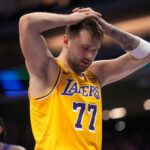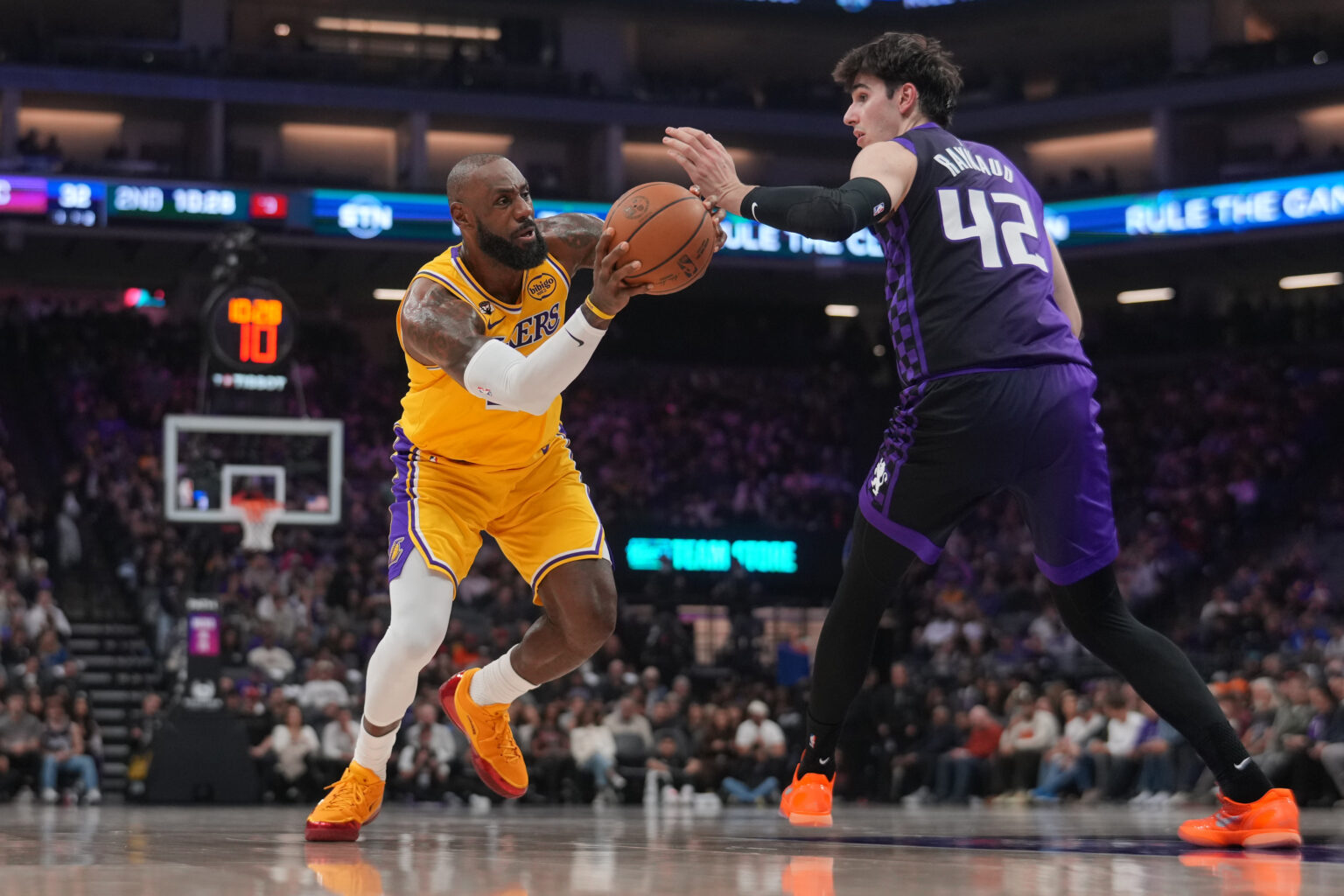
The Los Angeles Lakers came into Sacramento hoping to snap a losing streak, but instead, they left with a frustrating 112-124 defeat. After back-to-back losses, this marks the third consecutive game the Lakers have struggled to find consistency. Despite Luka Doncic’s 42-point effort, highlighted in our recent Lakers Player Ratings, the supporting cast failed to provide meaningful help, leaving the star duo of Luka and LeBron James to carry the heavy load against a Kings team that executed nearly flawlessly.
From cold shooting to defensive breakdowns, this game exposed multiple cracks in the Lakers’ approach. Below, we break down four major factors that contributed to this loss, backed by detailed box-score stats and on-court performance observations.
1. Poor Shooting From Beyond The Arc
The Lakers’ three-point shot never found its rhythm, and it hurt them all night. They finished just 8-of-36 from deep, an uncharacteristically low 22.2%, while Sacramento shot a scorching 65.4%, hitting 17-of-26 threes. Luka Doncic tried to create looks for himself and others, going 2-of-9 from three, and Jaxson Hayes and Marcus Smart combined for 5 attempts without success. That cold shooting put extra pressure on the Lakers’ interior scoring, forcing them into contested mid-range jumpers and disrupting the flow of their offense.
Even when they did manage to get looks, the Lakers often misfired in clutch moments. Maxi Kleber, for instance, went 0-for-3 on threes, and LeBron James couldn’t get a shot to drop from outside (0-for-5). The Kings were able to stay ahead because every time the Lakers tried to mount a comeback through the perimeter, the ball wouldn’t go in. The inability to stretch the floor consistently let Sacramento collapse into the paint, where they held the Lakers to just 58 points inside, despite Sacramento’s smaller frontcourt.
This lack of outside accuracy also affected spacing, leaving Doncic and James with less room to operate. When defenders could cheat off shooters, passing lanes became clogged, and Sacramento could anticipate drives more easily. Simply put, without connecting from long range, the Lakers had to work harder for every bucket, and it showed on the scoreboard.
2. LeBron’s Limited Production And Supporting Cast Struggles
LeBron James had a solid individual line with 22 points on 8-of-17 shooting, 3 assists, and 3 steals, but his influence didn’t translate into a complete team effort. He logged 33 minutes and managed just 4 rebounds, limiting his ability to control the paint defensively and offensively. With LeBron and Luka forced to shoulder the scoring load, the team’s depth struggled to pick up the slack.
Maxi Kleber and Nick Smith Jr., who were expected to provide bench stability, failed to contribute meaningfully. Kleber had 0 points in 26 minutes, going 0-of-3 from three, while Smith Jr. went scoreless in 2 minutes of mop-up duty. Even Dalton Knecht chipped in only 12 points on 5-of-6 shooting, but had minimal impact on defensive rotations. With these performances, Sacramento was able to exploit mismatches and maintain control of the floor throughout the game.
The lack of consistent scoring and floor spacing beyond the two stars meant Sacramento could funnel drives to defenders or collapse in the paint without fear of kick-outs. This imbalance showed that the Lakers’ roster depth is currently a critical problem, highlighted in both our ratings piece and evident in this loss.
3. Defensive Lapses And Paint Weakness
Another decisive factor in the defeat was the Lakers’ defense. Sacramento attacked the paint aggressively, scoring 46 points in the lane, with DeMar DeRozan finishing with 32 points on 14-of-19 shooting. Precious Achiuwa added 9 points and 7 rebounds, constantly challenging interior rotations and keeping the Lakers’ big men on their heels.
LeBron and Ayton were active, but not enough to prevent easy baskets. Ayton had 13 rebounds but struggled to alter shots consistently, while LeBron’s 4 rebounds didn’t give the team the rim protection needed. On the perimeter, the Lakers’ defenders allowed Sacramento’s guards to get clean looks, as Russell Westbrook went 4-of-8 from three-point range, and Zach LaVine connected on 3-of-4. The combination of poor perimeter defense and paint vulnerability allowed the Kings to build a 20-point lead late in the third quarter.
Additionally, defensive rotations suffered due to turnovers and missed assignments. The Lakers allowed 17 points off turnovers, which were mostly easy transition opportunities. Even Luka’s brilliance couldn’t cover up lapses in communication, leaving the team exposed against an offensive team like Sacramento.
4. Free-Throw Problems And Late-Game Execution
Free-throw shooting proved to be another overlooked issue. The Lakers hit 22-of-28 from the line, a respectable 78.6%, but Sacramento had the edge in opportunities, shooting 11-of-14. Key moments late in the third and early in the fourth quarter saw the Lakers miss critical free throws, which allowed Sacramento to extend their lead and dictate tempo.
Late-game execution also faltered. The Lakers’ turnovers in crunch time limited fast-break opportunities, as they managed only 16 fast-break points compared to Sacramento’s 12. Luka Doncic tried to create with 8 assists, but a lack of movement from secondary scorers limited high-percentage scoring chances. Meanwhile, Sacramento’s stars, DeRozan and LaVine, efficiently ran plays to exploit mismatches and close out the game comfortably.
The combination of slightly underwhelming free-throw impact and poor execution in decisive possessions made it nearly impossible for the Lakers to mount a comeback. These small but crucial details highlighted gaps in focus and strategy, underscoring the team’s need for cohesion beyond its star duo.