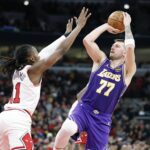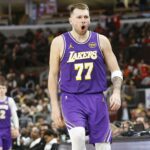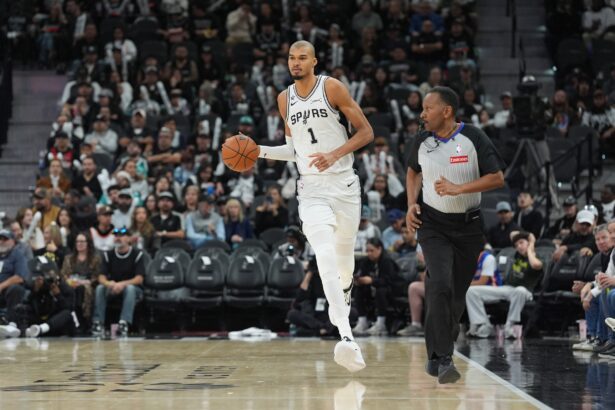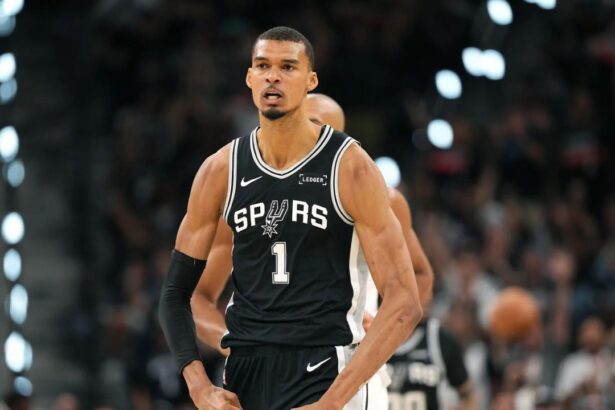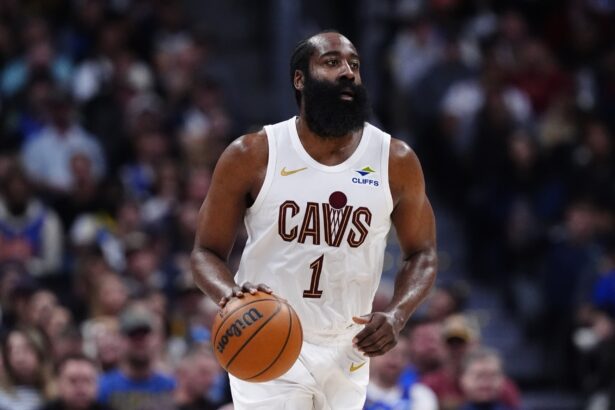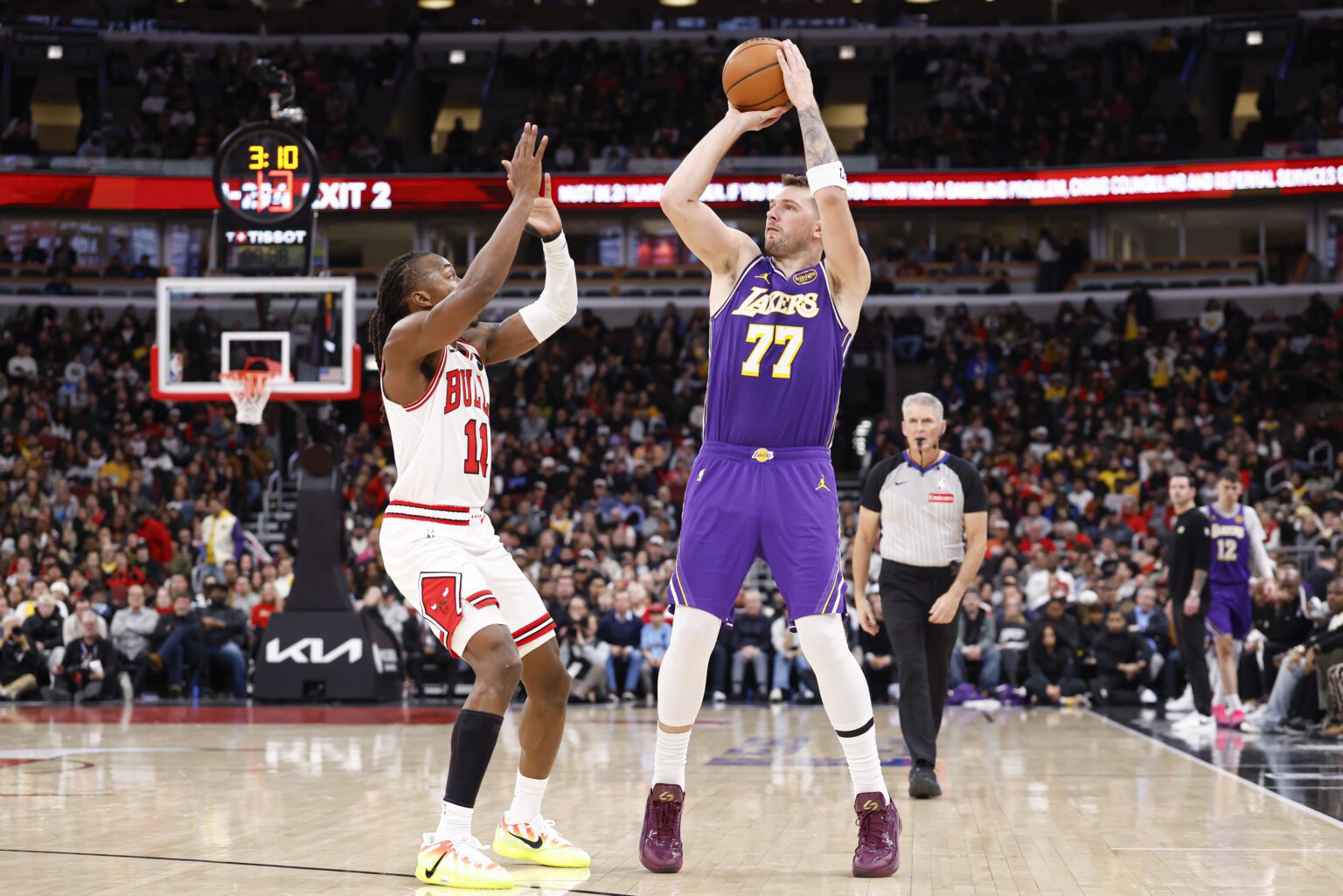
Luka Doncic didn’t just have a big night; he put on a full-blown scoring clinic. Behind his electric shot-making and all-around control, the Lakers rolled past the Bulls 129-118, leading for nearly the entire game and lighting up the scoreboard at 56% shooting. It was one of those offensive performances where every run Chicago tried to mount got answered immediately.
Los Angeles got contributions everywhere, but this was Luka’s show from start to finish. He poured in 46 points while adding 11 assists and 7 rebounds, and the Lakers’ offense hummed right along with him, drilling 16 threes and racking up 27 fast-break points. Chicago shot a solid 52% themselves, but they couldn’t keep pace with L.A.’s efficiency or take care of the ball well enough to truly threaten late.
1. Luka Doncic’s 46-Point Masterpiece
From the starting whistle, Doncic was in rhythm, going 15-of-25 from the floor and 8-of-14 from three. He had step-back threes, he had power drives, and when the Chicago defense closed in on him, he got 12 free throw attempts, making 8. Without dominating the offense, he scored. He had 11 assists, which directly resulted in 22 points.
What makes this performance more remarkable is the control he had. Luka played 38 of 48 possible minutes and committed 3 turnovers, extraordinary considering the volume of the ball in his hands. He had 7 defensive rebounds, and sparked a break that led to the Lakers’ team scoring 27 fast break points. When Doncic is both the leading scorer and the principal playmaker, the Lakers’ ceiling is immensely elevated.
2. LeBron Still Dictates The Game With 24 Points
LeBron James reserved another stable performance, completing his 24-point performance on 9-of-19 shooting, dishing 3 assists, and adding 5 boards. In a rather atypical game, he had his shooting most damage in the paint and cleared his boards in the defensive end. Johnson’s assists help slow the pace of the game, which the Bulls like to speed up and then control.
Most importantly, however, was LeBron’s selection of the spots to execute moves from. With Luka Doncic gunning from the waist, James concentrates on attacking the misses and controlling the offense. The Lakers made an even 56 on the scoreable attempts, and in the second half, LeBron made a three-pointer (5-of-6 from the paint) to help the Lakers stretch the lead to 20.
3. Rui Hachimura And The Bench Swung Momentum
Rui Hachimura was a major contributor off the bench for the Lakers, scoring 23 points on 9-of-11 shooting and hitting 4-of-5 three-pointers. Hachimura consistently responded to Chicago runs with a three-pointer or a strong drive to the basket. His +22 plus-minus demonstrated the positive impact he had on the game.
He had a strong supporting cast. Jaxson Hayes was +26 in 23 minutes, scoring 8 points on 3-of-4 shooting and grabbing 4 rebounds with 2 blocks. Jarred Vanderbilt added 7 rebounds and strength on the defensive end. Gabe Vincent had 3 assists in 12 minutes. The bench scoring for the Lakers kept pressure on the Bulls as the starters went to the bench.
4. Lakers’ Shooting Efficiency Was The Difference
Both teams shot well, but the Lakers were on another level. L.A. hit 46-of-82 shots (56%) and 16-of-33 from three (48%), compared to Chicago’s still-strong 52% overall but just 37% from deep. That difference from beyond the arc, +6 made threes, translated to an 18-point swing from long range alone.
The Lakers also generated better looks in transition and early offense. Their 27 fast-break points dwarfed Chicago’s 19, and L.A. outscored the Bulls 52-48 in the paint despite taking fewer shots overall. When a team is scoring efficiently at every level and spacing the floor this well, it becomes nearly impossible to string together defensive stops.
5. Turnovers And Defense Sealed It Late
Chicago’s biggest issue was ball security. The Bulls committed 15 turnovers, leading to 23 Lakers points, while Los Angeles gave it away just 8 times. That extra possession gap was crucial in a game where both teams were shooting over 50% for long stretches.
Defensively, the Lakers also made just enough key plays. They recorded 7 steals and held Chicago to 14 free-throw attempts made despite the Bulls attacking the rim. Marcus Smart added perimeter toughness with 1 steal and physical on-ball defense, while L.A.’s team defense forced tough shots late in the clock. When the Bulls made their final push in the fourth, a couple of stops and quick Luka buckets shut the door for good.