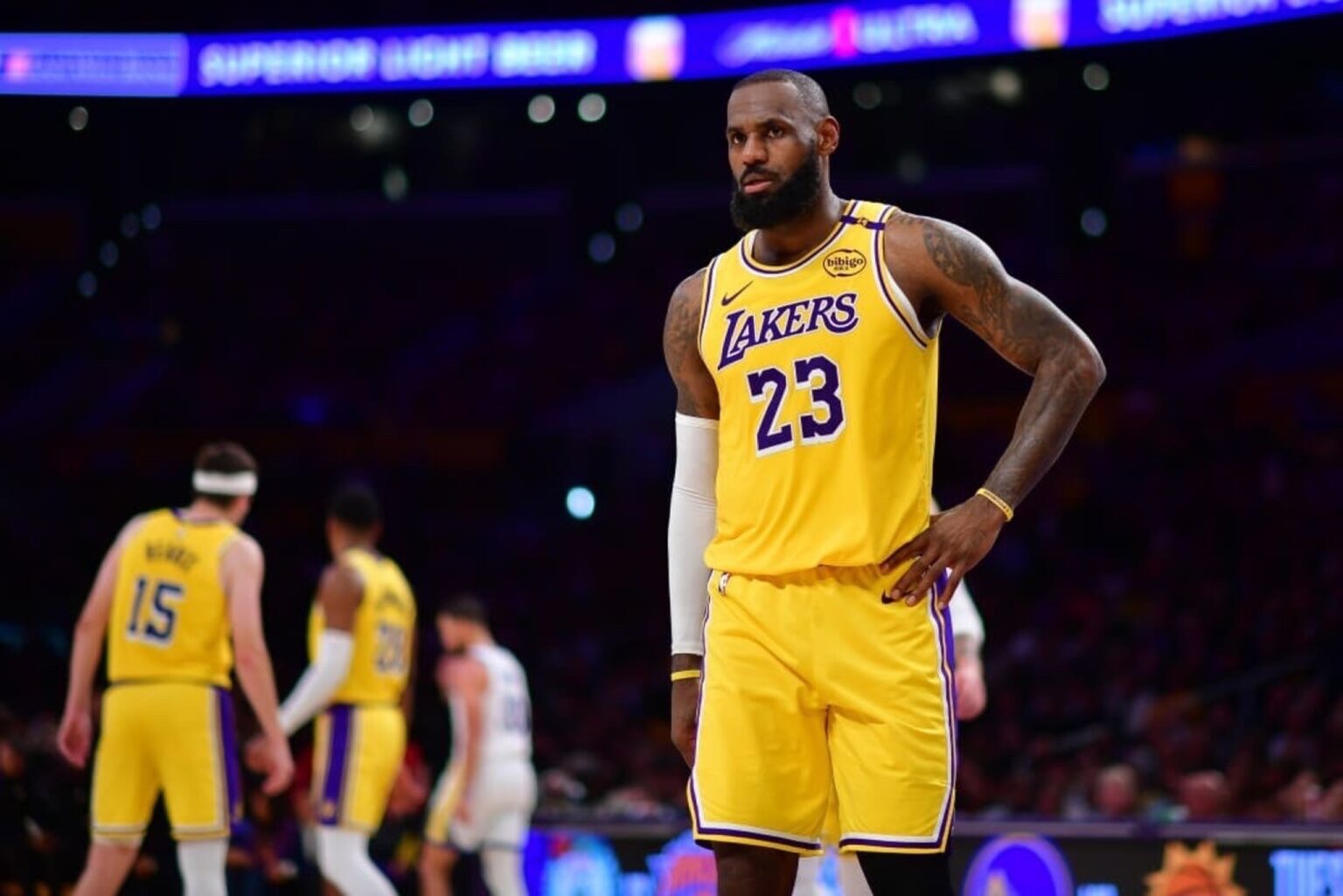
Max Kellerman believes the next version of LeBron James may look a lot like Karl Malone, only smarter. During an appearance on The Bill Simmons Podcast, Kellerman revealed that Rich Paul, James’ longtime agent, envisions a potential evolution for the 41-year-old Los Angeles Lakers star as he continues to adjust his role alongside Luka Doncic.
“Rich loves the idea of LeBron playing as the roller. Being Karl Malone. I love that idea too. A smarter Karl Malone. He’s the same size. 6-foot-8, 260, and he could shoot from the outside.”
The comparison immediately sparked debate, both because of Malone’s Hall of Fame resume and because of the difficulty in asking one of the greatest players in NBA history to redefine himself so late in his career. Simmons acknowledged that challenge.
The concept centers on James transitioning more frequently into a screen-and-roll role, similar to how Malone operated for much of his career with the Utah Jazz alongside John Stockton. Malone thrived as a pick-and-roll finisher, midrange shooter, and physical interior presence. Paul’s belief, as described by Kellerman, is that James could replicate that structural role while adding higher-level playmaking and shooting range.
The physical parallels are notable. Malone was listed at 6-foot-9 and roughly 250 pounds during his prime. James remains around 6-foot-8 and 260 pounds, maintaining elite strength even as his explosiveness has gradually declined. Unlike Malone, however, James has developed into a consistent perimeter shooter and remains one of the league’s most advanced decision-makers with the ball.
In his 23rd season at age 41, James is averaging 21.6 points, 5.6 rebounds, and 7.0 assists while shooting 49.9% from the field and 32.0% from three-point range. Those numbers represent a measurable step down from his typical statistical dominance, particularly from the perimeter. The efficiency inside the arc remains solid, but the decline in outside shooting suggests a potential pivot toward interior play, and screen-heavy involvement could maximize his impact.
Malone’s own late-career Lakers stint offers partial context. At age 40 in 2003–04, he averaged 13.2 points, 8.7 rebounds, and 3.9 assists in a reduced offensive role. James, even in statistical decline, remains significantly more versatile offensively. The projection is not about matching Malone’s MVP-level prime; it is about adapting to extend championship viability.
From a tactical standpoint, the idea gains relevance in the Lakers’ current construction. With Doncic operating as the primary ball-handler, opposing defenses frequently blitz pick-and-roll actions. When Deandre Ayton sets the screen, he is often tasked with making quick reads in short-roll situations. Replacing that decision point with James, one of the most intelligent passers in league history, would dramatically alter the outcome of those possessions.
James has consistently demonstrated adaptability throughout his career. He shifted from a slashing scorer in Cleveland to a point-forward facilitator in Miami, then to a primary orchestrator during his early tenure with the Lakers. This phase presents a different adjustment, one that would emphasize screening angles, timing, and off-ball reads over isolation creation.
The Lakers’ championship aspirations hinge on optimization rather than nostalgia. A high-IQ screener operating alongside Doncic could stress defenses in ways traditional lineups cannot. Kellerman framed it succinctly. The ceiling remains LeBron James. The floor, in this vision, resembles Karl Malone with expanded decision-making and range. At 41, reinvention may not just be optional. It may be necessary.