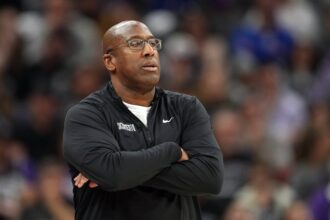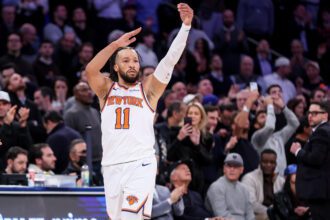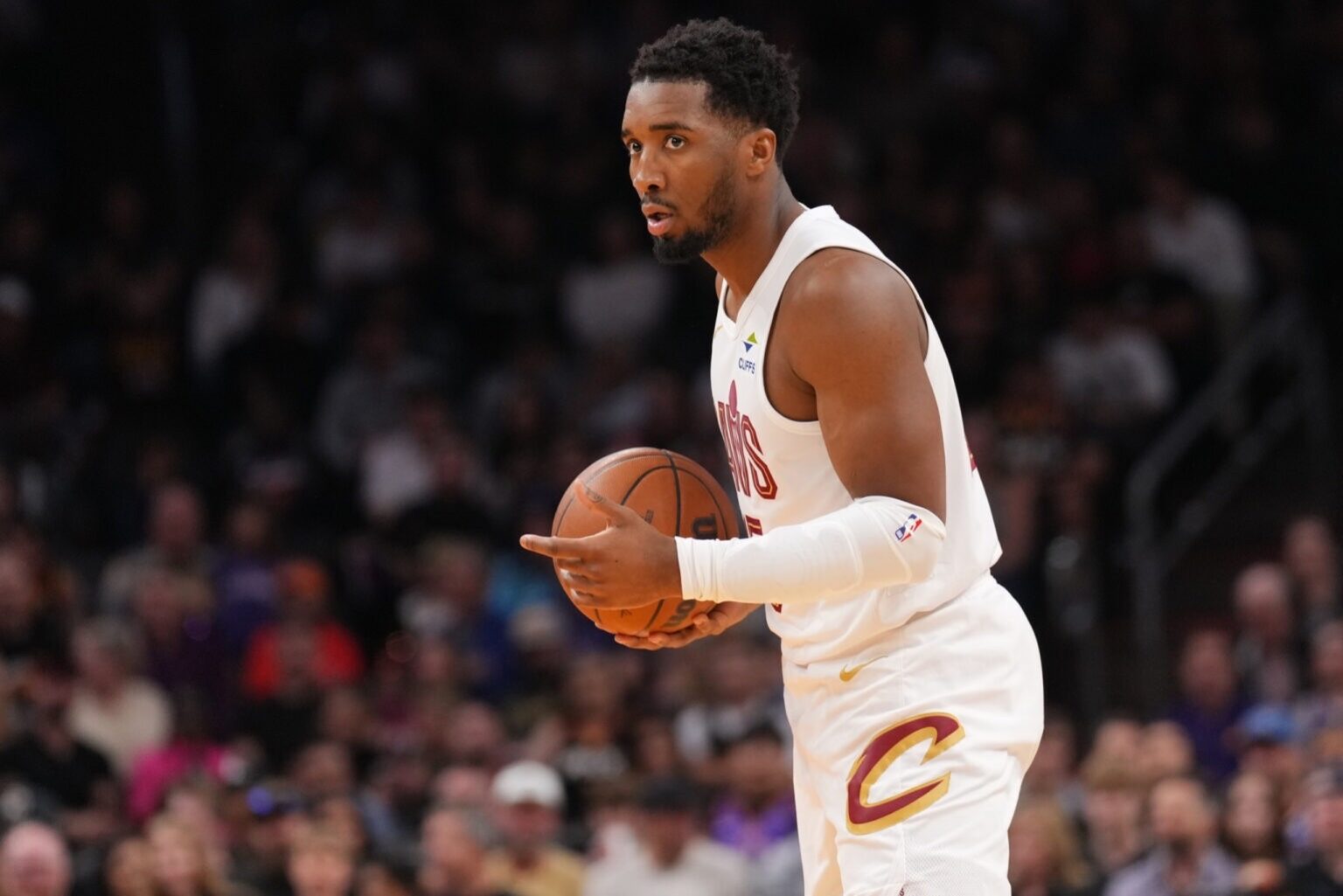
The Cavaliers enter the 2026 offseason in a strange place. The season was not bad. They finished 52-30, took the No. 4 seed in the East, beat the Raptors in seven games, beat the Pistons in seven games, and reached the Eastern Conference Finals for the first time since 2018.
That is real progress. But the ending was bad. The Knicks swept them in four games, and Game 4 was a 130-93 loss at Rocket Arena. That made the summer feel heavier than the record says.
The roster is also expensive. The Cavaliers already have huge money tied to Donovan Mitchell, Evan Mobley, James Harden, Jarrett Allen, Max Strus, Dennis Schroder, and Sam Merrill. The team has $221.8 million committed for next season if everything lands that way, which would put the Cavaliers above the second apron.
That means this is not a normal offseason. They can’t just add role players with big exceptions and fix the bench. Trades, minimum deals, small draft hits, and internal improvement are the main paths.
Cleveland Cavaliers Players Under Contract For 2026-27
1. Evan Mobley: $50.1 million
2. Donovan Mitchell: $50.1 million
3. James Harden: $42.3 million (Player Option)
4. Jarrett Allen: $28.0 million
5. Max Strus: $16.7 million
6. Dennis Schroder: $14.8 million
7. Sam Merrill: $9.2 million
8. Jaylon Tyson: $3.7 million
9. Nae’Qwan Tomlin: $2.4 million
10. Craig Porter Jr.: $2.4 million (Team Option)
11. Tyrese Proctor: $2.2 million
The salary list shows the whole problem. The Cavaliers have a team good enough to win 52 games and reach the conference finals, but they are paying like a team that should be aiming to win the Finals. Mitchell and Mobley are max players. Harden has a huge player option that he might decline for a longer extension.
Allen’s extension begins. Strus, Schroder, and Merrill are key rotation players. The cheap contracts are Tyson, Porter, Proctor, and Tomlin. That means the front office needs the low-cost group to give better minutes, not just roster spots.
Donovan Mitchell Is Still The Center Of The Whole Plan
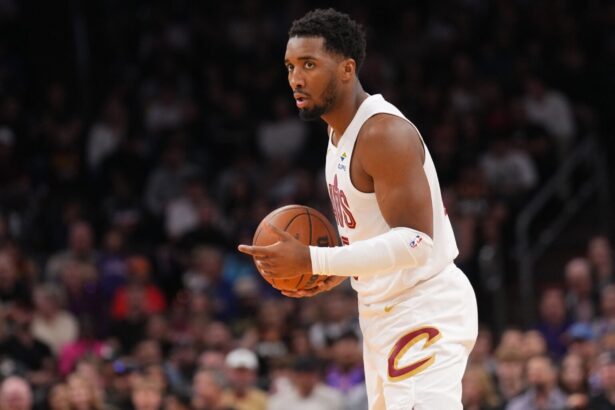
Donovan Mitchell is the first name on the basketball side, even if Mobley has the same salary next season. Mitchell had another elite scoring year, putting up 27.9 points, 4.5 rebounds, and 5.7 assists while shooting 48.3% from the field. He also made the All-NBA Second Team, which showed how strong his regular season was, even with the roster changing around him.
The contract is big, but it is not the problem. Mitchell is owed $50.1 million in 2026-27 and has a $53.8 million player option for 2027-28. That is expensive, but that is star money for a star player. The real question is not whether the Cavaliers should pay him. The real question is how they build a roster that gives him enough support without him declining his option and entering the free agent market.
The playoffs again showed the same issue. Mitchell can carry a lot, but he can’t be the only efficient source of pressure every round. Against the Knicks, the Cavaliers ran out of answers. Mitchell scored 31 in Game 4, but the team still lost by 37. That is the hard part. When the second creator is not efficient, and the frontcourt is not winning the glass, Mitchell’s shot-making only keeps the game alive for so long.
This is why his next extension decision is so important. Mitchell will be eligible for a four-year, $272.0 million extension this summer. If he waits until next year, he could become eligible for a five-year supermax around $350.0 million. The Cavaliers almost have to offer the extension. Letting the contract move into pressure territory would be dangerous. But if Mitchell waits, the front office will spend the whole season with that hanging over the roster.
Mitchell is not the player they should question. He is the reason this is still a contender. But the roster around him needs a more balanced playoff structure. The Cavaliers can’t keep asking him to be the scorer, the closer, the playmaker, and the emotional engine every time a series gets hard.
Evan Mobley’s Max Deal Puts The Real Pressure On
Evan Mobley might be the most important long-term piece on the roster. He is already paid like one. His five-year, $269.1 million extension has him at $50.1 million in 2026-27, with the deal running through 2029-30. That contract is huge, but it fits the way the league pays elite young bigs. The Cavaliers are paying for what Mobley is now and what he can still become.
Mobley gave them 18.2 points, 9.0 rebounds, 3.6 assists, and 1.7 blocks while shooting 54.6% from the field. Those numbers are strong, but the real value is his versatility. He can defend the rim, switch in space, pass from the elbows, run the floor, and play either big spot. He is not just a center. He is not just a power forward. He is the one player who should be controlling the defense communication and erasing mistakes.
The next step is offense. Mobley has to become more dominant in playoff games. That doesn’t mean 25 shots every night, but he attempted under 12 shots per night, and his scoring dipped to 17.0 points per game. The Cavaliers have enough guards who can handle. What they need from Mobley is pressure near the rim and more scoring that doesn’t need a perfect assist.
Paying Mobley $50.1 million and Allen $28.0 million means the Cavaliers are spending almost $80.0 million on the frontcourt. That can work if the defense is elite and the bigs punish smaller matchups. It gets harder if playoff opponents can pack the paint, live with Allen away from the ball, and make Mobley play in traffic without enough skillset to make the better read.
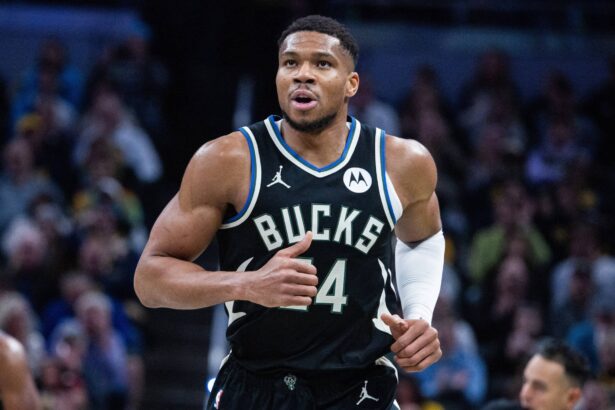
The Cavaliers should not move Mobley unless a Giannis Antetokounmpo deal is actually available. He is too young, too good defensively, and too important to their future. But the max deal removes patience. Mobley can’t just be “promising” anymore. At this salary, he has to be one of the best bigs in the East every postseason.
James Harden’s Player Option Is The Contract To Watch
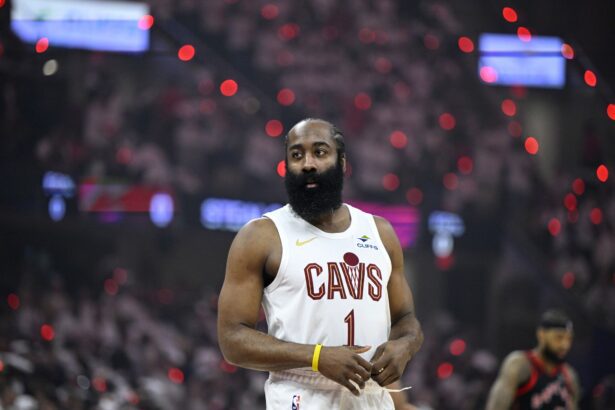
James Harden is the hardest part of the cap sheet. His $42.3 million player option sits over the whole offseason. If he picks it up, the Cavaliers are very expensive right away. If he declines it and signs a new deal at a lower first-year salary, the team can breathe a little more. ESPN’s Bobby Marks wrote that a two-year, $56.0 million structure starting at $28.0 million could put the Cavaliers under the second apron after filling the roster.
The Cavaliers traded Darius Garland and a second-round pick for Harden at the deadline. That was a huge identity shift. Garland was younger and homegrown. Harden was older, bigger, slower, and more playoff-tested. The trade was about winning now and changing the half-court offense.
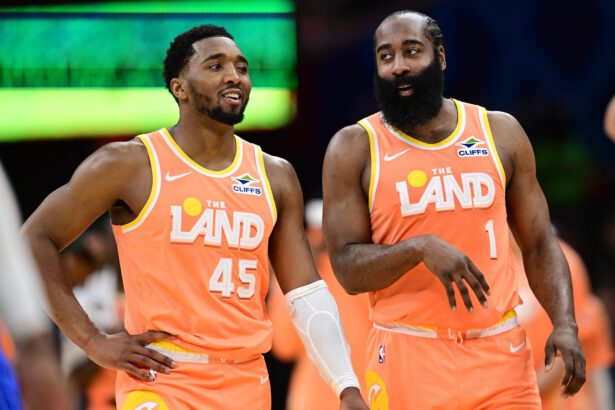
The regular-season fit was better than many expected. Harden produced 20.5 points, 4.8 rebounds, and 7.7 assists after joining the Cavaliers, while shooting 46.6% from the field and 43.5% from three. With Harden and Mitchell on the court, the Cavaliers went 16-6, and their 122.1 offensive efficiency would have ranked first in the league over a full season.
That is the case for keeping him. Harden still creates easy threes. He still manipulates pick-and-roll coverage. He helps Allen as a lob threat. He helps Mobley as a short-roll passer and finisher. He takes some ball-handling weight off Mitchell. In the regular season, that is useful.
The playoff concern is always there. Harden averaged 19.2 points, 5.5 assists, and 5.1 rebounds in the postseason while shooting 41.0% from the field and 29.9% from three. He posted a career-high 4.9 turnovers and had more giveaways than assists in the Eastern Conference Finals. That is not enough for a player at $42.3 million.
The best answer is probably not letting him walk. The Cavaliers are too far over the cap to replace him with equal talent. But they need the number lower. A shorter deal around $28.0 million per year would make more sense than the full option. Harden can still help them, but he can’t be paid like a top star if his playoff efficiency keeps falling.
Jarrett Allen’s Extension Creates A Big Frontcourt Bill
Jarrett Allen is entering the first season of a three-year, $90.7 million extension. His 2026-27 salary is $28.0 million, then it rises to $30.2 million and $32.5 million. That is not crazy money for a starting center, especially with the cap rising. But next to Mobley’s max, it is a major commitment to two bigs.
Allen finished the season with 15.4 points, 8.5 rebounds, 1.8 assists, and 0.8 blocks per game. He gives the Cavaliers screen setting, vertical spacing, rim finishing, defensive size, and regular-season stability. He is one of the reasons the team can win games without needing perfect shooting every night.
The fit with Harden is one of the stronger arguments for keeping him. Harden has always lifted rim-running centers because he holds the weakside defender, reads the tag, and throws lobs from different angles. Allen benefits from that. If Harden stays, Allen’s offensive value is easier to see than it was with smaller guards who needed more of the lane for themselves.
Still, the playoff question is always there. Allen is good. He is reliable. But when the Cavaliers lose the physical battle, the focus goes straight to the frontcourt. In Game 4 against the Knicks, the Cavaliers lost the rebounding battle 60-33. That is a brutal number when Mobley and Allen are two of the highest-paid players on the team.
That doesn’t mean Allen has to be traded. Moving him just to save money would be weak. But he is the most realistic big salary to move if the Cavaliers chase a different wing or need to change the roster shape. Mitchell is the star. Mobley is the young cornerstone. Harden is a question mark. Allen is the big contract that could bring back good-fitting players.
If the Cavaliers keep him, the demand is simple. Allen and Mobley must dominate enough defensively and on the glass to justify playing two bigs deep in May. If that doesn’t happen, the front office will have to look at a different structure.
Max Strus, Dennis Schroder, And Sam Merrill Are Key Deals
The middle salary group is where the Cavaliers need better value. Max Strus is at $16.7 million. Dennis Schroder is at $14.8 million. Sam Merrill is at $9.2 million. None of those numbers are horrible alone. Together, they are a lot for players who are not part of the main four.
Strus is still useful because the Cavaliers need shooting and lineup size on the wing. He only played 12 regular-season games, but he posted 11.2 points, 5.4 rebounds, and 2.0 assists while shooting 44.3% from the field and 40.2% from three. He is not a star wing or a defender, and he won’t create much off the dribble, but he spaces the floor and keeps the ball moving. For this roster, that has value.
The problem is that $16.7 million is not “a little” money on a second-apron team. If Strus is healthy and shooting over 40.0% from three, the contract is actually good. But across the 4 games he played in the ECF, he averaged 6.5 points, 4.2 rebounds, and 2.2 assists in roughly 25 minutes per contest, shooting 31.0% from the field and 26.9% from three-point range.
If injuries reduce him like it happened this season, or if he becomes a regular-season-only piece as we saw in the postseason, then his money becomes one of the few trade levers the Cavaliers have.
In Schroder’s case, he came in through the De’Andre Hunter trade. That deal also brought Keon Ellis and helped the Cavaliers reduce salary and tax pressure. Schroder gives them speed, ball pressure, and backup creation.
He had 8.2 points and 4.3 assists since the trade, but the shooting was not strong at 40.1% from the field and 29.0% from three. That is the issue. He can run a second unit, but if he is playing next to Harden or Mitchell in playoff minutes, teams will test the jumper.
Merrill is the simplest player in the middle group. He is there to shoot. He had 12.8 points, 2.6 rebounds, and 2.4 assists while shooting 46.1% from the field and 42.1% from three. On this roster, that shooting is needed. The Cavaliers have two bigs, a downhill star guard, and an older playmaker. They need fast-release shooters who don’t hold the ball. Merrill fits that.
The issue is defense. In the regular season, Merrill’s shooting can swing games. In the playoffs, opponents hunt weak defenders. If Merrill can survive enough defensively, he is one of their best value contracts. If he can’t, $9.2 million becomes more expensive than it looks.
Jaylon Tyson Is The Cheap Contract They Need To Trust
I love how well the Cavaliers hit the jackpot with the Jaylon Tyson draft pick. He is one of the most important players on this sheet because he is cheap and already useful. He’s also the reason the Cavaliers were comfortable moving De’Andre Hunter and his bigger $20 million salary at the deadline.
Tyson put up 13.2 points, 5.1 rebounds, and 2.2 assists while shooting 49.3% from the field and 44.6% from three. That is strong production for a young wing. But his minutes went from 27.0 to 12.7 in the postseason, so if he can solidify his role as a playoff piece, the Cavaliers have a low-cost answer at a position where they can’t spend much more money.
The Cavaliers badly need wings who can guard, shoot, rebound, and run the floor. Tyson is not a finished product, but he gives them more size than the guard-heavy bench pieces. He also gives them a way to survive if Dean Wade leaves in free agency and Max Strus stays more of a shooting guard than a true forward.
If the Cavaliers are over the second apron, Tyson has to play. They don’t have the money to find another version of him. He is one of the few young players who can give them surplus value. That is huge for a team with so much cash tied to the top of the roster.
The Free Agents Make The Bench Harder
The Cavaliers still have important free-agent decisions. Dean Wade, Larry Nance Jr., Thomas Bryant, and Keon Ellis are unrestricted free agents. Olivier Sarr is a restricted two-way free agent. Harden is the player-option case. Craig Porter has the club-option detail. That means the final 2026-27 roster is not fully settled.
Wade is the biggest name there because he has been a regular rotation forward. He started 38 games and played a career-high 22.3 minutes per game. On a cheaper team, keeping him would be simple. For the Cavaliers, it is harder because every extra dollar can push them deeper into tax and apron problems.
Ellis is the most interesting case. He was acquired as part of the Hunter-Schroder trade and gives them defensive guard depth. But he will become hard to keep with Schroder, Merrill, Strus, Porter, and Proctor already on the books.
This is why the Cavaliers’ offseason is not only about stars. The bottom of the roster is important because the expensive players already control the cap sheet. If they lose Wade and Ellis, they need the bench unit to fill winning minutes. If they keep Wade or Ellis, they probably need another move somewhere else.
Final Thoughts
The Cavaliers have a good team under contract, but good is not the same as finished. Mitchell is elite. Mobley is the long-term frontcourt star. Harden can still lift the offense if the contract comes down. Allen is a strong center, but his fit with Mobley has to win playoff matchups. Strus, Schroder, and Merrill are useful, but their value has to match the money.
The biggest issue is not talent. It is salary. The Cavaliers are built like a win-now team, and the payroll says the same thing. The problem is that the Knicks series showed they still need more size, more wing defense, more rebounding in hard playoff games, and more reliable offense when Mitchell is under pressure.
That puts the front office in a tough spot. Trading Allen could open a different roster build. Keeping Allen means trusting the two-big model again. Lowering Harden’s salary through a new deal could help the second-apron problem. Keeping Wade or Ellis would help the bench, but only if the money doesn’t block other moves.
The Cavaliers are not far away, but they are expensive enough that every mistake gets bigger. Their best path is not a wild rebuild. It is a sharper balance around Mitchell and Mobley. They need Tyson to keep rising. They need Strus and Merrill healthy. They need Harden on a better number. They need Allen and Mobley to control the glass when the season gets serious. If those things don’t happen, the Cavaliers will be very good again, but still short of the real Finals level.