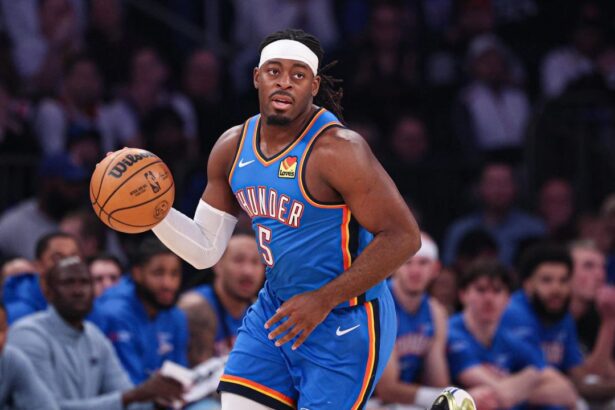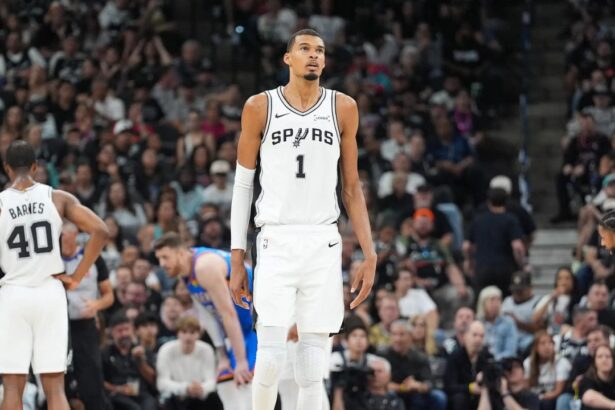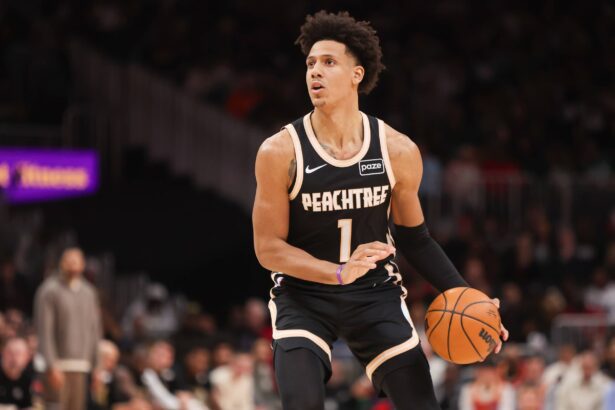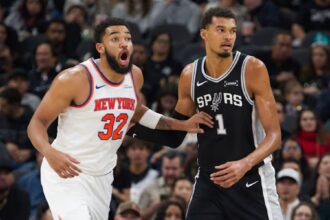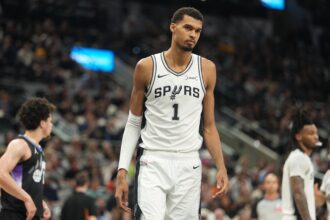
Dylan Harper gave the Spurs a lot in his NBA Finals debut, even if the game didn’t finish their way. He came off the bench against the Knicks and had 16 points, eight rebounds, one assist, and one steal in 28 minutes. He shot 6-of-10 from the field, 1-of-4 from three, and 3-of-3 from the line.
His first quarter was the best part. Harper came in hot and scored 10 points in only six minutes. He attacked early, didn’t look nervous, and gave the Spurs fast offense when they needed energy. For a rookie in his first Finals game, that was a strong sign.
This playoff run has already been very good for him. Harper is putting up 13.2 points, 5.5 rebounds, and 2.5 assists in 19 games, while shooting 52.9% from the field, 35.4% from three, and 85.2% from the line. That is efficient production for a rookie guard playing crucial playoff minutes.
Now he is close to history. Harper has 251 points in this postseason, which puts him 12th all-time for points by a rookie in one playoff run. Donovan Mitchell is 10th with 268, so Harper needs only 18 more points to enter the top 10. With the Finals still going, that looks very possible.
Here are the 10 rookies with the most points scored in a single NBA playoff run.
10. Donovan Mitchell – 268 Points
Donovan Mitchell reached this total during the Jazz’s surprising 2018 playoff run. His 268 points remain one of the highest scoring outputs ever by a rookie guard in a single postseason, and it has kept him inside the top 10 for several years.
Mitchell’s rookie run was short compared to some names above him, but the scoring rate was serious. He played 11 games for the Jazz and put up 24.4 points, 5.9 rebounds, 4.2 assists, and 1.5 steals in 37.4 minutes per game. He shot 42.0% from the field, 31.3% from three, and 90.7% from the line.
The volume was already impressive for a rookie. Mitchell averaged 22.1 shot attempts and 7.3 three-point attempts per game, numbers that usually belong to established stars, not first-year players. From the start, the Jazz trusted him with a huge offensive role and looked to him as their primary scoring option, which is rare for a rookie in the playoffs.
The first-round series against the Thunder was his big statement. Mitchell averaged 28.5 points in that matchup and closed the series with 38 points in Game 6. He made five threes, scored 15 points in the first six minutes of the third quarter, and helped the Jazz eliminate a team with Russell Westbrook, Paul George, and Carmelo Anthony.
His efficiency wasn’t perfect, especially from three, but the workload was huge for a rookie guard. Harper is close to passing him now, but Mitchell’s rookie run is still the first real wall on this list.
9. Jerry West – 275 Points
Jerry West reached 275 points in the 1961 playoffs, his rookie postseason with the Lakers. That total came in only 12 games, so the scoring rate was already strong from the start. West put up 22.9 points, 8.7 rebounds, and 5.3 assists in 38.4 minutes per game. He shot 49.0% from the field and 72.6% from the line.
The Lakers didn’t have an easy run. They finished the regular season 36-43, then beat the Pistons in five games before losing to the Hawks in seven in the Division Finals. West was a rookie, but he was already playing heavy minutes and giving the Lakers a star next to Elgin Baylor.
The efficiency is the best part. For a rookie guard in 1961, 49.0% from the field in the playoffs is a serious number. There was no three-point line, so all his scoring came from two-point shots and free throws.
West had two 30-point games in that run. He scored 31 against the Pistons in Game 4 of the Western Division Semifinals, then had 33 against the Hawks in Game 5. The rest of his scoring was more steady than explosive. He didn’t need one 50-point game to reach this list. He got there by giving the Lakers 20-plus almost every night.
His career after that became much bigger: 14-time All-Star, 12-time All-NBA, five-time All-Defensive, 1972 NBA champion, 1969 Finals MVP, and NBA 75th Anniversary Team member. But the rookie version was already elite. A 22-year-old guard scoring 275 playoff points in 12 games is still one of the best rookie runs ever.
8. Magic Johnson – 293 Points
The crazy part with Magic Johnson is that scoring wasn’t even the main thing in his rookie playoff run. He finished with 293 points in 16 games, but he also led the whole 1980 playoffs in assists with 151. That is why this run still looks different from almost every rookie run on the list.
Magic put up 18.3 points, 10.5 rebounds, 9.4 assists, and 3.1 steals per game. He shot 51.8% from the field and 80.2% from the line. For a rookie point guard, that is a complete playoff line. It wasn’t just scoring. It was rebounds, passing, defense, pace, and control.
The Lakers went 12-4 in those playoffs and won the championship. Magic wasn’t playing a small rookie role next to Kareem Abdul-Jabbar. He was already one of the main reasons the Lakers worked. He averaged 41.1 minutes per game, so the trust was huge from the start.
The Finals made the run historic. Magic had 21.5 points, 11.2 rebounds, and 8.7 assists per game against the 76ers, then won Finals MVP. Game 6 is still the number that everybody remembers: 42 points, 15 rebounds, seven assists, three steals, and one block in 47 minutes. He shot 14-of-23 from the field and 14-of-14 at the line.
That game came with Abdul-Jabbar out, so Magic had to do more than usual. He started at center, played every kind of role, and closed the title on the road. For a rookie, that is almost impossible to match.
He scored 293 points, led the playoffs in assists, won the title, and won Finals MVP. No rookie guard has a more complete playoff story than that.
7. Wilt Chamberlain – 299 Points
Only nine games were enough for Wilt Chamberlain to reach this list. That is the crazy part. He scored 299 points in the 1960 playoffs, so his total wasn’t built by a long run. It was built by pure volume.
Chamberlain put up 33.2 points, 25.8 rebounds, and 2.1 assists per game in that postseason. He also played 46.1 minutes per game, which shows how much the Warriors depended on him right away. He wasn’t being developed slowly. He was already the whole interior system as a rookie.
The shooting was strong for that era and role. Chamberlain made 13.9 field goals per game on 28.0 attempts, good for 49.6% from the field. The free throws were the weak spot, as usual. He hit only 44.5% at the line, but still got to 12.2 attempts per game.
His biggest game came against the Celtics in Game 5 of the Eastern Division Finals. Chamberlain had 50 points and 35 rebounds in a 128-107 win. For a rookie, that is absurd. For any player, it is absurd. The Warriors still lost the series in six, but that game showed the league what was coming.
The regular-season context makes it even more serious. Chamberlain entered the playoffs after winning MVP and Rookie of the Year in the same season. He also led the league with 37.6 points and 27.0 rebounds per game. So the playoff run wasn’t a surprise hot stretch. It was the continuation of one of the most dominant rookie seasons ever.
His 299 points rank seventh here, but his scoring average is higher than most players above him. The only reason he isn’t higher is the Warriors didn’t play enough games.
6. Jack Sikma – 301 Points
Jack Sikma wasn’t a high-usage guard like Donovan Mitchell, and he wasn’t a dominant first option like Wilt Chamberlain. He reached 301 points because the SuperSonics played 22 playoff games in 1978, and he stayed useful the whole way.
Sikma averaged 13.7 points, 8.1 rebounds, 1.2 assists, 0.8 steals, and 0.5 blocks in 31.9 minutes per game. He shot 46.6% from the field and 78.0% from the free-throw line. That is strong efficiency for a rookie big in a deep playoff run, especially with no three-point line to stretch the scoring.
His role was also very clear. Sikma wasn’t the main interior scorer on the team, but he gave the SuperSonics another center who could score, rebound, defend, and stay on the floor. He wasn’t just playing short rookie minutes. He was a rotation starter-level piece on a team that reached Game 7 of the NBA Finals.
The volume came in a steady way. Sikma made 5.2 field goals per game and 3.2 free throws per game. He didn’t have to score 30 every night. He just kept giving the SuperSonics double-figure scoring while playing real minutes through three rounds and the Finals.
That is why his 301 points are different from most players on this list. It wasn’t built on huge usage. It was built on availability, role trust, and a long run.
Sikma also showed the player he would become later. He made the All-Rookie Team in 1978, became an NBA champion in 1979, made seven All-Star teams, earned one All-Defensive selection, and later became a Hall of Famer. The rookie playoff run was not his peak, but it was already a strong start.
5. Elgin Baylor – 331 Points
Before the Lakers had their full glamour era, Elgin Baylor was already carrying them as a rookie. His 1959 playoff run finished with 331 points in 13 games, and that was enough to lead the whole postseason in total points.
Baylor put up 25.5 points, 12.0 rebounds, and 3.3 assists in 42.8 minutes per game. He shot 40.3% from the field and 77.0% from the line. The efficiency wasn’t elite, but the role was massive. He averaged 23.3 field-goal attempts and 8.7 free-throw attempts per game. For a rookie forward in 1959, that is star usage right away.
The Lakers needed that scoring because they weren’t the favorite. Baylor was only in his first season, but he had already become the main offensive piece. He wasn’t just getting points in a short upset series. He played through the full run to the NBA Finals, where the Lakers lost to the Celtics.
His Finals numbers were still strong: 22.8 points and 11.8 rebounds in four games. The Celtics had Bill Russell inside, so nothing was easy near the rim. The full rookie season also gives context. Baylor averaged 24.9 points, 15.0 rebounds, and 4.1 assists in the regular season, made the All-Star team, won Rookie of the Year, and shared All-Star Game MVP.
His 331 playoff points have stayed this high because the mix was rare: huge minutes, huge shot volume, Finals run, and immediate star role. Dylan Harper can pass many names with a strong Finals, but Baylor’s number is a much bigger wall.
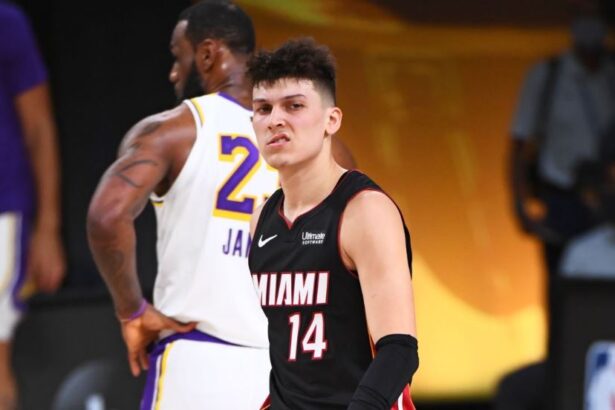
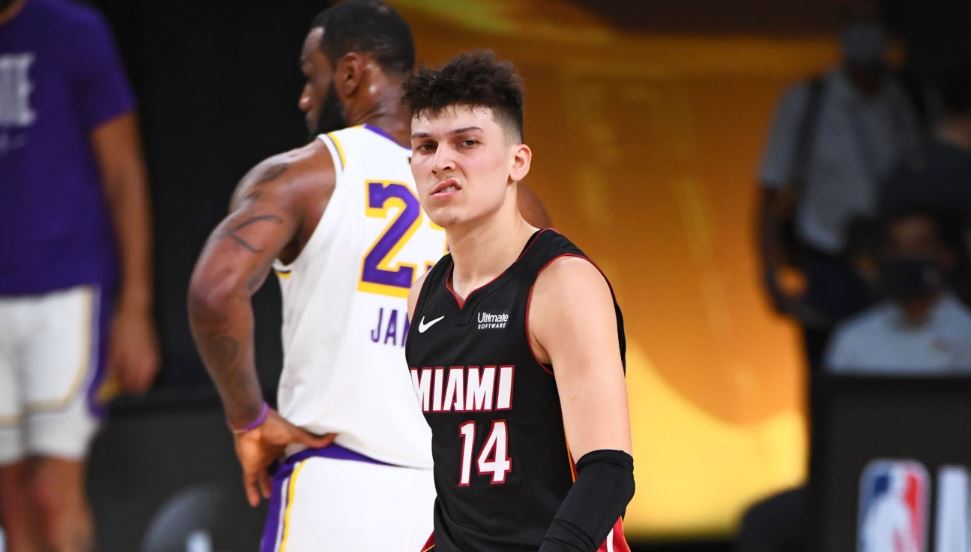
4. Tyler Herro – 335 Points
Tyler Herro’s 2020 playoff run is still one of the best rookie scoring runs by a guard in modern NBA history. He scored 335 points in 21 games for the Heat, and he did it as a 20-year-old bench player on a team that reached the NBA Finals.
Herro posted 16.0 points, 5.1 rebounds, and 3.7 assists in 33.6 minutes per game. He shot 43.3% from the field, 37.5% from three, and 87.0% at the line, with a 55.7% true shooting mark. That is very good for a rookie guard taking 13.2 shots and 6.1 threes per game in the playoffs.
Herro played 706 total minutes in that run. He made 120 field goals, 48 threes, and 47 free throws. That scoring mix is why he got to 335 points without being the No. 1 option. The biggest game came in the Eastern Conference Finals against the Celtics.
Herro had 37 points, six rebounds, and three assists in Game 4. He shot 14-of-21 from the field and 5-of-10 from three. That was the most points by a rookie in a Conference Finals game and one of the best bench scoring games in playoff history.
His full series against the Celtics was a big reason the Heat made it to the Finals. Herro put up 19.2 points, 6.3 rebounds, and 4.8 assists in six games. That wasn’t just bench scoring. He was part of the Heat’s closing lineups.
Herro’s 335 points are the top modern guard mark on this list. Harper is close to the top 10 now, but reaching Herro would need much more than one good Finals game.
3. Alvan Adams – 341 Points
A rookie center leading a 42-40 team to the NBA Finals is already strange. Alvan Adams did that in 1976, and his scoring total still sits near the top of this list. He scored 341 points in 19 playoff games for the Suns, while also giving them passing, rebounding, and interior defense.
Adams averaged 17.9 points, 10.1 rebounds, 5.2 assists, 1.4 steals, and 1.1 blocks in 35.2 minutes per game. He shot 45.2% from the field and 81.7% from the line. Those 5.2 assists per game are the big stat. He wasn’t just finishing plays. He was helping run offense from the frontcourt.
His biggest stage came against the Celtics in the 1976 Finals. In Game 3, Adams had 33 points and 14 rebounds in a 105-98 Suns win. That game cut the series to 2-1 and showed he could score against the league’s best team.
The regular-season context also helps. Adams had already won Rookie of the Year after putting up 19.0 points, 9.1 rebounds, 5.6 assists, 1.5 steals, and 1.5 blocks. He was an All-Star as a rookie, too.
His 341 playoff points came because the Suns trusted him like a major piece right away. He wasn’t the biggest name on the list, but the box score did the talking. Points, rebounds, assists, steals, blocks, and a Finals run.
2. Jayson Tatum – 351 Points
The Celtics didn’t plan to give Jayson Tatum this much responsibility as a rookie, but injuries changed the season. Gordon Hayward went down in the opener. Kyrie Irving missed the playoffs. Tatum had to grow fast, and he answered with 351 points in 19 games.
Tatum averaged 18.5 points, 4.4 rebounds, 2.7 assists, 1.2 steals, and 0.5 blocks in 35.9 minutes per game during the 2018 playoffs. He shot 47.1% from the field, 32.4% from three, and 84.5% from the line, with a 57.8% true shooting mark. For a rookie with that much responsibility, those shooting numbers held up well.
The Celtics reached Game 7 of the Eastern Conference Finals with Tatum as one of their main scorers. He had 14 games with at least 15 points and 10 games with at least 20 points. That last number was historic because he became the first rookie since Kareem Abdul-Jabbar to score 20-plus in 10 playoff games.
His best scoring game came against the 76ers in Game 3 of the second round, when he had 24 points on 11-of-17 shooting. He also had 24 points and seven rebounds in Game 7 against the Cavaliers, including the famous dunk on LeBron James. The Celtics lost, but Tatum didn’t hide from the moment.
The career after that made the run look even stronger: NBA champion, six-time All-Star, five-time All-NBA, Eastern Conference Finals MVP, and All-Rookie selection. But before all that, the rookie playoff run already showed the player coming.
1. Kareem Abdul-Jabbar – 352 Points
One point is all that separates Kareem Abdul-Jabbar from Tatum at the top. Kareem scored 352 points in the 1970 playoffs, and he did it in only 10 games. That is the most important part. He didn’t need a long Finals run. He reached the record with pure dominance.
Kareem averaged 35.2 points, 16.8 rebounds, and 4.1 assists in 43.5 minutes per game for the Bucks. He shot 56.7% from the field and 73.3% from the line, with a 60.8% true shooting mark.
The raw totals are even stronger. Kareem made 139 field goals on 245 attempts, added 74 free throws, grabbed 168 rebounds, and had 41 assists. He averaged 24.5 shots per game and still shot 56.7%. That is why this rookie playoff run still sits at No. 1.
His biggest game came against the 76ers in the first round, when he had 46 points and 25 rebounds. He was 22 years old, and that game later stood for decades as the youngest 40-point, 20-rebound playoff game ever before Victor Wembanyama passed the age mark in the second round this year.
The Bucks lost in the Eastern Division Finals to the Knicks, so this wasn’t even a full Finals run. That makes the total more impressive. Ten games, 352 points, and the No. 1 rookie playoff scoring mark.
The regular season already said he was different. Kareem won Rookie of the Year after averaging 28.8 points, 14.5 rebounds, and 4.1 assists. One year later, he was MVP, champion, and Finals MVP.
This is why the record is still hard to reach. Tatum needed 19 games and came up one point short. Kareem did it in 10. That scoring rate is the standard for rookie playoff dominance.