One of the most overlooked parts of the NBA offseason is the team-option deadline. Free agency gets the attention. Star signings, trade talks, and big contracts drive the headlines. But team options come first, and they can change the market before it really opens.
For contenders, the question is usually price. A player can help and still be too expensive. For rebuilding teams, the question is evaluation. A cheap option can give a young player one more season to prove he belongs. For other teams, the value is in waiting. One declined option can put a useful player back on the market at a better price.
This list covers the notable team-option decisions for the 2026 offseason. Some should be picked up. Some should be declined. Others depend on whether the team and player can agree on a smaller long-term deal before free agency starts.
1. Isaiah Hartenstein – $28.5 Million Team Option
2025-26 Stats: 9.2 PPG, 9.4 RPG, 3.5 APG, 1.0 SPG, 0.8 BPG, 62.2% FG, 0.0% 3P
Isaiah Hartenstein had a useful regular season when he was healthy. He played 47 games, started 46, and gave the Thunder 24.2 minutes per game as a real center next to Chet Holmgren. His value was not scoring volume. It was screening, rebounding, passing, size, and physical work. Still, the injuries matter. He missed the first 19 games because of right wrist injury recovery and also missed 26 games with a right hamstring strain. That makes the $28.5 million number harder to just accept.
The playoff context helps his case. In Game 2 against the Spurs, Hartenstein went from 12 minutes in Game 1 to 27 minutes and gave the Thunder 10 points, 13 rebounds, eight offensive rebounds, and three assists in a 122-113 win. More important, he made Victor Wembanyama deal with real physical pressure. He grabbed, annoyed, and Gortat-screened Wembanyama to give the Thunder guards a lane into the paint without a Defensive Player of the Year just waiting to snatch shots.
The best move is not picking up the option right away. The Thunder should try to decline it and renegotiate a smaller multi-year deal, but only if Hartenstein is already aligned on that plan. A deal around $15.0 million per year, but more seasons would help him get security and help the Thunder stay flexible around their expensive core. If there is no agreement ready, then declining it is risky because Hartenstein would hit unrestricted free agency, and the Thunder could lose a useful playoff center.
But if he is willing to work with them, $28.5 million for one year is too high. The smarter play is a longer deal at a lower annual number.
2. Jonathan Kuminga – $24.3 million Team Option
2025-26 Stats: 12.2 PPG, 5.6 RPG, 2.3 APG, 0.6 SPG, 0.3 BPG, 46.3% FG, 33.3% 3P
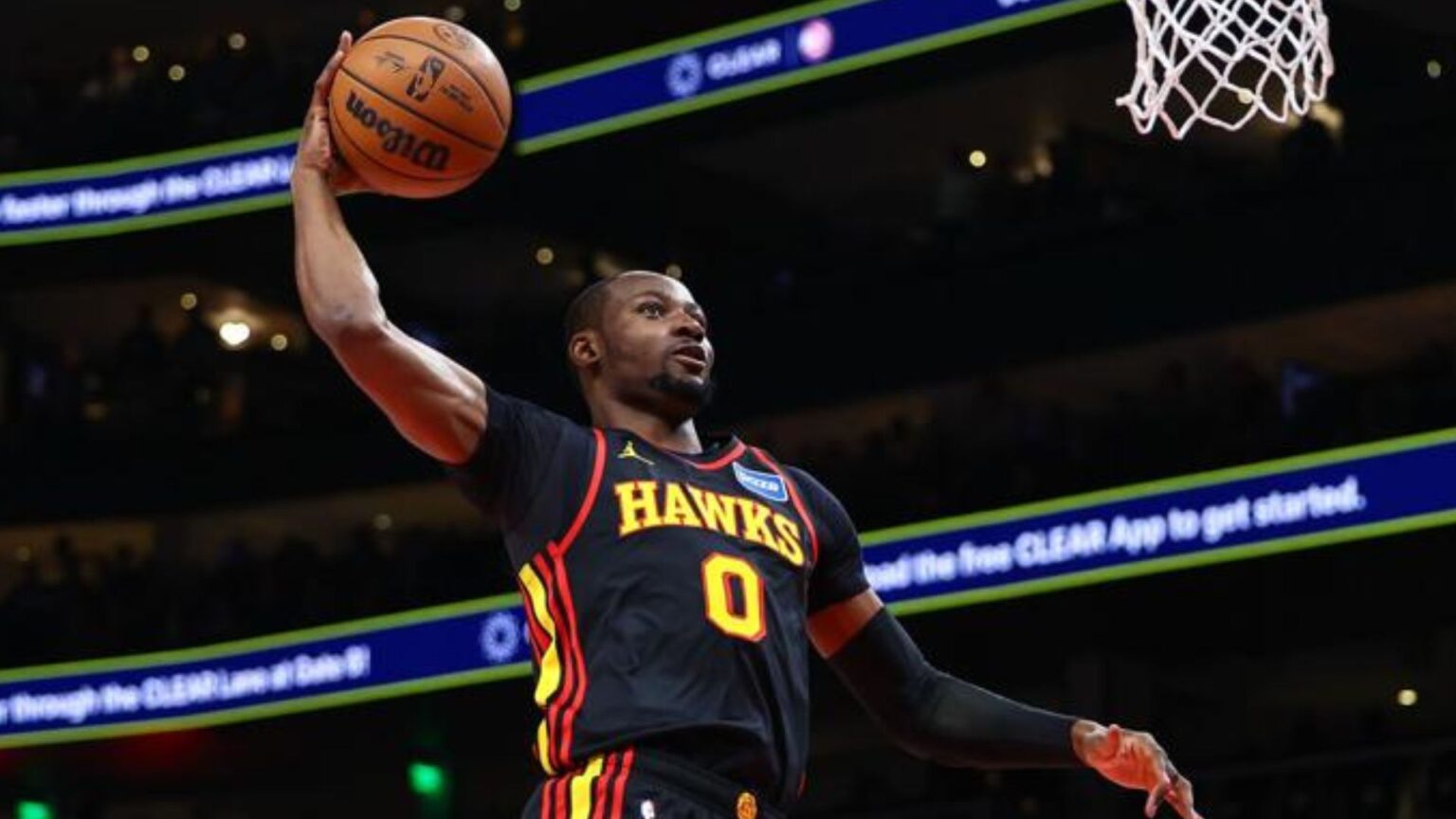
After joining the Hawks in a midseason trade, Jonatan Kuminga gave them 13.7 points and 3.3 rebounds in six playoff games, shooting 48.3% from the field, but only 20.8% from three. His debut was the best version of the idea: 27 points, seven rebounds, four assists, and two steals against the Wizards. He also had 19 points in Game 2 against the Knicks, so there were real flashes after the trade.
The contract part is why this one is different. Jake Fischer reported there is mutual interest between Kuminga and the Hawks in potentially declining his $24.3 million team option and working on a longer deal. That makes sense for both sides. Kuminga gets more security, and the Hawks can try to lower his yearly number instead of carrying a one-year $24.3 million hit. He is still 23, he gives them size and downhill pressure, and his role can grow if the shooting becomes more stable.
The Hawks should only pick up the option if there is no longer an agreement ready. The better path is to decline it and renegotiate, but only if Kuminga is already on board. His value is not high enough to make $24.3 million an easy number, but his age, athleticism, and playoff flashes make him too interesting to lose. A smaller annual salary over more years is the correct middle point.
3. Luguentz Dort – $18.2 Million Team Option
2025-26 Stats: 8.3 PPG, 3.6 RPG, 1.2 APG, 0.9 SPG, 0.4 BPG, 38.5% FG, 34.4% 3P
The Thunder didn’t need Luguentz Dort to score more this season. That was not his job. He played 69 games, averaged 26.8 minutes, and still finished with a +294 total plus-minus. The shooting dropped after he hit 41.2% from three in 2024-25, but 1.9 made threes per game at 34.4% is still enough when his main role is defense.
This decision is tied to the Thunder’s bigger payroll picture. Dort is not a star, but he is one of the main defensive pieces around big money makers like Shai Gilgeous-Alexander, Jalen Williams, and Chet Holmgren. Dort gives them something simple but hard to replace: a strong point-of-attack defender who accepts a low-usage role and still has to be guarded in the corners. His $18.2 million option is not cheap, but it is not bad for a starting-level playoff defender.
The Thunder should pick this option up unless they already have a longer deal lined up. Declining it just to save money would be too risky this year. Dort is not the player to overthink. He fits the identity, he knows the system, and he still has trade value if the Thunder need salary later. The smarter path is to keep control now and talk extension after.
4. Bogdan Bogdanovic – $16.0 million Team Option
2025-26 Stats: 7.4 PPG, 2.6 RPG, 2.2 APG, 0.4 SPG, 0.1 BPG, 38.8% FG, 34.7% 3P
Bogdan Bogdanovic’s season never really settled. He played only 23 games and averaged 19.7 minutes, so the Clippers never got the steady bench shooter they needed. The percentages were also below his standard: 38.8% from the field, 34.7% from three, and a 52.5% true shooting mark. For a veteran guard whose value is shooting, spacing, and second-unit creation, that is not enough.
The bigger issue was availability and trust. Bogdanovic missed time with a left hip injury, then a hamstring injury, and was kept out of the rotation once he got back. That is a bad sign for a $16.0 million team option. If a veteran shooter is healthy enough to be active but still not used, the role is already shrinking. The Clippers needed reliable minutes, not only the idea of what Bogdanovic used to be.
The Clippers should decline this option unless they need his salary in a trade. That is the only real argument to keep it. As a basketball move, $16.0 million is too high for a 33-year-old guard coming off a low-volume, injury-hit season. Bogdanovic can still help a team in the right role, but the Clippers need more athleticism, more defense, and more dependable rotation pieces.
5. Brook Lopez – $9.2 Million Team Option
2025-26 Stats: 8.5 PPG, 3.6 RPG, 1.3 APG, 0.6 SPG, 1.2 BPG, 42.8% FG, 36.0% 3P
At this price, Brook Lopez is not being paid like a star center. He is being paid like a veteran backup with one very specific skill package. He played 75 games for the Clippers, averaged 21.8 minutes, blocked 1.2 shots per game, and still made 1.5 threes per game at 36.0%. That is the whole case. He is 38, he is slower, and he can’t defend in space like he did in his best Bucks years, but he still protects the rim and forces defenses to respect him.
The Clippers used him behind Ivica Zubac, and that role made sense. Lopez was not asked to carry a big workload, but he gave them size when Zubac sat and helped keep the floor spaced for James Harden lineups. Now that both are gone in midseason trades, the issue is not usefulness. The issue is age, foot speed, and whether the Clippers can keep building around older players after finishing 42-40 and ninth in the West.
The Clippers should pick up the option. A $9.2 million number for a backup center who can block shots and shoot threes is fair. They would not find a much better replacement at that price while retooling for a younger timeline. Lopez won’t be there much longer, but for one extra year, this is fine.
6. Kevon Looney – $8.0 Million Team Option
2025-26 Stats: 2.8 PPG, 5.6 RPG, 1.6 APG, 0.4 SPG, 0.5 BPG, 41.7% FG, 15.4% 3P
This one is less about the box score and more about role. Kevon Looney played only 21 games for the Pelicans and averaged 14.7 minutes, so the production was small. Still, 5.6 rebounds in that limited time shows what he can still do. He is not a scorer, not a spacer, and not a vertical lob threat. He is a screen-setter, rebounder, short-roll passer, and veteran center who can help a second unit.
The season got off to a bad start before it really began. Looney suffered a sprain in his left knee during preseason action in Australia and was expected to miss two to three weeks. The Pelicans needed a stable veteran next to a young frontcourt. Instead, his role became smaller and uneven. By the end of the season, with the Pelicans already eliminated from postseason contention, he was not even starting the regular-season finale. That is not a strong sign for an $8.0 million option.
The Pelicans should decline it unless they badly want his locker-room value. Looney can still help a good team in a narrow role, but the Pelicans finished 26-56 and 11th in the West. They need youth, athleticism, and better frontcourt scoring. Paying $8.0 million for a limited veteran center doesn’t match where they are.
7. Kenrich Williams – $7.2 Million Team Option
2025-26 Stats: 6.5 PPG, 3.3 RPG, 1.4 APG, 0.6 SPG, 0.1 BPG, 47.3% FG, 38.8% 3P
There is still value in the regular-season version of Kenrich Williams. He played 56 games for the Thunder, averaged 15.3 minutes, and shot 38.8% from three on low volume. That is a useful profile when the roster needs a veteran forward who can defend, rebound, hit open threes, and not ask for touches.
But the playoff role tells the other side. He averaged only 2.7 minutes in the postseason so far, and that is the key part of this option. The Thunder are too good to keep spending on players who aren’t in the main playoff group. Williams is respected, and he has been part of the Thunder culture for years, but this roster is deeper now. Williams is more of an insurance piece than a rotation lock.
The Thunder should decline the option unless they need his $7.2 million number for a trade. That is the only strong reason to keep it. As a basketball move, paying $7.2 million for a 31-year-old forward who isn’t even in the playoff rotation is too much. If Williams wants to stay, a smaller deal would be the better path for both sides.
8. Day’Ron Sharpe – $6.3 Million Team Option
2025-26 Stats: 8.7 PPG, 6.7 RPG, 2.3 APG, 1.1 SPG, 0.4 BPG, 60.1% FG, 23.1% 3P
This is one of the simpler calls on the board. Day’Ron Sharpe had the best season of his career before the Nets shut him down with a torn ligament in his left thumb. He played 62 games, averaged 18.7 minutes, and gave the Nets 8.7 points, 6.7 rebounds, 2.3 assists, and 1.1 steals on 60.1% from the field. The three-point shot still isn’t there, but that is not a reason to move him.
The thumb injury stopped a good finish. In his last 20 games, Sharpe averaged 10.6 points, 7.6 rebounds, and 2.4 assists. He also had 14 points, 11 rebounds, four assists, one steal, and one block in 19 minutes against the Spurs in late February. That is exactly the type of backup center production the Nets need while they rebuild. He isn’t a franchise piece, but he is 24, strong, productive, and already knows the system.
The Nets should pick up the $6.3 million option. They finished 20-62 and 13th in the East, so this is not the time to throw away cheap, young frontcourt depth. Sharpe’s deal is also small enough to trade later if needed. At this number, he is worth keeping.
9. Ziaire Williams – $6.3 Million Team Option
2025-26 Stats: 10.2 PPG, 2.4 RPG, 1.1 APG, 1.4 SPG, 0.4 BPG, 42.5% FG, 34.3% 3P
The scoring line looks fine, but Ziaire Williams still had an uneven Nets season. He played 56 games, started 13, and averaged a career-high 10.2 points, but the rest of the profile didn’t take a big jump. The efficiency was acceptable for a wing at 57.9% true shooting, and 1.4 steals per game is a good number. Still, 2.4 rebounds from a 6-foot-9 forward is light, and the shooting stayed at 34.3% from three. That is playable, but it doesn’t jump off the page.
The season had some real movement. Jordi Fernandez benched Williams in December, arguing the defense had slipped, and that was the right message. Then Williams responded in January with one of his better stretches, averaging 13.7 points over three games, making 7 of 13 threes, and adding three steals and one block per game. He also had 14 points and five steals against the Rockets after getting another chance.
The Nets should pick up the $6.3 million option, but they shouldn’t treat Williams like a locked-in long-term piece yet. The price is too low to decline on a 24-year-old wing with size, steals, and some shooting growth. But the next step has to be consistency.
10. Nicolas Batum – $5.9 Million Team Option
2025-26 Stats: 4.0 PPG, 2.5 RPG, 0.9 APG, 0.6 SPG, 0.3 BPG, 40.3% FG, 40.4% 3P
At this stage, Nicolas Batum is almost a pure role player. He averaged only 4.0 points in 17.5 minutes, but the shooting still held up. He hit 40.4% from three and finished with a 60.3% true shooting mark, so the Clippers still got spacing from a veteran who doesn’t need plays called for him.
The contract side is also tied to retirement. Batum returned to the Clippers on a two-year, $11.5 million deal after declining his previous player option, and the second season is controlled by the team. There has also been reporting that he has thought about retirement for some time and had already hinted before the season that this could be his last year. That makes this decision less normal than most team options.
The Clippers should talk to Batum first. If he wants one more year, picking up $5.9 million is fine. That isn’t a heavy number for a 40.4% three-point shooter who knows the system and can play low-mistake minutes. But if retirement is near, there is no reason to force it. This is more about Batum’s plan than the cap sheet.
11. Daniss Jenkins – $4.0 Million Team Option
2025-26 Stats: 9.3 PPG, 2.3 RPG, 3.9 APG, 0.9 SPG, 0.2 BPG, 40.8% FG, 37.4% 3P
Daniss Jenkins did sign a multiyear contract. The key is that it was a two-year standard deal, but the second year is a team option for 2026-27. The Pistons converted him from a two-way contract into that two-year deal, and the 2026-27 club option sits at $4.0 million. So yes, it was multiyear, but it still leaves the Pistons with a decision this offseason.
The season made that decision easy. Jenkins went from two-way guard to a key rotation guard, and it wasn’t just empty minutes. He averaged 9.3 points and 3.9 assists in 20.2 minutes, shot 37.4% from three, and finished with a +209 plus-minus. In the playoffs, he put up 9.1 points and 3.0 assists in 14 games, started Game 6 against the Cavaliers, and led the Pistons with 17 points in their Game 7 loss.
The Pistons should pick up the option. A $4.0 million potential starting guard who can handle the ball, shoot enough, survive playoff minutes, and already has trust from the staff is useful. Jenkins isn’t a star prospect, but he earned this. For that price, there isn’t much debate.
12. Pat Connaughton – $3.8 Million Team Option
2025-26 Stats: 2.6 PPG, 1.5 RPG, 0.4 APG, 0.3 SPG, 0.0 BPG, 44.7% FG, 40.4% 3P
The shooting number still looks good, but Pat Connaughton wasn’t a true rotation piece this season. He averaged only 7.1 minutes across 32 games for the Hornets, and that is the whole story. A 40.4% mark from three usually has value, but the volume was small, and the role wasn’t stable. At 33, Connaughton is now more veteran depth than rotation answer.
The contract path was strange. Connaughton picked up his $9.4 million player option with the Bucks, then got traded to the Hornets with two second-round picks for Vasilije Micic. The Hornets later waived him on Feb. 4, then re-signed him on Feb. 9 to a two-year rest-of-season deal with a 2026-27 club option worth $3.8 million.
The Hornets can pick this up, and it wouldn’t hurt them much, but I’d still decline it unless they want him as a locker-room veteran. The money is low, but the roster spot has value. For a team trying to build around younger players, using one spot on a guard who barely played isn’t ideal.
13. Dominick Barlow – $3.4 Million Team Option
2025-26 Stats: 7.7 PPG, 4.8 RPG, 1.2 APG, 0.9 SPG, 0.7 BPG, 53.9% FG, 25.6% 3P
From two-way contract to 59 starts, Dominick Barlow had one of the better low-cost jumps on this list. He played 71 games for the 76ers, averaged 23.8 minutes, and gave them 7.7 points, 4.8 rebounds, 1.2 assists, 0.9 steals, and 0.7 blocks on 53.9% from the field. The three-point shot still wasn’t there at 25.6%, but that isn’t his main value. He gave the 76ers energy, size, activity on the glass, and enough defensive movement to stay on the floor.
The best moment came against the Clippers. Barlow had a career-high 26 points and 16 rebounds, including 10 offensive rebounds, in a 128-113 win. That game came right before the 76ers signed him to a standard NBA contract.
The 76ers should pick up the $3.4 million option. Barlow is 22, cheap, already gave them rotation minutes, and has a real body for frontcourt depth. He isn’t ready to be trusted as a full playoff piece yet, but this number is too small to decline.
14. Killian Hayes – $3.0 Million Team Option
2025-26 Stats: 5.5 PPG, 2.3 RPG, 3.5 APG, 0.9 SPG, 0.2 BPG, 30.4% FG, 27.0% 3P
Killian Hayes turned two 10-day contracts into a two-year deal with the Kings. Before that, he had been in the G League with the Cleveland Charge, where he scored 22.4 points, 4.1 rebounds, and 8.5 assists in 19 games. That is why the Kings took the look.
The NBA sample was rougher. Hayes averaged 5.5 points and 3.5 assists in 23 games, but the shooting was still a problem at 30.4% from the field and 27.0% from three. He did have a useful late game against the Warriors with 18 points, four assists, four steals, and three made threes, but that wasn’t the normal level.
The Kings should pick up the option. Hayes isn’t a rotation lock, and the shooting still isn’t good enough. But for $3.0 million with a non-guaranteed structure, he can compete in camp, cover backup point guard minutes, and be waived later if needed. For a 22-60 team, that is fine roster math.
15. Julian Champagnie – $3.0 Million Team Option
2025-26 Stats: 11.1 PPG, 5.8 RPG, 1.5 APG, 0.8 SPG, 0.5 BPG, 43.7% FG, 38.1% 3P
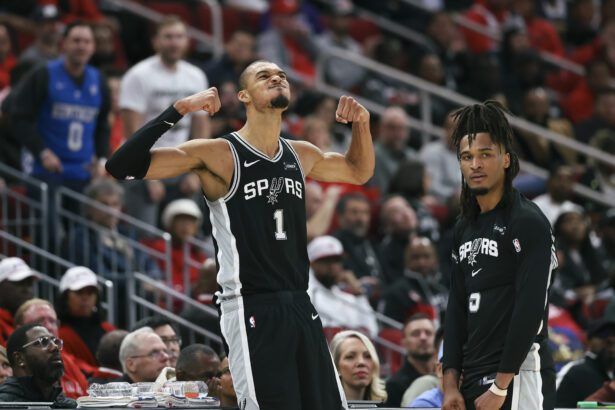
Few contracts on this list are easier to defend than Julian Champagnie at $3.0 million. He became an awesome starter for the Spurs this season, posting 11.1 points, 5.8 rebounds, and 1.5 assists in 27.6 minutes, while shooting 38.1% from three. In the playoffs, the role didn’t disappear. He has averaged 10.7 points, 5.8 rebounds, 1.5 assists, and 1.4 steals in 30.0 minutes, while shooting 40.0% from three.
The Spurs also trust him in high-level games. He has been in the starting group during the Western Conference Finals, and that says more than the regular-season stat line. After Game 2 against the Thunder, he also spoke about answering the physical pressure being thrown at him. That is the type of detail teams value from role players: shoot, defend, rebound, and understand the temperature of a playoff series.
The Spurs should pick this up without thinking a second, as his 2026-27 club option is one of the best values on the roster. For a 62-20 team already in the West Finals, keeping a 24-year-old 3-and-D wing at this price is automatic.
16. Micah Potter – $2.8 Million Team Option
2025-26 Stats: 9.7 PPG, 5.0 RPG, 1.5 APG, 0.5 SPG, 0.3 BPG, 51.5% FG, 42.3% 3P
A midseason pickup became useful fast for the Pacers. Micah Potter signed on Dec. 26 after injuries hit the frontcourt, and his deal became guaranteed for the rest of the season in January. He played 46 games and gave them real production: 9.7 points, 5.0 rebounds, and 1.5 assists in 19.3 minutes while shooting 51.5% from the field and 42.3% from three.
The point with Potter is simple. He isn’t a big defensive anchor, and he isn’t a playoff matchup answer against every team. But he gives the Pacers a stretch big man who can survive regular-season minutes, rebound enough, and punish second units. That has value when the roster is expensive, and the front office has to find cheap bench pieces.
The Pacers should pick this up. At $2.8 million, there isn’t much downside. Even if Potter becomes the third big, that salary is fine. A center who shoots 42.3% from three and already knows the system is hard to replace for the minimum. This should be one of the easier low-money decisions on the board.
17. Neemias Queta – $2.7 Million Team Option
2025-26 Stats: 10.2 PPG, 8.4 RPG, 1.7 APG, 0.8 SPG, 1.3 BPG, 65.3% FG, 12.5% 3P
This is almost automatic for the Celtics. Neemias Queta became a full-time starting center, played 76 games, and gave them size, finishing, rebounding, and rim protection on a cheap number. He wasn’t just a regular-season body either. He had 100 blocks, 636 rebounds, and 60 steals, which is real defensive production for a team that still wants to contend with Jayson Tatum and Jaylen Brown. The offense stayed simple, but that is fine. Queta finished hard, ran the floor, and shot 65.3% from the field.
The playoffs showed some limits because the Celtics didn’t always need him in every matchup, but that doesn’t change the contract call. At $2.7 million, this is cheap starting-center insurance. The Celtics should pick it up. There isn’t a better frontcourt value at that number, and Queta already proved he can handle a bigger role.
18. Jamaree Bouyea – $2.6 Million Team Option
2025-26 Stats: 5.7 PPG, 1.8 RPG, 1.8 APG, 0.6 SPG, 0.3 BPG, 45.8% FG, 29.5% 3P
The Suns gave Jamaree Bouyea his first real standard NBA contract after years of two-way deals and 10-day contracts. That alone says something about how the season went. He wasn’t a major rotation player, but he gave them 46 games, 14.0 minutes per night, and enough pressure as a backup guard to justify a longer look. His 27-point game against the Thunder was the big flash, and it showed the speed and downhill scoring that made the Suns keep him around.
The issue is the shooting. A backup guard at 29.5% from three is hard to trust if the ball isn’t in his hands. But this is only $2.6 million, and the Suns need cheap depth around a top-heavy roster. They should pick up the option, but Bouyea should enter camp fighting for minutes, not guaranteed a real role.
19. Jamal Cain – $2.6 Million Team Option
2025-26 Stats: 5.4 PPG, 2.0 RPG, 0.7 APG, 0.3 SPG, 0.1 BPG, 48.7% FG, 38.4% 3P
The Magic found a useful depth wing in Jamal Cain. He started on a two-way contract, then got converted to a standard deal in March. His regular-season role was small, but efficient: 5.4 points in 12.2 minutes, 48.7% from the field, and 38.4% from three. That is enough for a low-cost wing who doesn’t need touches.
There were also real flashes late. Cain had 20 points and eight rebounds against the Bulls in April, then gave the Magic 8 points and 9 rebounds in 24 minutes in Game 4 against the Pistons and a massive poster over Jalen Duren that went viral.
The Magic should pick up the option. Cain is 27, so this isn’t some huge upside play, but $2.6 million for a wing who can shoot, finish over people, rebound a little, and defend with energy is fine bench business.
20. GG Jackson – $2.4 Million Team Option
2025-26 Stats: 12.5 PPG, 4.3 RPG, 1.5 APG, 0.6 SPG, 0.8 BPG, 49.6% FG, 33.2% 3P
This is an easy keep for the Grizzlies. GG Jackson played 55 games, started 28, and gave them real scoring on a very small contract. The efficiency jump was important. After being more of a volume scorer early in his career, he shot 49.6% from the field and had a 59.1% true shooting mark this season. The three-point shot was only 33.2%, but he still made 1.2 threes per game and has enough size at 6-foot-9 to score over smaller wings.
The context also helped show what he can be. The Grizzlies had another broken season, Ja Morant missed a long stretch with a left elbow injury, and Jaren Jackson Jr. was moved to the Jazz in a major reset. Jackson had more freedom after that, including 20 points against the Trail Blazers when the Grizzlies had only eight players available and Morant was still out.
The Grizzlies should pick up the option without thinking. Jackson is 21, cheap, productive, and already has NBA scoring moments. The defense and shot selection still need work, but $2.4 million for a young forward with real creation ability is too good to decline.
21. Trayce Jackson-Davis – $2.4 Million Team Option
2025-26 Stats: 3.4 PPG, 2.7 RPG, 0.7 APG, 0.3 SPG, 0.5 BPG, 57.3% FG, 100.0% 3P
The full-season line doesn’t make Trayce Jackson-Davis look important, but the Raptors don’t need to judge him like a starter. He was stuck in a small role before the trade, then got moved from the Warriors to the Raptors for a 2026 second-round pick.
The best moment came right away. In his Raptors debut, Jackson-Davis had 10 points and 10 rebounds in a 122-104 win over the Pacers. That didn’t become his usual role, but it showed why the Raptors made the small bet. He finished the season at only 9.4 minutes per game, then barely played in the playoffs, so this isn’t some locked rotation piece.
The Raptors should still pick up the option. At $2.4 million, Jackson-Davis is a cheap center depth with size and NBA experience. If he doesn’t win minutes, the number is easy to move. If he does, the Raptors get a bench big man for almost nothing.
22. Pelle Larsson – $2.3 Million Team Option
2025-26 Stats: 11.4 PPG, 3.5 RPG, 3.4 APG, 0.7 SPG, 0.2 BPG, 49.6% FG, 32.3% 3P
The Heat should not overthink this one. Pelle Larsson became one of their best contract values this season. He played 70 games, started 54, and gave them 11.4 points, 3.5 rebounds, and 3.4 assists in 26.4 minutes. The three-point shot still needs work at 32.3%, but the rest of the offensive profile was strong.
The role was also bigger than expected because Tyler Herro missed time. Larsson became a starter, defended at the point of attack, handled secondary playmaking, and had his best game against the Bucks with 28 points, six rebounds, and six assists. He also played 22 minutes in the Play-In loss to the Hornets, so the Heat trusted him in a pressure game.
The Heat should pick up the $2.3 million option. That is not even a debate. Larsson is 25, productive, cheap, and extension eligible. The only question is how fast the Heat try to lock him up beyond next season.
23. Jamal Shead – $2.3 Million Team Option
2025-26 Stats: 6.6 PPG, 1.7 RPG, 5.4 APG, 0.9 SPG, 0.2 BPG, 36.7% FG, 32.1% 3P
The shooting still needs work, but Jamal Shead gave the Raptors real backup point guard minutes. He averaged 5.4 assists in only 20.6 minutes, which is strong production for a small guard who wasn’t used as a scorer first. Shead played with pace, pressured the ball, defended every star player incredibly, and didn’t look scared when the role got bigger.
The playoff stretch helped his case. After Immanuel Quickley re-aggravated his right hamstring injury and missed the rest of the Cavaliers series, Shead moved into a bigger role. He was praised by Darko Rajakovic for his defense during the series, and he finished Game 7 with 14 points, seven assists, and three rebounds in 36 minutes. That is valuable experience for a second-year guard on a cheap contract.
The Raptors should pick up the $2.3 million option. Shead isn’t a starter-level offensive guard yet, but he is cheap, tough, and already trusted in playoff minutes. At this price, declining him would make no sense.
24. Ryan Nembhard – $2.2 Million Team Option
2025-26 Stats: 6.6 PPG, 2.2 RPG, 5.3 APG, 0.4 SPG, 0.0 BPG, 41.5% FG, 35.6% 3P
Ryan Nembhard’s rookie season turned into more than a two-way story. He played 60 games for the Mavericks, started 27, and averaged 5.3 assists in 19.5 minutes. That assist number is the main reason this option is easy. He isn’t big, he doesn’t get to the line much, and his defense will always be tested because of size. But he controls tempo, gets the ball to the right spots, and shot 35.6% from three.
Nembhard had 15 points, nine rebounds, 23 assists, and two steals against the Bulls late in the season. That set a Mavericks rookie assist record and showed why they converted him from a two-way contract to a standard deal. Earlier in the season, he also had 28 points and 10 assists against the Nuggets, so this wasn’t only one random game.
The Mavericks should pick up the $2.2 million option. Nembhard isn’t locked as a long-term starter, but a cheap backup point guard with real passing feel is worth keeping. For that number, the risk is almost zero.