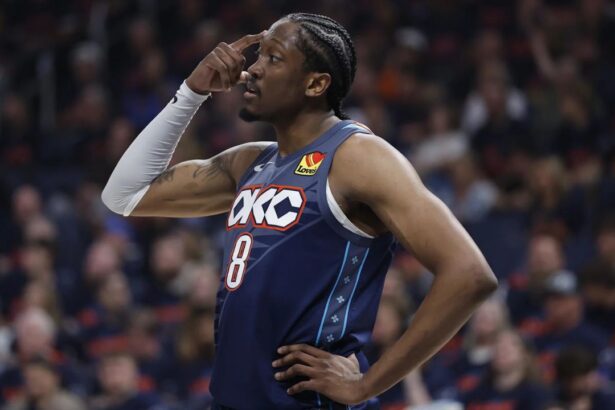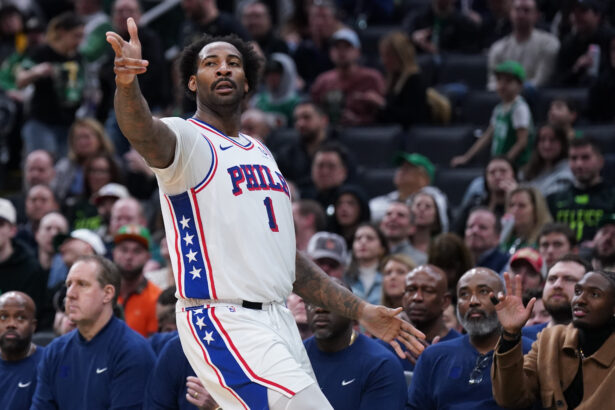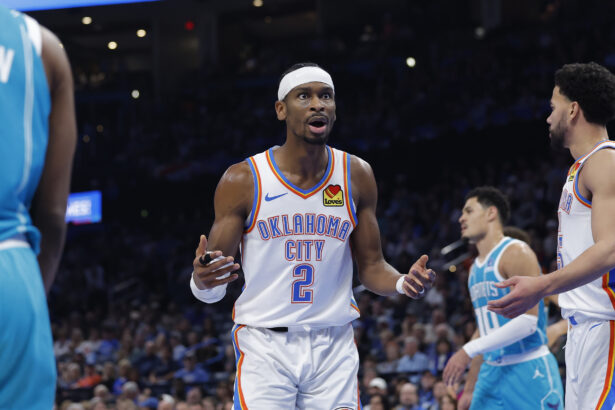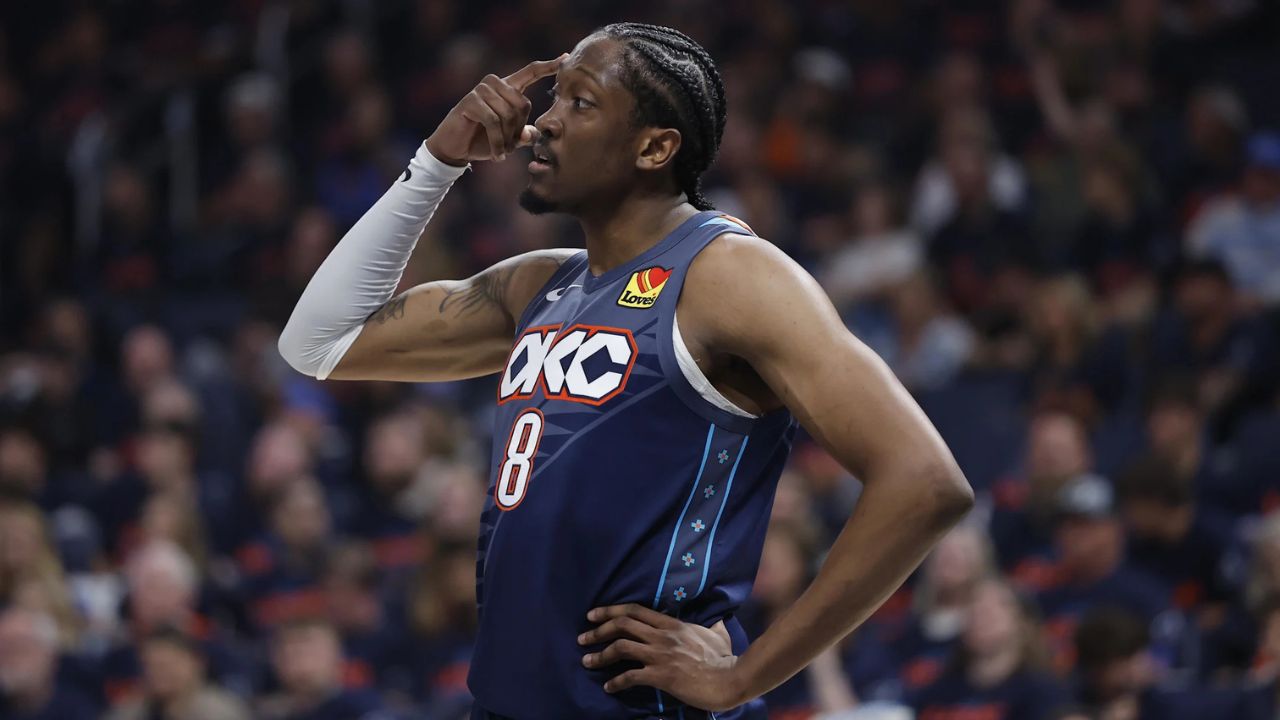
Jalen Williams is not the type of player a contender wants to trade. Williams is 25, already played at an All-NBA level, won the 2025 NBA championship with the Thunder, and has the exact wing profile every team wants: size, defense, passing, and efficient scoring. At his best, he is a title-level second or third star.
The problem is that the Thunder are entering a brutal payroll window. Williams’ five-year max extension starts in 2026-27, with a $41.3 million salary. Chet Holmgren also jumps to $41.3 million that same season, while Shai Gilgeous-Alexander is at $40.8 million before his supermax climbs to $61.0 million in 2027-28.
On top of that, Isaiah Hartenstein has a $28.5 million team option, Luguentz Dort has an $18.2 million team option, and Alex Caruso is at $19.6 million. That is a lot of money before the next decisions on Cason Wallace, Jared McCain, Ajay Mitchell, Isaiah Joe, and the rest of the rotation.
Williams also didn’t give the Thunder a max-player season in 2025-26. He played only 33 regular-season games and posted 17.1 points, 4.6 rebounds, and 5.5 assists on 48.4% from the field. In the playoffs, he had 14.4 points, 3.2 rebounds, and 2.8 assists in five games. He missed Game 7 of the Western Conference Finals against the Spurs with a left hamstring injury after struggling in Game 6 with one point and a minus-18 in 10 minutes.
That doesn’t mean the Thunder should rush into a trade. It means the front office has to be honest. If Williams is healthy, he is one of the best two-way wings in the league. If the injuries keep limiting him, his max salary becomes a harder fit next to Gilgeous-Alexander and Holmgren. For a team already carrying expensive decisions around Hartenstein, Dort, Caruso, Wallace, and McCain, one blockbuster move could become the cleanest way to protect the roster.
If the Thunder ever decide to turn Williams into multiple rotation pieces, cheaper contracts, and draft value, these five teams could build realistic trade offers.
5. Atlanta Hawks
Potential Trade Offer:
Atlanta Hawks Receive: Jalen Williams
Oklahoma City Thunder Receive: Dyson Daniels, Zaccharie Risacher, Buddy Hield, 2026 No. 8 pick
The Hawks are one of the more interesting landing spots because they already have a legitimate centerpiece in Jalen Johnson, who emerged as the franchise’s primary offensive engine after the Trae Young trade. The Hawks can use Johnson as the offensive hub, add Williams as the two-way wing, and pay with Dyson Daniels, Zaccharie Risacher, Buddy Hield, and the No. 8 pick.
This is a post-Young roster now, so the need is different. The Hawks don’t need another small guard who controls every possession. They need a wing who can score without stopping the offense, defend up a position, and take some creation load away from Johnson. Williams fits that. In 2025-26, his scoring was down because he played only 33 games and dealt with injuries, but the passing still shows why he works in a bigger offensive role.
The Hawks finished with Johnson as the clear center of the project. He put up 22.5 points, 10.3 rebounds, and 7.9 assists, which is not average forward production. That is why this trade should be built around helping him, not replacing him. Williams can work as the second creator next to Johnson, attack smaller wings, and guard the better perimeter scorer. That gives the Hawks a bigger playoff build than a guard-heavy roster.
Daniels is the real pain point for the Hawks. He gives elite defensive pressure, guard size, rebounding, and passing. He posted 11.9 points, 6.8 rebounds, and 5.9 assists on 51.7% from the field. He also has the exact defensive profile the Thunder value: long, active, low-usage, and able to play next to Shai Gilgeous-Alexander.
Risacher gives the Thunder a young wing with size and shooting growth. He had 9.6 points and 3.8 rebounds on 45.5% from the field. His $13.8 million salary in 2026-27 helps the salary structure. Hield adds $9.7 million in matching salary and shooting. The No. 8 pick is the asset that makes the package serious.
For the Hawks, this is expensive but logical. Johnson, Williams, Okongwu, Nickeil Alexander-Walker, Corey Kispert, and the rest of the rotation would have more size and more two-way balance. For the Thunder, it is a financial reset with real basketball value: Daniels replaces perimeter defense, Risacher gives wing upside, Hield gives shooting, and the No. 8 pick keeps the asset base strong.
4. Toronto Raptors
Potential Trade Offer:
Toronto Raptors Receive: Jalen Williams
Oklahoma City Thunder Receive: Brandon Ingram, Ja’Kobe Walter, 2028 first-round pick
The Raptors are a good landing spot because their roster already has size, passing, and enough offensive structure to use Williams without forcing him into full-time star creation. They finished 46-36, fifth in the Eastern Conference, with 114.6 points per game, 29.5 assists per game, and a +2.9 net rating. Their offense had strong flow, but the roster is heavy with similar wing creators. That is why this trade has logic.
Jalen Williams would give the Raptors a better defensive version of the Brandon Ingram role. He is not the same isolation scorer, but he has more two-way use in a playoff series. Scottie Barnes can handle as a big playmaker. RJ Barrett can attack downhill. Immanuel Quickley can play off the catch-and-run guard actions. Williams would be the wing who defends, passes, cuts, and works against tilted defenses.
The numbers show why this is also a risk. Williams’ 2025-26 was not at his 2024-25 level. He played 33 games, and the Thunder got only 14.4 points, 3.2 rebounds, and 2.8 assists from him in five playoff games. Trading for him means trusting the larger sample: the 2025 title run, the All-NBA level from the season before, and the fact that big wings with shot creation are still the hardest player type to find.
For the Thunder, this is not a salary-cut deal in year one. Brandon Ingram is at $40.0 million in 2026-27, close to Williams’ $41.5 million. The difference is contract shape. Williams is starting a five-year max. Ingram has a shorter veteran deal and gives the Thunder a different scorer next to Gilgeous-Alexander and Chet Holmgren. He posted 21.5 points, 5.6 rebounds, and 3.7 assists on 47.7% from the field. That is more scoring volume than Williams gave them this season.
Ja’Kobe Walter is needed because Ingram alone is not enough. Walter had 7.5 points, 2.6 rebounds, and 1.2 assists, and his $3.8 million salary in 2026-27 keeps him as a low-cost wing project. The 2028 first-round pick is the real value bridge. Without it, the Thunder would be trading the younger and more valuable player for an older scorer with less defensive range.
The Raptors would be betting on Williams as the more modern playoff wing. The Thunder would be betting that Ingram can help now while the extra pick and Walter soften the long-term loss.
3. Houston Rockets
Potential Trade Offer:
Houston Rockets Receive: Jalen Williams
Oklahoma City Thunder Receive: Jabari Smith Jr., Reed Sheppard, Dorian Finney-Smith, 2029 first-round pick
The Rockets have the best contending case of any team in this range. They finished 52-30, fifth in the Western Conference, with a 118.6 offensive rating, 113.2 defensive rating, and +5.4 net rating. They were also a major possession team: 48.1 rebounds per game, 15.0 offensive rebounds per game, and 34.4% offensive rebound rate, second in the league. That style travels in the regular season, but it can get tighter in the playoffs when opponents attack their lack of half-court creation.
Jalen Williams would fix part of that. He gives the Rockets another wing who can pass, defend, and create without stopping the offense. Kevin Durant can still score, but he is 37. Alperen Sengun is the offensive hub. Amen Thompson is a rim pressure and defensive monster, but still not a high-volume shooter. Williams fits between them because he can run secondary pick-and-roll, defend wings, and attack closeouts.
The Rockets’ three-point profile also explains the move. They shot 36.4% from three, but attempted only 31.5 threes per game. That is low for a contender built around spacing needs. Williams is not a movement shooter, but he helps by lowering bad possessions. In 2025-26, he had 5.5 assists per game in only 28.4 minutes. That means he can connect lineups without taking the ball from Sengun or Durant every trip.
The Thunder return is strong because it is not just picks. Jabari Smith Jr. starts a $122.0 million extension, with a $23.6 million salary in 2026-27. He had 15.8 points, 6.9 rebounds, and 1.9 assists on 44.9% from the field. Smith gives the Thunder size, spot-up shooting, defensive length, and a lower-cost forward who does not need a max role. He is not Williams as a creator, but he is easier to fit under a huge payroll.
Reed Sheppard is the upside guard. He gave the Rockets 13.5 points, 2.9 rebounds, and 3.4 assists, and shot 39.0% from three on high volume. That shooting profile has obvious value next to Gilgeous-Alexander and Holmgren. Dorian Finney-Smith adds $13.3 million in matching salary and veteran defense.
This is a hard offer for the Rockets because it removes two young rotation pieces. But a Durant, Sengun, Thompson, and Williams core has real playoff size and creation. For the Thunder, this is the best depth reset: one max wing becomes a younger stretch forward, a shooting guard, a veteran defender, and a first-round pick.
2. Miami Heat
Potential Trade Offer:
Miami Heat Receive: Jalen Williams
Oklahoma City Thunder Receive: Tyler Herro, Jaime Jaquez Jr., Nikola Jovic, 2030 first-round pick
The Heat are the most natural pressure team here. They finished 43-39, 10th in the Eastern Conference, with a 116.7 offensive rating, 114.5 defensive rating, and +2.2 net rating. That is not bad, but it is not enough for a roster paying veterans and trying to stay near the playoff race. The Heat scored 120.9 points per game and had 29.0 assists per game, but their roster still leaned too much on guards and shot creation that can be targeted in playoff series.
Jalen Williams would change the shape of their best lineups. He can play next to Bam Adebayo, Andrew Wiggins, Norman Powell, and Kel’el Ware without creating a size problem. He can defend wings, switch across bigger matchups, and handle second-side offense. That is the type of player the Heat have tried to find for years: not only a scorer, but a two-way wing who survives every possession in May.
The Heat also make sense because Williams would get a bigger offensive job than he had with the Thunder. Gilgeous-Alexander controls the Thunder offense. Holmgren needs frontcourt touches. Jalen Williams was still a second or third creator, and injuries limited him. With the Heat, he could run more elbow actions, more pick-and-rolls with Adebayo, and more late-clock possessions.
For the Thunder, Tyler Herro is the salary anchor. Herro is at $33.0 million in 2026-27 and put up 20.5 points, 4.8 rebounds, and 4.1 assists on 48.0% from the field. He gives the Thunder shooting and guard scoring next to Gilgeous-Alexander. The concern is defense, but the Thunder have enough defensive guards and bigs to cover that better than most teams.
Jaime Jaquez Jr. is the second piece. He posted 15.4 points, 5.0 rebounds, and 4.7 assists on 50.7% from the field. He is not a star, but he gives the Thunder a strong forward who can pass, cut, and run bench offense. Nikola Jovic adds size, shooting upside, and matching salary.
This deal is realistic because both teams get a direction. The Heat turn guard scoring and depth into a high-end wing. The Thunder turn one max into three useful salaries and a pick. The Heat would lose depth, but Williams gives them the better playoff archetype.
1. San Antonio Spurs
Potential Trade Offer:
San Antonio Spurs Receive: Jalen Williams
Oklahoma City Thunder Receive: Devin Vassell, Keldon Johnson, 2028 first-round pick, 2030 first-round pick
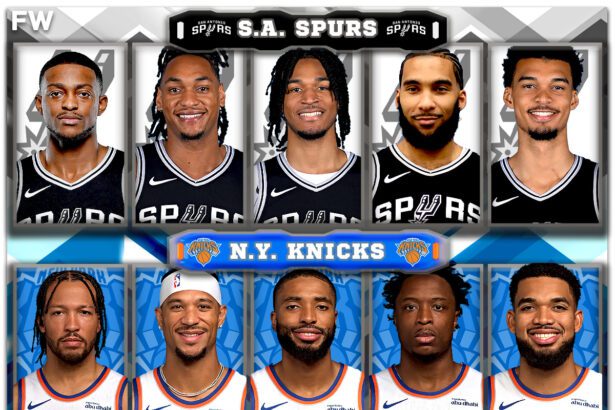
The Spurs are a great destination for a player who already knows what it takes to win a championship. This is a Finals team trying to turn a very good roster into a dangerous dynasty. The Spurs went 62-20, reached the 2026 NBA Finals, and already proved the base is real. Victor Wembanyama is the full system. De’Aaron Fox gives them rim pressure and late-clock speed. Stephon Castle and Dylan Harper give them young guard size. What they still don’t have is a true two-way wing scorer between the guards and Wembanyama.
Jalen Williams fits that exact hole. He would not need to be the first option. Wembanyama already had 25.0 points, 11.5 rebounds, and 3.1 blocks as the main star. Fox already bends defenses with speed. Castle led the Spurs with 7.4 assists. Williams would be the third creator who can attack weak defenders, defend strong wings, and keep lineups from becoming too guard-heavy. That role is better for him than being judged as the second scoring option on a Thunder team with huge salary pressure.
The salary structure also works. Williams starts his max extension at $41.3 million in 2026-27. Devin Vassell is at $27.0 million, and Keldon Johnson is at $17.5 million. That gets the Thunder real salary matching without forcing the Spurs to touch Wembanyama, Fox, Castle, or Harper. For the Thunder, this is not a pure downgrade. Vassell is a starting-level wing who can shoot, defend, and play without needing the ball every possession. Johnson gives them a strong forward body, downhill pressure, and bench scoring. The two first-round picks are needed because Williams is the best player in the trade.
From the Spurs’ side, the price is serious but not crazy. Vassell is good, but Williams is the better playoff archetype. Johnson is useful, but the Spurs already have enough frontcourt depth if Wembanyama, Harrison Barnes, Julian Champagnie, and the rest of the rotation stay healthy. The two picks hurt, but a Wembanyama team already in the Finals should not treat distant picks like untouchable assets.
The risk is obvious. The Thunder may not want to trade Williams to the team that just eliminated them in the Western Conference Finals. That is the biggest reason this deal could die fast. But if the offer is judged only by basketball and salary, the Spurs can make one of the strongest cases in the league. Williams would get a major role, better spacing, less creation burden, and a real title path next to the best defensive player in the NBA.