Game 7s never lie. And in this win-or-go-home battle, the Cleveland Cavaliers simply overwhelmed the Toronto Raptors when it mattered most.
It wasn’t always pretty, and at times it felt like both teams were trading punches in slow motion, but Cleveland’s dominance inside ultimately told the story in a 114-102 victory.
Behind monster efforts from Jarrett Allen and solid leadership from Donovan Mitchell, the Cavaliers imposed their will over the course of 48 minutes, turning second-chance opportunities into back-breaking sequences while controlling the tempo.
Meanwhile, the Raptors, despite strong performances from Scottie Barnes and RJ Barrett, simply couldn’t keep up with Cleveland’s size and discipline down the stretch, especially with Brandon Ingram absent.
Here are six things we learned from a gritty, bruising Game 7 that sent Cleveland forward and Toronto into an offseason full of questions.
1. Cleveland’s Rebounding Broke The Game Open
If you want to understand this game, start with the glass. The Cleveland Cavaliers completely hijacked the rebounding battle. Cleveland pulled down 60 total rebounds compared to just 33 for the Toronto Raptors, including a staggering 20 offensive rebounds.
Every missed shot turned into another opportunity, and Toronto simply had no answer for the second-chance pressure. Those extra possessions translated directly into control of the game’s rhythm.
Even though both teams shot nearly identical percentages (44.7% vs 43.7%), Cleveland generated far more chances to score. The Raptors actually held their own in points in the paint (50-42), but it didn’t matter when they couldn’t secure the ball after a stop.
2. Jarrett Allen Delivered A Game 7 Masterclass
Jarrett Allen was everywhere. His stat line, 22 points, 19 rebounds (8 offensive), and 3 blocks on 7-11 shooting, felt inevitable. Every time the Raptors looked like they might string together momentum, Allen would crash the glass, tip the ball out, or finish inside to stop the run.
What made his performance even more valuable was efficiency. Eight offensive boards meant eight extra chances, and several of those led directly to points or fouls. In a Game 7 where margins are razor-thin, Allen created separation almost single-handedly.
3. Donovan Mitchell Controlled The Tempo
While Donovan Mitchell didn’t have his most efficient shooting night (22 points on 9-20, 2-9 from three), he dictated when and how the game sped up or slowed down. He picked his spots, attacked mismatches, and most importantly, didn’t let the game spiral when Toronto made runs.
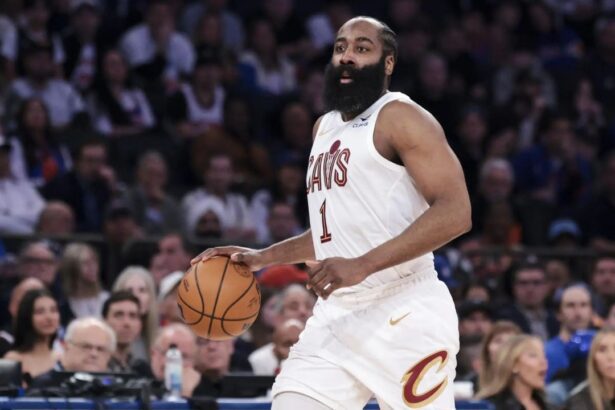
Then there was James Harden, who struggled and looked passive at times, but had 18 points, 11-13 from the line, 6 rebounds, 3 assists, and 3 steals. To his credit, though, his ability to get to the free-throw line stabilized Cleveland’s offense during some dry spells. The Cavaliers always had a steady hand on the wheel, with Mitchell attacking and Harden getting to the line.
4. Free Throw Disparity Affected The Outcome
Game 7s often come down to who executes the “boring” parts of basketball better, and Cleveland did exactly that at the line. The Cavaliers went 27-37 from the free-throw line, compared to 18-26 for Toronto. That’s a +9 advantage in made free throws, in a game decided by 12 points.
More importantly, Cleveland’s stars delivered under pressure. Harden (11-13) and Allen (8-14) constantly forced Toronto into fouls, putting the Raptors in reactive mode defensively. On the flip side, Toronto left points on the board with a 69.2% free-throw rate, and in a Game 7, missed opportunities like that stack up quickly.
5. Raptors’ Perimeter Shooting Failed Them At The Worst Time
The Toronto Raptors simply couldn’t generate enough offense from beyond the arc, finishing 8-28 (28.6%) from three-point range. In a modern playoff game, that’s a tough formula to win with – especially when your opponent is generating extra possessions.
RJ Barrett (1-6 from three) and Scottie Barnes (1-1, but limited volume) couldn’t stretch the defense enough, and players like Jamal Shead (2-8) struggled to convert open looks. Cleveland was able to pack the paint, contest drives, and dare Toronto to beat them from outside, and the Raptors couldn’t deliver.
6. Depth And Role Players Changed The Game
Beyond the stars, Cleveland’s supporting cast gave them just enough to stay in control. Max Strus chipped in 12 points, 8 rebounds, and 5 assists, while Sam Merrill added 13 points on 3-7 shooting from deep. These weren’t explosive performances, but they were timely, and in a Game 7, timely matters more than flashy.
Compare that to Toronto’s bench, which lacked consistent impact outside of Collin Murray-Boyles’ 17 points. The Raptors didn’t get enough supplementary scoring or playmaking to relieve pressure from their starters. Over the course of 48 minutes, Cleveland’s depth didn’t overwhelm, but it absolutely outperformed when it counted.