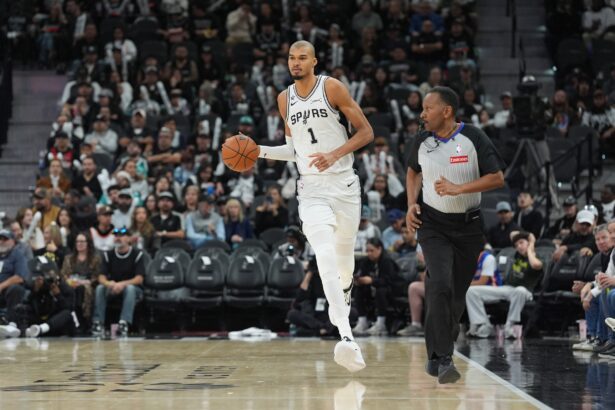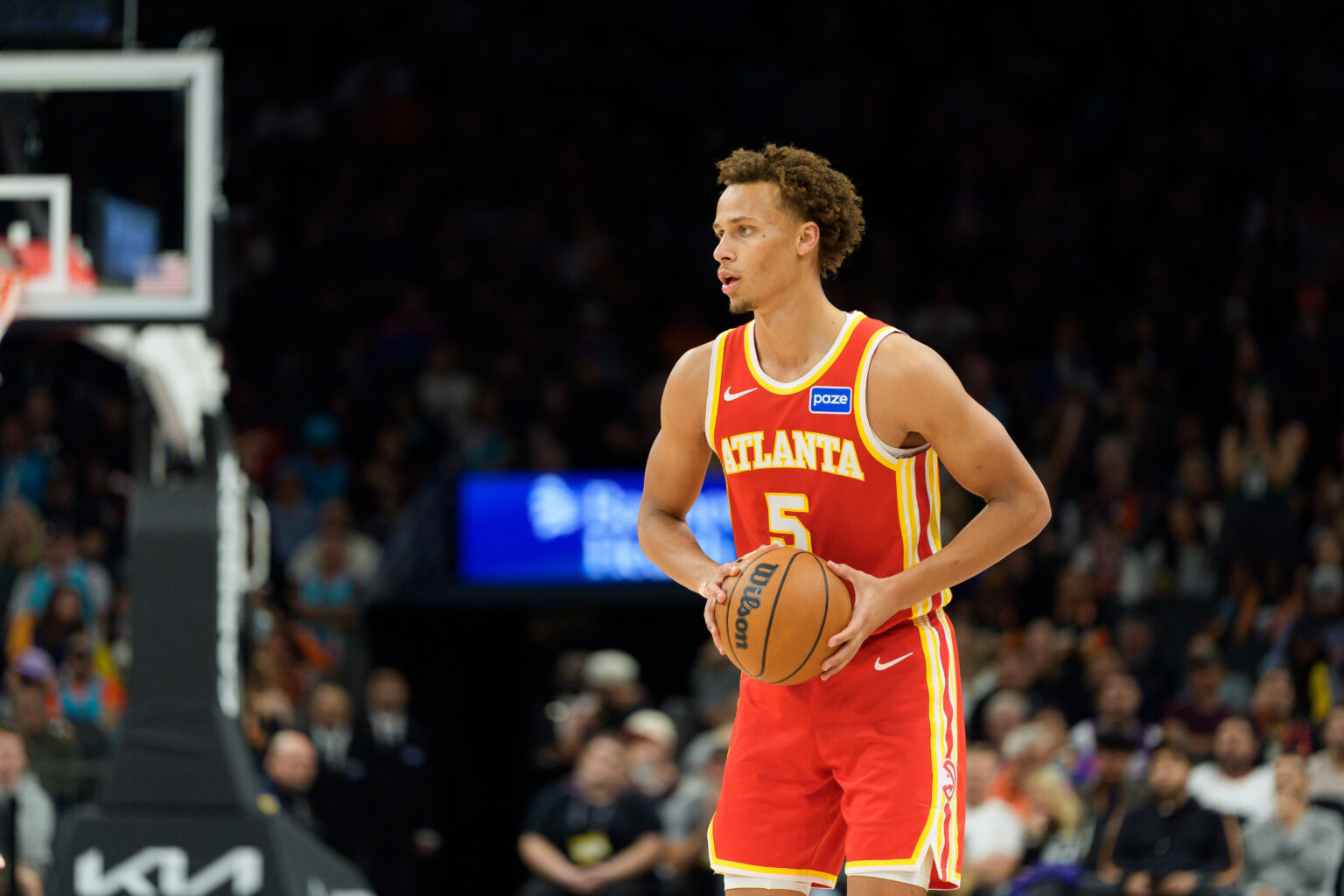
Dyson Daniels is still a high-level defender. He still gives the Hawks size at guard, elite hands, rebounding, passing, and ball pressure. He averaged 11.9 points, 6.8 rebounds, 5.9 assists, and 2.0 steals in 76 games this season, and the Hawks were better defensively with him on the floor. That part is real.
The problem is the contract and the shooting. Daniels signed a four-year, $100.0 million extension, and his 2026-27 salary jumps to $25.0 million. That is a big number for a guard who made only 18.8% from three-point range this season after hitting 34.0% in 2024-25. His three-point volume also collapsed from 3.1 attempts per game to 1.5 attempts per game.
That changes the conversation. Daniels is no longer a cheap defensive weapon. He is an expensive non-shooter who can be hard to close with in playoff games if teams ignore him away from the ball.
The Knicks exposed that problem in the first round. The Hawks lost the series in six games, then got crushed 140-89 in Game 6. Daniels finished that closeout game with three points, zero rebounds, zero assists, two turnovers, and a minus-36 in 15 minutes before being ejected.
If the Hawks can turn Daniels into shooting, scoring, or cheaper two-way depth, they should listen. Here are four realistic trades they should accept this offseason.
4. Brooklyn Nets
Brooklyn Nets Receive: Dyson Daniels
Atlanta Hawks Receive: Terance Mann, Drake Powell, 2028 second-round pick
This is not a star trade. That is why it feels realistic.
The Nets had one of the worst records in the league and are still building around young players, cap space, and future flexibility. They also have enough financial room to absorb a contract like Daniels without needing to match every dollar perfectly. Terance Mann is at $15.5 million for 2026-27, while Drake Powell is on a rookie deal worth about $3.4 million in 2025-26 and $3.5 million in 2026-27. Daniels is at $25.0 million, so the Nets would need to use room or structure the deal as an offseason cap-space move.
The basketball idea for the Nets is easy. They need perimeter defense. They have young guards and wings, but not many players who can take the hardest backcourt assignment every night. Daniels can do that. He can pressure the ball, jump passing lanes, rebound above his position, and make life easier for their bigs.
The Nets also have enough offensive development pieces to take a gamble on the jumper. Egor Demin, Nolan Traore, Drake Powell, Michael Porter Jr., and others are still forming roles. Daniels would not need to be a top scorer. He would need to defend, pass, run in transition, and help create a defensive identity.
For the Hawks, this is a value-reset trade. Mann averaged 7.2 points, 3.2 rebounds, and 3.0 assists while shooting 36.4% from three-point range. He is not a major scorer, but he is a veteran guard-wing who can defend, move the ball, and play without needing touches.
Powell is the swing piece. He averaged only 7.0 points, 2.0 rebounds, and 1.0 assists as a rookie, and his 28.0% three-point shooting was not good. But he is 21, athletic, and still has wing tools. NetsDaily noted that Powell showed flashes as a point-of-attack defender, even if his overall defensive impact and off-ball awareness were not consistent yet.
This is the lowest return on the list, but that is the point. Daniels’ value is not what it was last offseason. The Hawks would get a cheaper veteran, a young wing, and a second-round pick while moving off a $100.0 million contract that already looks harder to justify.
The Nets would be buying low. The Hawks would be reducing risk.
3. Utah Jazz
Utah Jazz Receive: Dyson Daniels
Atlanta Hawks Receive: Cody Williams, Brice Sensabaugh, John Konchar, 2030 second-round pick
The Jazz had the second-worst defensive rating in the NBA this season at 122.3, only ahead of the Wizards. That is the main reason they should even think about Daniels. They were not just bad defensively. They were close to non-competitive on that end. A guard who can defend the ball, create steals, and organize pressure would help them right away.
The money would require the Jazz to use cap flexibility. Cody Williams is listed at around $6.0 million for 2026-27, John Konchar is at $6.2 million, and Brice Sensabaugh is at $4.9 million. That is around $17.0 million going to the Hawks for Daniels’ $25.0 million. The Jazz are not an apron team, so they can make this work if they operate with room or adjust the structure with another small salary.
For the Jazz, Daniels would give them a defensive adult in the backcourt. Keyonte George can score. Lauri Markkanen can carry an efficient offense. Ace Bailey is a long-term wing bet. Walker Kessler protects the rim with Jaren Jackson Jr. as the roam safety. But none of that means much if guards get into the paint without resistance.
Daniels fixes part of that. He can guard point guards, bigger guards, and some wings. He can also push the pace after steals and rebounds. On a Jazz team that needs to build real habits, that has value.
For the Hawks, Williams is a developing prospect. He averaged 8.8 points, 3.0 rebounds, and 2.0 assists while shooting 46.8% from the field, but only 21.4% from three-point range. That shooting is a problem, so this would not be a perfect offensive fix. But Williams is 6-foot-8, still young, and gives the Hawks another wing development bet.
Sensabaugh gives the Hawks more upside as an exciting scoring option. He had flashes as a shooter and bench scorer with the Jazz, including a 27-point game against the Magic after previously scoring a career-high 34 against the Heat. He is not a proven rotation piece yet, but he has a clearer scoring profile than Daniels.
Konchar is just salary and depth. He can rebound, pass, and defend in limited minutes, but he is not the reason for the trade. The second-round pick helps close the gap.
This is not a perfect return. But if the Hawks believe Daniels’ contract will only get harder to move, this is a reasonable way to get younger wings and lower the long-term money.
The Jazz would be betting on defense. The Hawks would be betting that two young wings and flexibility are better than paying $25.0 million per year to a guard defenses refuse to guard.
2. Sacramento Kings
Sacramento Kings Receive: Dyson Daniels
Atlanta Hawks Receive: Malik Monk, Devin Carter
This is the best pure basketball trade for both teams outside the last framework.
The Kings were one of the worst defensive teams in the NBA. They had a 121.5 defensive rating, third-worst in the league behind only the Wizards and Jazz. A team with Domantas Sabonis, Zach LaVine, Malik Monk, DeMar DeRozan, and Keegan Murray had enough offensive names, but it did not have enough perimeter resistance.
Daniels would help with that immediately. He would take the toughest guard assignment, pressure ball-handlers, and let LaVine and Monk avoid the hardest defensive jobs. He would also give the Kings more size in the backcourt. For a team that gave up too many easy paint touches, that matters.
The salary is almost exact. Monk is owed $20.2 million in 2026-27, and Devin Carter is owed $5.2 million. Daniels is at $25.0 million. That makes this one of the easiest financial frameworks on the board.
For the Hawks, this is the trade they should like the most if they want to stay competitive without making a huge move. Monk averaged 12.5 points, 1.9 rebounds, and 3.0 assists in 62 games while shooting 39.5% from three-point range. His role was smaller than usual, but the skill set fits what the Hawks need: shooting, burst, bench scoring, and another guard who can attack a tilted defense.
Monk is not a perfect player. He can be streaky, and he is not a defensive answer. But he gives the Hawks something Daniels does not: real shooting gravity. Teams have to guard Monk above the break. They have to chase him in handoff actions. They have to respect his pull-up jumper. That opens the floor for Jalen Johnson, Zaccharie Risacher, Jonathan Kuminga, and Onyeka Okongwu.
Carter is the reason the Hawks should push for this structure. He is a young guard with defensive tools, rebounding, and enough upside to be more than a throw-in. He would not replace Daniels right away, but he gives the Hawks another cheap guard to develop while Monk improves the offense.
For the Kings, the risk is spacing. Daniels, Sabonis, and any non-elite shooter together can make the floor tight. The Kings would need LaVine, Murray, and their wings to make enough shots. But their defensive problem was so bad that they have to take some kind of swing.
This trade gives both teams a logical answer. The Kings get the defender they do not have. The Hawks get shooting, guard depth, and a younger salary. If this offer is on the table, the Hawks should take it.
1. Miami Heat
Miami Heat Receive: Dyson Daniels, Corey Kispert
Atlanta Hawks Receive: Tyler Herro, Davion Mitchell
This is still the best Daniels trade because it solves a real problem for both teams.
The Heat need more perimeter defense and a stronger identity around Bam Adebayo. They also have a Herro decision. Tyler Herro averaged 20.5 points, 4.8 rebounds, and 4.1 assists while shooting 48.0% from the field and 37.8% from three-point range, but he played only 33 games. He is expensive, extension-eligible, and not easy to build around defensively.
Daniels gives the Heat the opposite profile. He is not the scorer Herro is. He is not close. But he gives them a big defensive guard who can pressure the ball, rebound, and take hard assignments. That type of player fits next to Adebayo, Andrew Wiggins, Nikola Jovic, and the rest of their defensive structure.
The Heat are one of the few teams that could live with Daniels’ shooting problem. Erik Spoelstra can use him as a cutter, screener, transition passer, and defensive weapon. Adebayo can play at the elbow. Wiggins can attack the second side. Jovic can space. Daniels would not need to be a classic shooting guard.
Kispert is the key to making the Heat side work. If the Heat take Daniels, they need shooting coming with him. Kispert gives them that. He is a movement shooter who can play off Adebayo and help cover the spacing hit that Daniels creates.
For the Hawks, this is the best talent return. Herro gives them a 20-point scorer who can shoot, handle, and run offense. He can play off Jalen Johnson as a second-side scorer, take handoffs from Okongwu, and punish defenses that ignore the corners. The Hawks finished with a strong offense, but the Knicks series showed how quickly things can shrink when the game becomes physical. They need more real shot-making.
Davion Mitchell is also important. He averaged 9.3 points, 2.7 rebounds, and 6.5 assists while shooting 49.0% from the field and 39.5% from three-point range for the Heat. He is smaller than Daniels, but he gives the Hawks elite guard defense and playmaking at a lower cost.
Financially, this can be built in the offseason. Daniels is at $25.0 million, and Kispert is listed at about $14.0 million on the Hawks’ cap table. Herro is at $33.0 million on the Heat tax table, and Mitchell is at $12.4 million. The Hawks would take on more salary, but they would also receive the best offensive player in the deal.
This is not risk-free. Herro has injury issues. He is not a defender. His next contract could become expensive. But the Hawks are not getting a perfect player for Daniels after that shooting season. That is not how the market works.
The Heat get defense and shooting depth. The Hawks get scoring and a cheaper defensive guard. It is the type of trade where both teams are changing one problem for another.
For the Hawks, that is acceptable. Daniels’ defense is still valuable, but $25.0 million per year for a guard who shot 18.8% from three-point range is dangerous team-building. If the Heat are willing to put Herro into a Daniels-Kispert framework, the Hawks should say yes.