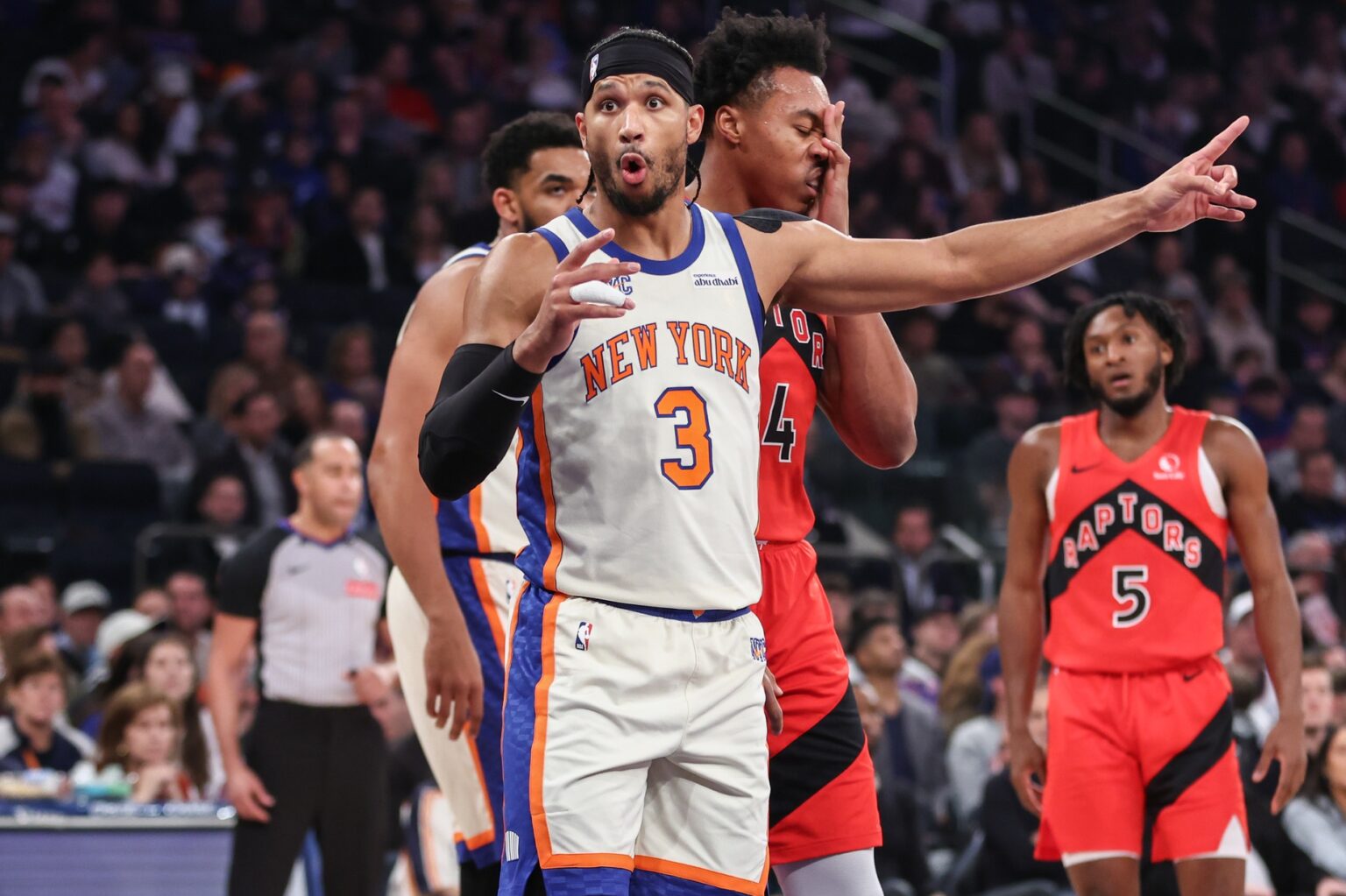
The Toronto Raptors host the New York Knicks at Scotiabank Arena on Tuesday, March 3, at 7:30 PM ET.
The Raptors are 35-25 and fifth in the East, while the Knicks are 39-22 and third. The Raptors are 16-15 at home, and the Knicks are 15-14 on the road.
The Raptors last played Saturday and beat the Wizards 134-125, while the Knicks come in off Sunday’s 114-89 win over the Spurs. This is the fourth meeting between them, and the Knicks lead the season series 3-0, including the 119-92 win on January 28.
For the Raptors, Scottie Barnes is at 19.1 points, 8.2 rebounds, and 5.5 assists, with Brandon Ingram leading in scoring at 21.9 points, 5.8 rebounds, and 3.8 assists.
For the Knicks, Jalen Brunson leads the attack with 26.7 points and 6.1 assists, and Karl-Anthony Towns brings 19.8 points and 11.8 rebounds.
The hook is straightforward: the Raptors are trying to stop a three-game home slide, and the Knicks are trying to keep their grip near the top of the conference.
Injury Report
Raptors
Chucky Hepburn: Out (G League – Two-Way)
Collin Murray-Boyles: Out (left thumb sprain)
Knicks
Pacome Dadiet: Out (G League – On Assignment)
Trey Jemison III: Out (G League – Two-Way)
Dillon Jones: Out (G League – Two-Way)
Miles McBride: Out (pelvic core muscle surgery)
Why The Raptors Have The Advantage
The Raptors’ best path starts with how they play in the open floor. They average 19.0 fastbreak points per game (1st), and they also allow just 12.5 opponent fastbreak points per game (2nd). If they can turn stops into early offense, it reduces the number of possessions where the Knicks can get set and dictate matchups.
Their offense is also built around movement. The Raptors are at 29.1 assists per game (4th) and 0.71 assists per made field goal (4th), and they pair that with a strong assist-to-turnover rate at 2.1 (3rd). In this matchup, that is key because the Knicks defend well in the half-court; the Raptors need the ball to change sides quickly to create clean looks.
The interior is another real lever. The Raptors score 52.0 points in the paint per game (7th), and they allow 47.3 paint points (8th). If they win the paint battle, they can keep pressure on the Knicks without needing a huge three-point night.
The other key is forcing mistakes. The Raptors force 15.9 opponent turnovers per game (5th) and sit in the top five in opponent turnovers per play (4th). Against a team that’s comfortable controlling pace, extra possessions are the simplest way for the Raptors to change the game.
The challenge is obvious, and it’s why this has been 3-0. The Raptors shoot 34.7% from three (22nd) and make 11.5 threes per game (25th). When the Knicks take away layups and clean paint points, the Raptors have to hit enough jumpers to keep the scoreboard moving.
Why The Knicks Have The Advantage
The Knicks’ advantage begins with the overall efficiency profile. They score 117.3 points per game (9th) and allow 111.2 (5th), which lines up with a +6.2 scoring margin (4th). That’s the baseline of a team that usually wins the possession battle without needing anything unusual to happen.
The shooting numbers support that. The Knicks are at 37.6% from three (4th), while taking 39.6 threes per game (8th) and making 14.9 (4th). Even though the Raptors have done a good job limiting opponent threes (34.9% allowed, 6th), the Knicks’ volume gives them a steady source of points when the game slows.
The paint defense is the matchup hinge. The Knicks allow 44.3 points in the paint per game (4th) and hold opponents to 45.7% shooting overall (6th). Since the Raptors’ best offense is built around rim pressure and quick touches inside, this is the area where the Knicks can force tougher attempts.
Rebounding is another quiet edge that can show up in a road game. The Knicks grab 54.5 rebounds per game (9th) and pull down 13.1 offensive rebounds (4th). If they get second shots, it becomes harder for the Raptors to run, because they’re inbounding after makes instead of pushing after misses.
The final piece is control. The Knicks commit 13.4 turnovers per game (4th) and sit fourth in turnovers per play (11.7%). If they stay clean with the ball, it takes away the Raptors’ easiest scoring source, which is pressure into transition.
X-Factors
Gradey Dick is the type of swing shooter the Raptors need right now. Dick is scoring 6.3 points with 2.2 rebounds and 0.7 assists. If he hits early catch-and-shoot looks, it makes the Knicks think twice about loading the paint, and it gives the Raptors more room for Barnes and Ingram to attack.
Immanuel Quickley is the offensive chaos piece. Quickley is at 17.5 points, 4.2 rebounds, and 6.0 assists. Against a defense that wants to squeeze possessions late, his job is keeping the Raptors afloat with his extended range from deep, getting the defense collapse on aggressive drives, and making sure empty trips don’t pile up.
Josh Hart is the Knicks’ effort advantage. Hart brings 11.8 points, 7.4 rebounds, and 5.2 assists, and his value is the extra possessions: rebounds that extend quarters, quick outlets that create early offense, and loose-ball plays that tilt a close game.
Mitchell Robinson is the defensive swing. Robinson is at 5.1 points and 8.6 rebounds while shooting 69.9% from the field. If he controls the paint and keeps the Raptors from getting easy finishes, it pushes more of the game toward perimeter shot-making, which favors the Knicks over 48 minutes.
Prediction
I’m taking the Knicks. The two-way baseline is stronger, and it matches the matchup: 117.3 points per game (9th) with 111.2 allowed (5th), plus a top-five paint defense at 44.3 opponent points in the paint (4th). If the Raptors don’t win the turnover battle decisively, it’s hard to get enough clean scoring against this profile.
Prediction: Knicks 113, Raptors 108