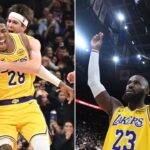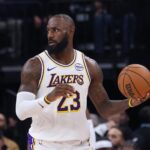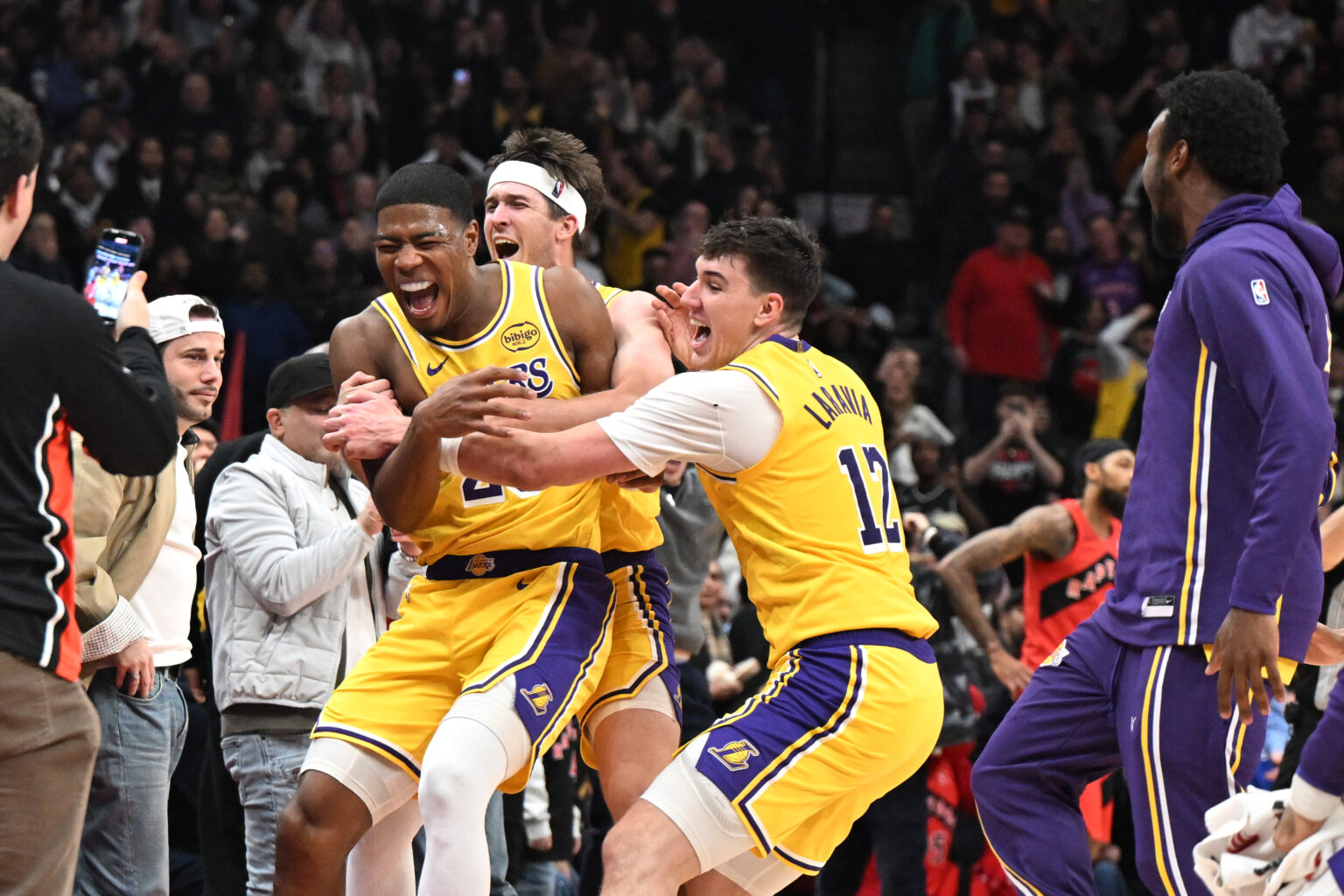
The Lakers survived one of those wild finishes that can tilt the momentum of a season. Rui Hachimura buried a corner three as time expired, capping a night where Los Angeles had to scratch through cold stretches, a rough LeBron James shooting performance, and a Raptors team that punched back every time the Lakers looked ready to pull away. The game-winner not only saved the Lakers from overtime, but it also arrived on the same night LeBron’s historic streak of 1,297 straight double-digit scoring games finally came to a halt.
What made the ending even more surreal is that LeBron, who went just 4-for-17, trusted the moment instead of trying to force himself out of a slump. His 11th assist, a drive and kick that drew half the defense, set up Hachimura’s dagger and sealed a 123-120 victory. Austin Reaves was spectacular with a 44-point masterpiece, including a jaw-dropping 22 in the third quarter, while Los Angeles got timely contributions from Deandre Ayton, Jake LaRavia, and several bench pieces. Now 9-2 on the road and winners in eight of their last nine, the Lakers continue to look like a group that’s learning how to close games in different ways.
1. Austin Reaves Played Like A Star And Then Some
On a night when the Lakers desperately needed someone to carry the offensive load, Austin Reaves delivered one of the best games of his career. His 44 points came on a hyper-efficient 13-of-21 shooting, and the Raptors never figured out how to keep him out of the lane. Reaves piled up 22 points in the third quarter alone, repeatedly attacking mismatches, drawing fouls, and burying shots from deep (5-of-11 from three). He also added 10 assists and got to the line 15 times, a sign of how much pressure he put on Toronto’s defense from every angle.
What stood out most was his command. Even while the Lakers were wobbling early and LeBron couldn’t buy a bucket, Reaves looked calm, orchestrating possessions like he’d been the lead guard for a decade. The Raptors tried length on him, then strength, then traps but none of it worked. Games like this change reputations around the league, and Reaves looked every bit like a player ready to take on more responsibility moving forward.
2. LeBron’s Shooting Faltered, But His Decision-Making Won the Game
It’s hard to remember many nights where LeBron James shot this poorly. He finished with eight points on 4-of-17 shooting, missed all five threes he attempted, and didn’t earn a single free throw, something that almost never happens. Yet despite the struggles, he still impacted the game in a meaningful way. His 11 assists guided the Lakers’ offense when it started to drift, and his playmaking freed Reaves, Hachimura, and Ayton for clean looks all night long.
And when it mattered most, LeBron didn’t force it. After Brandon Ingram missed a potential go-ahead layup with 23 seconds left, LeBron drove, collapsed the defense, and rifled a pass to Hachimura in the corner. That shot snapped Toronto’s hopes and highlighted why LeBron’s IQ still swings games, even when the scoring isn’t there. His streak of double-digit scoring finally ended, but his imprint on the win was unmistakable.
3. The Lakers’ Supporting Cast Tilted The Game
Rui Hachimura’s game-winner will grab headlines, but his stat line (12 points on 4-of-9 shooting and seven boards) tells the story of a steady, low-drama performance. Deandre Ayton gave the Lakers an efficient 17 points on 8-of-11 shooting along with eight rebounds and two blocks, punishing Toronto in the paint whenever they went small. Meanwhile, Jake LaRavia added 14 points in 28 minutes, hitting two threes and cleaning up several broken possessions with strong cuts and offensive rebounds.
The bench didn’t dominate, but it made the right plays at the right times. Nick Smith Jr. produced 12 points in just 14 minutes, converting two threes and giving L.A. a spark when the offense stalled. Even role players who only logged short stints, Adou Thiero and Jaxson Hayes, helped the Lakers survive defensive lapses by Toronto. With the Lakers missing Luka Doncic, they needed collective steadiness. They got exactly that.
4. Los Angeles Won The Efficiency Battle
The Lakers didn’t win this game with flashy numbers; they won it by being more efficient in the places that matter. They shot 50% from the field and 42% from three (13-of-31), while Toronto matched them nearly shot-for-shot but couldn’t keep pace at the foul line. L.A. hit 22 of its 26 free throws, compared to 17-of-21 for the Raptors. Those five extra points ended up being the margin that kept the door open for Hachimura’s heroics.
They also protected the ball. The Lakers finished with just 11 turnovers to Toronto’s 15, and both teams converted those mistakes into exactly 14 points each. The difference came elsewhere, in the paint, where L.A. dominated 58-46, and in clutch shot-making late. Toronto got strong games from Scottie Barnes (23 points, 11 rebounds, nine assists), Brandon Ingram (20 points, seven assists), and Ja’Kobe Walter (17 points), but they couldn’t slow down Reaves or keep Los Angeles off the glass in the final stretch. The Lakers didn’t play perfect basketball, but they played composed basketball, and it showed.