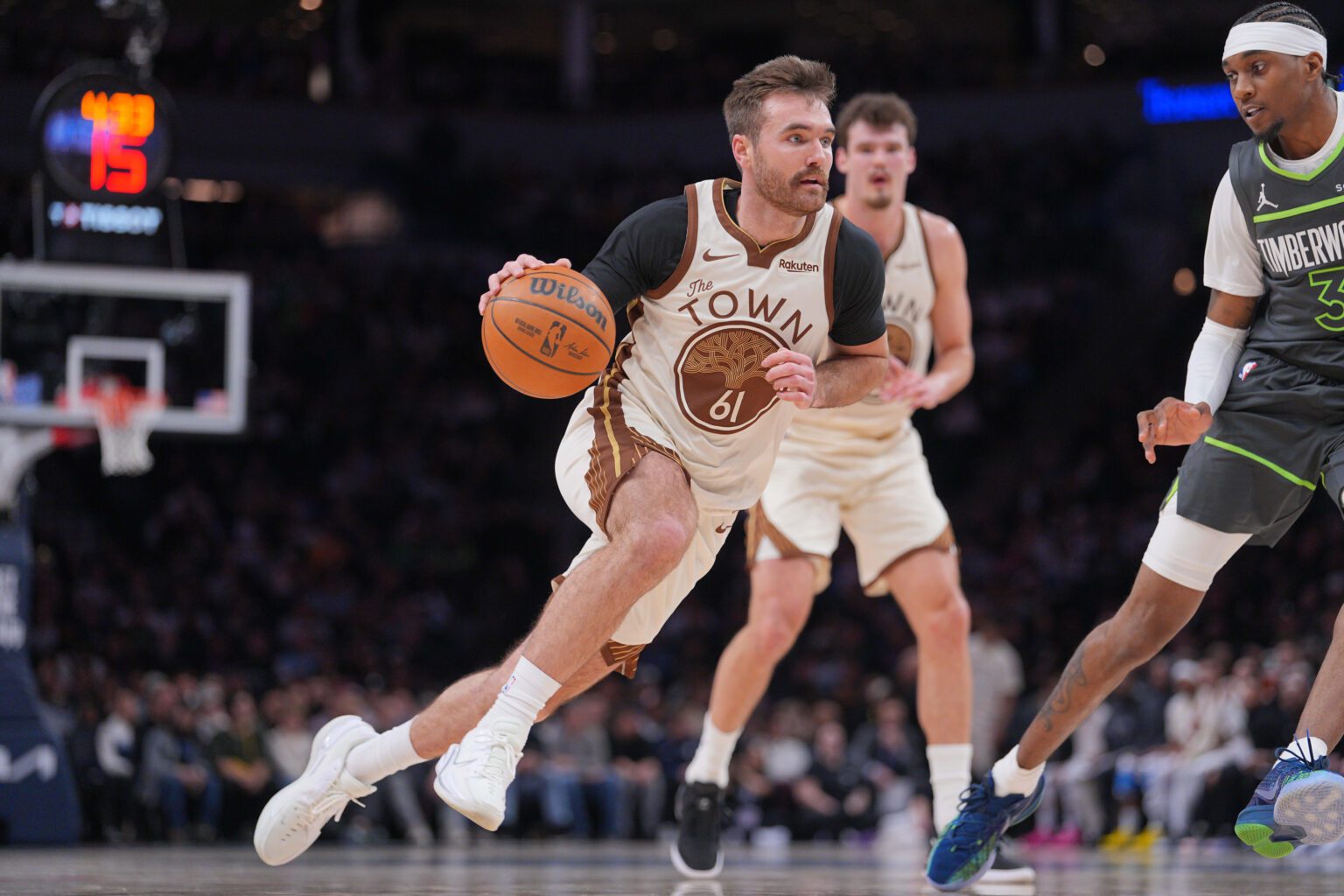
The Timberwolves, looking confident from the start, outmatched the Warriors, 83-108. Golden State, whose only productive scorer, Stephen Curry, was out, couldn’t find their scoring groove and shot poorly the entire game. Minnesota took the lead quickly and increased it to 30 points in the second half. The Warriors’ loss exposed the impact of Curry not playing and the Warriors’ shooting struggles.
Golden State shot only 34.7% from the field and an abysmal 23.1% from deep (9-39). Minnesota’s statistics looked much better. They shot 45.7% from the field and dominated the boards, winning 56-45. Along with some other talking points, this was a night to forget for the Warriors, and we uncover the five major takeaways.
1. No Curry, No Offensive Identity
Without Curry’s shooting gravity, the Warriors’ offense shrank. Passing lanes were tighter, defenders stayed home on shooters, and clean looks were hard to come by. Golden State finished with only 83 points despite launching 95 shots, a stat that practically screams inefficiency. Their 21 assists were well below their usual flow, and long scoring droughts let Minnesota slowly stretch the lead.
Brandin Podziemski tried to keep things organized with 12 points, 7 rebounds, and 4 assists, but he needed 13 shots to get there. Moses Moody added 10 points on 4-of-12 shooting, and Pat Spencer had 10 points and 6 assists, though much of that came after the game had already tilted heavily. The starters combined to shoot just 36%, and there simply wasn’t a player who could bend the defense or calm things down when possessions got stuck.
2. Timberwolves Owned The Glass, Especially Gobert
Rudy Gobert was an absolute game-changer. He didn’t even need to put up a huge number to have an essential impact; just look at his 15 points and 17 boards; 14 were defensive. He dominated the glass and altered so many shots that they didn’t even need to be counted. This also made an impact on defense and closed the rim off when the Warriors were driving.
As a unit, Minnesota tallied 56 total rebounds and 47 defensively to Golden State’s 34. This resulted in 2nd chance opportunities to an already struggling shooting Warriors team. This rebounding also fueled Minnesota’s transition offense, resulting in 29 fast-break points. Golden State was consistently punished for their missed shots.
3. Bench Unit Blew The Game Open
The Timberwolves’ second unit didn’t just hold the lead; they blew the doors open. Naz Reid was everywhere, scoring 15 points on 6-of-12 shooting, hitting 3 threes, grabbing 7 rebounds, and finishing a game-best +30. His energy turned loose balls into points and kept the pressure on while starters rested.
Bones Hyland added another punch with 17 points on 6-of-9 shooting and 3-of-4 from deep, plus 5 assists in 25 minutes. Meanwhile, Golden State’s bench struggled to keep up. Buddy Hield had a particularly tough night, going 2-of-10 overall and 1-of-4 from three for just 5 points and a -20 plus-minus. The Warriors’ reserves shot a combined 11-of-36, and every empty trip seemed to fuel another Minnesota run.
4. Defense And Rim Protection Set The Tone
Minnesota made life miserable at the rim and on the perimeter. The Wolves recorded 10 blocks, with Jaden McDaniels swatting 3 and Gobert anchoring the middle. Even Donte DiVincenzo got involved with 3 blocks from the guard spot, a sign of how locked in Minnesota was defensively.
Golden State did score 44 points in the paint, but it took a grind to get them, and many came late. From outside, the story was worse: 9-of-39 from deep. Minnesota chased shooters off the line, contested hard, and rotated well enough that the Warriors rarely got those quick, rhythm threes they rely on. Without Curry flying around screens, the defense never had to panic.
5. Turnovers Didn’t Save Golden State
To Golden State’s credit, they were active defensively. The Warriors forced 22 Timberwolves turnovers and came up with 13 steals, numbers that usually give them a chance to stay in games. Gary Payton II and Trayce Jackson-Davis each had 2 steals, and there were stretches where their defensive energy sparked brief hope.
But the Warriors couldn’t cash in enough. They scored just 17 fast-break points, while Minnesota turned Golden State’s own 19 turnovers into 23 points. That was the backbreaker – every time the Warriors threatened to string something together, a sloppy pass or rushed play led to an easy Timberwolves bucket the other way.