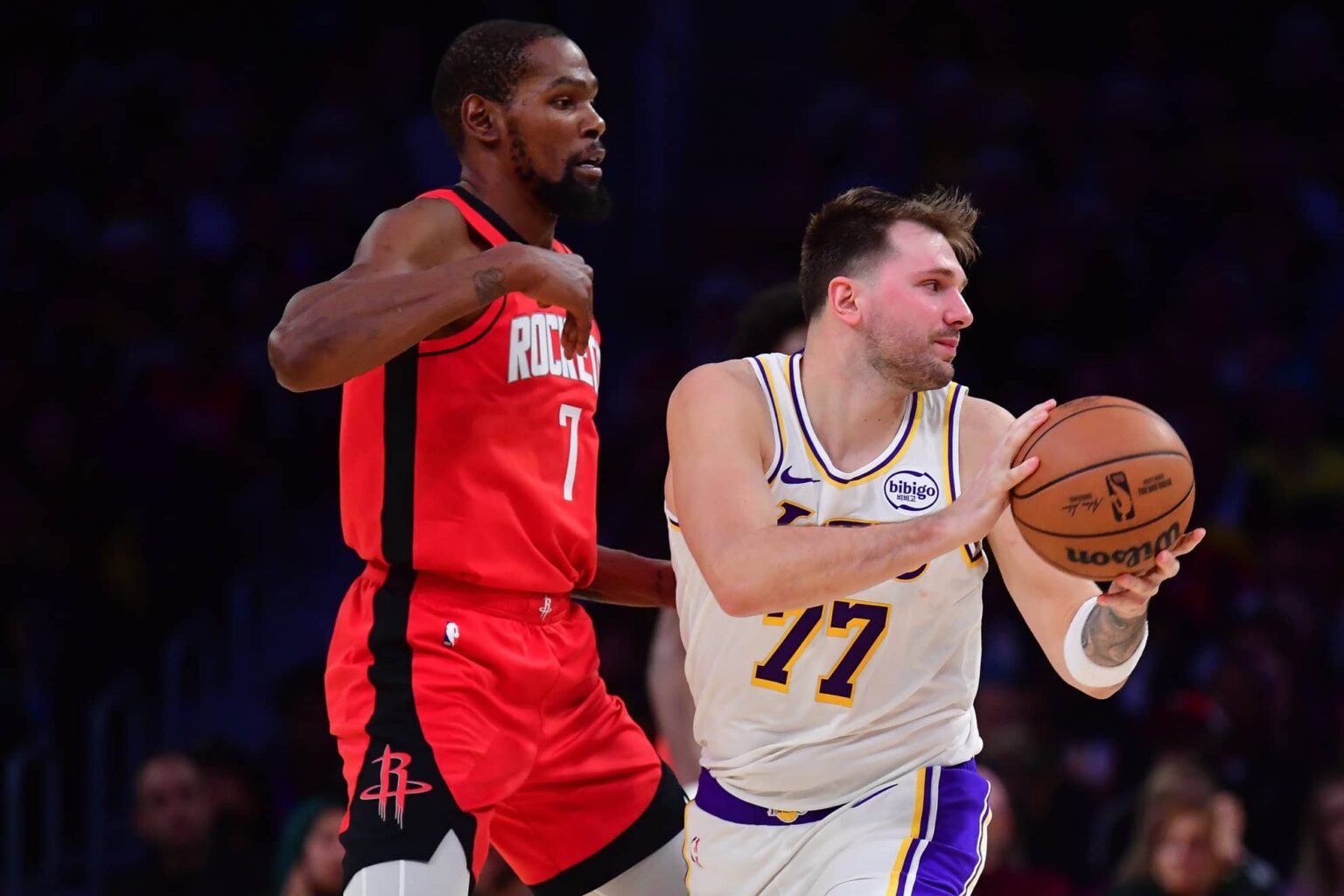
The Rockets host the Lakers at Toyota Center on Monday, March 16, at 8:30 p.m. CT.
The Rockets come in at 41-25 and fourth in the West with a 23-8 home record, while the Lakers are 42-25 and third in the West with a 19-13 road record.
The Rockets beat the Pelicans 107-105 in their last game, and the Lakers are coming off a 127-125 overtime win over the Nuggets.
The Rockets also lead the season series 1-0 after a 119-96 win on Christmas Day, so this one has real standings weight on top of the matchup value.
Kevin Durant has given the Rockets the late-clock scorer they needed, averaging 26.0 points, 5.5 rebounds, and 4.5 assists while shooting 51.5% from the field and 40.6% from three.
Alperen Sengun has been the offensive hub beside him at 20.2 points, 8.9 rebounds, and 6.1 assists per game, and if that back lets him move normally, he changes the entire shape of this matchup.
On the other side, Luka Doncic is still putting up superstar numbers with 32.8 points, 8.0 rebounds, and 8.5 assists per game, while Austin Reaves has become a real second engine at 24.0 points, 4.8 rebounds, and 5.5 assists on 50.2% shooting and 38.0% from three.
This is not just a star-power game. It is a shot-creation game between two teams that can both score, but in very different ways.
Injury Report
Rockets
Steven Adams: Out (left ankle surgery)
JD Davison: Out (G League – Two-Way)
Alperen Sengun: Questionable (low back pain)
Jae’Sean Tate: Out (right knee sprain)
Fred VanVleet: Out (right knee ACL repair)
Lakers
Maxi Kleber: Out (lumbar back strain)
Why The Rockets Have The Advantage
The clearest edge is the Rockets’ defensive and physical profile. They are allowing just 109.9 points per game, compared with 115.3 for the Lakers, and they are one of the best rebounding teams in the league at 48.2 boards per game. The Lakers are down at 41.1 rebounds per game, which is a massive gap in a matchup that is likely to feature a lot of half-court possessions and a lot of contested misses. If the Rockets control the glass, they control the texture of the game.
The Rockets also have the better season-long defensive efficiency. They carry a 113.2 defensive rating and a 4.4 net rating, while the Lakers sit at 116.8 in defensive rating and 1.2 in net rating. That difference matters because the Lakers can absolutely score, but they have not defended at a consistently high level over the full season. The Rockets, by contrast, are still built first around size, pressure and winning the possession battle. That gives them a steadier floor in a game that should feel physical from the opening tip.
There is also direct matchup evidence here. The Rockets already beat the Lakers 119-96 in the first meeting, and one of the biggest reasons was how much they flattened the Lakers’ usual free-throw pressure and kept them from ever finding rhythm. That matters because the Lakers are at their best when Doncic and Reaves get downhill, bend the defense, and force rotations. The Rockets have more size to throw into those driving lanes than most teams do, especially if Sengun can go.
Then there is the home-court piece. The Rockets are 23-8 at Toyota Center, and this is one of those games where their identity should travel especially well at home. Durant gives them the best pure mid-range bailout option in the matchup outside of Doncic, Sengun can punish smaller lineups from the elbows and the block, and the supporting cast has enough length to make the Lakers work for every clean read. If this turns into a playoff-style game, that usually favors the bigger, more defensive team. I lean that way here.
Why The Lakers Have The Advantage
The Lakers’ case starts with perimeter shot creation, and that is a serious one. Doncic is having another monster season, Reaves is scoring like an All-Star-level secondary guard, and the Lakers are averaging 116.5 points per game with a top-5 offense by rating. Against a Rockets defense that can sometimes get bogged down in late-game execution, having two guards who can manufacture good offense without perfect spacing is a real weapon.
The other big point is current form. The Lakers have won five straight and eight of their last nine, and the quality of wins is impressive. They just beat the Nuggets in overtime after already handling the Bulls, Timberwolves, and Knicks in this recent stretch. This is not empty momentum. The offense has been humming, and the clutch execution has looked much sharper with Doncic and Reaves sharing the burden.
The Lakers are also more dangerous now than they were in that first loss to the Rockets. Since then, they have gotten stronger on the margins with Marcus Smart and Deandre Ayton taking real rotation roles, and LeBron James is back on the floor. Ayton gives them a more stable rebounding option than they had in earlier stretches, Smart gives them another rugged defender and ball-handler, and LeBron still changes the game with his passing even when he is not carrying the scoring load. That matters against a Rockets team that can get very aggressive at the point of attack.
There is also a simple offensive math case for the Lakers. They are shooting 49.9% from the field as a team, and they get to 116.5 points per game while playing slightly faster than the Rockets. If they can keep the rebounding gap from getting ugly and turn this into a game won by half-court skill rather than pure force, they have the better backcourt creators and probably the best closer on the floor in Doncic. That is why even with the Rockets’ home edge, this still feels like a one-possession type of game on paper.
X-Factors
Amen Thompson is the Rockets’ swing piece because he changes the game without needing plays called for him. He is averaging 17.8 points, 7.7 rebounds, and 5.3 assists, and his length is exactly the kind that can bother the Lakers’ guard-heavy actions. If Thompson is wrecking passing lanes, pushing in transition and making the Lakers finish through size, the Rockets’ defensive identity looks a lot more real for 48 minutes.
Reed Sheppard is the spacing variable. He is averaging 13.5 points, 2.8 rebounds, and 3.2 assists while shooting 39.0% from three. The Lakers are going to load up on Durant and show bodies to Sengun if he plays, so Sheppard matters as the guard who can punish overhelp and keep the offense from shrinking. If he is hitting, the Lakers have a problem. If he is missing, they can crowd the stars more aggressively.
Jabari Smith Jr. is the other Rockets x-factor because he is the frontcourt connector that can tilt both ends. He is averaging 15.4 points and 6.8 rebounds while shooting 36.6% from three. Against the Lakers, his value is obvious. He gives the Rockets another rebounder, another long defender to throw at LeBron or Hachimura-type matchups, and another release valve if the Lakers overcommit to Durant. He does not have to be the best player on the floor. He just has to make the Lakers pay for choosing the wrong help.
LeBron James is still an x-factor even in a game now driven more by Doncic and Reaves. He is averaging 21.3 points, 5.7 rebounds, and 7.0 assists, and his role here is less about scoring 30 than about solving pressure. The Rockets are going to try to turn this into a size game. LeBron is the one Laker who can meet that physically and still keep the offense organized. If he wins the strength battle, the Lakers have a much easier path.
Deandre Ayton matters because the Lakers cannot let the Rockets own the glass. Ayton is averaging 12.6 points and 8.3 rebounds this season, and his recent run has been solid, including 23 and 10 against the Bulls and 14 and 12 against the Timberwolves. The Lakers do not need him to outplay Sengun or the Rockets’ front line by himself. They need him to keep the game from becoming a second-chance parade.
Marcus Smart is the final Lakers x-factor because this game is going to need some nastiness. Smart is averaging 9.6 points, 2.8 rebounds, and 2.8 assists, and he just had 21 points and five steals against the Nuggets. The Lakers need his ball pressure on Thompson and Sheppard, and they need his willingness to turn a clean game into a messy one. If Smart makes this matchup uncomfortable on the perimeter, the Lakers become a lot more dangerous late.
Prediction
I think the Rockets take this one. The Lakers have the hotter offense and the best guard in the matchup, but the Rockets have the stronger defensive base, the much better rebounding profile, the 23-8 home record and the head-to-head proof that they can make this game look ugly for the Lakers. If Sengun plays, even at something short of 100%, the size gap is hard to ignore. And even if he is limited, the Rockets still have enough length and enough Durant shot-making to close it out at home.
Prediction: Rockets 116, Lakers 113