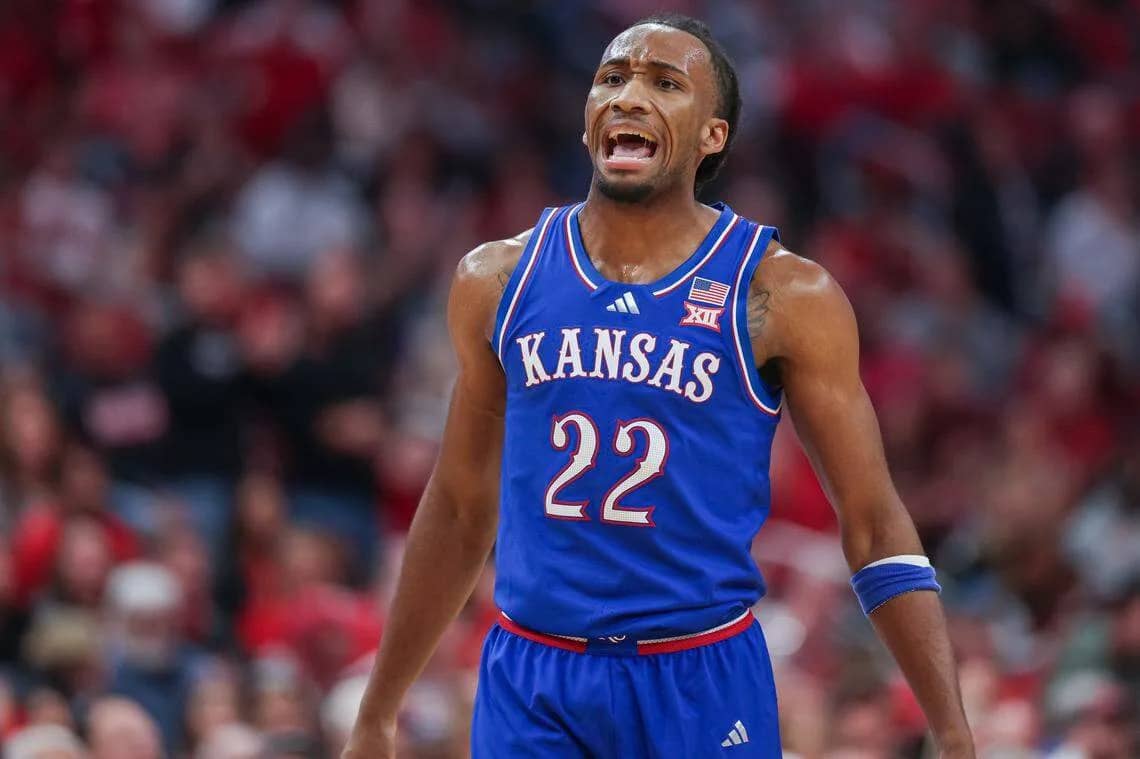
Darryn Peterson is making his position very obvious before the 2026 NBA Draft. According to ESPN’s Shams Charania and Jeremy Woo, Peterson completed a formal visit with the Wizards and doesn’t plan to meet with any other team. That includes the Jazz, who own the No. 2 pick and could easily select him if the Wizards go in another direction.
AJ Dybantsa has taken a different route. He met with both the Wizards and Jazz, keeping both possibilities open. Peterson is doing the opposite. He is acting like he expects to go No. 1 and doesn’t see a reason to work out or interview anywhere else.
That doesn’t officially mean Peterson would refuse to play for the Jazz. He also can’t control who drafts him. Still, skipping a meeting with the team picking second is a pretty strong message, especially when many mocks still have Dybantsa going first and Peterson landing with the Jazz.
Peterson averaged 20.2 points and 4.2 rebounds in 24 games for Kansas. His scoring, shot creation, size, and ability to play on or off the ball make him a real option at No. 1. The questions are mostly about availability after he missed 11 games with different physical problems, including serious cramping.
The Wizards now have the biggest decision in the draft. Dybantsa was the more productive college player, Cameron Boozer is also in the top group, and Peterson clearly wants the first pick. That doesn’t make the decision easier. It only adds more pressure one week before draft night.
After our latest mock draft following the lottery reveal, the board has already changed again. With workouts almost finished, new reports arriving, and Peterson trying to push his way toward the Wizards, here is our final mock before the first round of the NBA Draft on June 23.
No. 1 Pick – Washington Wizards – Darryn Peterson
Darryn Peterson has made it pretty clear where he expects to land. He even skipped a meeting with the Jazz, who own the second pick. That is a big risk unless his camp feels very confident about No. 1.
Peterson averaged 20.2 points, 4.2 rebounds, 1.6 assists, and 1.4 steals in 24 games for Kansas. He shot 43.8% from the field, 38.2% from three, and 82.6% from the line. The scoring was real, especially from the mid-range and off the dribble.
The fit next to Trae Young also makes sense. Peterson is 6-foot-6 and doesn’t need to become a full-time point guard immediately. Young can run the offense, while Peterson plays at shooting guard, attacks mismatches, and handles possessions when Young sits. His game has received Devin Booker and Anthony Edwards comparisons because he can score from different levels and has the size to become a strong two-way guard.
The Wizards already have several young wings and forwards, so adding another one could create a minutes problem. What they don’t have is another serious backcourt creator. There has also been league reporting that they don’t view AJ Dybantsa as some automatic franchise savior.
Peterson only meeting with the Wizards feels like more than normal draft noise. This mock now has them taking the scoring guard who fits their roster better.
No. 2 Pick – Utah Jazz – AJ Dybantsa
AJ Dybantsa falling to the Jazz would be a perfect result for a team picking second. He entered the year as the favorite to go first, led the country in scoring, and still has a real argument as the best player in the class.
Dybantsa averaged 25.5 points, 6.8 rebounds, 3.7 assists, and 1.1 steals in 35 games at BYU. He shot 51.0% from the field, 33.1% from three, and 77.4% from the line. He also scored 43 points against Utah and finished with 894 total points, the third-most ever by a Division I freshman.
The Jazz need this type of player. Keyonte George can score and handle the ball, but he isn’t the same type of full-time organizer as Young. Pairing him with Peterson could force both guards to share too many creation possessions and may slow the development of one of them.
Dybantsa gives the Jazz a big wing who can score without changing George’s role. Ace Bailey is already there, but Dybantsa would still become their best pure wing creator. Lauri Markkanen and Jaren Jackson Jr. already give them established frontcourt scoring, while Walker Kessler’s future remains uncertain.
There is also the Utah connection. Dybantsa played at Utah Prep and then BYU, met with both the Wizards and Jazz, and previous reporting said he was interested in staying in the state. He has also said he wants to go No. 1, so this shouldn’t be treated as a demand.
Still, if Peterson goes first, the Jazz shouldn’t think for very long. Dybantsa is the easiest selection on the board.
No. 3 Pick – Memphis Grizzlies – Cameron Boozer
Cameron Boozer feels almost locked into this spot if Peterson and Dybantsa go first. ESPN’s latest reporting said the league-wide assumption is that the Grizzlies would be very happy to get him at No. 3.
Boozer averaged 22.5 points, 10.2 rebounds, 4.1 assists, and 1.4 steals across 38 games for Duke. He shot 55.6% from the field, 39.1% from three, and 78.9% from the line. He also won the Wooden Award and led college basketball with a 17.1 box plus-minus.
He may not have the same explosive scoring style as Peterson or Dybantsa, but his floor is probably higher. Boozer scores inside, rebounds at an elite level, makes quick passes, and doesn’t need to stop the offense to create value. His shooting also allows him to play next to another big man without killing the spacing.
That profile fits the Grizzlies very well. They normally value toughness, production, basketball IQ, and players who affect winning without needing every possession. Boozer checks every one of those boxes.
The concern is athletic upside. He isn’t an elite vertical athlete, and some scouts question whether he can become the main scorer on a championship team. Still, the numbers are too strong to ignore. He produced every night, stayed available, and helped Duke win at a high level.
The Grizzlies don’t need to overthink this pick. Boozer may become the best player in the class even if he never looks like the flashiest one.
No. 4 Pick – Chicago Bulls – Caleb Wilson
Caleb Wilson feels like the safest pick after the first three names leave the board. ESPN reported that Wilson is visiting the Bulls this week and is believed to be happy with this landing spot. Most people around the league also see No. 4 as a pretty simple decision if Peterson, Dybantsa, and Boozer are already gone.
Wilson averaged 19.8 points, 9.4 rebounds, 2.7 assists, 1.5 steals, and 1.4 blocks in 24 games at North Carolina. He shot 57.8% from the field and gave them production on both sides before two hand injuries ended his season early. The medical situation isn’t expected to create major draft concerns.
The fit is easy. The Bulls already have Josh Giddey and Matas Buzelis as two main young pieces. Wilson would add another 6-foot-10 athlete who can run, rebound, block shots, and finish around the rim. He doesn’t need the ball every possession, but he can still attack slower big men and smaller forwards.
The outside shot remains the big question after he made only 25.9% from three. Still, his speed, motor, and defensive tools give him value even if the shooting takes time. A Buzelis-Wilson frontcourt would have size, movement, and real transition potential.
The Bulls moved up from No. 9 in the lottery, and Wilson gives them the type of player they probably couldn’t get from their original position. This shouldn’t be complicated.
No. 5 Pick – Los Angeles Clippers – Keaton Wagler
The draft becomes much harder at No. 5, but Keaton Wagler is now the strongest guess for the Clippers. ESPN reported that rival teams see him as one of their main options. Wagler also cancelled several workouts with teams inside the top 10, which normally means his camp feels comfortable about where he will be selected.
Wagler averaged 17.9 points, 5.1 rebounds, and 4.2 assists at Illinois. He shot 44.5% from the field and 39.7% from three while making 2.4 threes per game. He isn’t a pure point guard, but he can handle the ball, move it quickly, run some pick-and-roll, and score without needing to dominate every possession.
That profile fits next to Darius Garland. The Clippers need a bigger guard who can defend shooting guards and take pressure away from Garland as a creator. At 6-foot-6, Wagler gives them more size than Darius Acuff Jr. and a more immediate shooting role than some of the other guards in this range.
The Clippers are also listening to trade offers for the pick. They could move down, add another asset, and still target Mikel Brown Jr. or Brayden Burries. Still, keeping No. 5 and taking Wagler would give an old roster one real young player who can help early.
Wagler isn’t the most explosive athlete, and stronger guards may attack him at first. His shooting, decision-making, and low turnover numbers make the risk smaller. This feels like the best balance between upside and immediate value.
No. 6 Pick – Brooklyn Nets – Darius Acuff Jr.
The Nets are the hardest team to predict because they have been connected to almost every guard in this range. Still, Darius Acuff Jr. has become a serious candidate, according to ESPN. The Nets and Kings are now viewed as his two main landing spots.
Acuff had one of the best freshman seasons in the country. He averaged 23.5 points, 3.1 rebounds, and 6.4 assists while shooting 48.4% from the field and 44.0% from three. He won the Bob Cousy Award and became one of only two Power Five freshmen this century to average at least 23 points and six assists.
The concern is obvious. Acuff is only around 6-foot-3, and the Nets normally prefer bigger guards and wings. He may also have problems defending larger backcourts. That shouldn’t stop them from selecting the best creator available.
The Nets need someone who can control an offense and create a good shot late in the clock. Acuff can score from three levels, change speed in the pick-and-roll, and get teammates involved. He would probably become their best young ball-handler immediately.
They also don’t control their own 2027 first-round pick, so they have less reason to stay bad next season. ESPN projects around $34.0 million in cap space, meaning they can add veterans around Acuff instead of placing him inside another empty rebuild.
Mikel Brown Jr. and Nate Ament are other options. Acuff’s production and immediate offensive value make him the better pick here.
No. 7 Pick – Sacramento Kings – Mikel Brown Jr.
Darius Acuff Jr. is widely believed to be the Kings’ favorite guard, but he is already gone in this mock. ESPN reported that the Kings haven’t shown much interest in trading up, so they may simply take the best guard left at No. 7.
That player could be Mikel Brown Jr. Brown averaged 18.2 points, 3.3 rebounds, and 4.7 assists in 21 games for Louisville. He shot only 41.0% from the field, but his season included nine 20-point games and a 45-point performance with 10 threes against NC State.
The back injury that ended his season early and the inconsistent efficiency create some risk. Still, Brown has reportedly looked very good during workouts. Teams have been impressed by his deep shooting range, footwork, and ability to create space with the ball. He is also 6-foot-5, giving the Kings better size than Acuff.
The Kings need a lead guard after moving De’Aaron Fox. Brown isn’t a finished point guard, but he can run pick-and-rolls, create his own shot, and play next to another ball-handler. His range would also help open space for Domantas Sabonis and the rest of the offense.
Kingston Flemings is another real option because of his speed and defensive upside. Brown offers more shooting and maybe the higher offensive ceiling. If the workouts are as strong as teams are saying, he could even go before this pick.
The Kings want Acuff, but staying at No. 7 and taking Brown would still give them a young guard worth building around.
No. 8 Pick – Atlanta Hawks – Kingston Flemings
Kingston Flemings gives the Hawks another fast guard who can put pressure on the paint without needing to become the full offense immediately. ESPN reported that he is still expected to go inside the top 10, with the Hawks among the teams doing serious work on him.
Flemings averaged 16.1 points, 4.1 rebounds, and 5.2 assists at Houston while shooting 47.6% from the field and 38.7% from three. He led the team in scoring, assists, steals, and three-point percentage. That is a very strong freshman season on a team that doesn’t give easy minutes to young players.
The fit next to Dyson Daniels is interesting. Daniels can guard the best perimeter player, while Flemings handles more creation and transition possessions. Jalen Johnson can also initiate offense, so Flemings wouldn’t need to become a full-time point guard from day one.
His combine measurements were a little smaller than expected, and he isn’t the same shooter as Keaton Wagler or Mikel Brown Jr. Still, his speed, passing, and toughness give him a clear NBA role.
Aday Mara is another real option because the Hawks need size at center. They also own the No. 23 pick and have shown interest in moving up or down. If they stay here, Flemings gives them the best young guard left and another player who can grow with Daniels and Johnson.
No. 9 Pick – Dallas Mavericks – Brayden Burries
Brayden Burries has stayed pretty quiet during the predraft process, but that may be a good sign. ESPN reported that he hasn’t scheduled many workouts and appears comfortable with teams in this range, including the Mavericks.
Burries averaged 16.1 points, 4.9 rebounds, 2.4 assists, and 1.5 steals at Arizona. He shot 49.1% from the field, 39.1% from three, and played all 39 games. He also increased his scoring to 16.8 points during the NCAA Tournament, helping Arizona reach the Final Four.
The Mavericks don’t need him to become a star immediately. Cooper Flagg is already the main young piece, and Burries can enter as a secondary scorer who cuts, attacks closeouts, defends guards, and makes open threes. He has enough strength to play through contact and doesn’t need 20 shots to stay useful.
The handle and playmaking are still basic. Burries looks more like a shooting guard than a real lead creator, but that isn’t a big problem on this roster. The Mavericks need players who can fit around Flagg instead of taking the ball away from him.
ESPN also reported that the Mavericks are open to trading down and have worked out a wide group of prospects. Still, Burries is probably the safest wing available here. His shooting, physicality, and low-maintenance role make him an easy fit on a team trying to stay competitive while building around Flagg.
No. 10 Pick – Milwaukee Bucks – Nate Ament
The Bucks’ entire draft plan depends on what happens with Giannis Antetokounmpo. ESPN reported that the team is trying to finish draft night with multiple first-round picks, which suggests a major retool could be coming.
At No. 10, Nate Ament has the best upside swing. He averaged 16.7 points, 6.3 rebounds, and 2.3 assists at Tennessee, but shot only 39.9% from the field and around 33.0% from three. The efficiency wasn’t good, yet the skill level at 6-foot-10 is still hard to ignore.
Ament can handle the ball, shoot over smaller defenders, attack in transition, and make passes on the move. He is also young enough to improve physically and become much more efficient with better spacing. The Bucks may need that type of long-term project if Giannis leaves.
His draft range is wide. The Nets have been mentioned as his realistic high point at No. 6, but ESPN also reported that he has declined workouts with several teams inside the top 10. That could mean he has a preferred landing spot or simply feels comfortable with his floor.
The Bucks need guards, but they may have another first-round pick to solve that later. Taking a lower-upside point guard here only because of position wouldn’t make much sense.
Ament isn’t ready to carry an NBA offense. He may need two or three years. Still, the Bucks need ceiling more than safety if they are starting a new era.
No. 11 Pick – Golden State Warriors – Aday Mara
Aday Mara may be exactly the type of swing the Warriors usually avoid, but the need for real size is impossible to ignore now. ESPN reported that he is expected to be the first center selected and has interest from the Hawks, Mavericks, Warriors, and Thunder.
Mara averaged 12.1 points, 6.8 rebounds, 2.4 assists, and 2.6 blocks for Michigan while shooting 66.8% from the field. He stands 7-foot-3 with a 9-foot-9 standing reach, giving the Warriors a type of interior presence they haven’t had in years.
The passing is what makes the fit more interesting. Mara can operate from the high post, find cutters, and keep the ball moving instead of stopping the offense. That matters in a system built around Stephen Curry’s movement.
He would also give Draymond Green a normal center to play next to. Green could defend forwards and help from different areas instead of spending every night battling much larger players inside.
Mara isn’t quick, and defending in space will be a problem. The Warriors can’t expect him to switch onto guards or play every matchup. Still, rim protection and finishing would help immediately.
The Warriors have also worked out Yaxel Lendeborg, Morez Johnson Jr., and Chris Cenac Jr., while reports say they may trade down. If they stay at No. 11, Mara gives them the rarest physical profile available and a center who could enter the rotation early.
No. 12 Pick – Oklahoma City Thunder – Yaxel Lendeborg
Yaxel Lendeborg is older than most lottery prospects, but that shouldn’t scare the Thunder. They already have enough young development projects. They need someone who can enter the rotation and help right away.
Lendeborg averaged 15.1 points, 6.8 rebounds, and 3.2 assists for national champion Michigan. He shot 51.5% from the field and 37.2% from three while also producing 1.1 steals and 1.2 blocks per game. He can defend several positions, rebound, pass, cut, and make open shots.
That is a very easy fit. The Thunder don’t need him to create offense or become a main scorer. He could play as a small-ball power forward, defend bigger wings, move the ball, and give them another physical player against teams with size.
Lendeborg turns 24 in September, so his long-term ceiling may be lower than younger prospects. For the Thunder, that isn’t a huge issue. Their roster is already deep enough to compete for a title, and an NBA-ready forward has more value than another teenager who needs three years.
ESPN reported that the Thunder are exploring trades, including moving up. They also hold No. 17 and have enough future assets to consolidate both picks.
If they stay at No. 12, Lendeborg is the simple choice. He gives them immediate depth and directly answers the need for more frontcourt strength after the seven-game series against the Spurs.
No. 13 Pick – Miami Heat – Karim Lopez
Karim Lopez makes more sense for the Heat because he gives them a bigger creative wing instead of another frontcourt piece next to Bam Adebayo. He averaged 11.9 points, 6.1 rebounds, 1.9 assists, 1.2 steals, and 1.0 block for the New Zealand Breakers while shooting 49.0% from the field.
Lopez is 6-foot-9, can play both forward spots, and already has experience against professional players. He can attack slower defenders, rebound, push the ball after defensive stops, and make simple passes. The shot still needs work, but the overall skill level is more interesting than taking another low-usage inside presence.
The Heat need more size on the wing. They have enough guards and smaller forwards, but they don’t have many players who can defend bigger scorers while also creating something with the ball. Lopez could begin in a bench role and slowly develop next to Adebayo.
He is only 19, so this wouldn’t be an immediate win-now pick. The Heat may also trade No. 13 in a bigger deal. Still, if they stay here, Lopez gives them more upside and a better positional fit than many remaining lottery prospects.
No. 14 Pick – Charlotte Hornets – Morez Johnson Jr.
Morez Johnson Jr. would give the Hornets the physical frontcourt player they still need. He averaged 13.1 points and 7.3 rebounds in only 25.1 minutes for Michigan while starting all 40 games for the national champions.
Johnson is only 6-foot-9, but he plays with strength, energy, and a much bigger interior presence than his height suggests. He rebounds, runs the floor, finishes through contact, and can defend stronger centers. He also doesn’t need plays called for him, which matters on a roster already built around LaMelo Ball, Brandon Miller, and Kon Knueppel.
The Hornets need more toughness and reliable rebounding. Johnson could enter as a backup center, play some minutes at power forward, and help immediately without needing years to understand his role.
His upside may not be as high as some younger lottery prospects, but the floor is strong. The Hornets also own pick No. 18, so they can take another bigger swing later.
At No. 14, Johnson gives them a rotation big man who can help early and brings the type of physical play the roster still lacks.
No. 15 Pick – Chicago Bulls – Dailyn Swain
After taking Caleb Wilson at No. 4, the Bulls can add another long and athletic forward with Dailyn Swain. The Athletic reported that Swain is one of the names connected to this pick if the Bulls don’t trade up for a second lottery selection.
Swain averaged 17.3 points, 7.5 rebounds, and 3.6 assists at Texas while shooting 54.2% from the field and 34.4% from three. He isn’t a great shooter yet, but he can handle the ball, attack the rim, defend different positions, and create for teammates.
A young group with Josh Giddey, Matas Buzelis, Wilson, and Swain would have a lot of size and athleticism. The spacing may look strange at first, but the Bulls aren’t close enough to compete to only draft for immediate fit.
Swain gives them another flexible forward with real defensive tools. At No. 15, that is a fair upside swing.
No. 16 Pick – Memphis Grizzlies – Christian Anderson Jr.
The Grizzlies already added Cameron Boozer at No. 3, so they can use this pick on another guard with shooting and playmaking. Christian Anderson Jr. has helped himself during workouts and is now getting real first-round interest.
Anderson averaged 18.5 points and 7.4 assists for Texas Tech while making 41.5% of his threes. He is only around 6-foot-1 without shoes, but he can run pick-and-rolls, create shots, and play at different speeds.
The Grizzlies still have Ja Morant, Ty Jerome, and Scotty Pippen Jr., but Morant’s long-term future isn’t completely safe. Anderson gives them a cheaper guard who can organize the offense and play off another ball-handler because of his shooting.
He may struggle defensively because of his size. Still, the production and shooting are difficult to ignore here. The Grizzlies usually trust productive college players, and Anderson fits that idea.
No. 17 Pick – Oklahoma City Thunder – Jayden Quaintance
Jayden Quaintance is the biggest medical gamble in the first round. He played only four games for Kentucky after returning from a torn ACL, averaging 5.0 points and 5.0 rebounds before knee swelling ended his season again.
His freshman year at Arizona State shows why teams still care. Quaintance averaged 9.4 points, 7.9 rebounds, and 2.6 blocks while showing the ability to protect the rim and switch onto smaller players.
The Thunder can afford this risk. They already added Yaxel Lendeborg at No. 12 and don’t need another rookie to play immediately. Quaintance can take his time, recover fully, and develop behind a deep roster.
The Athletic also called him the best possible Victor Wembanyama defender in this class. That matters after the Thunder needed seven games against the Spurs.
If the medical reports look good enough, this is exactly the type of long-term bet the Thunder can make.
No. 18 Pick – Charlotte Hornets – Allen Graves
The Hornets already added Morez Johnson Jr. at No. 14, but Allen Graves gives them a very different type of forward. Graves is one of the biggest analytics risers in the class and has been directly connected to the Hornets.
He averaged 11.8 points, 6.5 rebounds, 1.8 assists, and 1.9 steals for Santa Clara. He shot 51.2% from the field and 41.3% from three, giving him a very useful mix of shooting, defense, and fast decision-making.
Graves isn’t an elite athlete, and this may be higher than most public boards have him. Still, the Hornets own two first-round picks and can take one safer player after using No. 14 on Johnson.
Graves could play next to LaMelo Ball, Brandon Miller, and Kon Knueppel without needing many touches. He can make open shots, move the ball, and defend both forward positions.
It is a little early, but the reporting makes this a real possibility.
No. 19 Pick – Toronto Raptors – Labaron Philon Jr.
Labaron Philon Jr. gives the Raptors another guard who can create offense. He averaged 22.0 points, 3.5 rebounds, and 5.0 assists for Alabama while shooting 50.1% from the field and 39.9% from three.
Those numbers are very strong for a player still available at No. 19. Philon can attack the paint, score from the mid-range, run pick-and-rolls, and play next to another guard. He wouldn’t need to replace Immanuel Quickley. He could lead the bench offense and close some games when the Raptors need more creation.
The main issue is defense. Philon isn’t very big, and the Raptors already have several guards who can be attacked. Still, Scottie Barnes and their bigger wings can help cover some of that.
The Raptors need more scoring if they want to move past the first round. Philon gives them a player who already proved he can carry a major offensive role.
At No. 19, the talent is worth the fit questions.
No. 20 Pick – San Antonio Spurs – Cameron Carr
The Spurs need shooting around Victor Wembanyama, Stephon Castle, and Dylan Harper. Cameron Carr gives them that, plus real athleticism at shooting guard.
Carr averaged 18.9 points, 5.1 rebounds, and 2.6 assists for Baylor. He shot 49.4% from the field and 37.4% from three while playing as the main scorer. He also posted a 42.5-inch vertical at the combine and has a wingspan close to 7-foot-1.
The Spurs wouldn’t ask him to create much. Carr could run in transition, cut behind defenders, make open threes, and attack closeouts. Castle and Harper would handle most of the ball work.
His defense still needs work, and he has to add strength. The physical tools are there, but the consistency isn’t.
Carr has been connected to teams in the late lottery and teens, so he may not even reach No. 20. If he does, the Spurs get another athletic shooter without adding another small guard.
No. 21 Pick – Detroit Pistons – Bennett Stirtz
The Pistons need another guard who can create offense when Cade Cunningham rests, and Bennett Stirtz is one of the safer options left.
Stirtz averaged 19.8 points, 4.4 assists, and 1.4 steals at Iowa. He shot 47.7% from the field, 35.8% from three, and 84.8% from the line. He isn’t a crazy athlete, but he controls pick-and-rolls, makes good decisions, and can play next to Cunningham because he shoots well enough off the ball.
The Athletic reported that lead guards and shooting wings are the two main types connected to this pick, with Stirtz mentioned as a possible fit. He is already 22, so the upside isn’t huge. Still, the Pistons don’t need another long project.
Stirtz could run the bench offense, make open threes, and give the Pistons more control when Cunningham sits. It isn’t a flashy pick, but it makes sense for a team ready to keep winning.
No. 22 Pick – Philadelphia 76ers – Koa Peat
Koa Peat entered the season as a possible lottery pick, so getting him at No. 22 would be good value for the 76ers.
Peat averaged 14.1 points, 5.6 rebounds, and 2.6 assists while shooting 52.8% from the field at Arizona. He is a strong 6-foot-7 forward who attacks the rim, rebounds, passes, and plays with real physicality.
The outside shot is the main problem. Peat barely attempted threes and shot only 62.3% from the line. Playing him next to Joel Embiid could make the spacing strange, but Embiid now spends more possessions outside and Peat is a very good baseline cutter.
The 76ers need younger forwards who can defend and survive physical games. Peat isn’t going to become a main scorer early, but he can bring energy and play without needing the ball.
At this point of the draft, the upside is worth the shooting risk.
No. 23 Pick – Atlanta Hawks – Hannes Steinbach
The Hawks already took Kingston Flemings at No. 8, so they can use their second pick on frontcourt size.
Hannes Steinbach averaged 18.5 points and an NCAA-leading 11.8 rebounds at Washington while shooting 57.7% from the field. He is 6-foot-11, plays with energy, and knows how to find points without needing many isolation possessions.
Steinbach can screen, roll, rebound, pass a little, and punish smaller players inside. His defense isn’t elite and the outside shot still needs work, but he would give the Hawks another physical big next to Jalen Johnson.
The Athletic reported interest from teams earlier in the first round, including the Bucks and Heat. Falling to No. 23 would be a small slide, but this range becomes difficult to predict very fast.
The Hawks need more rebounding and frontcourt depth. Steinbach gives them both while still being young enough to develop.
No. 24 Pick – New York Knicks – Tarris Reed Jr.
Tarris Reed Jr. feels like a very typical Knicks pick.
Reed averaged 14.7 points, 9.0 rebounds, 2.3 assists, and nearly two blocks while shooting 60.7% from the field at UConn. He also became one of the biggest players of the NCAA Tournament, including a 31-point, 27-rebound game against Furman.
The Knicks may lose Mitchell Robinson in free agency, so adding another strong rebounder and interior defender makes sense. Reed could back up Karl-Anthony Towns, protect the rim, and create extra possessions on the offensive glass.
He isn’t a shooter, and that limits some lineup combinations. Still, the Knicks don’t need him to create offense. They need him to screen, rebound, defend, and finish simple plays around the basket.
Reed is already 22 and should be ready for minutes faster than most players in this range. For the defending champions, that matters more than taking another raw project.
No. 25 Pick – Los Angeles Lakers – Chris Cenac Jr.
Chris Cenac Jr. is one of the biggest upside swings still available, and the Lakers badly need young size.
Cenac averaged 9.5 points and 7.9 rebounds at Houston. He didn’t have a huge offensive role, but he finished 78.0% of his shots at the rim and showed some potential as a three-point shooter.
At 6-foot-10 with a 7-foot-5 wingspan, Cenac has the physical tools to become a real defensive center. He can block shots, run the floor, and finish lobs from Luka Doncic. That alone gives him a simple path toward becoming useful.
The problem is that his feel and decision-making are still raw. He may need time before he can defend NBA pick-and-rolls or stay on the floor during important games.
The Lakers need immediate help, but they also need one young big player with real long-term upside. Cenac may not help much in Year 1. At No. 25, the possible reward is still too good to ignore.
No. 26 Pick – Denver Nuggets – Sergio De Larrea
Sergio De Larrea gives the Nuggets a bigger backup guard who can organize possessions without needing to score every time. The 6-foot-5 Spaniard has already played professional basketball with Valencia in the EuroLeague, averaging 7.0 points with almost three assists per game.
De Larrea can run pick-and-rolls, make passes over smaller defenders, and play off Nikola Jokic or Jamal Murray. His three-point shooting also gives him a path toward sharing the floor with Murray instead of only replacing him.
He isn’t an explosive athlete, and quick guards may attack him early. Still, the Nuggets need more control from the bench. Their offense often becomes much worse when Jokic sits, and adding another small scoring guard wouldn’t completely fix that.
De Larrea may need time before becoming a full rotation player, but his size, passing, and professional experience make him a useful long-term option at No. 26.
No. 27 Pick – Boston Celtics – Joshua Jefferson
Joshua Jefferson gives the Celtics another physical and smart wing who can help without needing many shots.
He averaged 16.4 points, 7.4 rebounds, 4.8 assists, and 1.6 steals at Iowa State. Jefferson can defend several positions, rebound, move the ball, and attack smaller players inside. That type of all-around game fits a roster already built around Jayson Tatum and Jaylen Brown.
The three-point shot remains inconsistent, so he may not play in every matchup immediately. Still, the Celtics need cheap rotation players because their main contracts are very expensive.
Jefferson is already 22 and should understand a smaller role faster than most younger prospects. He wouldn’t be asked to create the offense. He would defend, cut, rebound, and make quick decisions.
At No. 27, that is a useful pick for a contender.
No. 28 Pick – Minnesota Timberwolves – Ebuka Okorie
Ebuka Okorie gives the Timberwolves another fast guard who can create his own offense. He averaged 23.2 points at Stanford and set an ACC freshman record with eight 30-point games.
Okorie can attack the rim, score from the mid-range, and get to the free-throw line. The Timberwolves need another guard who can create when Anthony Edwards rests or when defenses send extra help toward him.
He is only around 6-foot-1, so his defense could become a problem. The Timberwolves already have size and strong defenders around the perimeter, which may help cover some of that weakness.
Okorie doesn’t need to become the starting point guard immediately, with Ayo Dosunmu likely to return and Mike Conley still active. He could begin as a bench scorer, pressure the paint, and slowly improve as a passer.
At No. 28, his scoring upside is more interesting than taking a safer guard with less creation.
No. 29 Pick – Cleveland Cavaliers – Meleek Thomas
Meleek Thomas would give the Cavaliers a much-needed scoring option for the bench.
Thomas averaged 15.6 points, 2.5 assists, and 1.5 steals at Arkansas while shooting 41.6% from three. He can attack closeouts, handle the ball for short stretches, and make difficult shots when the offense becomes slow.
The Cavaliers need cheaper rotation players around Donovan Mitchell and their expensive frontcourt. Thomas could provide scoring without needing to become the full-time point guard.
His decision-making can become messy, and he sometimes forces shots. He also isn’t a major playmaker for teammates. Still, his shooting gives him one NBA skill from the first day.
At No. 29, the Cavaliers aren’t looking for a complete player. Thomas gives them a young guard who can score quickly and develop behind the veterans.
No. 30 Pick – Dallas Mavericks – Isaiah Evans
Isaiah Evans gives the Mavericks another tall shooter around Cooper Flagg.
Evans averaged 15.0 points and made 101 threes for Duke while shooting 36.1% from deep. The 6-foot-6 wing moves well without the ball and can release his shot quickly over smaller defenders.
He already played with Flagg at Duke, so he understands how to find open space when Flagg attacks or creates for teammates. That connection helps, even if it shouldn’t be the main reason for the pick.
Evans still needs more strength, and stronger wings could target him defensively. He also doesn’t create much for others. The Mavericks wouldn’t ask him to handle those responsibilities early.
His role would be simple: run around screens, stay ready outside, and punish teams that send extra defenders toward Flagg.
For the final pick of the first round, a young 6-foot-6 wing with real shooting volume is a good option.