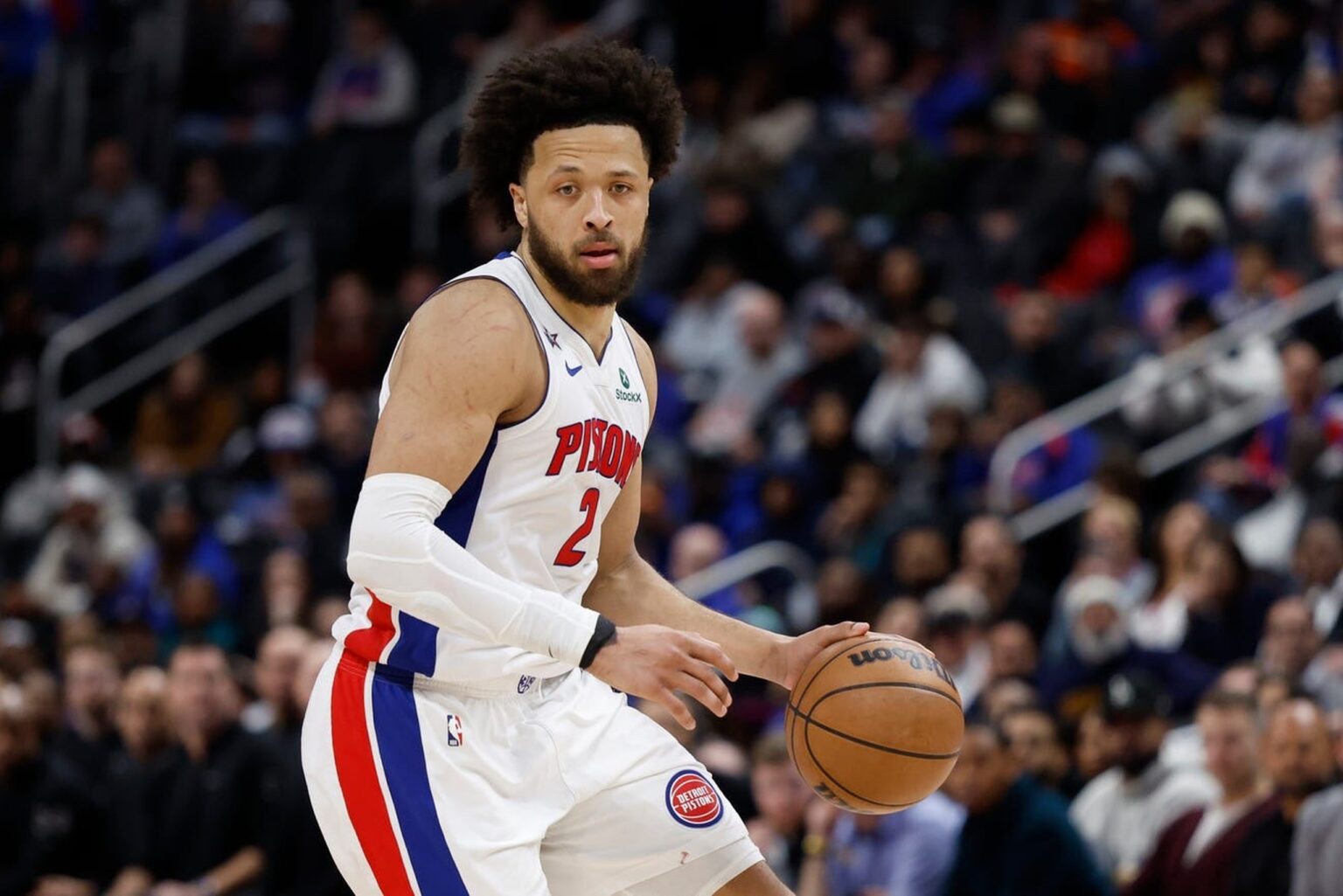
The Pistons are past the stage where patience is enough. They finished 60-22, earned the No. 1 seed in the Eastern Conference, and built one of the best regular-season profiles in the league.
The second-round loss to the Cavaliers was not just a disappointment. The Pistons lost Game 7 at home, 125-94, and Cade Cunningham finished with 13 points while missing all seven of his 3-point attempts. That type of ending does not erase the season, but it shows the next step. The Pistons need another high-level offensive player who can create against playoff defenses, punish switches, and reduce the load on Cunningham.
Cade is already the franchise player. He averaged 25.4 points, 5.9 rebounds, and 10.5 assists while shooting 46.1% from the field, 34.2% from three, and 81.2% from the line. He gave the Pistons control, size at guard, half-court creation, and late-game shot-making. The problem is that the playoffs showed how much pressure still sits on him when the game slows down.
This is not about panic. It is about timing. The Pistons have young players, contracts, picks, and a 24-year-old All-Star guard who is ready to win now. Standing still would be safe, but it would also waste the advantage they built. If an All-Star becomes available, the Pistons should be aggressive.
Here are three trade scenarios they can study this offseason.
3. Zion Williamson Gives The Pistons A Real Second Star
Detroit Pistons Receive: Zion Williamson
New Orleans Pelicans Receive: Jalen Duren, 2029 first-round pick
This is the type of trade the Pistons must study if they do not want to give Jalen Duren a five-year max contract worth around $239.0 million. Duren had a very strong regular season, averaging 19.5 points, 10.5 rebounds, and 2.0 assists on 65.0% from the field. He was efficient, physical, and useful in the regular season. That is not the issue. The issue is the price after what happened in the playoffs. Duren dropped to 10.6 points and 9.4 rebounds in the postseason, and his offensive impact was not close to the same when defenses became more direct and more physical.
That is a dangerous contract point for the Pistons. Paying Duren like a franchise-level center after that playoff run would be a big bet on regular-season production. The Pistons already have Cade Cunningham as the main offensive player. They need another scorer who bends the floor, not a center who depends on others to create most of his points.
Zion Williamson is risky, but the upside is obvious. He averaged 21.0 points, 5.7 rebounds, and 3.2 assists while shooting 60.0% from the field in 62 games. He is not a shooter, and that creates spacing questions. Still, his rim pressure is at a different level from Duren’s. Zion can attack from the elbow, short roll, transition, and isolation. He can punish switches without needing a lob or a deep seal. That changes the Pistons’ half-court offense next to Cunningham.
This deal would have to be built as a Jalen Duren sign-and-trade on his projected five-year, $239.0 million max contract. His first-year salary would land around $41.2 million for 2026-27, which puts him close enough to Zion Williamson’s $42.2 million salary. That is also the main reason for the Pistons to study this move now: instead of locking Duren into a massive center contract after a weak playoff run, they would turn that salary slot into a higher-ceiling star.
For the Pelicans, this is about moving off the long-term Zion question while still getting a 22-year-old All-Star center. Duren is younger, more stable physically, and fits a reset better than keeping Zion without a clear path back to the playoffs. The 2029 first-round pick gives the Pelicans another future asset, and Duren gives them a frontcourt piece they can control for the long-term.
This trade is not safe for the Pistons. Zion’s health history makes it impossible to call safe. But the Pistons are not looking for a safe upgrade. They are looking for a second star who can make defenses react to someone other than Cunningham. Duren is valuable, but his next contract could reduce that value fast. Turning him into Zion before that decision arrives is the kind of aggressive move a 60-win team should consider.
2. Lauri Markkanen Gives The Pistons A Second Scorer With Size
Detroit Pistons Receive: Lauri Markkanen
Utah Jazz Receive: Tobias Harris, Duncan Robinson, Ron Holland II, 2029 first-round pick, 2031 first-round pick
The Pistons should look at Lauri Markkanen because he solves a direct problem. They need another scorer next to Cade Cunningham. Not another low-usage role player. Not another defender who needs Cunningham to create the shot. Markkanen averaged 26.7 points, 6.9 rebounds, and 2.1 assists while shooting 47.7% from the field, 35.5% from three, and 89.6% from the line. He gives the Pistons a 7-foot forward who can shoot, attack closeouts, post smaller defenders, and score without stopping the offense.
The key part is that Jalen Duren stays. That changes the trade logic. The Pistons would not be replacing their center. They would be adding a scoring forward over Duren and next to Ausar Thompson. That gives the Pistons size and needed spacing across the frontcourt. It also gives Cunningham a real release valve when teams load the strong side, switch late in the clock, or shrink the floor against Duren rolls.
For the Jazz, this is about salary timing. They went 22-60, so there is no strong reason to keep an expensive veteran frontcourt together unless the roster is ready to win. Markkanen has a $46.1 million salary in 2026-27. Jaren Jackson Jr. has a $49.0 million salary. That is $95.1 million for two frontcourt players before Walker Kessler’s restricted free agency and before Keyonte George’s next contract. Kessler is set to become a restricted free agent in 2026. George already has a $6.6 million salary for 2026-27, but his extension decision comes after that.
That is why moving Markkanen now makes sense. The Jazz would not be dumping salary for nothing. Tobias Harris would be the salary piece in a sign-and-trade. Duncan Robinson gives them shooting and a contract that is only partly guaranteed in 2026-27. Ron Holland II gives them a young wing. The two first-round picks are the real long-term return. Harris averaged 13.3 points, 5.1 rebounds, and 2.5 assists. Robinson averaged 12.2 points and shot 41.0% from three. Holland averaged 8.2 points and 4.0 rebounds in 19.9 minutes.
This deal would likely need Harris in a sign-and-trade starting around $25.0 million to $30.0 million. Robinson is at $16.0 million for 2026-27, with only $2.0 million guaranteed before his guarantee date. That gives the Pistons enough outgoing salary to build a workable structure, while the Jazz turn one large Markkanen salary into Harris, Robinson, Holland, and two first-round picks.
This is expensive for the Pistons, but it fits the roster. Cunningham stays as the main creator. Duren stays as the center. Markkanen becomes the second scorer. The Pistons would lose wing depth and two picks, but they would add the exact offensive piece they missed in the playoffs: a high-volume forward who can score without needing the whole game built for him.
1. Kawhi Leonard Gives The Pistons The Highest Playoff Ceiling
Detroit Pistons Receive: Kawhi Leonard
Los Angeles Clippers Receive: Tobias Harris, Duncan Robinson, Ron Holland II, 2029 first-round pick
This is the riskiest trade, but it is also the trade with the highest short-term ceiling. Kawhi Leonard averaged 27.9 points, 6.4 rebounds, 3.6 assists, and 1.9 steals while shooting 50.5% from the field, 38.7% from three, and 89.2% from the line. He is 35 next season, and the injury history is well known. But when he plays, he is still one of the best playoff-style wings in the NBA. He can score in isolation, attack switches, play through contact, and defend strong wings without needing help on every drive.
That is the exact player type the Pistons didn’t have in the playoffs. Cade Cunningham had to create too much. The offense became too dependent on his pace, his reads, and his shot-making. Leonard would change that. He can take the hardest half-court possessions. He can score from the elbows. He can post smaller defenders. He can make pull-up jumpers. He’d be the release valve the Pistons needed during the entire postseason.
The fit is simple. Cunningham stays as the main ball-handler. Leonard becomes the second scorer and the big wing defender. Jalen Duren stays as the center. Ausar Thompson can guard up or down depending on matchups. The Pistons would not become faster, but they would become harder to guard in a series. Cunningham and Leonard would give them two big shot creators, and both can play with the ball or away from it.
For the Clippers, this is a timing move. They finished 42-40, ninth in the Western Conference, and lost 126-121 to the Warriors in the Play-In Tournament. Leonard is entering the final guaranteed year of his deal at $50.3 million. ESPN also reported that the Warriors were among the teams that called the Clippers about Leonard’s availability after the James Harden trade, with the possibility that those talks could return in the offseason. That does not mean the Clippers are shopping him. It means the league already sees the situation as worth monitoring.
Tobias Harris would give the Clippers a veteran forward in a sign-and-trade. Duncan Robinson gives them shooting and a contract they can control before the full guarantee date. Ron Holland II gives them a young wing. The 2029 first-round pick gives them future value without asking the Pistons to move Duren. This structure would send Harris in a sign-and-trade around $25.0 million, Robinson at $16.0 million, and Holland at $9.1 million. That gets the outgoing salary at $50.1 million.
This is not a long-window trade. It is a title-window trade. Leonard has one year left before unrestricted free agency in 2027, and the Pistons would need to be comfortable with the medical risk. But the basketball case is strong. The Pistons already have depth, size, defense, and a franchise guard. What they need is another elite half-court scorer. Leonard gives them that without moving Duren. That is why this trade belongs on the board.