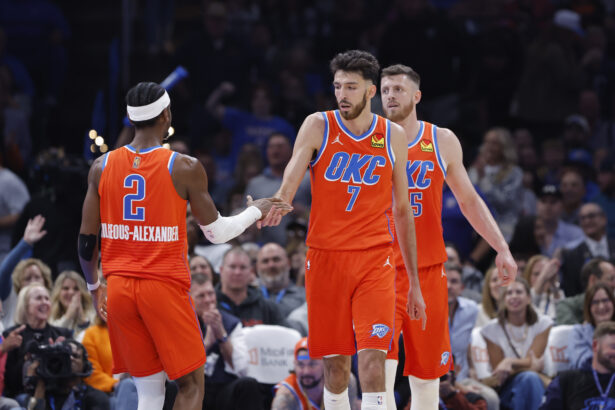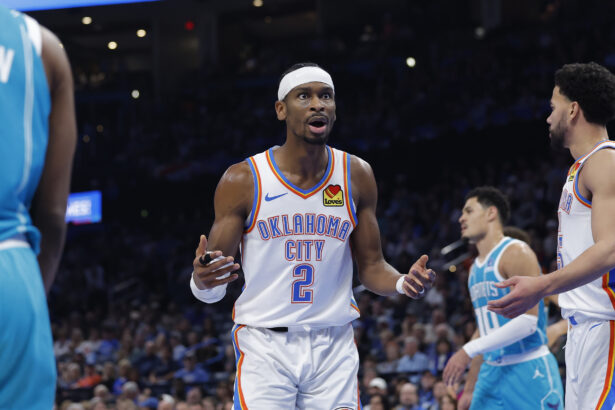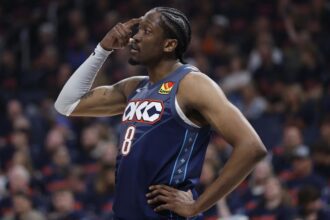
Chet Holmgren had the worst kind of Game 7 for a player starting a max contract. The Thunder lost 111-103 to the Spurs in the Western Conference Finals, and Holmgren finished with four points, four rebounds, two steals, and two blocks in 33 minutes. The shot total was worse than the scoring total: 1-of-2 from the field. In a Game 7 at home, with Jalen Williams out and Shai Gilgeous-Alexander carrying 35 points and nine assists, Holmgren barely touched the offense.
That performance made the offseason questions louder. Holmgren is no longer only a young center on a team-friendly rookie contract. His max extension starts in 2026-27 at $41.5 million, and rumblings about acquiring another young center have already started.
Jalen Williams is also at $41.5 million. Gilgeous-Alexander is at $40.8 million before his supermax jumps to $61.0 million in 2027-28. Isaiah Hartenstein has a $28.5 million team option. Alex Caruso is at $19.6 million. Luguentz Dort also has an option worth $18.2 million. Cason Wallace becomes extension-eligible this offseason with questions around his future.
Holmgren is still very good. He had 17.1 points, 8.9 rebounds, 1.7 assists, and 2.0 blocks on 55.7% from the field in 2025-26. But the Spurs series exposed the problem. Against the Spurs, he averaged 10.5 points, shot 38.7% from the field, and hit only 20.0% from three. Against everyone else, he was much better: 17.6 points, 57.0% from the field, and 37.0% from three.
That is the debate. The Thunder can keep believing in Holmgren. That is the safer path. Or they can ask if potential No. 3 Draft pick Cameron Boozer gives them a cheaper, stronger, more flexible frontcourt path next to Gilgeous-Alexander and Williams. Either way, the Thunder could make a move in the offseason after an earlier exit than expected.
The Trade Proposal
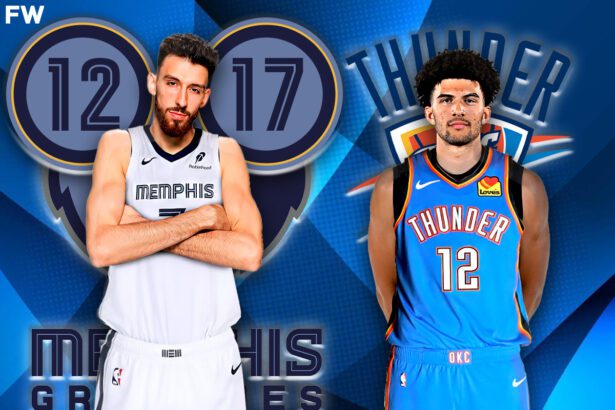
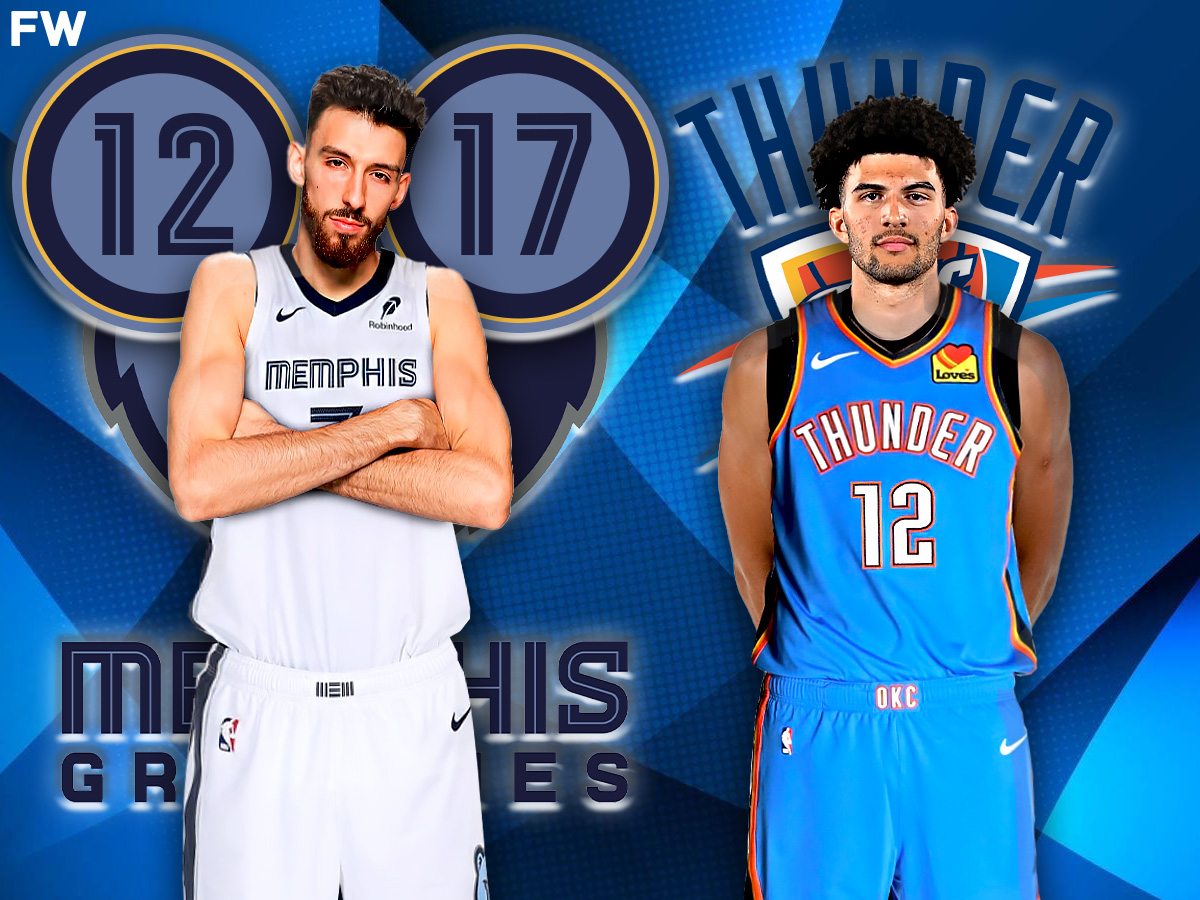
Oklahoma City Thunder Receive: No. 3 pick (used to select Cameron Boozer)
Memphis Grizzlies Receive: Chet Holmgren, No. 12 pick, No. 17 pick
This is a blockbuster draft trade. The Thunder would be moving a 24-year-old center with elite rim protection, real shooting touch, and a max extension already in place. Holmgren is not a failing player. He is still one of the best young bigs in the league. The price is high because the Thunder are getting a top-three pick and a chance to draft Boozer, who had 22.5 points, 10.2 rebounds, 4.1 assists, and 1.4 steals at Duke on 55.6% from the field, 39.1% from three, and 78.9% from the line.
The Grizzlies would be betting that Holmgren is a better rebuild piece than Boozer alone. They also add two first-round picks in the same draft, which gives them three real assets from one selection: Holmgren, No. 12, and No. 17. For the Thunder, the bet is financial and positional. Boozer’s rookie-scale salary as the No. 3 pick starts at $11.1 million in 2026-27. Holmgren starts at $41.5 million. That is a $30.4 million first-year gap before looking at the rest of the roster.
Why The Thunder Make This Move
The Thunder make this because they could be in financial trouble keeping their draft picks, and if they believe the frontcourt answer is with Hartenstein, they could turn them and Holmgren into Boozer. That sounds extreme, but the salary sheet makes it a real discussion. Hartenstein could come back at $28.5 million in 2026-27. If the Thunder keep him and also keep Holmgren, they are paying around $70.0 million for two centers before adding Williams, Gilgeous-Alexander, Dort, Caruso, Wallace, Jared McCain, Ajay Mitchell, and Isaiah Joe. That is a heavy roster.
Hartenstein also gave the Thunder a real Wembanyama matchup. In Game 2 of the Western Conference Finals, he had 10 points, 13 rebounds, eight offensive rebounds, and three assists while playing important minutes against Victor Wembanyama. Wembanyama still had 21 points, 17 rebounds, six assists, and four blocks, but Hartenstein made the matchup physical. He hit the glass, sealed him on drives, and gave the Thunder a different defensive feel than Holmgren.
That is important because the Thunder lost the series with Holmgren looking passive. Boozer would not solve every Wembanyama problem by himself. He is 6-foot-9, not 7-foot-1. But he gives the Thunder a true power forward body, more scoring strength, and better frontcourt versatility. Boozer posted 22.5 points and 10.2 rebounds at Duke, and the passing is a big part of the appeal. A forward with 4.1 assists per game can run dribble handoffs, attack short rolls, pass from the elbow, and punish smaller defenders without needing the offense built only for him.
The roster construction is the other reason. If Boozer starts at power forward and Hartenstein starts at center, the Thunder can keep more of the roster. Dort at $18.2 million stays easier to carry. Wallace can get an extension without forcing a deeper tax problem. Caruso remains expensive but useful. McCain and Mitchell can still develop into rotation pieces. The Thunder would turn one max big into a rookie-scale forward who fits the age line and lowers the bill.
This also protects the Thunder from paying for a player who may not be their best playoff center in the biggest matchup. Holmgren’s regular season was strong, but Game 7 was a warning. Two shots in 33 minutes is not enough for a max frontcourt player when the team is missing Williams. Four points is not enough when Gilgeous-Alexander is being asked to create everything.
The counter is obvious: Holmgren is proven in the NBA, and Boozer has not played one NBA minute. That is why this trade is dangerous. But the Thunder are already a title team, already deep, and already expensive to add even more rookies to their rotation. Their real question is not talent. But if Holmgren is a $41.5 million center who gets outplayed by Wembanyama every series, the Thunder have to at least study the Boozer path.
This Could Be Great For The Grizzlies
The Grizzlies need a new main structure. The old core is already broken. Desmond Bane was moved. Jaren Jackson Jr. was moved. Ja Morant is expected to be on the trade market again after a 25-57 season, only 20 games played, a torn UCL, and many clashes with the team. That leaves the Grizzlies with young pieces, draft capital, and no obvious franchise big.
Holmgren would give them that type of player. He is not perfect, but he is already an NBA defensive anchor with offensive skill. For a rebuilding team, getting a player who has already protected the rim on a championship roster is a major step.
The fit with Zach Edey is complicated but interesting. Edey had 13.6 points, 11.1 rebounds, and 1.9 blocks, but he played only 11 games and had another left ankle issue before season-ending surgery. The Grizzlies can’t build the whole frontcourt around Edey’s health right now. Holmgren gives them a much safer high-end center, while Edey can become a matchup presence, second-unit hammer, or two-big option depending on health.
The Grizzlies also have solid young wings. Cedric Coward had 13.6 points, 5.9 rebounds, and 2.8 assists as a rookie. Jaylen Wells started 69 games before toe surgery while posting 12.6 points per game. GG Jackson still gives them scoring upside with 12.5 points a night. Add Holmgren to that group, and the rebuild has a better two-way base. Coward and Wells can defend and space. Jackson can score. Holmgren protects the rim and gives the offense a stretch-big element.
The two Thunder picks are the part that makes this stronger than just keeping Boozer. At No. 12, the Grizzlies could target Labaron Philon Jr., a creative point guard who gave Alabama 22.0 points, 3.5 rebounds, and 5.0 assists on 50.1% from the field. If Morant leaves, Philon gives them a downhill guard with scoring and passing. He would not have to be the franchise player on day one because Holmgren would already be there.
At No. 17, the Grizzlies could go frontcourt again with Aday Mara if he is still on the board. Mara had 12.1 points, 6.8 rebounds, 2.4 assists, and 2.6 blocks at Michigan while shooting 66.8% from the field. He also gives them a different center type than Edey: taller, more passing touch, more rim protection, and less usage pressure. A Holmgren, Philon, Mara draft-night return gives the Grizzlies three long-term pieces instead of one.
That is the argument against keeping Boozer. Boozer may be the best single prospect in this deal. He is strong, productive, efficient, and NBA-ready. But the Grizzlies need more than one player. Their roster lost its veteran core. Their best guard may be gone next. Edey is hurt. The young wings need structure. Holmgren plus two picks gives them more ways to build.
The risk is taking on Holmgren’s $41.5 million salary. That is a huge contract for a rebuilding team. But the Grizzlies are not paying Bane and Jackson anymore. If Morant leaves, they can handle one max big better than the Thunder can handle three near-max core salaries plus Hartenstein, Dort, Caruso, and Wallace.
Final Thoughts
The Thunder shouldn’t make this trade because Holmgren had one bad Game 7. That would be reactionary. They should think about it because Game 7 matched the larger question. Holmgren is starting a $41.5 million salary, and the Thunder already have plenty of salaries on the board.
Boozer gives them a different solution: cheaper salary, power forward size, elite college production, rebounding, passing, and shooting touch. A Boozer-Hartenstein frontcourt would be heavier, cheaper, and easier to build around financially.
The Grizzlies should think about it because Holmgren plus No. 12 and No. 17 may be stronger than Boozer alone for a full-scale rebuild. Holmgren gives them the best current NBA player in the deal. Philon could give them the guard path after Morant. Mara could give them another long-term big.
The answer is close. If the Thunder believe Holmgren is still their long-term Wembanyama answer, they should keep him. If they believe Hartenstein handled that matchup better and Boozer can become a star forward on a rookie deal, the trade is worth a serious call.