The Heat are still in a strange spot. They finished 43-39, landed 10th in the East, and their season ended before the playoffs with a 127-126 loss to the Hornets in the first Play-In game. The roster had enough offense to win 43 games, but not much top-end talent or defensive consistency to avoid the Play-In.
The numbers show the split. The Heat scored 120.9 points per game, second in the NBA, and played at the league’s fastest pace. But their half-court profile was not elite enough to carry them. They finished 13th in offensive rating at 116.7, 13th in defensive rating at 114.5, and 13th in net rating.
The payroll also gives them no reason to stay patient. The Heat have $197.9 million in total allocations, 14th in the NBA, and $186.4 million in active roster money, 13th in the league. They are hard-capped at the first apron with only $6.8 million below that line. For a team that missed the playoffs, that is too much money without a top seed attached to it.
Bam Adebayo is the one safe piece. He gave the Heat 18.1 points, 9.6 rebounds, 4.3 assists, 1.3 steals, and 0.8 blocks on 48.5% from the field, and he remains the defensive base. After him, the roster gets more flexible. Tyler Herro has the salary to headline a star trade. Andrew Wiggins has a $30.2 million player option. Norman Powell is a free-agent decision. Kel’el Ware and Nikola Jovic are young trade assets with real value.
The Heat can keep the same core and hope for better health, but the standings have already answered. After another disappointing year, here are several players that might be moved as the Heat try to retool the roster for 2026-27.
5. Norman Powell
The All-Star campaign is where this starts. Norman Powell led the Heat with 21.7 points per game, ahead of Tyler Herro, Bam Adebayo, Andrew Wiggins, and Kel’el Ware. Powell played 58 games, logged 29.6 minutes per night, and carried real shot volume with 15.4 field-goal attempts and 7.1 three-point attempts per game. He shot 47.0% from the field, 38.0% from three, and 82.7% from the line, so the efficiency matched the usage.
The Heat needed that offense. Herro played only 33 games, Adebayo was not a high-volume perimeter creator, and the roster had too many lineups without a true advantage scorer. Powell gave them direct pressure. He could attack closeouts, run secondary pick-and-roll, shoot off movement, and get to the line. His 5.5 free-throw attempts per game gave the Heat points without needing perfect half-court execution.
The question is not whether Powell helped. He did. The question is whether the Heat should pay for that season at age 33. Powell made $20.5 million in 2025-26 and enters the offseason as a free agent coming off an All-Star season.
A team that finished 10th can’t treat every productive veteran like a long-term piece. The Heat already have Adebayo at $49.5 million in 2026-27, Herro at $33.0 million, Wiggins with a $30.2 million player option, and Nikola Jovic starting a $16.2 million extension. Paying Powell at a strong number keeps the same expensive core together.
There is also a usage problem. Powell and Herro both need touches to justify their value. Wiggins needs wing minutes. Davion Mitchell led the Heat with 6.5 assists and gives them a better defensive guard profile. Pelle Larsson, Kasparas Jakucionis, and Dru Smith are cheaper backcourt options. Powell is better than most of those players today, but keeping him at the wrong number can block flexibility.
The Heat should want Powell back only if the contract fits the larger plan. A short deal makes sense. A strong one-year number can make sense. A long veteran contract is harder to defend for a team trying to escape the Play-In level. Powell leaving would not be a rejection of his season. It would be a cap decision after a 43-win year that already showed the roster needs more than scoring volume.
4. Andrew Wiggins
June 29 is the date that decides Andrew Wiggins’ offseason. His $30.2 million player option for 2026-27 is not a small detail. It can make him one of the Heat’s biggest trade salaries, or it can force a different conversation if he opts out. Either way, Wiggins is in a spot where leaving is a real possibility; either he comes back or tests the market.
His season was useful. Wiggins gave the Heat 15.4 points, 4.8 rebounds, 2.7 assists, 1.1 steals, and 1.0 blocks in 30.3 minutes. He shot 47.5% from the field, 41.4% from three, and 78.4% from the line. That is strong wing production, especially because the Heat needed size and shooting around Adebayo and Ware. His three-point jump was the most important part. A wing making 41.4% from deep has more value, even without high-level creation.
The Play-In game also showed why Wiggins still has a market. He played 42 minutes against the Hornets and finished with 27 points, seven rebounds, and three assists. Adebayo left early, and Wiggins became one of the few Heat players who could handle the physical level. That matters in trade talks because teams still pay for big wings who can thrive in playoff minutes.
The issue is ceiling. Wiggins is a strong third or fourth option. He is not a primary creator. His 2.7 assists per game are fine, but he doesn’t raise a half-court offense. He doesn’t force double or solve late-clock shot creation. On a top-four seed, that profile is good. On a 10th seed with a top-15 payroll, a $30.2 million slot has to bring more pressure on the game.
The Heat also have cheaper forward options. Jaime Jaquez Jr., Jovic, Simone Fontecchio, and smaller lineups with Adebayo at power forward can cover pieces of the role. None of them replaces Wiggins perfectly. That is not the point. The point is that Wiggins’ salary can be more valuable as trade structure than as a fixed rotation piece.
If the Heat chase a star, Wiggins will be one of the first contracts in the trade. Herro is the offensive headline, but Wiggins is the added wing salary. He can help another team immediately, and that is why his contract is movable. The Heat need higher-end talent. Wiggins could be the bridge to get there.
3. Nikola Jovic
The idea of Nikola Jovic still looks better than the season he just had. A 6-foot-10 forward who can handle, pass, and play in transition is a useful NBA concept. The 2025-26 production did not match it. Jovic played 47 games and finished with 7.3 points, 3.3 rebounds, and 2.2 assists while shooting 36.6% from the field, 26.9% from three, and 68.3% from the line. For a forward whose offensive value depends on spacing and quick decisions, those numbers are a real concern.
The passing keeps him interesting. Jovic can grab a rebound and push, make hit-ahead passes, and work as a connector from the wing. The Heat need that type of player because Adebayo and Ware are frontcourt pieces who benefit from movement around them. Jovic can be more than a spot-up forward when his game is right. He sees second-side reads and can move the ball before the defense resets.
The problem is that his shooting has to hold for the rest to play. At 26.9% from three, defenses can help off him. At 36.6% from the field, his drives and cuts don’t punish enough. That makes it harder to keep him in playoff-type lineups. The Heat already had a fast offense and strong scoring volume. What they needed was more reliable half-court spacing and more dependable two-way pieces. Jovic didn’t give them that often enough.
The contract changes the evaluation. Jovic made $4.4 million in 2025-26, but his extension starts at $16.2 million in 2026-27. That is still a manageable number, but it is no longer a cheap development salary. Once a player moves into that range, the role has to become clearer. A $16.2 million forward who shoots under 30.0% from three becomes a harder fit on an expensive team.
That is why Jovic could leave. He should not be dumped for nothing because age, size, and passing still have value. But in a bigger trade, he is a logical salary piece. He gives another team a young forward with skill, while the Heat use his contract to build a stronger package.
Ware has more upside. Herro has more salary value. Wiggins has more veteran trade structure. Powell is a free-agent decision. Jovic sits in the middle, which is often where trade pieces live. If the Heat need to add one young salary to a larger deal, Jovic is one of the easiest names to include.
2. Kel’el Ware
Other teams will ask about Kel’el Ware before the Heat want to move him. And they might have to. Ware produced 11.1 points, 9.0 rebounds, and 1.1 blocks in only 22.1 minutes per game. He shot 53.0% from the field, 39.5% from three, and 74.0% from the line. That is not normal low-minute production for a 21-year-old center. It is one of the better young-big profiles on the roster.
The per-minute case is the strongest part. Ware’s 9.0 rebounds in 22.1 minutes translate to 14.7 rebounds per 36 minutes. His scoring moves to 18.1 points per 36. He also gave the Heat 2.8 offensive rebounds per game, which is high for his playing time. Ware can always bring size, rolls, second chances, and rim presence.
The shooting is what raises the asset value. A young center who rebounds and blocks shots is useful. A young center who does that and shoots 39.5% from three becomes much harder to find. The Heat don’t need Ware to take seven threes per game. They need enough shooting respect to play him next to Adebayo. If defenders can’t fully ignore him, the Heat can build bigger lineups without destroying spacing.
His contract makes him even more valuable. Ware made $4.4 million in 2025-26 and is due around $4.7 million in 2026-27. That is one of the best value contracts on the team. Cheap production is the only way an expensive roster can breathe. The Heat don’t have many players who combine upside and low salary. Ware does.
That is also why he could leave. Star trades need pain. Herro gives salary. Picks give future value. Jovic gives a mid-tier young contract. Ware gives the piece that another front office can sell to its fans. He is young, productive, cheap, and still far from finished. If the Heat truly go all-in for Giannis Antetokounmpo, Ware will be one of the first names requested.
Ware has a real path to becoming a starting center next to Adebayo or a high-minute big who changes the defensive glass. If he leaves, it has to be for a player who changes the top of the roster. Anything less would be too light.
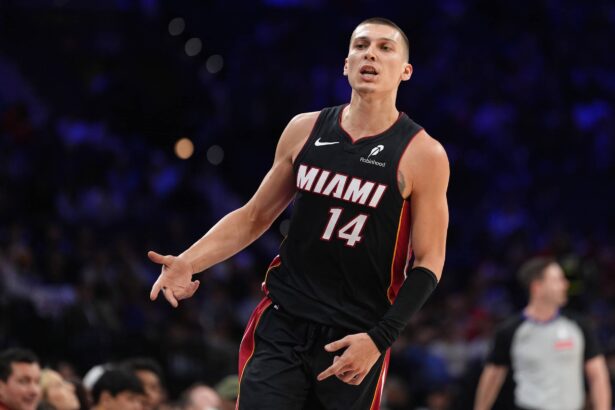
1. Tyler Herro
A real star trade almost always starts with Tyler Herro’s salary. That is why he is No. 1. Herro is due $33.0 million in 2026-27, which makes him the easiest Heat player to place in a major salary match. He is also productive enough to be more than filler. In 2025-26, he put up 20.5 points, 4.8 rebounds, and 4.1 assists while shooting 48.0% from the field, 37.8% from three, and 91.7% from the line.
The efficiency is strong. Herro had a 56.1% effective field-goal rate and 60.2% true shooting. That is good for a guard who takes difficult shots and handles real offensive usage. He can run dribble handoffs with Adebayo, shoot off movement, attack closeouts, and punish defenses that go under screens.
The concern is availability and team ceiling. Herro played only 33 games, and the Heat still finished 10th. His scoring is useful, but it has not lifted the roster above the middle of the East. That does not make him a bad player. It makes the roster question bigger. Can the Heat keep paying Herro like a core scorer and still build around him? The last few seasons keep pushing the answer toward no.
The defensive part also affects playoff roster building. Herro competes, but guards can be targeted in matchup series. If the Heat close with Herro and another scoring guard, they need heavy coverage behind them. Adebayo can erase some of that. Wiggins can help. Ware can protect the rim. Still, the best playoff teams usually need more two-way size, not only another 20-point guard.
That is why Herro’s trade value is complicated but real. Some teams may worry about the next contract. Others may value the shooting, age, and production. He is 26, has a 20-point scoring base, and fits many offenses that need a guard who can play on or off the ball. He is not dead salary. He is a real trade piece.
For the Heat, the logic is simple. If no star is available, keeping Herro is fine because he is still their best perimeter scorer. If a star becomes available, Herro is the first major salary in the offer. He has the contract, the numbers, and the extension question to headline the move. That makes him the most likely Heat player to leave if the offseason turns aggressive.