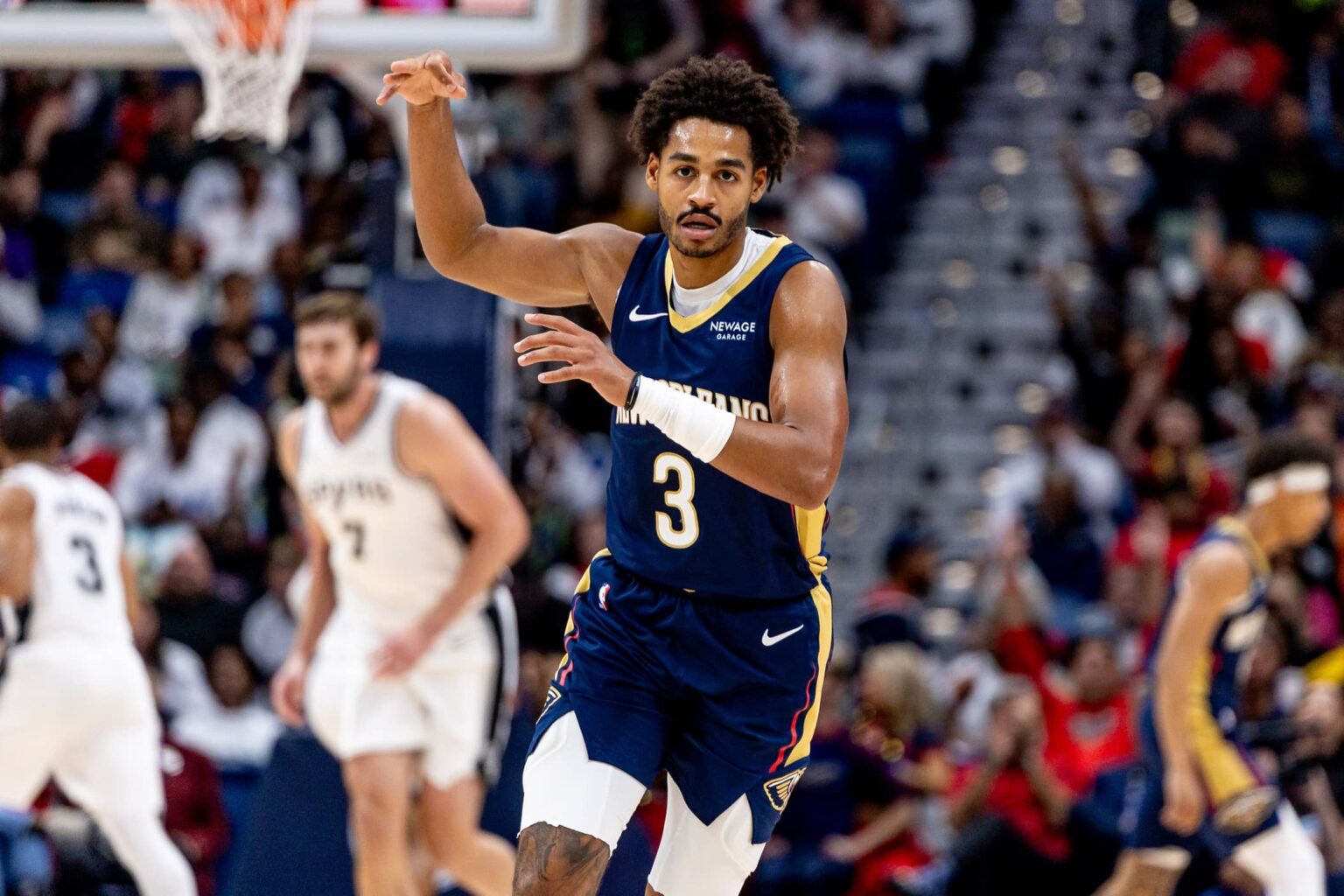
The Jordan Poole gamble is already blowing up in the face of the New Orleans Pelicans. They are 3-22, dead last in the West with a brutal -10.6 net rating, and looking like the league’s softest defense on most nights.
It gets even darker when you remember the Pelicans already shipped out their 2026 first-round pick to the Atlanta Hawks in the Derik Queen draft-night trade, so there is no “we’re awful but at least we get a franchise-changing prospect” safety net coming next June.
Poole was supposed to be one of the pressure valves on offense after coming over from Washington. Instead, he has averaged 17.3 points, 3.4 assists, and 1.7 rebounds in 7 games, shooting just 35.4% from the field and 33.9% from three before a quad injury took him out of the lineup.
The scoring is there on paper, but the efficiency and impact are exactly the concerns that followed him out of Golden State and Washington.
Now, multiple reports say the Pelicans are expected to evaluate Poole’s trade market ahead of the deadline, with his name popping up as one of the contracts the front office would be willing to move if they can find neutral or slightly positive value.
On a 3-22 team that already punted its 2026 first, that kind of noise around Poole feels less like background chatter and more like the opening act to another big reset.
1. Jordan Poole Gives The Pistons A Volatile Scoring Punch
Proposed Trade Details
Detroit Pistons Receive: Jordan Poole
New Orleans Pelicans Receive: Tobias Harris, Jaden Ivey, 2027 second-round pick (via BKN or DAL), 2028 second-round pick (via NYK)
If the Detroit Pistons want to supercharge their second unit without touching the Cade Cunningham core, Jordan Poole is exactly the kind of buy-low swing that makes sense. The Pistons sit at 19-5, first in the East, with Cade running the show and a deep, physical rotation built around size and defense.
What they do not really have is a wild-card scorer off the bench who can catch fire for ten minutes and flip a playoff game.
Poole is messy, but he is still that guy. In Detroit, he would not be asked to save a broken offense. He would live in lineups where Cunningham and Jalen Duren already have the defense in rotation, attacking tilted floors against backups, hunting pull-up threes, and getting to the line.
If he is cooking, you ride it. If he is 4-of-15, you close with the usual starters and forget it.
For the Pelicans, this is about escaping basketball purgatory. Being this bad with no control of that 2026 pick is a nightmare.
Tobias Harris gives them immediate competence at forward, with 14.7 points, 5.1 rebounds, and 2.4 assists on 45.3% from the field this season.
Jaden Ivey is the upside play, even if he is down to 7.6 points, 2.7 rebounds, and 1.1 assists in a reduced role. The seconds are extra shots in future drafts that they desperately need after burning that 2026 first.
2. A Young Backcourt Wild Card For The Blazers
Proposed Trade Details
Portland Trail Blazers Receive: Jordan Poole
New Orleans Pelicans Receive: Jerami Grant, 2028 first-round pick (via ORL), 2029 second-round pick
The Portland Trail Blazers are 9-15 and somehow trying to run an NBA offense with every real point guard on the shelf. Scoot Henderson has not played a regular-season minute because of a torn left hamstring, Damian Lillard is out for the year with Achilles issues, and Jrue Holiday has missed time with a calf strain, leaving the backcourt completely gutted.
That is how you end up with Deni Avdija moonlighting as a point forward, putting up 25.8 points, 7.2 rebounds, and 6.3 assists while trying to keep the entire offense afloat.
Poole is not a traditional floor general, but for this version of the Trail Blazers, he does not have to be. He just has to be another live dribble. He is at 17.3 points on 35.4% from the field and 33.9% from three in New Orleans, ugly efficiency for sure, yet he still bends defenses in a way the Blazers’ current guards simply cannot.
Put him next to Avdija and Donovan Clingan, let him spam high pick and roll, and suddenly the Trail Blazers have a young shot creator who actually matches the Scoot and Shaedon Sharpe timeline once everyone is healthy.
This is all about survival and structure for the Pels. They desperately need to restock future assets. A 2028 first from Orlando is exactly the kind of long-term chip they cannot say no to.
Grant also fits a real need. He is averaging 19.5 points, 3.9 rebounds, and 2.7 assists on 43.8% shooting, giving you a legit two-way forward who can defend multiple positions and hit threes at volume.
With Zion Williamson hurt again, Grant can basically walk into that vacant scoring forward role, playing next to Queen, who is already at 12.9 points, 6.4 rebounds, and 3.9 assists on 49.6% from the field, and just dropped a historic 33-point triple-double against the Spurs.
A frontcourt of Grant and Queen at least looks like a professional NBA pairing instead of another developmental experiment, while the extra pick gives the Pelicans one more chance to hit on a difference-maker in a draft where they actually control their own future.
The Blazers get a younger, higher-upside scorer and clear Grant’s long-term money. The Pelicans get a real forward, a badly needed first-round pick, and a cleaner depth chart around their rookie big. That is a Poole trade both sides can live with.
3. The Kings Find A Needed Chaos Guard
Proposed Trade Details
Sacramento Kings Receive: Jordan Poole
New Orleans Pelicans Receive: DeMar DeRozan, 2029 first-round pick, 2026 second-round pick (via CHA)
If the Sacramento Kings are honest with themselves, the “old stars” experiment is already falling apart. They are 6-18, 13th in the West, and the Russell Westbrook–DeMar DeRozan–Zach LaVine trio has turned into a nostalgia tour more than a winning core.
This is where Poole comes in. The Kings desperately need someone under 30 who can actually grow with Nique Clifford, Keegan Murray, and whatever is left of this roster once the dust settles.
Poole is volatile, but he gives the Kings something they flat-out lack: a young guard who can create his own shot from anywhere. Slide him into a sixth-man role behind Westbrook, let him run units with Murray, and you suddenly have a version of the Kings that is at least leaning into a new timeline instead of pretending the current one works.
On the other side, this is quietly a dream escape hatch for the Pelicans. DeRozan is still a bucket on command. With the Kings, he is averaging 18.0 points, 3.0 rebounds, and 3.5 assists on an efficient 49.8% from the field, plus he has a track record of living in the clutch and calming down ugly half-court possessions.
Drop that guy next to Derik Queen, and suddenly the offense looks way more grown-up. Queen is already flashing legit Rookie of the Year upside with double-digit scoring, strong rebounding, and playmaking from the five spot, including that recent triple-double that basically screamed, “build around me now.”
DeRozan can live in the midrange, punish single coverage, and take the toughest perimeter matchup, letting Queen focus on owning the paint and running delay actions at the top of the floor.
And then there’s the draft capital. Sneaking a 2029 first plus a 2026 second into this deal is exactly the kind of slow, patient asset play the Pelicans need after tossing away their 2026 first in the Queen trade.
Those picks might not pay off tomorrow, but they give the front office real ammo for either another trade or a long-term rebuild around Queen.
For the Kings, this is a high-variance bet that Poole turns back into the wild-card scorer he was in Golden State.
For the Pelicans, it’s a chance to turn a problem contract into a real adult scorer, pick up an extra first and second, and finally start reshaping the roster around the one thing that’s actually working: Queen’s rise.