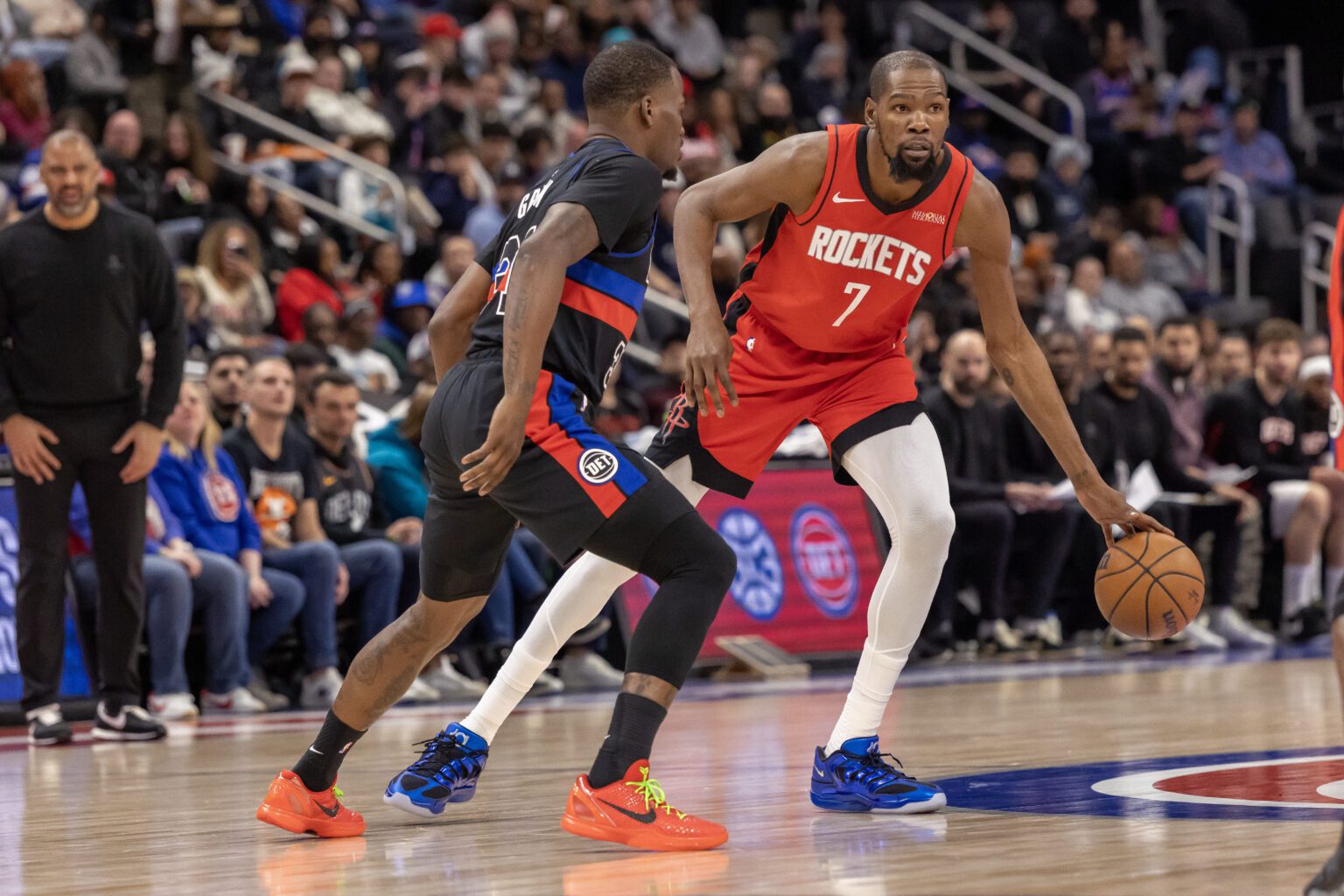
Some nights, Kevin Durant scores for certain, but he also controls the temperature of the entire game.
That’s what this was. Every time Detroit made a push, every time the building started to buzz, Durant calmly walked into a midrange jumper, buried a three over a late contest, or drew contact and quietly stacked points at the line. By the time the final buzzer sounded on Houston’s 111-104 win, Durant had once again reminded everyone that when he gets to his spots, there isn’t a defense in the league that can truly bother him.
And this wasn’t empty production. The Rockets needed all of it. Detroit hung around, attacked the paint, and tried to turn the game physical. Houston responded with efficiency, defense, and just enough late-game execution, led, as usual, by their closer wearing No. 7.
1. Durant’s Efficiency Set The Tone Early
Durant finished with 32 points on 11-of-19 shooting, and the efficiency wasn’t a late-game flurry, it was steady pressure from the opening quarter. He knocked down 5 of his 11 attempts from deep and added 5-of-6 at the free-throw line, forcing Detroit to defend every level of the floor.
What stood out most was shot selection. Detroit tried multiple defenders, but Durant never rushed. When they pressed up, he drove. When they sagged, he rose into rhythm jumpers. Houston shot 49.4% as a team, and Durant’s shot diet was a big reason why those possessions didn’t spiral into empty trips.
Even when the Pistons tightened coverage in the second half, Durant didn’t force the issue. He took what the defense gave him and made them pay just enough to prevent any real momentum shift.
2. Houston Won The Glass Battle Behind Jabari And Capela
The Rockets quietly controlled the rebounding battle, finishing with a 43-35 edge on the boards. Jabari Smith Jr. grabbed 10 rebounds, including three offensive boards, while Clint Capela added nine rebounds in just 16 minutes off the bench.
Those extra possessions mattered in a game where Detroit shot nearly as well overall (47.6%). Houston’s 12 offensive rebounds led to second-chance opportunities that helped offset stretches where the offense slowed down.
Defensively, limiting Detroit to one-and-done trips was just as important. Capela and Smith combined for six defensive boards in the fourth quarter alone, helping Houston close out possessions and keep the Pistons from building late rhythm.
3. Amen Thompson Filled The Box Score Everywhere
Amen Thompson’s stat line isn’t impressive, but it has value. In 40 minutes, he scored 15 points, grabbed 9 rebounds, made 7 assists, got 2 steals, and had a block.
He went 5 of 11 and made 5 free throws. Pace control was a huge contribution from him. He organized the Rockets when they needed it, and pushed when they needed speed. He had a plus 11 which means he was with the Rockets when they did the most scoring.
As always Thompson’s high level of activity played a big role in Houston’s 11 steals. He helped Houston’s defense with his length, and helped Houston score before Detroit’s defense was set.
4. Detroit’s Three-Point Struggles Changed The Math
The Pistons actually shot a respectable 47.6% from the field, but their night beyond the arc dug a hole they never climbed out of. Detroit went just 7-of-32 from three (21.9%), compared to Houston’s 9-of-26 (34.6%).
Duncan Robinson went 2-for-8, Cade Cunningham 0-for-4, and Tobias Harris 0-for-3. Those empty possessions piled up, especially in the second half when Detroit tried to speed the game up.
Houston’s defense deserves credit here. The Rockets closed out under control and forced Detroit into late-clock attempts. Even when the Pistons got clean looks, the volume of misses allowed Houston to maintain a two-possession cushion most of the final quarter.
5. Free Throws And Late Execution Sealed It
In a game that had the potential to be a nail-biter, the difference was Houston’s free throw shooting. The Rockets were 24-for-30 compared to Detroit’s 17-for-24.
Durant, Sengun, and Thompson had a combined free throw performance of 17-for-21 which resulted in the Rockets getting the edge while the Pistons tried to defend them aggressively. The Pistons have also relied on free flowing play to create fast breaks and to set the tempo. These free throws also helped in getting the Pistons to lose their tempo.
Execution was also evident in the turnover department. Even though both teams had 17 turnovers, Houston was able to convert 21 of Detroit’s turnovers to points while the Pistons were only able to score 11 points from turnovers. These differences along with Durant’s performance in the clutch were able to make a huge difference in the game’s end.