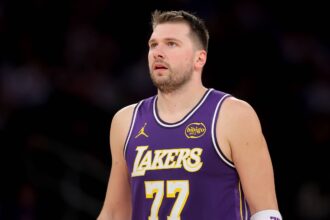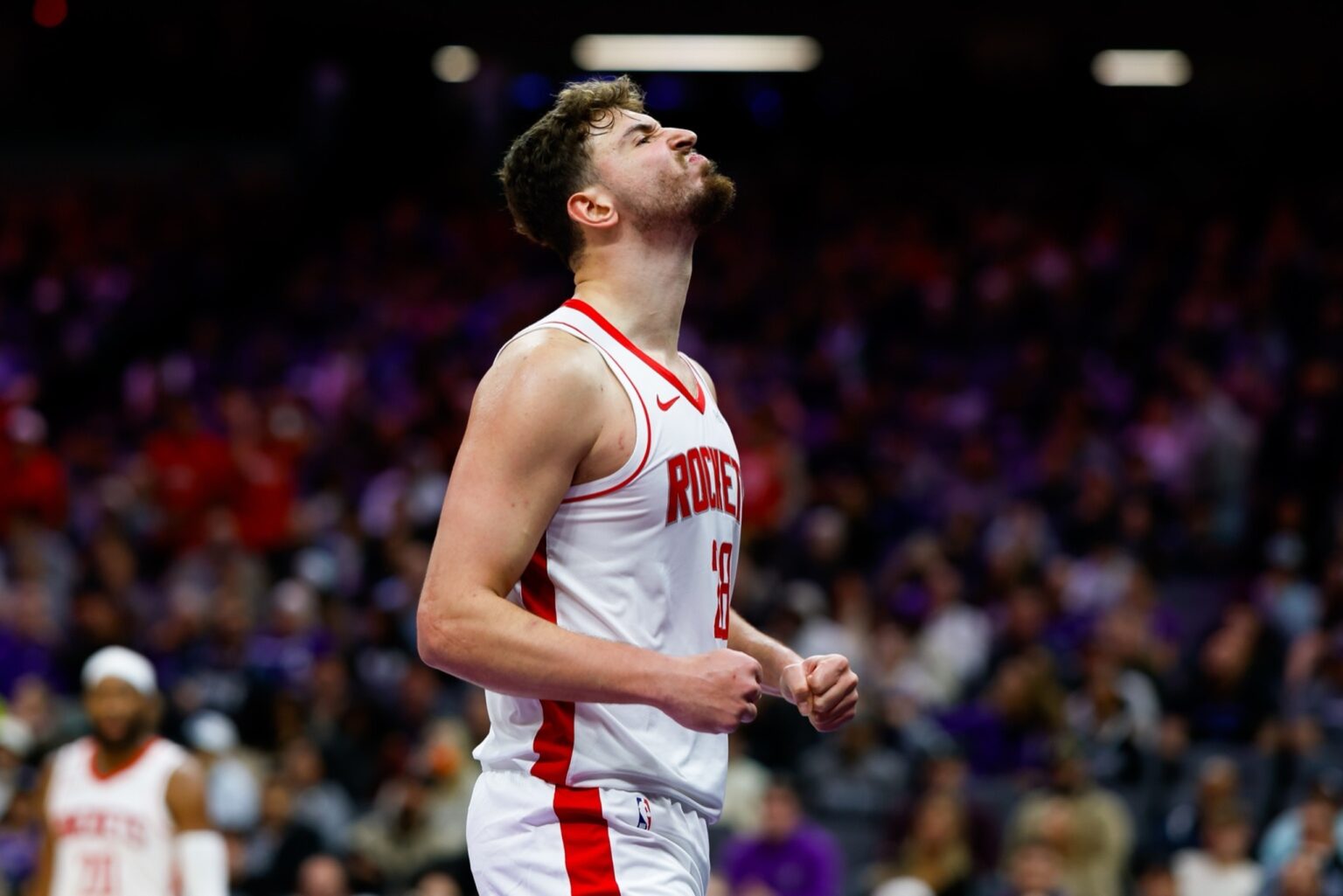
When the Western Conference First Round paired the Los Angeles Lakers against the Houston Rockets, the expectation was that the Rockets should get an easy series with Luka Doncic and Austin Reaves out of the picture early on.
Yet, the Lakers won Game 1 with LeBron James controlling the entire tempo of the game, finishing with 19 points and 13 assists. The Lakers beat the Rockets 107-98, even though the Rockets had 27 more field-goal attempts, 21 offensive rebounds, and 20 forced turnovers. The Lakers shot 60.6% from the field and 52.6% from three. The Rockets shot 37.6% from the field and 33.3% from three. That was the game.
Kevin Durant is still the swing factor. He missed Game 1 with a right knee contusion. The official injury report for Tuesday lists him as questionable. Doncic and Reaves are also out for the Lakers again. Durant averaged 26.0 points, 5.5 rebounds, and 4.8 assists in the regular season, so the Rockets cannot replace him with one player. They have to win with structure, spacing, and shot quality to tie the series going back to Houston.
Game 1 already showed the outline. The Rockets controlled the glass, created extra possessions, and made the Lakers work. But their half-court offense was crowded, slow, and too easy to load up against. Now in desperation mode, that has to change fast. The Rockets still have a path to split the series. Here is how they can win Game 2 without Durant.
Create More Open Shots From Deep
The first fix is simple. The Rockets need more threes.
They attempted 31.5 threes per game in the regular season, one of the lowest marks in the league. That works only if they finish well inside and win the free-throw line. In Game 1, they did neither. They got 93 shots because they crushed the offensive glass, but only 33 of those attempts were from three. That is too low for a team missing Durant.
This is not about random volume. It is about where the extra possessions go. In Game 1, the Rockets won the possession battle and still lost by nine because too many of those extra trips ended with forced shots in traffic. The Lakers were fine with that. They could sit in the paint, show extra bodies to Alperen Sengun and Amen Thompson, and trust the Rockets to keep driving into crowds instead of kicking out.
That has to flip in Game 2. More empty-corner pick-and-roll. More quick swing-swing action after the first touch. More drift passes to the weak side when the low man tags the roller. More second-side attacks instead of first-side force. If the Rockets get a paint touch and do not make the defense rotate twice, the possession is not good enough. One rotation gets a contested two. Two rotations get a clean three.
This also puts real pressure on the Lakers’ rotation players. Luke Kennard shot 47.8% from three in the regular season and went 5-for-5 from deep in Game 1 while scoring 27 points, but the Lakers do not want him living inside long defensive possessions over and over. More spacing forces him to guard more ground. That is a win for the Rockets before the shot even goes up.
Run Through Sengun Earlier
The Rockets do not need Sengun to take 25 hard shots. They need him to organize the offense earlier on the clock.
Sengun averaged 20.4 points, 8.9 rebounds, and 6.2 assists this season. In Game 1, he had 19 points, eight rebounds, and six assists, but he shot 6-for-19. Too many of his touches came with the floor already shrunk and the help already waiting. That let the Lakers crowd him on the catch and stay home on the next pass.
The Rockets already play late too often. 24% of their shots came in the last six seconds of the shot clock, the second-highest rate in the league. That is a bad setup for a team without Durant. Late-clock offense asks for shot-making. The Rockets need easier reads than that.
So the change is clear. Get Sengun the ball sooner and in better spots. Catch at the elbow. Catch at the nail. Catch one step above the block, not buried under the rim with two defenders sitting on his lap. From there, the Rockets can run split action, use Thompson as a cutter, and bring shooters behind the play. That makes the Lakers choose. Stay home on shooters and let Sengun work in space, or dig down and give up the kick-out.
Ime Udoka said after Game 1 that the answer was better off-ball movement and deeper post position, not less post play. He is right. The problem was not Sengun touching the ball. The problem was static offense around him. Without Durant, the Rockets cannot afford possessions where four players watch Sengun wrestle through a loaded lane. The cut has to come on time. The outlet has to be there on the first read.
This is where Reed Sheppard becomes important. He scored 17 in Game 1. He has to be part of those actions, not just a standstill spacer. Have him lift from the corner behind Sengun post touches. Have him screen and slip into space. Make the Lakers track him. If the Rockets get Sengun into decision-making mode instead of grind mode, the whole game looks different.
Turn Offensive Rebounds Into Threes
The Rockets already won one of the biggest areas in Game 1. They grabbed 21 offensive rebounds. They led the league in offensive rebound percentage in the regular season at 34.8%. That part of their identity showed up. The problem was what came next.
Too many second chances turned into bad shots. Quick flips in traffic. Forced putbacks. Crowded short attempts. The Rockets got the ball back and still gave the Lakers a possession they could defend. That cannot happen again. Extra possessions only help if they become efficient possessions.
The best fix is inside-out offense off the second rebound. When the ball comes down in traffic, the first look should often be out to the perimeter, not straight back into the shot blocker. That is where the Lakers are vulnerable. Their first effort on the glass in Game 1 was bad. Their recovery after that was not tested enough. The Rockets let them recover by forcing the next shot too fast.
This is where Jabari Smith Jr. and Sheppard have to cash in. Smith had 16 points and 12 rebounds in Game 1. Sheppard had 17. Those numbers were useful, but the Rockets need more damage from clean catch-and-shoot looks after the defense collapses on the glass. The Lakers can survive one more body-on-body finish at the rim. They are much less comfortable if the ball comes back out and the next shot is open.
This also keeps the floor clean for the next action. If the first second-chance look is not there, reset fast and attack a bent defense. Do not turn every broken possession into a wrestling match. The Rockets were already strong enough to win the rebounding part. Now they need to win the skill part right after it.
Put Kennard And James In Defensive Actions
The Rockets cannot let the Lakers hide their weak points on defense.
Kennard was the Game 1 breaker. He scored 27 points and hit all five of his threes. LeBron James ran the game with 19 points and 13 assists. Those two drove too much of the Lakers’ offense. The Rockets have to make both of them work harder on the other end.
Kennard is the easy target. He is a great shooter. He is not who the Lakers want handling repeated screening action and downhill force for 35 minutes. The Rockets should drag him into empty-side pick-and-roll, make him switch onto Thompson, and attack him with size. If he is guarding a spacer, use that spacer as the screener. If he is the low man, force him to tag and recover over and over. Make the Lakers choose between protecting him and keeping their shell intact.
LeBron is a different case. He is still one of the best processors in the league, and he averaged 20.9 points, 6.1 rebounds, and 7.2 assists this season. But with Doncic and Reaves out, the Lakers need a lot from him as a creator. The Rockets should make him work on both ends. Use his man as a screener. Run him through ghost screens, re-screens, and post seals. Make him switch. Make him box out. Make him defend second and third actions in the same trip.
That does not mean he will wear down and fall apart. It means the margins move. One slow stunt. One late closeout. One missed box-out. In a game like this, that is enough. The Rockets do not have Durant’s shot-making available if he sits. They have to create stress somewhere else. Making Kennard and James defend more actions is one of the clearest ways to do it.
This is also why the Rockets need to keep enough shooting on the floor. If they play too many non-shooters together, the Lakers can hide Kennard in the gaps and keep James out of the main action. That is a gift. The Rockets cannot give them that again. Lineups have to make those matchups collide.
Cut Off The Role Performers
The defensive side is not as broken as the offensive side, but the Rockets still have two clear jobs.
First, Kennard cannot get the same diet of shots. He was perfect from three in Game 1. Some of that is shot-making. Some of it was clean offense. The Rockets have to top-lock him off screens, trail tighter on handoffs, and switch earlier when he starts moving off the ball. If Marcus Smart or another Laker has to take a few more pull-up jumpers because of that, the Rockets should live with it. Kennard is the one who bent the game.
Second, Deandre Ayton has to catch the ball farther out. He had 19 points and 11 rebounds in Game 1, and his value went beyond the box score because he gave the Lakers easy interior finishing and enough rim protection to kill bad Rockets drives. The Rockets have to crowd the lob threat sooner and meet him before he gets to the restricted area. If Ayton catches at the dotted line, the defense is already late. If he catches at 10 feet and has to gather through traffic, the possession is still alive.
There is a bigger point here. The Rockets were a good defensive team all season. They finished with a 113.2 defensive rating. That level is good enough to win this series game to game, especially with the Lakers still missing two key creators. The Rockets do not need a perfect defense in Game 2. They need a cleaner one. No easy Kennard rhythm threes. No simple James-to-Ayton connections at the rim. Make the Lakers score through more bodies and later in the clock.
If they do that, the game will look more like a grind. That helps the Rockets. They are bigger on the glass, more physical across the front line, and still strong enough defensively to drag this game into a possession fight. That is the setup they need.
Keep LeBron From Running The Game
This is the biggest defensive key. LeBron had 13 assists in Game 1, and that should worry the Rockets most heading to Game 2. He did not have to force shots. He controlled pace, got the Lakers into the right spots, and kept feeding Luke Kennard and Deandre Ayton in designed actions.
The Rockets have to change the trade-off. Show size at the nail, crowd his drives, and stay home on shooters. Do not overhelp one pass away. Do not let him see the whole floor. Amen Thompson should get more of that matchup because he has the size and recovery speed to stay in front and still contest late. If LeBron gets 24 or 26 on tougher twos, live with it. What cannot happen again is LeBron walking into the game as a passer and running every read.
There is also a clock piece. Pick him up earlier, make him work to start the set, and push the Lakers deeper into the shot clock. That cuts down the number of reads he can make in one possession and makes the decisions harder. The goal is simple: make LeBron finish possessions, not control them.
The Game Plan Is Clear
The Rockets do not have to reinvent the series. Game 1 already showed where the openings are. They won the offensive glass 21-3, forced 20 turnovers, and finished with far more shot attempts than the Lakers. That usually gives a team a strong chance to win a playoff game. But those extra possessions did not turn into enough efficient shots. Too many chances ended with forced shots in traffic, late-clock offense, or empty second chances. The Lakers were better on possessions that produced half-court points, which decided the game.
That is the first correction for Game 2. The Rockets have to turn their physical edge into better offense. More threes. Better spacing around Alperen Sengun. Faster decisions once the ball gets into the paint. When the first action bends the defense, the next pass has to come right away. When they get an offensive rebound, they cannot treat every second chance like a putback drill. Kick it out, move the defense again, and create a clean shot.
The second part is on defense. The Lakers cannot get another game where LeBron James controls tempo, Luke Kennard gets loose off the ball, and Deandre Ayton catches the ball too close to the rim. The Rockets have to crowd LeBron without giving him easy kick-out passes. They have to stay attached to Kennard and make every catch harder. They have to hit Ayton earlier in the possession and force him to finish through bodies instead of playing above the rim.
If Durant does not play, the path is still there. The Rockets have enough size, enough defense, and enough rebounding to make this a real fight. But the margin is small now. They have to be sharper with shot selection, sharper with spacing, and sharper with their help defense against LeBron. That is the series swing. If they raise the quality of their offense without losing the edge they already showed on the glass and in the turnover battle, they can win Game 2 and send the series back tied.