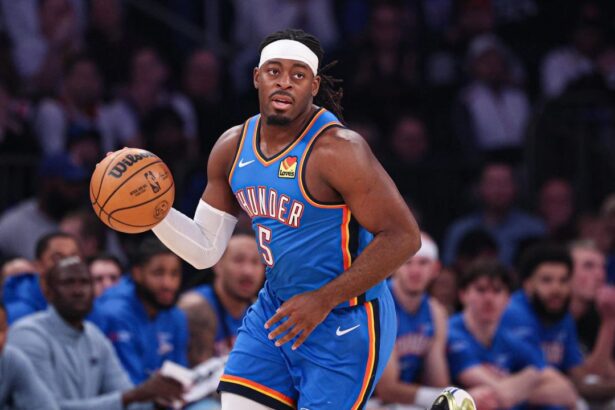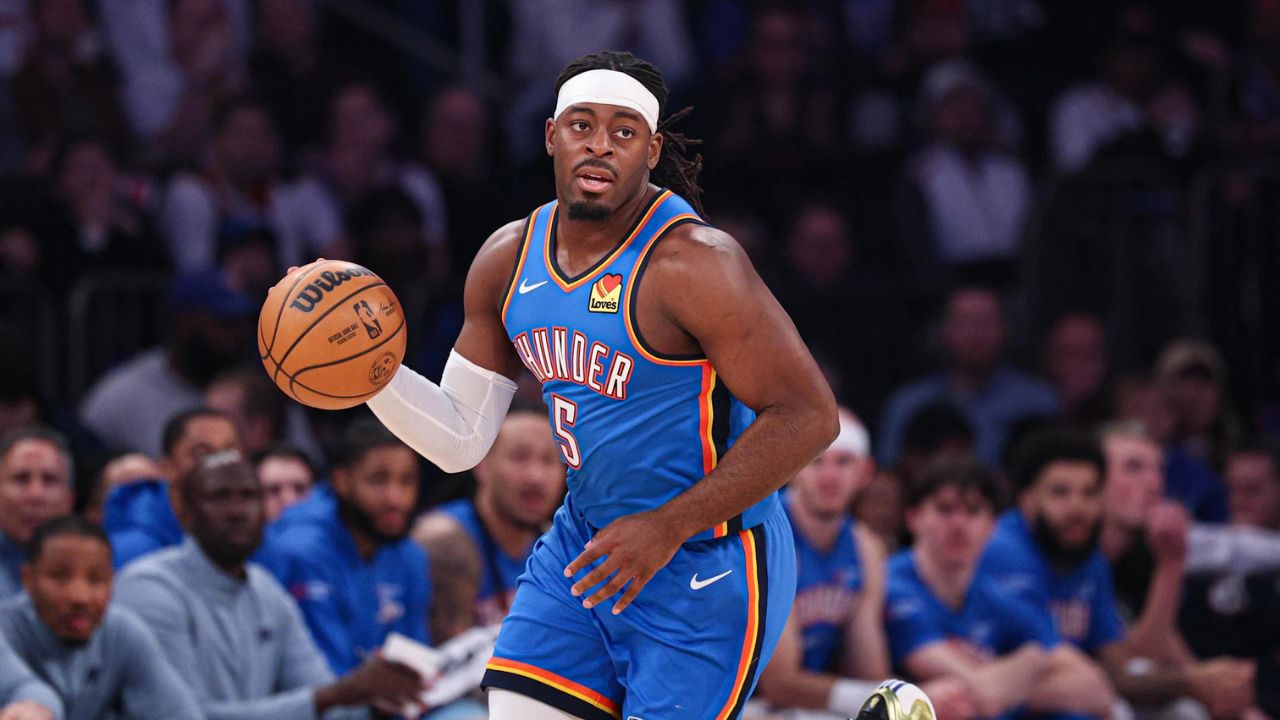
Lu Dort becoming available would be strange, but the Thunder have a salary problem. Shai Gilgeous-Alexander, Jalen Williams, Chet Holmgren, Isaiah Hartenstein, Alex Caruso, Cason Wallace, and Dort can’t all stay cheap forever. Dort has a $18.2 million team option for 2026-27, and if the Thunder decline it, he becomes one of the best defensive wings on the market.
The question is price. Dort finished 2025-26 with 8.3 points, 3.6 rebounds, 1.2 assists, and 0.9 steals in 26.8 minutes. The offense was limited: 38.5% from the field, 34.4% from three, and 52.4% true shooting. In the playoffs, it dropped to 5.5 points on 36.6% shooting and 30.8% from three.
Still, the defensive value is the sell. Dort was All-Defensive First Team in 2025 and still took the hardest perimeter matchup most nights. He is 6-foot-4, 220 pounds, strong through screens, and physical against big scoring guards.
There isn’t a direct report tying Dort to these teams. This is a fit and money framework. The best landing spots are contenders that need point-of-attack defense and have a path to offer more than a minimum deal.
4. Denver Nuggets
The Nuggets are a strong fit because their defensive problem is specific. The Nuggets didn’t need more offense. They ranked near the top of the league in scoring at 122.1 points per game, with Nikola Jokic and Jamal Murray carrying one of the best half-court attacks in the NBA. The issue was the other side.
The Nuggets had a 117.4 defensive rating and allowed 116.93 points per game. They also averaged only 6.8 steals, the fewest in the league. That tells the story. Their defense didn’t create enough pressure at the point of attack, and too many possessions reached the paint too easily.
That is a problem for a team built around Jokic. He can read everything on offense, but defensively, the first defender has to give him better effort. If guards get downhill too fast, the Nuggets’ coverage breaks early. Then Jokic has to help, rotate, and recover more than he should.
The Nuggets also allowed opponents to shoot 46.8% from the field. That number isn’t terrible by itself, but with their low steals rate, it shows a defense that didn’t disrupt enough before the shot went up.
Lu Dort would fit as the main ball-pressure defender. He could take Anthony Edwards, Shai Gilgeous-Alexander, Luka Doncic, Devin Booker, and Jalen Brunson-type matchups. Murray wouldn’t need to start on those players. Christian Braun also wouldn’t need to carry every hard guard-wing assignment.
The money is the difficult part. The Nuggets probably can’t beat cap-space teams, so their best normal path would be the full non-taxpayer mid-level exception. A four-year deal around $64.0 million, about $16.0 million per season, is the offer that makes sense for them, only if they move pieces like Braun or Cameron Johnson instead.
That probably isn’t Dort’s highest possible market, considering the Nuggets still need to retain Peyton Watston, but it is the best contender-type offer the Nuggets can make without destroying their salary structure.
For the Nuggets, the idea is simple. Pay Dort like a high-end defensive starter, not like a scorer. They need more ball pressure, more steals, and fewer easy first-side attacks. Dort gives them that.
3. Philadelphia 76ers
The 76ers need a stronger perimeter defender because their team defense was too average for a roster with Joel Embiid behind it. The 76ers had a 115.5 defensive rating, ranked 16th in the league, and finished with a -0.2 net rating. That isn’t good enough for a team built around Embiid, Tyrese Maxey, and Paul George.
The bigger issue is how opponents moved the ball against them. The 76ers allowed 27.56 assists per game, 9th-most in the league. That shows too many rotations, too much help, and too many open passes after the first action. A better first defender would reduce some of that pressure.
The perimeter numbers also show the need. The 76ers allowed 13.38 made threes per game. They weren’t destroyed only by percentage, but the volume still hurt them. When a team gives up too many assisted looks and too many threes, the problem usually starts before the final closeout.
Maxey also can’t be the answer on both ends. He carried a huge offensive load and made the All-NBA Third Team after putting up 28.3 points and 6.6 assists. Asking him to also defend the best guard every night is bad roster design. George can still guard in stretches, but he shouldn’t be used like a 28-year-old stopper for four rounds.
Dort would fix the matchup chart. He can take Brunson, Donovan Mitchell, James Harden, Cade Cunningham, or bigger guards depending on the series. That lets Maxey save energy, lets George defend more selected possessions, and gives Embiid better rim-protection angles.
The contract would be tied to the apron. If the 76ers can use the full non-taxpayer mid-level exception, the logical offer is four years and about $64.0 million, which means around $16.0 million per season. That is strong money for a contender role, but it may not be enough if Dort gets $20.0 million-plus per season from a cap-space team.
If that happens, the 76ers would need a sign-and-trade path. Still, the basketball fit is direct. They need a guard-wing defender who reduces the first breakdown and stops Maxey from burning energy on the hardest matchup.
2. Boston Celtics
The Celtics had a strong defense overall, with a 112.7 defensive rating that ranked 4th in the league, but their 3-point volume allowed was still a problem. They gave up 39.12 opponent 3-point attempts per game, 4th-most in the NBA, and 14.01 made threes per game, which ranked in the bottom third of the league by opponent rank.
The percentage wasn’t the big issue. Opponents shot 35.8% from three against the Celtics, around league average. The issue was how many threes they allowed. A defense can be top-five overall and still have a specific playoff weakness if it gives opponents too much 3-point volume.
That is where Lu Dort fits. He would give the Celtics another first-line defender who can pressure the ball, fight over screens, and reduce emergency rotations. Fewer breakdowns at the point of attack should mean fewer kickout threes. For a team that already defends well, that is the small correction that can change a playoff series.
Derrick White is a great defender, but he shouldn’t be the only guard stopper. Jaylen Brown can defend hard wings, but the Celtics also need his scoring. Jayson Tatum’s workload is already high. The Celtics need one more player who can take the first assignment and reduce scramble rotations.
Dort would help against Brunson, Maxey, Mitchell, Haliburton, and bigger scoring guards. He gives the Celtics another body to fight over screens and keep the ball away from the middle. That would lower the number of emergency closeouts that became opponent threes.
The Celtics’ offer would probably have to be the full non-taxpayer mid-level exception. That means something close to four years and $64.0 million. That isn’t a cap-space offer, so it probably doesn’t win if Dort only chases the biggest salary. But it is a serious number for a player whose main job would be defense, not shot creation.
For the Celtics, the value is matchup control. They don’t need Dort to change the offense. They need fewer opponent threes, more first-action resistance, and less pressure on White and Brown.
1. Los Angeles Lakers
The Lakers are the best fit because they have the strongest mix of need, role, and money. The Lakers went 53-29 and finished fourth in the West, but their defense still had a clear ceiling. They had a 116.4 defensive rating, ranked 19th in the league, and opponents shot 48.3% from the field against them, which ranked 24th.
The three-point defense wasn’t the main issue. Opponents shot only 35.2% from three against the Lakers, and their opponent 3-point volume was closer to league average than terrible. The problem was more about first-line resistance, matchup balance, and how much pressure the backcourt puts on the rest of the defense.
Luka Doncic and Austin Reaves give the Lakers enough offense. Doncic creates the main advantage, and Reaves gives them another ball-handler who can score and pass. But that backcourt still needs a physical defender next to it. The Lakers can’t ask Doncic to carry the offense and also take hard defensive matchups. They also shouldn’t ask Reaves to guard the best scoring guard or wing every night.
Lu Dort would give the Lakers a more direct defensive answer. He could take the hardest perimeter matchup, let Doncic hide more often, and keep Reaves away from the most physical assignments. That is the better roster balance.
The money is the separator. The Lakers have a projected cap-space path around $48.0 million, so they can go above the mid-level exception and beat most contenders. A three-year offer around $69.0 million, about $23.0 million per season, would make sense. That is starter money for a starter-level defensive role.
The Lakers don’t need another ball-dominant scorer first. They need a point-of-attack defender who fixes the matchup chart around Doncic and Reaves.