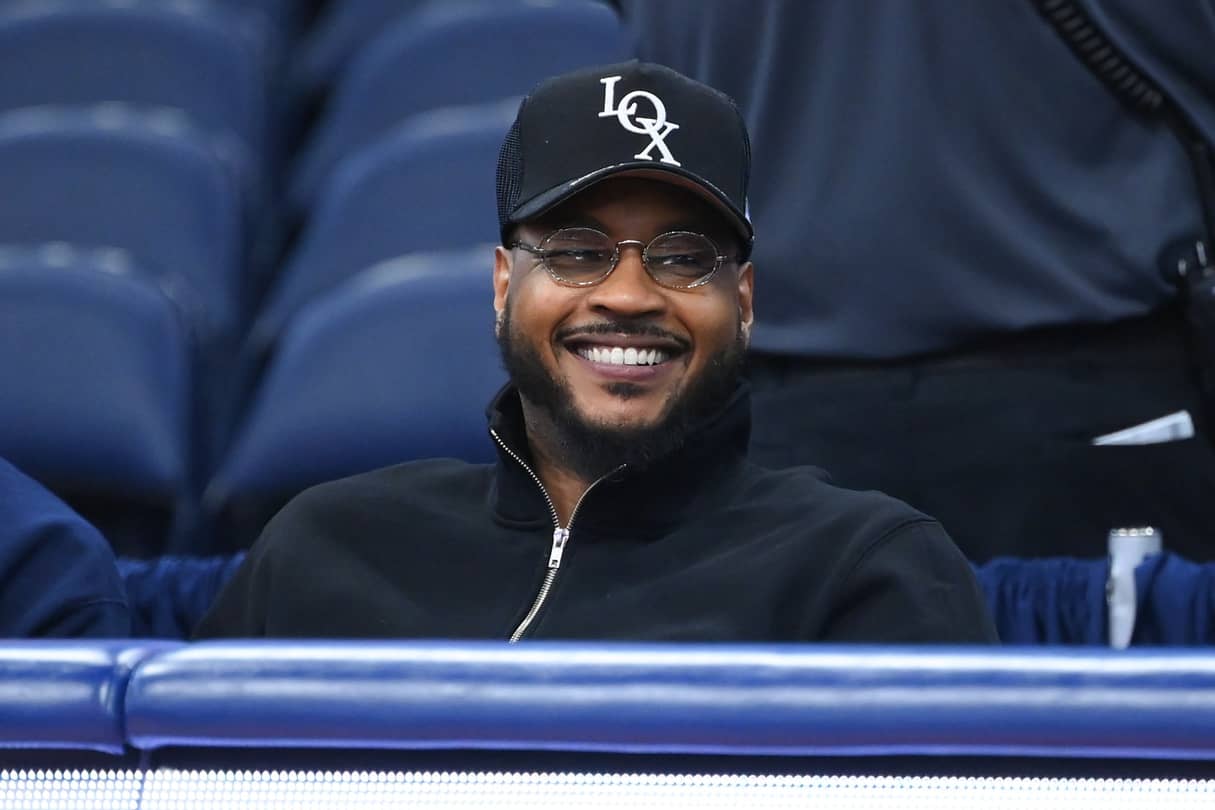
Carmelo Anthony recently offered a reality check about NBA contracts, explaining why even a $100 million deal does not automatically translate into generational wealth for players. Speaking on his 6 PM in Brooklyn podcast, the former NBA superstar broke down how taxes, expenses, and financial obligations quickly reduce what appears to be a massive payday.
“Well, a hundred million dollars, that’s not… That’s a hundred million dollars. Let’s not get that twisted. But it’s not really a hundred million dollars over a five-year span, right? Like, you’re talking about taking 58% or 48%, half your check. So that 10 goes to five over five years.”
“Now within that five, you got other taxes that you got to pay. Every state you play in, right? So now you’ve got taxes alone, that’s going to hit you. Boom. You can’t do nothing about that. Then you got to live. You got to get a house. You’re going to take care of your moms. You got your agency fees.”
“So you got all of this s**t that’s happening within that 5 million. You ain’t working with 10, you’re working with five. So now you got to bust down to five, right?”
Anthony explained that the first major hit comes from taxes, which can immediately take nearly half of a player’s earnings. That means a player earning $10 million per year might actually see only about $5 million before even accounting for other deductions.
NBA players also face something known as the ‘jock tax,’ which requires them to pay income taxes in every state where they play games. Because NBA teams travel constantly throughout the season, athletes end up paying taxes across multiple states.
Those tax rates can vary significantly depending on location. States such as California and New York have some of the highest tax burdens for athletes. In California, total tax rates for high earners can exceed 50%. In New York, they sit at around 47.9%. States like Minnesota, Oregon, New Jersey, and Washington, D.C. also hover around the mid-to-high 40% range.
On the other end of the spectrum, players in states without income tax, such as Florida or Texas, may pay closer to 37% overall. But taxes are only part of the financial picture.
Anthony pointed out that players still have to pay agent commissions, financial advisors, and other professional fees. Agents typically take around three to four percent of an NBA contract, while additional business managers, lawyers, and accountants also take their share. Then come normal living expenses and family obligations.
Anthony’s comments echo warnings that other NBA legends have shared in the past. Shaquille O’Neal famously told young players that a $100 million contract can disappear quickly if they are not careful with their spending and investments.
Even the largest contracts in NBA history look very different once taxes are applied. For example, Jayson Tatum’s record-setting five-year, $314 million contract averages about $62.8 million per season. But after federal taxes, jock taxes, agent fees, escrow deductions, and Medicare contributions, the net income drops dramatically.
In one estimate, a $62.8 million salary could shrink to roughly $25 million after those deductions.
That is still an enormous amount of money, but it highlights Anthony’s broader point. The headline number fans see in contract announcements is rarely the actual amount players take home. For Anthony, the message is simple. NBA contracts may look massive on paper, but without careful financial planning, even nine-figure deals are not automatically guaranteed to build wealth for generations.