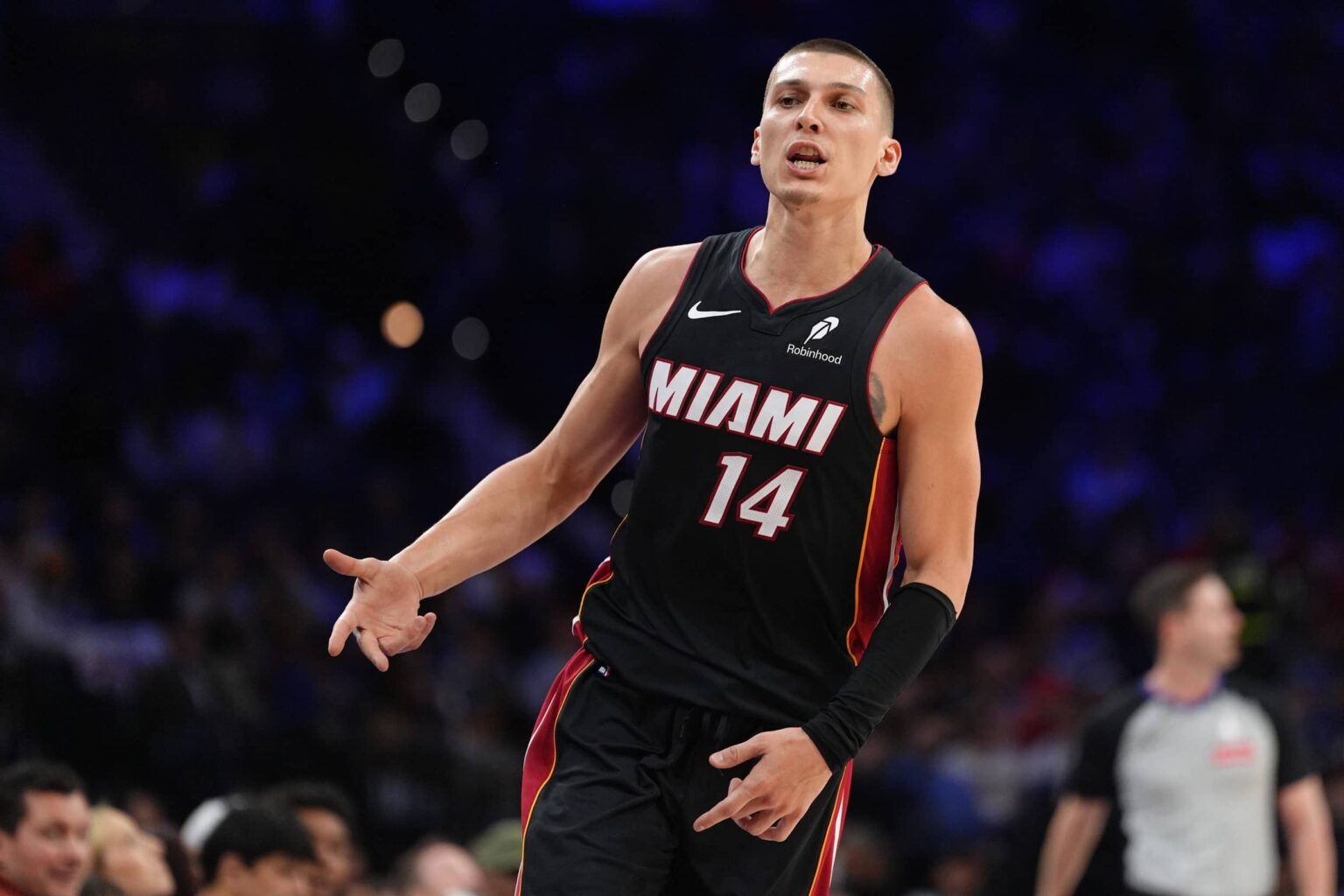
The Heat are entering a hard offseason because Tyler Herro is no longer just a productive scorer. He is an expiring contract, a major extension decision, and a player who may be easier to trade now than to pay later.
Herro averaged 20.5 points, 4.8 rebounds, and 4.1 assists in 33 games this season while shooting 48.0% from the field, 37.8% from three, and 91.7% from the line. The scoring was still there. The availability was not. He missed 49 games, and that matters for a team that just missed the playoffs for the first time since 2018-19. Greg Sylvander reported that he has a “strong sense” Herro and the Heat are heading for a divorce this summer, while the Miami Herald noted Herro is extension-eligible for up to four years and $206.9 million, but it is unlikely the Heat give him a deal in that range.
Herro will make $33.0 million in 2026-27, then he can become an unrestricted free agent in 2027. That makes this summer the obvious trade window. The Heat can still sell him as a 26-year-old scorer, but they do not have to commit to a huge long-term number.
Here are six realistic trade destinations for Herro, with financial frameworks that can work this summer.
6. Sacramento Kings
Sacramento Kings Receive: Tyler Herro
Miami Heat Receive: DeMar DeRozan, Devin Carter, Nique Clifford, 2031 first-round pick (top-8 protected)
This is the strangest fit of the six, but it is also possible if the Kings want to change the shape of their offense. DeMar DeRozan is owed $25.7 million in 2026-27 if his salary becomes guaranteed. Devin Carter is at $5.2 million, and Nique Clifford is at $3.3 million. That sends out around $34.2 million for Herro’s $33.0 million, so the money can work. The key detail is DeRozan’s guarantee. If the Kings waive him before that date, this framework is gone.
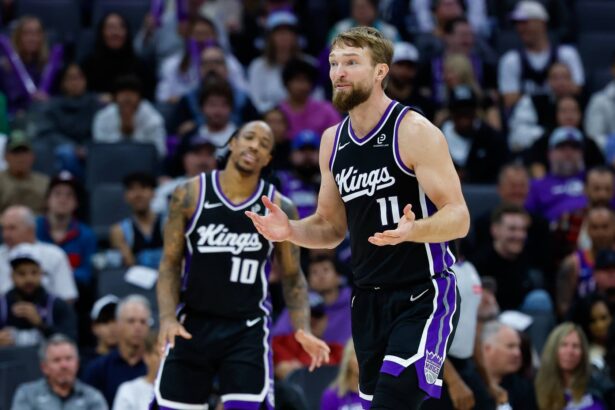
The basketball case is about spacing and age. DeRozan is still useful, but he is 36 and lives in the midrange. He produced 18.4 points, 2.9 rebounds, and 4.1 assists this season on 49.7% from the field, but only 31.6% from three. That is fine if the rest of the roster shoots. It is harder if the Kings are trying to build better spacing around Domantas Sabonis, Zach LaVine, Malik Monk, and their younger pieces.
Herro gives the Kings a different offensive profile. He is younger, shoots with more volume, and can work as a handoff guard next to Sabonis. That fit is easy to see. Sabonis can screen, pass, and create touch passes around the elbows. Herro can fly off those actions, shoot on the move, and punish teams that go under. If the Kings want more three-point pressure and less midrange isolation, Herro makes sense.
The concern is defense. A Herro-LaVine-Monk guard group would put a lot of pressure on the wings and bigs. The Kings would score, but they could also give back too much on the other end. Herro is not a stopper, and he should not be used like one. He needs to be protected by size, activity, and better point-of-attack defense.
For the Heat, this is not the best return, but it has pieces. DeRozan is a short-term scorer who can help keep the offense alive without forcing a long commitment. Carter is the real prize. He gives the Heat a young guard with defensive pressure and some upside. Clifford adds wing size, and the first-round pick gives the Heat something to use later in a bigger move.
This is realistic, but not ideal. It works if the Kings want more shooting and the Heat value Carter enough to take DeRozan as the main salary.
5. Toronto Raptors
Toronto Raptors Receive: Tyler Herro
Miami Heat Receive: RJ Barrett, 2030 second-round pick (via Raptors)
This is the easiest one-for-one style trade. RJ Barrett is owed $29.6 million in 2026-27, and Herro is owed $33.0 million. That is close enough for normal offseason matching if the Raptors operate below the apron limits. It is not complicated. It is a direct change of player type.
The Raptors have a roster that can use Herro’s shooting. Scottie Barnes is a strong playmaker, but he is not a pull-up guard. Brandon Ingram can score, but he likes the midrange. Immanuel Quickley can shoot and pass, but injuries and contract size complicate the long-term guard setup. Herro would give the Raptors a guard scorer who can play off Barnes and Ingram without needing to be the main ball-handler every possession.
Herro’s value there is simple. He can space the floor, run second-side pick-and-roll, attack off handoffs, and create late in the clock. The Raptors have size. They have wings. They have forwards. They do not have enough easy shooting. Herro fixes part of that.
The defensive question is easier for the Raptors than it is for some teams. Barnes can defend multiple spots. Ingram has length. Jakob Poeltl can protect the paint. The Raptors have enough size to hide Herro better than the Heat have been able to do at times. If Herro is guarding weaker perimeter players and spending most of his energy on offense, his value increases.
For the Heat, Barrett is a more physical wing. He averaged 19.3 points, 5.3 rebounds, and 3.3 assists while shooting 49.1% from the field this season. He is not the shooter Herro is, but he gives the Heat more downhill force and size on the wing. He can play next to Bam Adebayo, Andrew Wiggins, Nikola Jovic, and Jaime Jaquez Jr. without making the backcourt small.
Barrett is not perfect. He can hold the ball too long, his three-point shot can swing, and he is not a high-level defensive answer by himself. But he is durable, strong, and still in his prime. He also fits the Heat’s usual preference for physical players who can attack the paint.
This trade is more about roster balance than pure upside. The Raptors get the better shooter and more natural guard scorer. The Heat get the bigger player and move off the Herro extension decision. It is realistic, but the Heat may ask for more than a second-round pick because Herro’s shooting is harder to find.
4. Atlanta Hawks
Atlanta Hawks Receive: Tyler Herro
Miami Heat Receive: C.J. McCollum (sign-and-trade), Corey Kispert, 2029 first-round pick (top-10 protected)
This framework only works if the Hawks keep control of C.J. McCollum’s free agency. That is the key point. McCollum is entering unrestricted free agency after finishing the season on a $30.7 million expiring contract, so the Hawks cannot just trade him like a normal salary piece unless he agrees to a new deal and is moved through a sign-and-trade structure. Jake Fischer reported that the Hawks’ plan is to bring McCollum back, while The Athletic’s John Hollinger reported that executives view his likely market around one or two years and $35.0 million to $40.0 million, with a possible one-year balloon offer from a cap-space team also in play.
That makes this more complicated than a simple McCollum-for-Tyler Herro swap, but it also makes the logic more realistic. If McCollum commands something close to $18.0 million to $20.0 million annually, the Hawks would need to add salary to make the Herro framework work. Corey Kispert makes sense in that role because he gives the Heat another shooter and helps build a more complete outgoing package.
For the Hawks, Herro would be the younger version of what McCollum gave them after the trade deadline. McCollum averaged 18.7 points, 3.3 rebounds, and 3.9 assists this season, and he gave the Hawks real scoring stability after arriving in the Trae Young deal. Herro is eight years younger, still in his prime, and gives them a higher-volume shooter who can play next to Jalen Johnson, Dyson Daniels, Zaccharie Risacher, and Onyeka Okongwu.
The Heat side is also easy to explain if Norman Powell leaves in free agency. Powell is an unrestricted free agent, and the Heat have to decide whether they want to pay him after his $20.4 million expiring deal. He is eligible for a four-year, $128.5 million extension, but Barry Jackson reported that the Heat are looking at wing options in case Herro is traded or Powell leaves in free agency.
McCollum would not be a long-term answer, but he would replace some of Powell’s scoring. He can still run pick-and-roll, shoot off the catch, play next to Bam Adebayo, and stabilize second units. Kispert would give the Heat another movement shooter, and the protected 2029 first-round pick would be the asset that makes the deal worth taking.
This is not the highest-upside Herro trade, but it is one of the most logical if the Hawks really want to keep McCollum and then use that salary slot to chase a younger scorer. The Heat would get a veteran guard, a shooter, and a pick instead of paying Herro long-term.
3. Brooklyn Nets
Brooklyn Nets Receive: Tyler Herro
Miami Heat Receive: Terance Mann, Drake Powell, 2027 first-round pick (via Knicks, unprotected)
The Nets make sense because they have cap space, draft capital, and a need for a real scorer. They do not need to match Herro’s full $33.0 million if they operate with room. Terance Mann is owed $15.5 million in 2026-27, while Drake Powell is on a rookie deal. The Nets can use cap space to absorb the difference, making this cleaner than most Herro trades. Spotrac’s Keith Smith projected the Nets to have one of the largest cap-space totals in the league for 2026-27.
Herro would give the Nets something they do not have: a proven 20-point scorer who can be featured right away. That does not mean he should be treated as a No. 1 player on a contender. It means the Nets can use him as a scoring bridge while their younger players develop.
The Nets have spent time collecting picks and flexible pieces. At some point, they need to add real offense. Herro can run pick-and-roll, score off screens, shoot from deep, and take pressure off their younger guards. He is also young enough to fit a retool, but old enough to help now. That is why this is not a pure win-now move. It is a middle path.
The cost is the real question. Would the Nets give up an unprotected 2027 first-round pick via Knicks? That may be aggressive. But if the Nets believe that pick will land in the middle or back part of the first round, it becomes easier. Herro is not free. If the Heat are taking back Mann and a developmental player, the first-round pick has to be strong.
For the Heat, this is one of the better reset trades. Mann averaged 7.2 points, 3.2 rebounds, and 3.0 assists this season. He is not a star, but he is a useful guard-wing who can defend, move the ball, and play without a high usage rate. Powell averaged 7.0 points, 2.0 rebounds, and 1.0 assists as a rookie, with clear defensive tools but a weak 28.0% mark from three.
That is fine for the Heat if the pick is the point of the deal. Mann helps the rotation. Powell gives them a young wing. The Knicks pick gives them a stronger asset for the next major trade.
The Nets would be betting that Herro’s injuries were more bad timing than a permanent issue. The Heat would be betting that flexibility and a pick are better than paying Herro. That makes this one of the most balanced options.
2. Milwaukee Bucks
Milwaukee Bucks Receive: Tyler Herro
Miami Heat Receive: Kyle Kuzma, Bobby Portis, 2031 first-round pick (top-8 protected)
The Bucks should be near the top of any Herro list because their problem is simple: they need more shot creation around Giannis Antetokounmpo. They have tried different guards and forwards, but the same playoff question keeps coming back. Who can make perimeter shots when the defense builds a wall against Giannis?
Herro is a logical answer. He is not a superstar, but he is a real shooter and scorer, and is a Wisconsin native, which helps to make the case, too. He can run pick-and-roll, take dribble handoffs, shoot off movement, and play as a second or third offensive option. Next to Giannis, that has value. Giannis forces help at the rim. Herro punishes help with pull-ups, relocation threes, and quick attacks.
The money works. Kyle Kuzma is owed around $20.5 million, and Bobby Portis is owed $14.5 million. That is about $35.0 million going to the Heat for Herro’s $33.0 million. For a team watching apron rules, sending out slightly more than it takes back is important.
The basketball fit for the Bucks is better than the outgoing package. Kuzma averaged around 13.0 points and 4.5 rebounds, while Portis averaged 13.6 points and 6.4 rebounds in 67 games. Both are useful. Neither changes the shot-making ceiling of the Bucks the way Herro could.
Herro would give the Bucks another player defenses must guard 25 feet from the rim. That helps Giannis. It also gives the Bucks a guard who can score when Giannis sits. The concern is defense, but the Bucks can cover some of that if they keep strong defensive personnel around him. Herro should not guard top options. He should be hidden while he gives them 20 points and spacing.
For the Heat, this is practical. Kuzma gives them a forward who can score, rebound, and soak up usage. Portis gives them toughness, shooting at the big spot, and regular-season production. The first-round pick is the real prize. If the Bucks are trading a 2031 first-round pick, the Heat should be interested because of the long-term risk around an older roster.
This is probably the most “Heat-style” trade if they do not want to bottom out. Kuzma and Portis keep them competitive, and the pick gives them upside. The downside is that both players are more role pieces than core pieces. The Heat would still need another move to raise their ceiling.
The Bucks should do this if they believe Herro can stay healthy. They need more offense. Herro gives them that. The Heat should do it only if the pick is included.
1. Detroit Pistons
Detroit Pistons Receive: Tyler Herro
Miami Heat Receive: Isaiah Stewart, Ron Holland II, Marcus Sasser, 2029 first-round pick (top-10 protected)
The Pistons are the best Herro fit because they can give him the right job. He would not have to be the franchise player. He would not have to carry the offense every night. He would be the second perimeter scorer next to Cade Cunningham, and that is the best basketball version of Herro.
The salary works. Isaiah Stewart is owed $15.0 million, Ron Holland II is owed $9.1 million, and Marcus Sasser is owed $5.2 million. That is around $29.3 million outgoing for Herro’s $33.0 million. The Pistons can make that work under normal offseason matching because they are not built like a second-apron team.
The fit is obvious. Cunningham needs shooting and secondary scoring. Herro gives him both. The Pistons can run Cade-Herro actions, use Herro off pindowns, and let him attack against a tilted defense instead of asking him to create everything from a set floor. That is where Herro is at his best.
Herro’s defense is less of a problem with the Pistons than it would be elsewhere. Cunningham has size. Ausar Thompson is an elite athlete. Jalen Duren gives them power inside. Stewart can defend bigs and hit enough threes to stay useful. The Pistons have bodies to protect Herro. The Heat did not always have that same setup when lineups got small.
For the Pistons, this trade is about speeding up the rebuild without giving up the wrong player. They keep Cunningham, Ausar Thompson, Duren, and their most important structure. They give up Holland, Sasser, Stewart, and a protected pick. That is a real price, but not a reckless one.
Holland is the tough part. He played 78 games and averaged 7.0 points in 19.9 minutes, but his shooting was rough at 25.3% from three. He is still young, athletic, and built like a Heat development target. That is the type of player Miami usually likes.
Stewart also fits the Heat. He is physical, defensive, and under contract at a manageable number. He can play next to Bam in some matchups or behind him in others. Sasser gives the Heat a guard who can score off the bench and stay on a cheap contract. The first-round pick gives them the upside piece.
This is the best trade because both teams can explain it without forcing the logic. The Pistons get a proven scorer who fits next to their franchise guard. The Heat get size, youth, depth, and a first-round pick without taking back an awful contract.
If Herro is moved this summer, the Pistons should be one of the first teams calling. They have the need, the salary, the young pieces, and the defensive structure to make the risk worth it. For the Heat, this is the cleanest way to move Herro without admitting defeat. They would not be tanking. They would be changing the roster into something bigger, younger, and easier to reshape around Adebayo.





![Knicks Fans Assault Police, Destroy Cab And Five Guys Restaurant In Violent Game 4 Aftermath [Video]](https://fadeawayworld.net/wp-content/uploads/2026/06/Knicks-Fans-riot-after-Game-4-615x410.jpg)