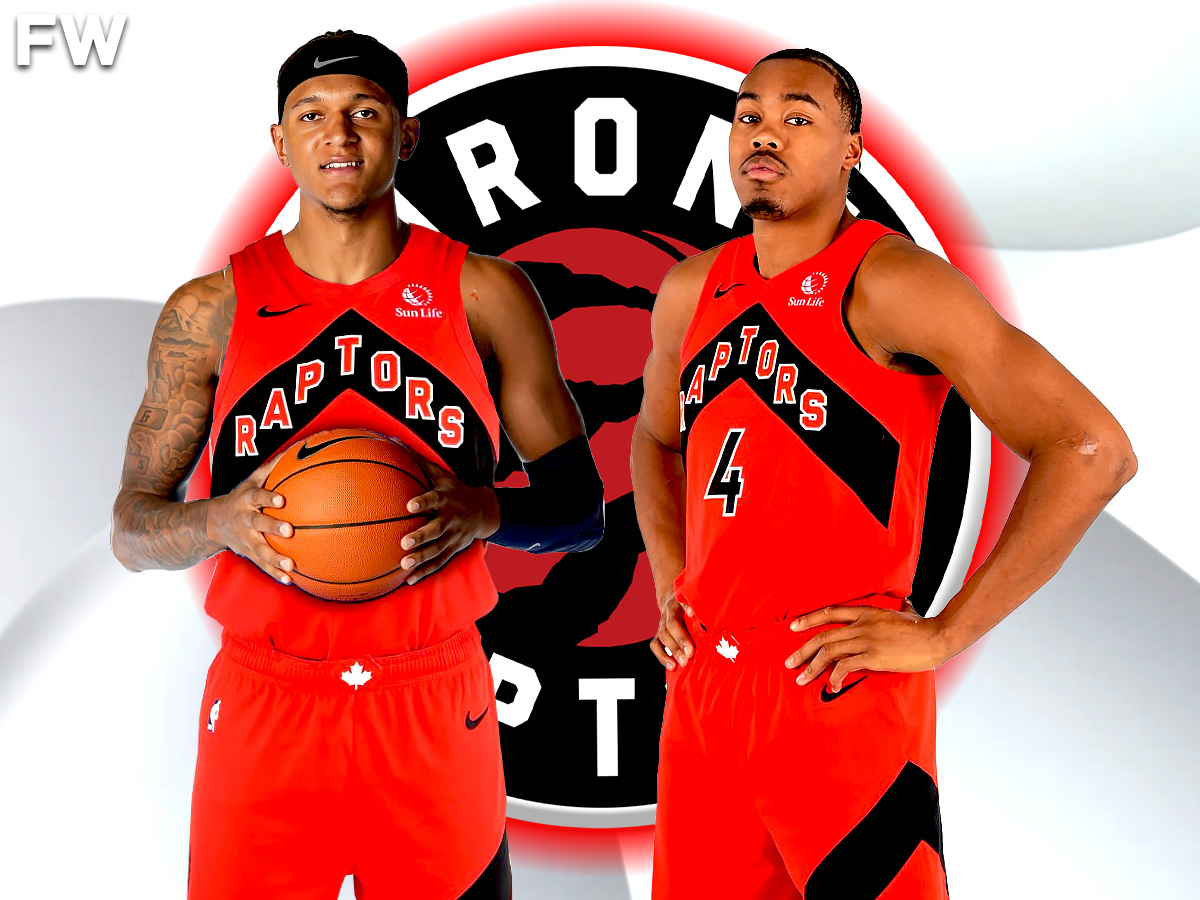
The Raptors hosted the Magic on Sunday and rolled to a historic 139-87 win, while Paolo Banchero finished with nine points on 3-of-14 shooting. But the bigger story after the game was not his stat line. It was what he said about Scottie Barnes.
That’s a guy you would love to play with, just off the strength of how he contributes to his team. He’s not really ever caught up in the scoring. He’s always trying to look to find others, guards at a high level, picks up full court. He’s always been a super impactful player in my eyes in terms of the stuff he does for the team. He’s just a winning player.”
That is why this mock trade idea suddenly feels more interesting. Banchero did not just give Barnes a quick compliment. He described the exact kind of player stars usually want next to them. So today, we are building a framework for how the Raptors could try to pair Barnes and Banchero in the same frontcourt.
It still looks unlikely right now. The Magic are not under pressure to move him, and Banchero is still one of the franchise’s core pieces. But if the Magic keep hovering around the play-in range and Banchero keeps falling short of the All-Star level many expected from him, this is the kind of idea that can start as noise and slowly become more serious.
The Trade Framework
Orlando Magic Receive: Brandon Ingram, Gradey Dick, 2027 first-round pick, 2030 first-round pick
Toronto Raptors Receive: Paolo Banchero
This framework only really works in the 2026 offseason because that is when Paolo Banchero’s rookie max extension starts. That deal is projected to begin at about $41.4 million in 2026-27, so any serious trade idea has to be built around that new number, not his current rookie-scale salary.
From the Raptors’ side, the money is at least clean on paper. Brandon Ingram is set to make $40.0 million in 2026-27 under his new contract, while Gradey Dick would be at about $7.1 million in the fourth year of his rookie deal. Put together, that gives the Raptors roughly $47.1 million in outgoing salary for Banchero’s projected $41.4 million. So from a salary-matching point of view, this is not a complicated structure.
That is the basic logic behind the framework. The Raptors would be turning one major salary, one young rotation player, and two first-round picks into a 23-year-old franchise forward. The Magic, on the other side, would be giving up the best player in the deal by a wide margin, which is why a package like this only becomes realistic if there is some real pressure behind the scenes. From a cap perspective, it works. From a basketball and asset perspective, it would still take a lot for the Magic to seriously consider it.
How The Raptors Get Better With This Move
There is a real case for the Magic to like Brandon Ingram in this kind of deal, because he has quietly had one of the best offensive seasons of his career with the Raptors. He came back to the All-Star team, averaging 21.4 points, 5.6 rebounds, and 3.7 assists while shooting 47.1% from the field and 37.8% from three this year. That is strong production on good efficiency, and it has come on a Raptors team that is 42-32 and sitting fifth in the East with a week left in the regular season.
What stands out with Ingram is not only the scoring. It is the fit. Next to Scottie Barnes, Immanuel Quickley, RJ Barrett, and Jakob Poeltl, he gives the Raptors another half-court shot creator who does not need to dominate every possession to be effective. Barnes is at 18.6 points, 7.7 rebounds, and 5.8 assists, Quickley is giving them 16.9 points and 6.0 assists, Barrett is adding 19.0 points and 5.3 rebounds, and Poeltl is finishing efficiently inside at 10.6 points on 69.6% shooting. Ingram slides into that structure as the cleanest mid-range and wing isolation scorer on the roster. He can punish switches, work from the elbows, and take pressure off Barnes late in games when defenses load up on the Raptors’ main initiators.
That is why this trade idea is interesting from both sides. The Raptors already look more balanced with Ingram in place because he gives them a scorer who can operate in slower playoff possessions, something this core did not always have. Barnes drives the engine with size, passing, and defense. Quickley brings pull-up shooting and pick-and-roll pace. Barrett attacks gaps and gets downhill. Ingram ties that together by giving them a long wing that can create his own look when the first action dies. That is a serious playoff skill.
There is also the Gradey Dick part of this. Dick’s value is lower now than it was a year ago, but he is still a 22-year-old wing on a rookie contract, and that matters in trade talks. He is averaging 6.3 points in 14.9 minutes per game this season. The shot has not fully come around yet at 30.1% from three, but the age, cost control, and movement shooting profile still carry value for a team looking to reshape its wing rotation.
Now to Banchero. The talent is obvious, but this has not been a clean season. He is averaging 22.6 points, 8.3 rebounds, and 5.1 assists, which looks strong on the surface, but the efficiency has been mixed. He is shooting 45.9% from the field and 31.0% from three, with a 56.7% true shooting mark and 3.0 turnovers per game. He also had a brutal game against the Raptors on Sunday, finishing with nine points on 3-of-14 shooting in the Magic’s worst loss in franchise history. The Magic are 39-35 and stuck in the play-in zone, while their offense ranks near the middle of the league, and their three-point shooting remains weak.
The key question is whether Banchero would be a better fit in Toronto than he has been in Orlando. I think the answer is yes, at least offensively. On the Raptors, he would not need to carry the same level of shot creation every trip. Barnes would take some of the playmaking burden. Quickley would give him a real pull-up guard next to him. Barrett would attack secondary defenders. Poeltl would still give him a strong screen-and-dive partner. In that setup, Banchero could work more as a mismatch scorer, a short-roll passer, and a face-up four rather than as the player who has to solve everything himself. That could help the efficiency.
So yes, Banchero is the bigger name and the higher-upside talent. But this is not as simple as star-for-star. Ingram has been excellent, the Raptors are already winning with this core, and Dick still has some asset value. The Raptors would be betting that Banchero’s age, size, and offensive ceiling are worth giving up a setup that is already working. That is a big bet, but there is a basketball argument for it.
Why The Magic Would Make This Deal
The hardest part of the Paolo Banchero decision is that the box-score numbers still look good. He is averaging 22.6 points, 8.3 rebounds, and 5.1 assists. But once you go a level deeper, the season has been much less convincing than that line suggests.
Banchero is shooting 45.9% from the field and 31.0% from three, with a 56.7% true shooting mark. His turnover rate is also high for a player carrying this much offense, and his offensive rating sits at 110 with a defensive rating at 114. Those are not disaster numbers, but they are not the profile of a clean No. 1 option either.
On the court, the issue is pretty clear. Banchero still gets to his spots, but too many possessions end with hard pull-ups, late-clock isolations, or drives into loaded paint. The three-point shot has not become a real weapon, so defenses still go under, shrink the floor, and dare him to beat them with efficiency instead of force. When that happens, the offense can get stuck.
He is strong enough to draw contact and gifted enough to create shots, but the process is still heavy. There is a lot of self-created difficulty in his offense, and the efficiency has not caught up to the usage. That is a problem when the team is sitting around the play-in line instead of climbing into the top six.
There is also the coaching angle. Publicly, Jamahl Mosley has continued to back Banchero and call him central to what the Magic need. But there has also been outside reporting by Grant Afseth this season about possible tension or a growing disconnect between Banchero and Mosley.
There was also a more visible public moment between Banchero and Mosley after the loss to the Pistons on March 1. Banchero said, “Teams, a lot of times, adjust at halftime and I think that’s why we struggled a lot in the second half,” which was read by many as a clear shot at the coaching staff. The next day, Mosley pushed back on that idea and said the real issue was not adjustments, but effort, saying the Pistons simply “played harder.”
That does not prove some huge internal problem by itself, but it was one of the clearest signs this season of frustration showing up in public, and it added more noise around a team that has already spent most of the year stuck in the lower part of the East playoff picture.
The financial side is where this gets more interesting. Banchero’s new deal is projected to start at about $41.3 million in 2026-27. Franz Wagner, meanwhile, is set to make about $41.8 million next season. So the cost difference between the two franchise forwards is basically negligible. If the salaries are that close, then the real question becomes which player gives the Magic the cleaner team-building path.
And there is a real argument that Wagner is the better pillar right now. Before his left high ankle injury, he was averaging 21.3 points, 5.8 rebounds, and 3.6 assists in 28 games, while shooting 47.9% from the field, 36.5% from three, and posting a 59.1% true shooting mark. ESPN reported on February 18 that Wagner was out indefinitely and had already missed 25 of the previous 29 games. That injury changed the season for the Magic in a major way.
From a basketball perspective, Wagner is easier to plug into different lineups. He can score without stopping the ball as much, he is a more natural connector, and the shooting is cleaner. If the Magic believe Wagner is the forward who fits better with the rest of the roster, and if they are not fully sold on Banchero as the long-term offensive engine at max money, then this kind of deal starts to make more sense.
They would be selling high on the bigger name, bringing back Brandon Ingram, Gradey Dick, and picks, and quietly choosing Wagner as the player to build around. That is a risky call, but based on this season’s efficiency gap, lineup feel, and the team’s uneven results with Banchero as the main engine, it is not a crazy one.
Potential Lineups For Both Eastern Contenders
For the Raptors, the clean version is Immanuel Quickley, RJ Barrett, Scottie Barnes, Paolo Banchero, and Jakob Poeltl, with Banchero sliding into the frontcourt next to Barnes and giving the offense another real half-court scorer.
Quickley would still handle the first layer of pick-and-roll creation, Barnes would keep working as the main connector and matchup problem, and Poeltl would stay in the middle as the screener and rim finisher. The difference is that the Raptors would now have a power forward who can create his own shot from the elbows, attack slower bigs off the dribble, and give them a bigger isolation option late in possessions.
The second unit would also make more sense than people think. Jamal Shead can organize the bench, Ja’Kobe Walter gives them another wing body, Sandro Mamukelashvili can play as a stretch frontcourt option, and the rotation would still have enough scoring because one of Barnes, Banchero, or Barrett would almost always stay on the floor.
Right now, one of the Raptors’ biggest strengths is lineup size and playmaking across positions. A Barnes-Banchero frontcourt would push that even further. Defensively, there would still be real questions about whether that group has enough point-of-attack resistance against elite guards, but the offensive talent and size would be difficult to ignore.
For the Magic, the likely starting group after this deal would be Jalen Suggs, Desmond Bane, Franz Wagner, Brandon Ingram, and Wendell Carter Jr. That lineup is less star-heavy than one built around Banchero, but it may be cleaner.
Suggs handles pressure defense and secondary creation, Bane gives them a real perimeter scorer and movement shooter, Wagner stays as the main franchise pillar, Ingram becomes the long wing scorer who can settle possessions, and Carter holds the middle.
The bigger change for the Magic would be depth and flexibility. Gradey Dick would come in as a young wing shooter on a cheap deal, and the two first-round picks would give them more ways to keep building around Wagner, Suggs, and Bane. That does not replace Banchero’s upside, but it does give the Magic a more stable roster-building path if they decide Wagner is the better long-term centerpiece.
So the trade would push the Raptors toward a higher-upside frontcourt built around size and creation, while the Magic would be shifting toward a more balanced, deeper rotation with cleaner wing fit around Wagner.
Final Thoughts
A Paolo Banchero trade still feels very unlikely today. The Magic do not have any reason to rush into that kind of decision, especially with Banchero still just 23 and under long-term control. But the new NBA has shown that these ideas are not as impossible as they used to look. The Hawks moved Trae Young in January. The Mavericks traded Luka Doncic in February 2025. The Nuggets moved Michael Porter Jr. in the 2025 offseason. Big names are not untouchable anymore when a front office starts to question the ceiling, the fit, or the long-term money.
That said, for Magic to seriously consider something like this, the pressure probably has to build for a while. The most realistic trigger would be time. It is hard to see them making that call right after giving Banchero the rookie max extension that is projected to start in 2026-27. A move like this would likely require at least another year of evidence that the current core is not going far enough.
So the real pivot point may come closer to the last fully guaranteed years of his deal, or if the Magic miss the playoffs, or stay stuck in the play-in range, over the next two seasons. If that happens, and if Franz Wagner looks like the cleaner long-term centerpiece, then the idea stops sounding like pure fantasy. It would still be a blockbuster. But in this league, that no longer means impossible.