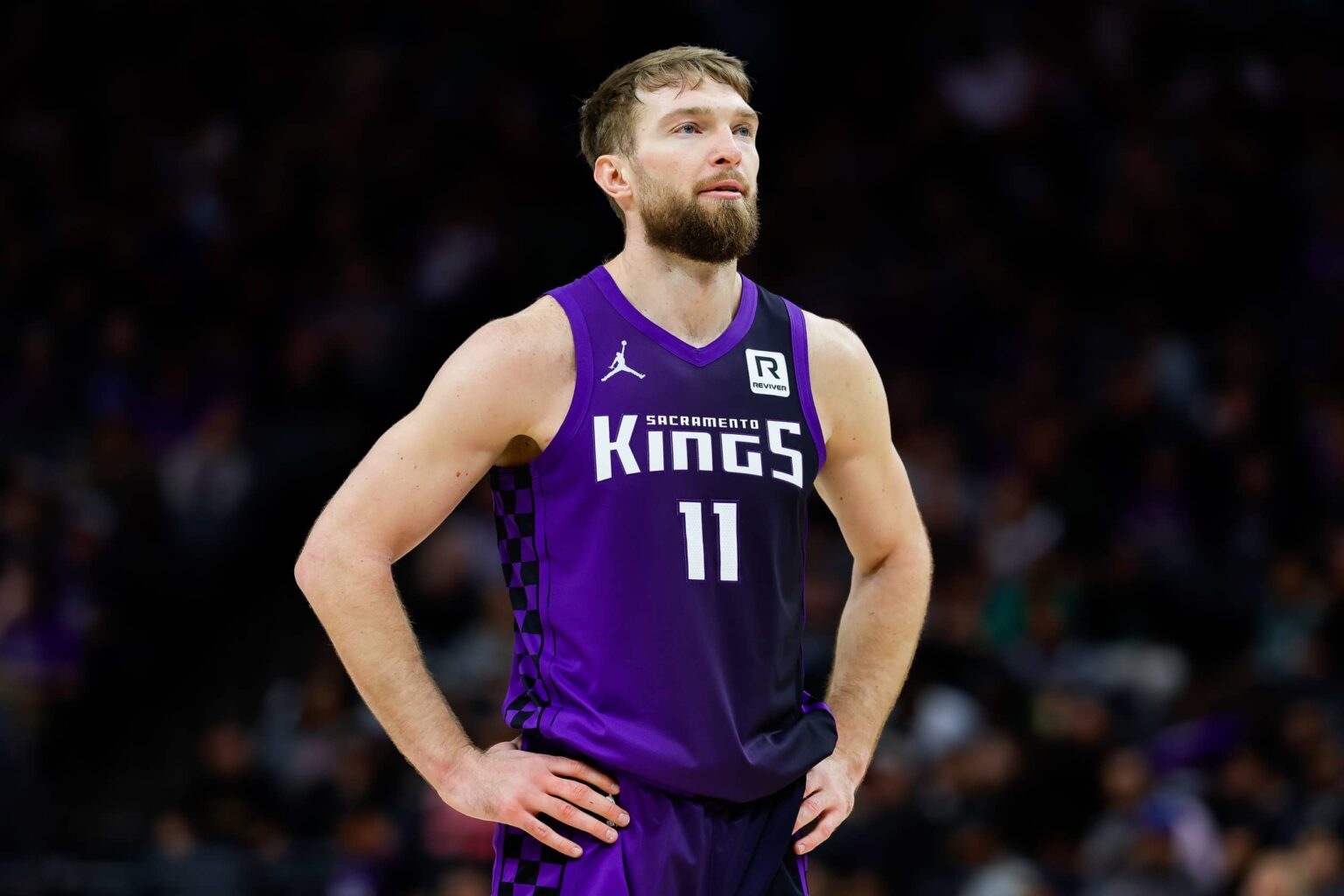
Domantas Sabonis enters the 2026 offseason as the biggest decision on the Kings’ roster. The rumors have returned because the situation is difficult to separate from the contract, the injury, and the direction of the team.
A recent Evan Sidery post claimed the Kings are going to openly shop Sabonis in the offseason, while earlier reporting from Sam Amick connected the Raptors, Suns, Bulls, and Wizards to interest before the trade deadline.
Sabonis is still a high-level offensive center when healthy. He averaged 15.8 points, 11.4 rebounds, and 4.1 assists this season before undergoing surgery to repair a torn meniscus in his left knee. That production explains why teams would call.
The medical situation and the salary explain why a deal is not simple. Sabonis is owed $45.5 million in 2026-27 and $48.6 million in 2027-28, which means any interested team has to treat him as a major financial commitment, not just a frontcourt upgrade.
The Kings also have to be honest about their own timeline. They finished at the bottom of the league, shut down Sabonis and Zach LaVine after surgeries, and moved into an offseason where small fixes are hard to justify.
The Kings do not have a top 5 Draft pick after falling out of the projected top 3 for the No. 1 selection in the lottery, and simply lack any type of franchise cornerstone for the next decade. Keegan Murray, Maxime Raynaud, or Devin Carter are good players, just not the caliber of young pieces a team builds around for the future.
Keeping Sabonis means staying attached to a 30-year-old center who needs the ball, does not stretch the floor, and has playoff defensive questions. Trading him means accepting that the previous core has reached its limit, and maybe even gaining a young asset they can hope to develop into an All-Star at some point.
That is the tension behind these five trade ideas. The Kings can’t just ask for a superstar return, but they cannot move Sabonis for dead salary either. The right deal has to bring back rotation talent, salary flexibility, and at least one asset that fits a reset.
Here are five realistic Domantas Sabonis trades as the Kings’ offseason noise grows louder.
5. A Brand New Big Man For LaMelo Ball
Charlotte Hornets Receive: Domantas Sabonis
Sacramento Kings Receive: Miles Bridges, Josh Green, 2027 first-round pick, 2029 second-round pick
This is the least dramatic trade of the five, but it is not weak. The Hornets finished 44-38 and took the No. 9 seed, which changes the way they should think. They are no longer operating like a deep rebuild. They have LaMelo Ball, Brandon Miller, Kon Knueppel, Moussa Diabate, and enough young talent to justify a stronger frontcourt move. Sabonis would not make them a contender alone, but he would give them the first serious offensive center of this build.
The salary structure works because Miles Bridges and Josh Green combine for roughly $37.5 million in 2026-27. Bridges is owed $22.8 million, while Green is around $14.7 million. That amount gets close enough to Sabonis’ salary for matching purposes without forcing the Hornets to include one of their premium young pieces, given they still have space under the apron.
For the Hornets, the logic is half-court order. Ball is an elite passer, but he has spent too much of his career carrying unstable rosters. Sabonis would give him a high-post partner, a dribble-handoff engine, and a rebounder who can start transition with the pass instead of needing a guard to come back for the ball. Miller would also benefit because Sabonis can screen, re-screen, and find shooters when defenses top-lock actions.
The price is fair because Bridges is not a salary piece only. He averaged 17.1 points, 5.8 rebounds, and 3.2 assists while shooting 46.0% from the field and 33.3% from three. That is useful production, especially on a declining contract. Green gives the Kings another wing contract, but his season was uneven. He averaged only 4.3 points, 1.8 rebounds, and 0.8 assists, though he did shoot 42.0% from three.
The Kings would ask for the first-round pick because Bridges and Green are not enough to move Sabonis by themselves. The pick should be protected, likely top-8 protected in 2027, because the Hornets are not strong enough to trade an unprotected first-round pick for an expensive center with playoff defensive questions. The second-round pick adds value without pushing the deal into reckless territory.
For the Kings, this is a soft reset. Bridges can start or be moved again. Green is matching salary with some defensive use if his shot holds. The first-round pick is the real reason to consider it. It is not a franchise-changing offer, but it gives the Kings a younger forward, a usable wing, and draft value instead of paying Sabonis through another directionless season.
4. The Raptors Land Their Deadline Target
Toronto Raptors Receive: Domantas Sabonis
Sacramento Kings Receive: RJ Barrett, Gradey Dick, 2028 first-round pick, 2030 second-round pick
This is the most reported structure on the board. Sam Amick reported that the Raptors were a serious Sabonis suitor, as most sources viewed them as the most viable team in the talks before the deadline. The same reporting also made clear why nothing was easy: the Kings had no interest in taking Jakob Poeltl’s long-term money, which forced the Raptors to stay put in trade talks.
This version removes Poeltl and uses RJ Barrett as the main salary. Barrett is owed $29.6 million in 2026-27, and Gradey Dick is at $7.1 million. Together, they get to about $36.7 million, which approaches the number needed to match Sabonis, as they can absorb the rest while losing their full MLE space. The Raptors would likely need to manage the margins carefully, but as a framework, this is the most natural version without sending Poeltl to the Kings.
For the Raptors, Sabonis would give them a stronger offensive identity. They finished 46-36 and took the No. 5 seed, so this is not a team starting from zero. Scottie Barnes, Brandon Ingram, Immanuel Quickley, and Sabonis would form a real top-end group, with Sabonis operating as the passing big who can organize actions around Barnes and Ingram.
The question is whether that group has enough shooting and enough rim protection. Sabonis would help the offense, but he does not fix the defensive ceiling. That is why this trade cannot become a massive pick package. The Raptors should not send multiple first-round picks for a high-salary center who still requires a very specific defensive structure around him.
For the Kings, Barrett is the center of the return. He averaged 19.3 points, 5.3 rebounds, and 3.3 assists while shooting 49.1% from the field, 33.9% from three, and 71.7% at the line. The efficiency is not ideal, but he is a strong downhill wing who can get to the rim and carry possessions when the offense breaks down.
Dick gives the Kings a younger shooter on a rookie-scale deal. His value has dropped from the idea of him as a pure movement shooter, but he is still young enough to be part of a retool. The first-round pick is the key. If the Raptors protect it lightly, this becomes a serious offer. If they demand heavy protections, the Kings should push for another second-round pick or a better young player.
This is not the loudest trade, but it is the most logical. The reporting is there. The salary can work. The Raptors need a frontcourt upgrade. The Kings need to get off Sabonis without taking Poeltl. It is probably the most realistic pathway if both sides reopen talks in the offseason.
3. A New Partnership Could Grow In Chicago
Chicago Bulls Receive: Domantas Sabonis
Sacramento Kings Receive: Anfernee Simons, Patrick Williams, 2028 first-round pick
This is the most complicated deal because it depends on Anfernee Simons agreeing to a sign-and-trade. Simons is an unrestricted free agent with Bird rights, so the Bulls can sign him and move him in the same transaction if the structure goes along the apron rules.
Something around a $24.0 million first-year salary for Simons, combined with Patrick Williams’ $18.0 million salary, gets the outgoing money to roughly $42.0 million. That brings the Bulls close enough to Sabonis’ salary for a workable framework.
The hard part is not only the math. A sign-and-trade would require Simons’ approval, and the team acquiring him would be hard-capped at the first apron. That means the Kings would need to know their full summer plan before doing this. If they are also manage to move Zach LaVine or other salary, this structure becomes easier. If not, it can create a tight cap sheet fast.
The Bulls finished 31-51 and missed the playoffs, so this trade would be an aggressive attempt to stop drifting. Sabonis would give them a real offensive big next to Josh Giddey and Matas Buzelis. That fit is strange, but interesting. Giddey and Sabonis both want to pass. Both need spacing. Neither is a high-volume shooter. The Bulls would be betting that size, decision-making, and paint touch can replace a more traditional star hierarchy.
The risk for the Bulls is obvious. They could build a big, slow half-court offense without enough shooting or rim protection. Sabonis would improve their rebounding and passing, but the roster would still need guards who can pressure the rim and wings who can defend. This cannot be the only major move.
For the Kings, the appeal is Simons’ scoring. He averaged 14.3 points, 2.5 rebounds, and 2.4 assists this season while shooting 44.0% from the field, 38.5% from three, and 89.6% at the line. His overall role changed after his Celtics-Bulls trade, but the shooting remains valuable. He can run pick-and-roll, take pull-up threes, and function as a high-volume spacer next to another creator.
Williams is a question mark. He is not worth his contract right now, but he is still a 6-foot-7 forward with size, defensive tools, and enough shooting history to keep teams interested. At $18.0 million per year, he is expensive for what he has produced. That is why the first-round pick has to be in the deal.
The Bulls would be paying to change their identity. The Kings would be taking a scorer, a reclamation forward, and a first-round pick. It is not perfect for either side, but that is why it feels real. Both teams would be accepting risk because their current paths are still unclear.
2. The Timberwolves Might Want A New Change
Minnesota Timberwolves Receive: Domantas Sabonis
Sacramento Kings Receive: Julius Randle, Donte DiVincenzo, 2030 second-round pick
This trade is high on the list because it changes a good team overnight, and it could send shockwaves through the league. The Timberwolves went 49-33 and finished as the No. 6 seed, then dealt with a postseason shaped by injuries and offensive pressure around Anthony Edwards. They do not need to chase chaos, but they do need to ask whether Julius Randle is the right second offensive pillar for the next playoff run.
The salary match makes sense for the Timberwolves. Randle is owed $33.3 million in 2026-27, and Donte DiVincenzo is owed $12.5 million. Together, that puts the outgoing number around $45.9 million, which is almost right on top of Sabonis’ salary for the same season. The second-round pick is not the main value. It is compensation for the Kings taking DiVincenzo while he is recovering.
The important point is that Randle is not a filler. He averaged 21.1 points, 6.7 rebounds, and 5.0 assists while shooting 55.8% from the field. The numbers show great value, even if his playoff reputation remains unstable. He can create his own shot, punish switches, score through contact, and carry offense in ways Sabonis cannot.
That is why the Timberwolves should not attach a first-round pick. Sabonis is a better passer, better rebound organizer, and stronger handoff hub, but Randle has more individual scoring force. This is not a salary dump. It is a frontcourt style change. The Timberwolves would be choosing structure over self-creation, which is a serious tradeoff.
DiVincenzo suffered a ruptured right Achilles tendon in the first round and underwent surgery, as he is due about $12.5 million in 2026-27. That makes him difficult to treat as immediate rotation value. Before the injury, he was a strong movement shooter and defender. After it, he is salary, recovery upside, and a possible future playoff piece if the recovery goes well.
For the Kings, this is a retool trade. Randle can replace much of Sabonis’ regular-season production without requiring the same offensive structure. He also gives them a contract that could be moved again. DiVincenzo is the medical bet. If he returns well, he becomes useful. If not, he is an expiring-type contract after 2026-27.
For the Timberwolves, Sabonis would give Edwards a better screening and passing partner. Edwards could work off dribble handoffs, reject screens, attack downhill, and receive the ball back against bent defenses. The concern is spacing next to Rudy Gobert. If the Timberwolves keep Gobert and add Sabonis, the half-court offense can shrink. That is why this deal likely requires a second move, either now or later.
Still, the trade has a real argument. The Timberwolves get a more organized offensive hub. The Kings get a productive forward, salary balance, and a second-round pick. No first-round pick. No Ayo Dosunmu or Terrence Shannon Jr. That is the line.
1. Suns Trade
Phoenix Suns Receive: Domantas Sabonis
Sacramento Kings Receive: Jalen Green, Royce O’Neale, 2031 second-round pick
This is the biggest headline because it puts Sabonis next to Devin Booker. The Suns finished 45-37 and took the No. 7 seed, so they are not operating like a patient team. Their roster is expensive, their timeline is immediate, and their front office has to find a way to turn Booker’s prime into a more stable title shot. Sabonis would be the most aggressive realistic answer.
The salary construction is direct. Jalen Green is owed $36.3 million in 2026-27, and Royce O’Neale is owed $10.9 million. Together, they reach about $47.1 million, which matches Sabonis without needing a large multi-player package. That is why this is the best Suns structure. It avoids depth packages and puts a real young scorer on the table.
The Suns were also linked to Sabonis through Amick’s reporting before the deadline, along with the Raptors, Bulls, and Wizards. That does not mean a deal is close, but it gives the concept a reporting base. It is not just a trade-machine idea built around big names.
For the Suns, the appeal is the Booker-Sabonis two-man game. Booker is already one of the best tough-shot guards in the league, but he has too often had to create against set defenses without a true passing outlet beside him. Sabonis would give him handoffs, delay actions, short-roll passing, and a center who can punish small lineups on the glass. It would also give the Suns a better regular-season floor because Sabonis can organize offense when Booker sits.
The defensive concern is real. Sabonis does not erase mistakes at the rim. If the Suns trade Green and O’Neale, they lose athletic scoring and a tough wing defender. That puts more pressure on the rest of the roster to cover the ball and protect the paint. This trade would raise their offensive ceiling, but thin their playoff defense.
For the Kings, Green is the reason to take the call. He averaged 17.8 points, 3.6 rebounds, and 2.8 assists while shooting 42.2% from the field, 31.3% from three, and 74.7% from the line. The efficiency is not elite, but he is still young, explosive, and capable of creating shots at a volume most trade targets cannot reach.
O’Neale is not just filler. He started 67 games, made $10.5 million annually, and remained a strong three-point shooter, shooting above 40.0% from deep again after doing the same in 2024-25. For the Kings, he would be either a veteran rotation piece or a contract they can move later.
The second-round pick is enough because the Suns do not have the draft capital to win a bidding war. If the Kings want multiple first-round picks, the Suns are not the team. If the Kings want a younger scorer with upside and a simple salary match, this is the most powerful offer the Suns can make.
This is No. 1 because it has the strongest headline, the sharpest offensive fit, and the most interesting Kings return. Booker and Sabonis would immediately become one of the league’s most skilled guard-center offensive partnerships. Green going back to the Kings would create a new direction, even if it comes with efficiency and decision-making risk. For both teams, it is bold without becoming impossible.